The Most Biodiverse Wetlands In The United States
Water creeps south through the Everglades so slowly that an early writer called the marsh a river of grass rather than a swamp, and that unhurried sheet of water sustains one of the richest concentrations of life in North America. Wetlands cover only a small fraction of the land area of the United States, yet they shelter a share of its plants and animals far out of proportion to their size. A place where land, water, and air all meet offers more ways to make a living than any single dry habitat can, which is why marshes, swamps, and estuaries so often outrank the forests around them in sheer number of species. The wetlands described below hold the country's deepest reserves of that richness. Each one is built on a different kind of water and a different history, and together they trace a national map of abundance that reaches across the Gulf Coast, up the Atlantic seaboard, and into the glaciated plains of the north.
The Everglades, Florida

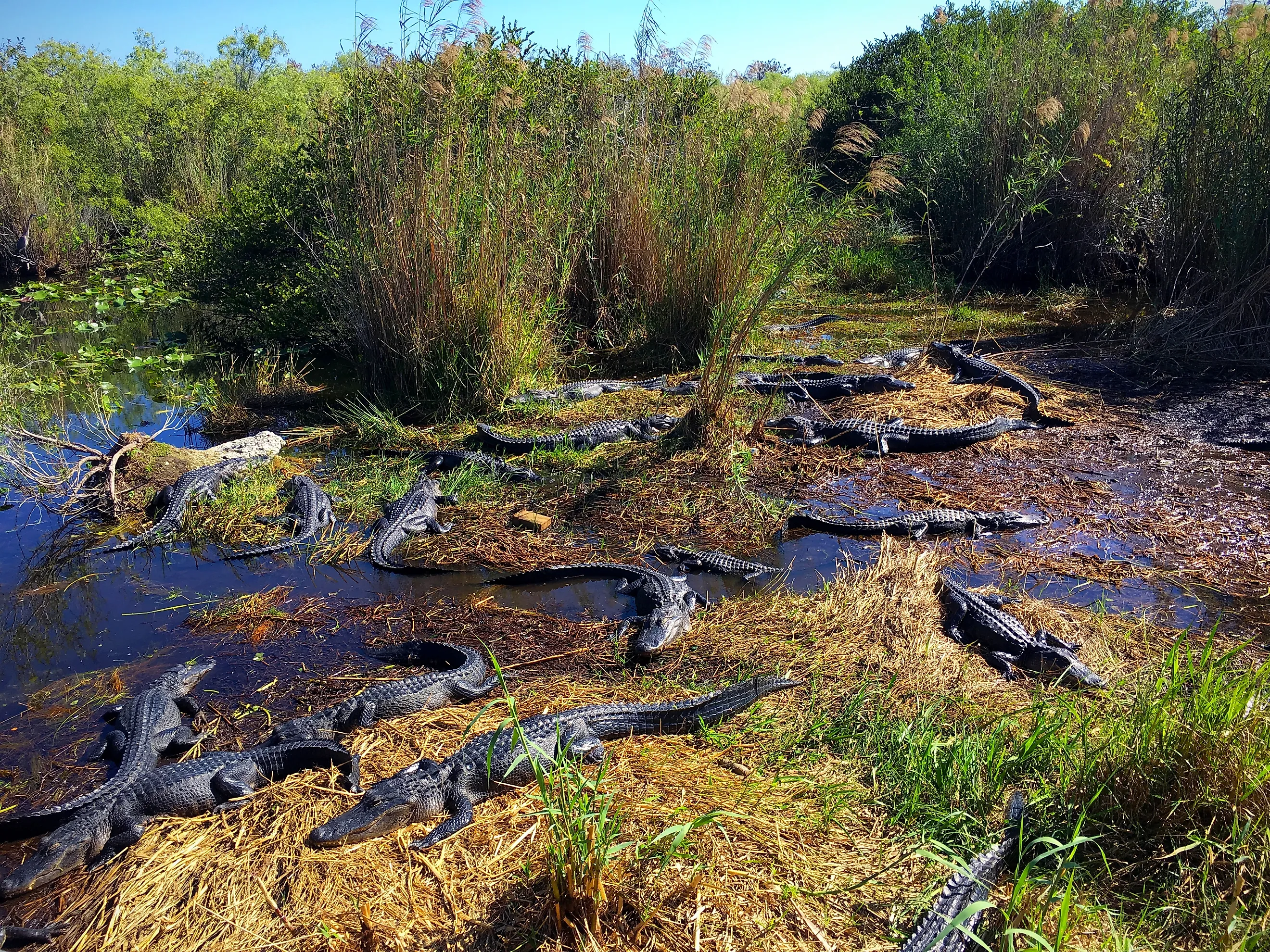
A shallow sheet of fresh water, in places 50 miles (80 km) wide and only inches (a few centimeters) deep, defines the Everglades of southern Florida and the life it carries. Rainfall rather than a single river feeds this wetland, a trait that sets it apart from most other great wetlands of the world. The dominant plant across its marshes is sawgrass (Cladium jamaicense), a member of the sedge family rather than a true grass. Within Everglades National Park live more than 360 species of birds, around 300 fish, 40 mammals, 50 reptiles, and 17 amphibians, and nearly forty native species found there carry federal protection as threatened or endangered. The park is one of the few places on Earth where the American alligator (Alligator mississippiensis) and the American crocodile (Crocodylus acutus) share the same water. Alligators act as engineers of this richness by digging depressions known as gator holes, which hold water through the dry season and become refuges for fish, turtles, and wading birds. Less than half of the historic Everglades remains after a century of drainage, and invasive Burmese pythons now press on its mammals, which makes the surviving core all the more valuable.
The Atchafalaya Basin, Louisiana

Nearly a million acres (400,000 hectares) of bayou, lake, and flooded forest in southern Louisiana make the Atchafalaya Basin the largest river swamp in the United States, larger than the Everglades. It holds the largest contiguous tract of coastal cypress left in the country, roughly 260,000 acres (105,000 hectares) of baldcypress (Taxodium distichum) and water tupelo draped over slow brown water. The U.S. Geological Survey counts more than 170 bird species, over 40 mammals, more than 40 reptiles and 20 amphibians, and over 100 species of finfish and shellfish within the basin, along with important wintering grounds for birds of the Mississippi Flyway. The Louisiana black bear, the subspecies that inspired the teddy bear, recovered here from roughly 150 animals at its 1992 listing to a population healthy enough that federal protection was removed in 2016. The endangered pallid sturgeon still swims the basin's channels. Fed by the largest distributary of the Mississippi River, the Atchafalaya also builds the most actively growing river delta in the lower 48 states, so this is one of the rare American wetlands still gaining ground rather than losing it.
The Okefenokee Swamp, Georgia

The Muscogee word behind the name Okefenokee describes trembling earth, a reference to the floating peat islands that quake underfoot across this vast blackwater swamp near the Georgia and Florida line. Rain rather than a river supplies the water, making the Okefenokee one of the largest and most intact precipitation-fed freshwater wetlands in North America. Thousands of years of slowly accumulating peat have built an acidic, tannin-stained landscape of prairies, cypress stands, and pine islands covering about 438,000 acres (177,000 hectares), most of it protected within a national wildlife refuge. In July 2026, the swamp became Georgia's first UNESCO World Heritage Site, recognized for biodiversity that includes at least 856 plant species, 48 mammals, 238 birds, 39 fish, and 90 reptiles and amphibians. The refuge is renowned for its herpetofauna, holding about a quarter of the reptile species and a third of the amphibian species endemic to the North American Coastal Plain, a recognized global biodiversity hotspot. American alligators, once nearly wiped out, are abundant again here, and the swamp shelters the wood stork, the red-cockaded woodpecker, and the eastern indigo snake.
The Prairie Pothole Region, Northern Plains

Across parts of five northern states and three Canadian provinces lies a landscape of millions of shallow basins gouged by Ice Age glaciers, a wetland complex so productive for waterfowl that biologists call it the continent's duck factory. The U.S. portion of the Prairie Pothole Region produces an estimated 5 million breeding ducks and supports more than half of North America's migratory ducks in a good water year. Pintails, gadwalls, canvasbacks, blue-winged teal, and redheads nest among the potholes, alongside roughly 40 breeding waterbird species and shorebirds such as the piping plover, the American avocet, and Wilson's phalarope. The region's value rests on sheer numbers and on the way wet and dry years shuffle which basins fill, spreading production across a huge area. That same shallowness leaves it exposed. Most of the original prairie wetlands have already been drained for farming, and modeling by the U.S. Geological Survey projects that a warming, drying climate could sharply reduce suitable habitat, with breeding duck abundance falling by 27 to 53 percent before the century ends.
Chesapeake Bay, Mid-Atlantic

The largest estuary in the United States and the third largest in the world, Chesapeake Bay gathers fresh water from more than 150 rivers across a 64,000 square mile (166,000 square kilometer) watershed spanning six states and the District of Columbia. Where that fresh water mixes with Atlantic salt, it supports more than 3,600 species of plants and animals, among them 348 kinds of finfish and 173 kinds of shellfish. The blue crab (Callinectes sapidus) is the bay's signature resident, while native oysters build reefs that filter the water and shelter young fish, and 26 species of underwater grasses carpet its shallows as nurseries. As a central link in the Atlantic Flyway, the Chesapeake winters about a third of the migratory birds of the Atlantic Coast, and anadromous fish such as striped bass, American shad, and the endangered Atlantic sturgeon run up its tributaries to spawn. Nutrient pollution, recurring low-oxygen dead zones, the collapse of historic oyster beds, and water that has warmed nearly two degrees Fahrenheit (about one degree Celsius) over three decades all weigh on a system whose biological wealth depends on clean, well-oxygenated shallows.
What Makes Wetlands So Rich

These five places differ in almost every physical detail, yet they share the traits that make wetlands exceptional. Each sits at an edge where open water, saturated ground, and dry land interlock, and that patchwork of conditions multiplies the niches available to living things. Shallow, sunlit, nutrient-fed water also drives high biological productivity, which feeds dense populations rather than merely a long species list. On top of resident life, most of these wetlands carry enormous seasonal pulses of migratory birds and spawning fish, so their diversity rises and falls with the calendar. A 2006 comparison of globally important wetlands in the journal Aquatic Sciences by Junk and colleagues found that endemism in most large wetlands is low, with the Everglades standing out as a notable exception. The same study flagged the threats these systems have in common, including water diversion, altered flooding, land reclamation, pollution, and invasion by exotic species, pressures visible in every wetland above.
A Shrinking Inheritance Worth Defending
The country has already lost more than half of the wetlands it held before European settlement, and the richest survivors owe their persistence as much to deliberate protection as to luck. The Everglades is the focus of the largest ecosystem restoration effort ever attempted in the United States, the Prairie Pothole Region draws tens of millions of dollars in annual conservation investment, and the Okefenokee earned World Heritage recognition only in 2026. What distinguishes these wetlands from an ordinary scenic landscape is measurable, the counts of fish, birds, reptiles, and plants that no comparable area of dry ground can match. Holding that line matters because a drained marsh or a poisoned estuary does not simply lose its water. It loses the stacked, overlapping forms of life that only shallow water at the edge of the land can support, and those are far harder to rebuild than to protect.