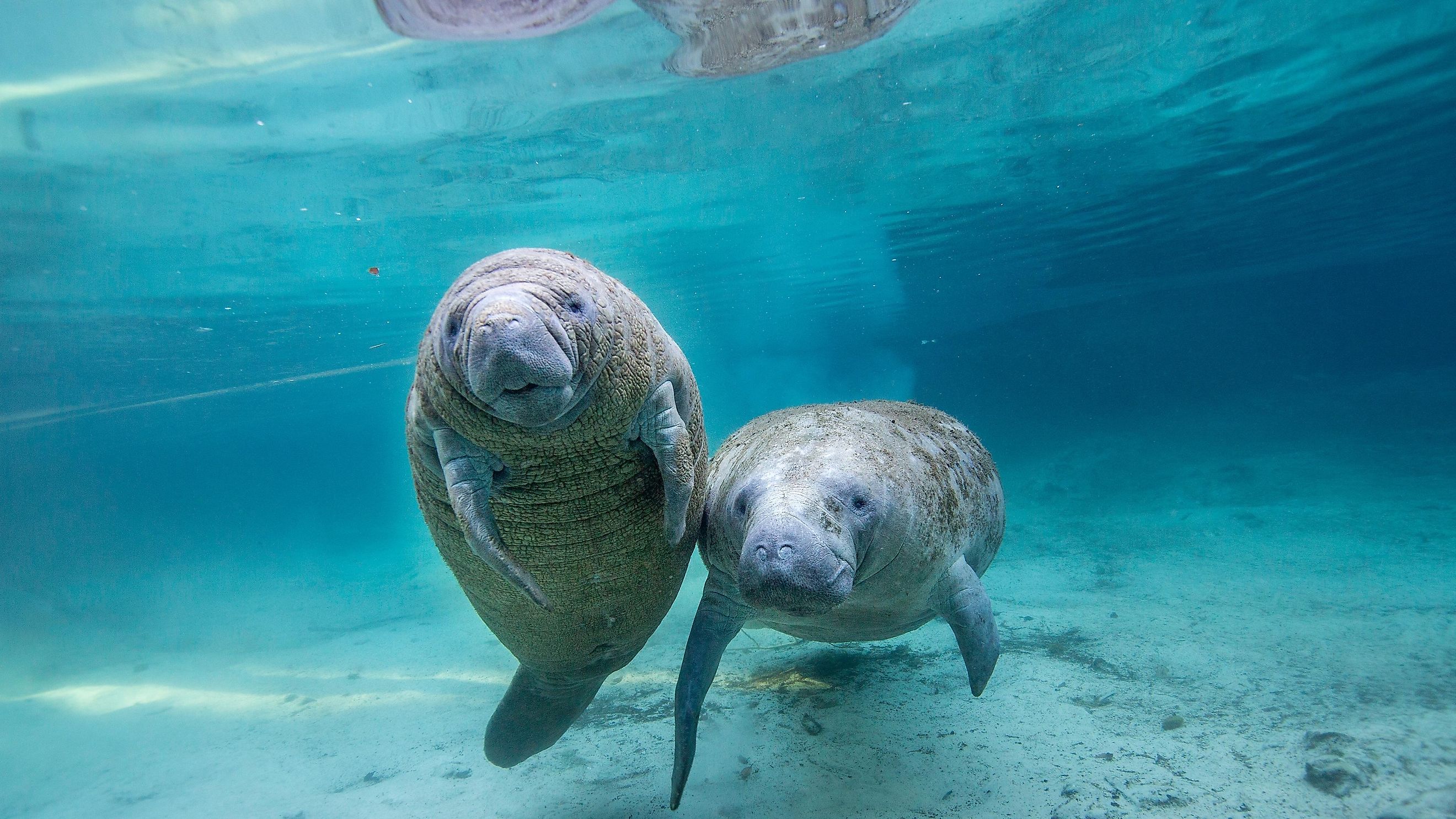
Where Manatees Gather In The Winter
When the first hard cold front of the season drops Gulf and Atlantic water below about 68 degrees Fahrenheit (20 degrees Celsius), Florida's manatees stop spreading out and start crowding together. The Florida manatee (Trichechus manatus latirostris) lives at the northern edge of a tropical animal's range, and it cannot survive long exposure to cool water. As a result, the animals funnel into a scattered set of warm-water refuges across the southern two-thirds of the peninsula, places where spring flow or industrial discharge holds steady in the low 70s Fahrenheit (low 20s Celsius) while the estuaries around them turn cold. Some of these gathering spots hold a few dozen animals. The largest hold more than a thousand. Together they trace a winter map drawn almost entirely by water temperature.
Why Cold Water Threatens a Manatee

Despite its bulk, a manatee is poorly built for cold. It carries little of the insulating blubber that protects seals and whales, and it runs a low metabolic rate for an animal its size. Sustained water below roughly 68 degrees Fahrenheit pushes manatees toward a condition biologists call cold stress syndrome, a slow cascade of metabolic and immune failure that produces skin lesions, internal damage, and eventually death. Water in the low 50s Fahrenheit (around 11 degrees Celsius) can be lethal within days, and juveniles, with less body mass to hold heat, suffer first. Researchers have settled on 68 degrees as the approximate point at which many manatees leave open water and head for a refuge. That single threshold explains the entire winter pattern that follows, because once the estuaries chill, survival depends on reaching warm water and staying in it. The constraint is tighter than temperature alone. A manatee eats as much as a tenth of its body weight in plants each day, so a good refuge needs seagrass or other vegetation within reach of the warmth. When seagrass collapsed along the Atlantic coast in the early 2020s, animals crowded into warm water with little left to eat, and starvation drove an unusual spike in deaths.
Blue Spring and the St. Johns River

Blue Spring, on the St. Johns River near Orange City, pours out groundwater at a near-constant 72 degrees Fahrenheit (22 degrees Celsius) every day of the year. On January 21, 2024, after a prolonged cold snap had pushed the adjacent river into the upper 50s Fahrenheit (around 14 degrees Celsius), park rangers counted a record 932 manatees packed into the spring run, a channel that winds only about four-tenths of a mile (0.6 kilometers) from the spring boil to the river. The scale of that gathering is recent. When a researcher completed a doctoral study of the spring in 1981, the single-day high count was just 35 animals. The difference reflects decades of boat-speed rules, habitat protection, and herbicide limits along this stretch of the St. Johns. Blue Spring now ranks among the largest winter gathering sites in the state, and it fills and empties with the weather, drawing its biggest crowds on the coldest mornings.
Crystal River and Kings Bay

On the Gulf coast, Kings Bay at the head of the Crystal River is fed by dozens of springs that together form one of the most important wintering grounds in Florida. Three Sisters Springs, a cluster of vents inside the bay, draws manatees by the hundreds when Gulf water cools. The Crystal River National Wildlife Refuge, established in large part for this purpose, manages a set of warm-water sanctuaries within the bay and closes portions of them during severe cold so the animals can rest without disturbance. Crystal River is also one of the few places where regulated in-water viewing is allowed, which has made its wintering manatees among the most watched and studied in the world. The constant spring temperature near 72 degrees Fahrenheit is what holds them there through every cold front. The contrast with summer is sharp. In warm months the same animals scatter widely through coastal waters and rivers, ranging up the Atlantic seaboard as far as the Carolinas and, in rare cases, Massachusetts. Winter reverses that dispersal and pulls the whole population back toward a few dependable warm points in peninsular Florida.
The Power Plant Refuges

Not every winter gathering forms over a natural spring. Along both coasts, manatees crowd into the warm discharge canals of coastal power plants, where water drawn in for cooling returns to the estuary warmer than it left. The best known is Tampa Electric's Big Bend Power Station in Apollo Beach, where animals have massed each winter since 1986. The plant circulates roughly 600 million gallons a day (about 2.3 billion liters), and on cold days its canal can run warmer than a spring. In January 2024 the site set a record of about 1,100 manatees at once, well past its earlier high of 850. The discharge canal is a state and federally designated manatee sanctuary, and a public viewing center with boardwalks and a 50-foot (15-meter) tower lets visitors watch the herd from above. Other discharge sites play the same role, including the Florida Power and Light canal beside Lee County Manatee Park in Fort Myers and the plant at Cape Canaveral, where wildlife officials fed starving manatees romaine lettuce in the plant's warm discharge during a recent die-off.
Animals Faithful to the Same Water

Manatees do not pick a refuge at random each year. They return to the same warm water winter after winter, and calves learn the route and the destination from their mothers across the months they stay together. That fidelity is strong enough that biologists recognize four relatively distinct Florida manatee subpopulations, grouped around the Atlantic coast, the upper St. Johns River, the southwest Gulf coast, and the northwest springs region. The pattern matters for conservation, because an animal that knows only one refuge is in danger if that site fails. A manatee accustomed to a power plant canal will not automatically find a spring 50 miles (80 kilometers) away when the plant goes quiet, which is why the location and reliability of each refuge carry weight far beyond the single winter in front of it.
A Warm-Water Network Built Partly by Accident

The modern winter map is not the one manatees used before Florida was developed. As the state diverted rivers, drained wetlands, and drew down the aquifer that feeds its springs, several historic warm-water sites lost flow, and manatees shifted toward the industrial discharges that appeared in their place. A large share of the subspecies now depends on power plants that were never built for wildlife and that will not run forever. As aging plants retire or convert to systems that no longer release warm water, managers face the problem of replacing refuges the animals have relied on for decades. Studies comparing refuge types have found that natural springs offer the steadiest protection against cold, while once-through power plants can fall short during the hardest freezes, when they need to perform most. Protecting and restoring spring flow, and planning for the loss of individual plants, has become central to keeping the winter network intact.
Why the Winter Map Matters
Across a peninsula with millions of people and more than a million registered boats, the survival of an entire subspecies narrows each winter to a short list of warm places, such as a spring run shorter than half a mile (0.8 kilometers), a canal behind a power station, and a bay fed by underground vents. These points do outsized work, holding thousands of cold-sensitive animals alive through the months when the open water would kill them. The gatherings are a spectacle, and they are also a measure of how much the Florida manatee now depends on a handful of reliable thermal refuges. Watching where the animals cluster, and watching which of those refuges endure, is one of the clearest ways to read the future of the species.