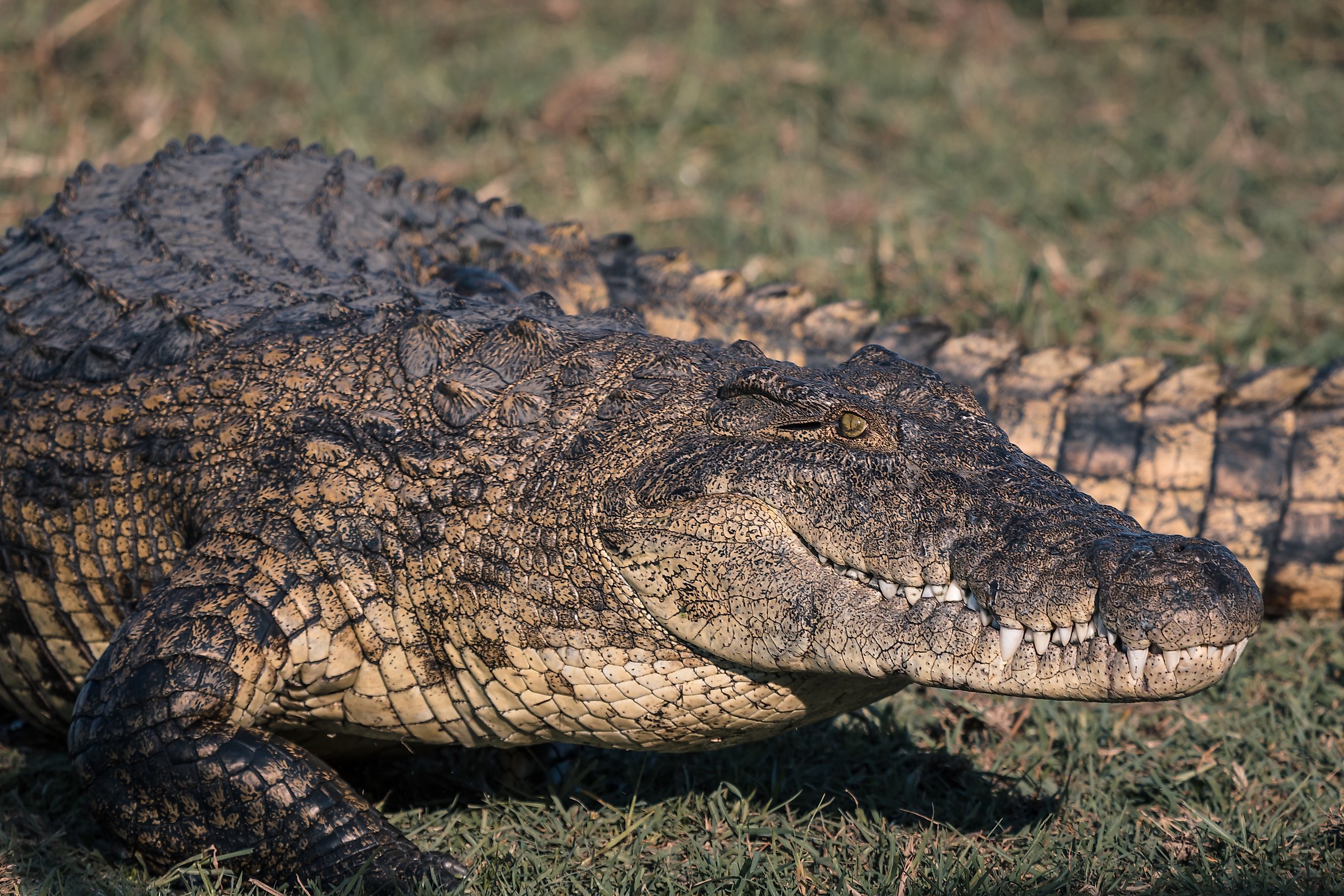
American Crocodile
Few large predators are as at home in salt water as the American crocodile. While most of its relatives are bound to rivers and freshwater swamps, this species ranges into tidal creeks, mangrove lagoons, and open coastlines, hunting the brackish margins of the tropical Americas as an apex predator. Known as Crocodylus acutus, it is one of the largest crocodiles in the world and the most far-ranging in the Americas, occupying 18 countries and reaching as far north as the southern tip of Florida and as far south as the Pacific coast of northern Peru.
That reach once looked far more secure than it does today. Decades of hunting for the animal's hide thinned its numbers across the region, and by the 1970s, only a few hundred remained in Florida. The years since have made the American crocodile more than just a survivor. It is now a large predator in recovery, and its gradual return to the coastlines of the Everglades and the Caribbean is increasingly seen as a sign of healthier waters.
Taxonomic Classification

The American crocodile belongs to the family Crocodylidae and the order Crocodilia, the group that also contains alligators, caimans, and gharials. Within the genus Crocodylus, its species name is acutus, from the Latin for sharp or pointed, a reference to the animal's narrow, tapered snout. The French naturalist Georges Cuvier formally described the species in 1807, when it was first known as the "sharp-snout alligator." In 1822, Constantine Samuel Rafinesque corrected the record and placed it among the true crocodiles.
Of the four crocodile species native to the Americas, Crocodylus acutus is the most widespread. It shares its range with the American alligator in Florida and with the spectacled caiman across Central and South America. Genetic surveys have documented natural hybridization between the American crocodile and Morelet's crocodile (Crocodylus moreletii) along the coasts of Belize and Mexico, a finding that continues to shape how researchers define the species boundary.
Physical Description

The American crocodile is among the largest crocodiles in the world. Exceptional males have reached about 20 feet (6.1 m) and weighed as much as 2,000 pounds (907 kg), though animals of that size are rare today. Mature males typically measure 13 to 16 feet (4 to 5 m), and in the Florida population, they seldom exceed 14 feet (4.3 m). Females are generally smaller, usually measuring 8 to 12 feet (2.4 to 3.7 m). Large adults typically weigh between 880 and 1,100 pounds (400 to 500 kg).
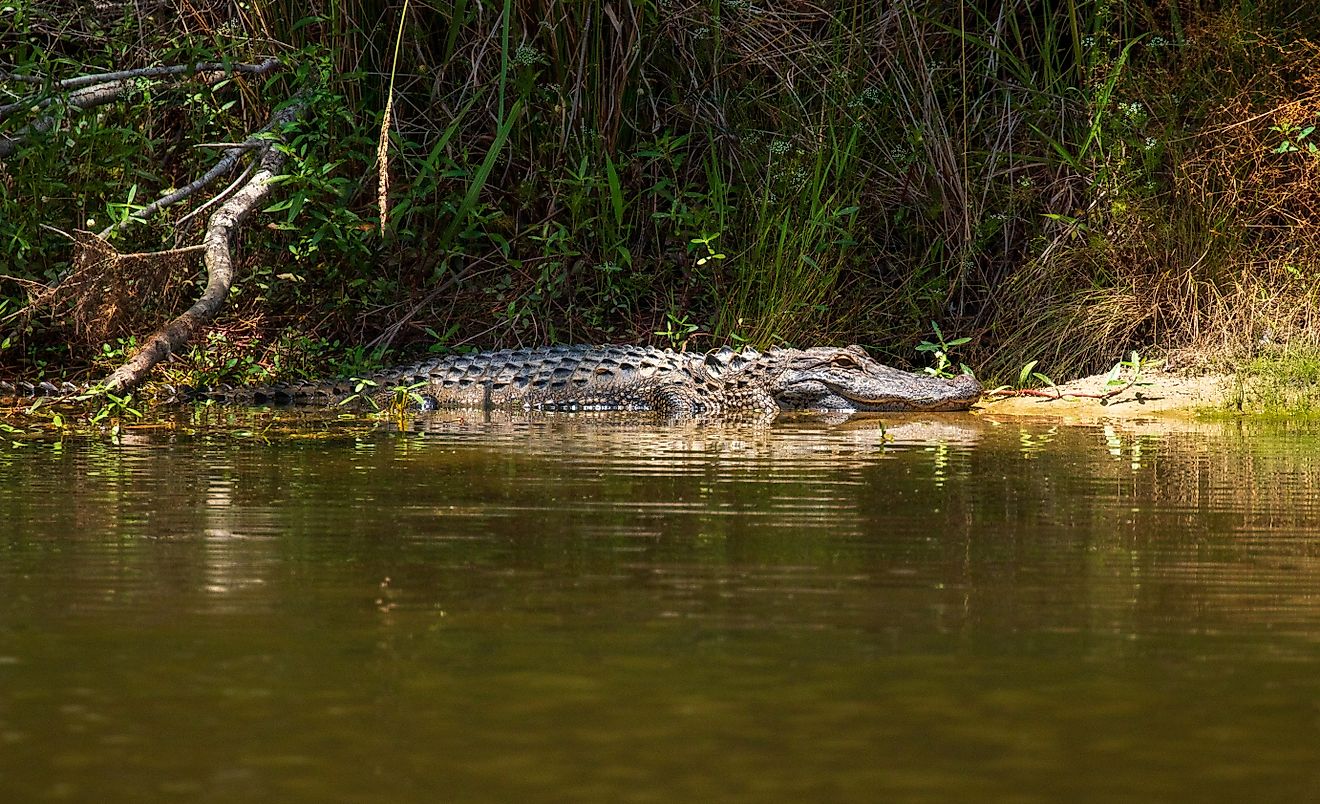
Color separates this crocodile from the darker alligator it lives alongside in Florida. Adults are grayish-green to olive on the back and tail, with a white or yellowish underside, and juveniles carry darker cross-bands that fade with age. The easiest feature to recognize is its narrow, triangular snout, along with the prominent fourth tooth on each side of the lower jaw, which remains visible even when the mouth is closed. The bony plates, called osteoderms, that armor the back are more scattered than in other crocodile species.
Several adaptations tie the animal to saltwater. Specialized salt glands on the tongue excrete excess sodium and chloride, allowing adults to tolerate brackish and marine conditions that exclude the alligator. A transparent third eyelid, the nictitating membrane, protects the eye underwater, and the placement of the eyes, ears, and nostrils on top of the head lets a crocodile watch, hear, and breathe while nearly submerged.
Range and Habitat

The American crocodile occupies 18 countries across the northern Neotropics. Its range extends from the southern tip of Florida, the absolute northern limit of the species, along both the Atlantic and Pacific coasts of southern Mexico, through Central America, and into northern South America. On the Pacific side, it reaches as far north as Sinaloa in Mexico and as far south as the mangrove coasts of northern Peru. The species also occupies the Caribbean islands of Cuba, Jamaica, and Hispaniola.
The American crocodile is, above all, a coastal animal and prefers brackish areas where freshwater meets the sea, including lower river reaches, coastal lagoons, tidal creeks, and mangrove swamps, as well as the offshore cays and small islands of the Caribbean. It does move inland into freshwater reservoirs and river systems, but its tolerance for salt lets it reach places no other American crocodilian can. One of the largest known populations lives in Lago Enriquillo, a hypersaline lake in the Dominican Republic that sits about 130 feet (40 m) below sea level. In the United States, the species is tied to the Everglades and the coastal estuaries of South Florida, including Biscayne Bay, Cape Sable, and the shores of the Gulf of Mexico.
Diet and Hunting

The American crocodile is a carnivore and an ambush predator. Rather than chase, it waits motionless at the surface with only its eyes and nostrils exposed, then strikes when prey moves within reach. Fish make up the bulk of the diet, with mullet, crabs, and other coastal species featuring heavily in the brackish zones the animal prefers. Larger individuals also take turtles, water birds, and small mammals, and they will feed on carrion when the opportunity arises. Prey is seized and, if large, drowned or dismembered with a spinning maneuver known as the death roll.
Two features aid digestion. The crocodile's stomach is among the most acidic of any animal, capable of breaking down bone and shell, and the animal swallows small stones, called gastroliths, that assist in grinding food and in controlling buoyancy. Hatchlings and juveniles begin with insects and small fish before graduating to larger prey. A large crocodile's slow, efficient metabolism means it can go long stretches between meals.
Behavior and Reproduction

Compared with the Nile and saltwater crocodiles, the American crocodile is notably shy. Wildlife managers in Florida describe it as reclusive, and it will usually retreat rather than confront a person. It hunts mostly at night and spends much of the day basking to regulate its body temperature, often holding its mouth open to shed heat, a posture that signals thermoregulation rather than aggression. During dry spells or cold snaps the animal digs burrows, with entrances at or below the waterline, that serve as refuges. On land it can move by crawling on its belly or by lifting its body into a "high walk," and it is capable of traveling long distances overland to reach new habitat.
Breeding follows the coastal calendar. Males become territorial as courtship begins in the late dry season, advertising with low roars, growls, and head-slaps against the water. Both sexes reach maturity at roughly 8 to 10 years of age. Females lay clutches of about 30 to 60 eggs, building either a mounded nest of soil and vegetation above the high-tide line or a hole dug into a bank, depending on the substrate available. Incubation lasts around 85 to 90 days, and as with other crocodilians, nest temperature determines the sex of the hatchlings. The relationship is not a simple gradient: intermediate temperatures of roughly 88 to 90°F (31 to 32°C) produce males, while both cooler and warmer nests tend to produce females.
When the young call from inside the eggs, the mother opens the nest and helps carry the hatchlings to water. Parental care is real but brief, shorter than the multi-year guarding seen in the American alligator, and hatchling survival is low. Long-term monitoring in South Florida found that only about a quarter of hatchlings survive their first year. Those that reach adulthood are long-lived, commonly reaching 45 to 70 years, with some evidence that individuals in ideal conditions can live longer still.
Importance to the World

As an apex predator, the American crocodile helps regulate the populations of fish, crustaceans, and other animals in the estuaries and mangroves it occupies, keeping the coastal food web in balance. Its presence, or absence, tells ecologists a great deal about the surrounding water. In the Florida Everglades, the species is considered both a flagship and an ecological indicator. Because it relies on a specific balance of fresh and salt water for successful nesting, changes in its population can reveal shifts in the health of the region's hydrology. When freshwater flow is restored and salinity returns to natural levels, crocodile populations expand, which is one reason the animal features so prominently in Everglades restoration planning.
The species carries economic and cultural weight as well. Historically, it was valued and heavily exploited for its hide, and today it draws attention as a subject of ecotourism and long-term scientific study across its range.
Threats and Conservation

The International Union for Conservation of Nature lists the American crocodile as Vulnerable, in an assessment published in 2021. The listing reflects an inferred population decline of about 30% over three generations, driven mainly by habitat loss and past overexploitation, and estimates roughly 5,000 mature individuals across the range. The global trend, however, is now increasing, as populations recover in many areas. The species is also protected under Appendix I of the Convention on International Trade in Endangered Species (CITES).
The heaviest historical damage came from commercial hide hunting between the 1930s and the 1970s. Current pressures are habitat loss and degradation, illegal hunting, drowning in fishing nets, pollution, coastal development, and hybridization with Morelet's crocodile in parts of the range. In the United States, the species was listed as federally endangered in 1975, when the Florida population had fallen below a few hundred adults. Part of the recovery came from an unexpected source. The cooling canals at the Turkey Point power plant south of Miami offered warm, isolated nesting habitat with little human traffic. By 2007, the Florida population had improved enough for its federal status to be downgraded to threatened, and today it numbers around 2,000 adults. Elsewhere, protected areas, captive breeding programs, and sustained monitoring continue to support the region's crocodilians, several of which remain far more endangered than Crocodylus acutus.
Takeaway
The American crocodile holds an unusual place along the modern coastline. It is a top predator powerful enough to command respect, yet so elusive that most people sharing its waters rarely ever see it. What makes it worth understanding is not only its size or its reach across the Americas, but its role as a keystone of the estuaries and mangroves it patrols, and its value as a living gauge of whether those systems still function. Poaching, coastal development, and lost nesting habitat continue to weigh on the species, and a full recovery is far from guaranteed. Even so, the ground it has regained since the 1970s offers a reason for cautious optimism. Protecting its waterways and coastal habitat has shown that this ancient predator can recover and reclaim parts of its former range.
Fun Facts

- Built for the sea. Along with the saltwater crocodile, the American crocodile is one of only two crocodile species that commonly live and thrive in full saltwater, thanks to salt-excreting glands on the tongue.
- A crocodile below sea level. One of the largest known populations lives in Lago Enriquillo, a hypersaline lake in the Dominican Republic that sits about 130 feet (40 m) below sea level.
- Saved by a power plant. The cooling canals at Florida's Turkey Point nuclear facility became a crucial nesting refuge that helped the state's crocodiles recover.
- One shared shoreline. South Florida is the only place on Earth where wild crocodiles and wild alligators live in the same waters.
- The telltale grin. Unlike an alligator, a crocodile shows its large fourth lower tooth even with its mouth shut, the origin of the classic "crocodile smile."
Quick Facts
- Scientific name: Crocodylus acutus
- Family / Order: Crocodylidae / Crocodilia
- IUCN status: Vulnerable (2021); CITES Appendix I
- Length: Males commonly 13-16 ft (4-5 m), exceptionally to 20 ft (6.1 m); females 8-12 ft (2.4-3.7 m)
- Weight: Typically 880-1,100 lb (400-500 kg); up to 2,000 lb (907 kg)
- Lifespan: About 45-70 years
- Diet: Carnivore. Fish, crustaceans, turtles, birds, and small mammals
- Range: Southern Florida, the Caribbean, both coasts of Mexico and Central America, and northern South America (18 countries)