What Animals Live in the Atlantic Ocean?
The Atlantic Ocean covers roughly 20% of Earth's surface and about 29% of its ocean water, a vast basin stretching from the Arctic ice to the Southern Ocean and separating the Americas from Europe and Africa. Between its cold northern shelves and its warm tropical currents, it supports a staggering range of life, from the largest animals ever to exist down to invertebrates that predate the dinosaurs. Some of its residents roam every ocean on the planet; others live in the Atlantic and nowhere else. Here are some of the animals that call this ocean home, including several found in no other sea on Earth.
Found Only in the Atlantic
A number of species live exclusively in the Atlantic Ocean and its adjoining waters, having evolved to its particular temperatures, currents, and coastlines. These are true Atlantic endemics, absent from the Pacific and Indian Oceans.
North Atlantic Right Whale

The North Atlantic right whale (Eubalaena glacialis) is one of the rarest large animals on Earth, with only around 370 individuals left, and it lives nowhere but the Atlantic. Once found on both sides of the ocean, it now survives almost entirely along the east coasts of the United States and Canada, migrating between summer feeding grounds in the Gulf of St. Lawrence and Bay of Fundy and winter calving grounds off Florida and Georgia. It is a stocky baleen whale with no dorsal fin, a broad back, and rough white patches of skin called callosities on its head, unique to each animal. Right whales were hunted to the brink of extinction, and today the survivors face two main threats: entanglement in fishing gear and collisions with ships. The species is listed as Critically Endangered by the IUCN.
Atlantic Puffin

The Atlantic puffin (Fratercula arctica) is a small seabird found only in the North Atlantic, nesting in burrows on rocky islands from Maine and eastern Canada across to Iceland, the British Isles, and Norway. Its black-and-white plumage and broad, boldly striped orange-and-black bill have earned it the nickname "sea parrot," though the bright colors fade to a duller grey after the breeding season. Puffins spend most of the year far out at sea, swimming and diving with their wings for propulsion, and can hold several small fish crosswise in their bills at once. Despite a large total population, the species has declined sharply in parts of its range and is listed as Vulnerable by the IUCN.
Atlantic Horseshoe Crab

The Atlantic horseshoe crab (Limulus polyphemus) is a living fossil, part of a lineage older than the dinosaurs, and it is found only in the Gulf of Mexico and along the Atlantic coast of North America. Despite the name, it is not a crab at all but a chelicerate, more closely related to spiders and scorpions. Its domed shell, long spike-like tail, and ten legs are unmistakable, and it uses that tail to right itself when flipped by the surf rather than as a weapon. Each spring, horseshoe crabs mass on beaches like those of Delaware Bay to spawn, and their eggs are a critical food source for migrating shorebirds. Their distinctive blue, copper-based blood is used by the medical industry to test the safety of vaccines and injectable drugs. The species is listed as Vulnerable by the IUCN.
Atlantic Cod

The Atlantic cod (Gadus morhua) lives only in the North Atlantic, on both the North American and European sides, and few fish have shaped human history more. For centuries, the cod fisheries of the Grand Banks and North Sea fed and enriched nations, drawing fishing fleets across the ocean long before permanent settlement of the Americas. A cold-water bottom-dweller identified by the barbel on its chin and three dorsal fins, the cod can live around 25 years and reach two meters in length. Centuries of intensive fishing led to a catastrophic collapse, most famously off Newfoundland in 1992, when the fishery was shut down and tens of thousands lost their jobs; many stocks have still not recovered. The species is listed as Vulnerable by the IUCN.
American Lobster

The American lobster (Homarus americanus) is found only along the Atlantic coast of North America, from Labrador down to the Carolinas, and is most abundant in the cold waters off Maine and Atlantic Canada. It is one of the heaviest crustaceans in the world, with the largest confirmed specimen weighing over 20 kilograms. Living lobsters are typically greenish-brown, not the bright red of the dinner plate, a color that only appears after cooking. They carry two large, differently shaped claws, a heavy crusher and a finer cutter, and can regenerate a lost limb over successive molts. Long-lived and slow-growing, lobsters support one of the most valuable fisheries in the North Atlantic.
Wide-Ranging Atlantic Residents
Many of the ocean's most familiar animals travel widely, appearing throughout the Atlantic and, in most cases, across other oceans too.
Walrus

The Atlantic walrus (Odobenus rosmarus rosmarus) is found between the Canadian Arctic in the west and the Russian Arctic in the east, with an estimated 25,000 animals in the region. Marine mammals known for their long tusks, which are elongated canine teeth used for hauling out of the water and establishing dominance, walruses are highly social and often gather in large groups, communicating with a wide range of vocalizations. They feed mainly on small invertebrates such as clams on the seabed, and their life expectancy is between 30 and 40 years.
Spinner Dolphin

Dolphins, porpoises, and whales all belong to the same order, Cetacea, though to different families within it. The spinner dolphin (Stenella longirostris) inhabits subtropical and tropical waters around the world, including the Atlantic, and is named for its habit of leaping from the water and spinning in the air before splashing down. Highly social and vocal, these dolphins use clicks and whistles to communicate and rely on echolocation to map their surroundings and hunt fish, squid, and crustaceans. Like most dolphins, they are threatened more by human activity, particularly fishing bycatch, than by natural predators.
Manatee

Also known as sea cows, manatees are gentle, slow-moving herbivores that graze on seagrass and other aquatic plants in warm coastal waters. They are large, growing up to four meters long and around 590 kilograms, with distinctive paddle-like flippers. The West Indian manatee (Trichechus manatus) is found in the Caribbean Sea and the Gulf of Mexico, especially around Florida, while the West African manatee (Trichechus senegalensis) inhabits the coastal waters and rivers of West Africa. Both are threatened by boat strikes, habitat loss, and cold snaps.
Spotted Eagle Ray

The spotted eagle ray (Aetobatus narinari) is a cartilaginous fish, related to sharks, and in the Atlantic is most common in the Caribbean and the Gulf of Mexico. Recognizable by the white spots across its dark back and a snout shaped like a duck's bill, it has a notably long tail. It preys on crustaceans and small fish, sometimes using its snout to root through the sand of the seabed. Usually solitary, eagle rays are occasionally seen leaping clear of the water. The species is listed as Endangered by the IUCN, in part due to fishing pressure.
Atlantic Bluefin Tuna

The Atlantic bluefin tuna (Thunnus thynnus) is one of the largest and fastest bony fish in the ocean, prized in the sushi trade and heavily pressured by overfishing. It is warm-blooded, able to keep its body temperature above the surrounding water, which lets it range from cold northern feeding grounds to warm spawning areas and cross the entire Atlantic more than once a year. Its metallic blue back and streamlined body suit it for high-speed pursuit of herring, mackerel, squid, and crustaceans. The largest Atlantic bluefin ever caught on rod and reel weighed 678.6 kilograms (1,496 lbs), landed off Nova Scotia in 1979.
Great White Shark

The great white shark (Carcharodon carcharias) is warm-bodied and, in addition to the usual senses, can detect the faint electrical fields of its prey. Its jaws hold rows of large, serrated, triangular teeth, numbering around 300 at any time. One of the ocean's apex predators, it feeds on seals, sea lions, other sharks, fish, sea turtles, and carrion. Great whites can grow up to six meters long and weigh over 2,000 kilograms, and can live around 70 years, though their slow maturity leaves populations vulnerable. Dyer Island, off South Africa, is one of the best-known gathering spots for the species.
Green Sea Turtle

The green sea turtle (Chelonia mydas) takes its name from the greenish fat beneath its shell, a result of its largely plant-based diet. Its smooth carapace comes in shades of green, brown, gray, and black, and it uses its flippers to glide through the water. Uniquely among sea turtles, adults are mostly herbivorous, grazing on seagrass and algae, while juveniles also eat invertebrates. Green turtles grow up to about 1.5 meters long and weigh between 68 and 190 kilograms. Found in warm waters throughout the Atlantic and beyond, the species is listed as Endangered by the IUCN.
Leatherback Sea Turtle

The leatherback (Dermochelys coriacea) is the largest turtle in the world and the only one without a hard, bony shell; instead, its back is a leathery, ridged skin over a teardrop-shaped body. It ranges across the Atlantic and dives deeper than any other turtle, to more than 1,200 meters, tolerating cold water that would slow other reptiles. Its long front flippers can span more than two and a half meters. Largely solitary, leatherbacks provide no care to their young after hatching and feed almost entirely on jellyfish and other soft-bodied animals, following blooms across open ocean.
Humpback Whale

The humpback whale (Megaptera novaeangliae) is named for the small hump in front of its dorsal fin, and it undertakes some of the longest migrations of any mammal, moving between polar feeding grounds and tropical breeding areas. It feeds on krill and small fish, filtering up to 1,360 kilograms of food a day through its baleen, and is famous for the complex, evolving songs of the males. Humpbacks can reach around 18 meters in length and weigh between 22,000 and 36,000 kilograms, with females typically larger than males. Their exceptionally long pectoral fins set them apart from other whales and give the species its scientific name, meaning "big-winged New Englander."
Narwhal
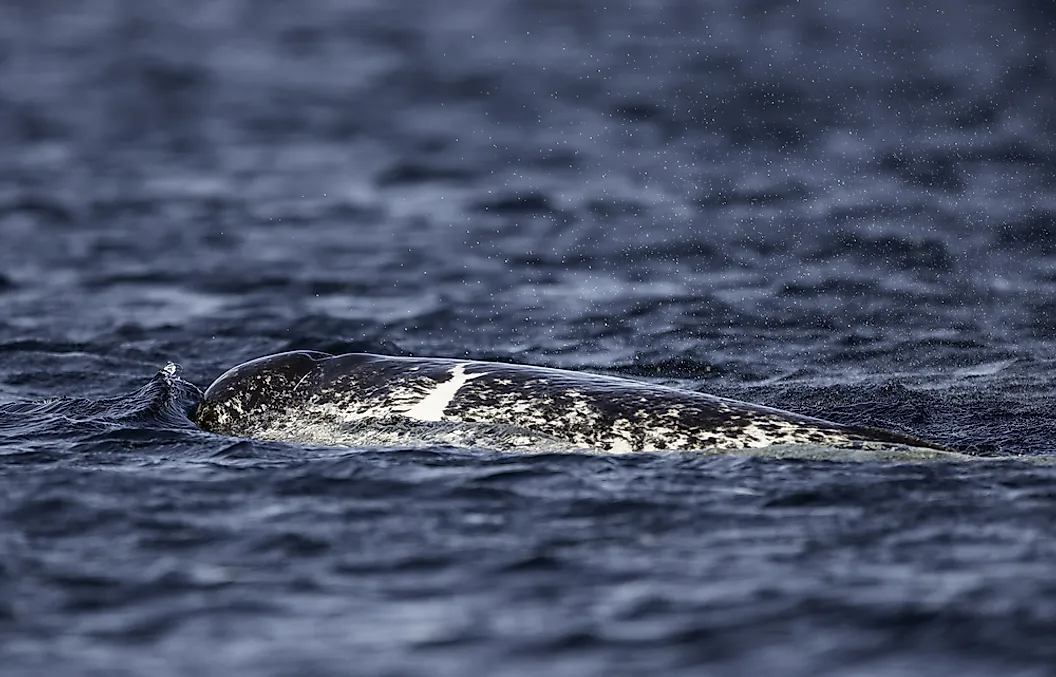
The narwhal (Monodon monoceros) is an Arctic whale famous for the long spiral tusk of the males, which is actually an overgrown left canine tooth; rarely, an animal grows two. The tusk is packed with nerve endings and is thought to serve as a sensory organ. Narwhals lack a dorsal fin, weigh between 800 and 1,600 kilograms, and reach lengths of about 4 to 5.5 meters. They use echolocation to hunt Arctic and polar cod, halibut, shrimp, and squid, often in the deep waters off Greenland and the Canadian Arctic. Their predators include polar bears, killer whales, and humans.
Killer Whale

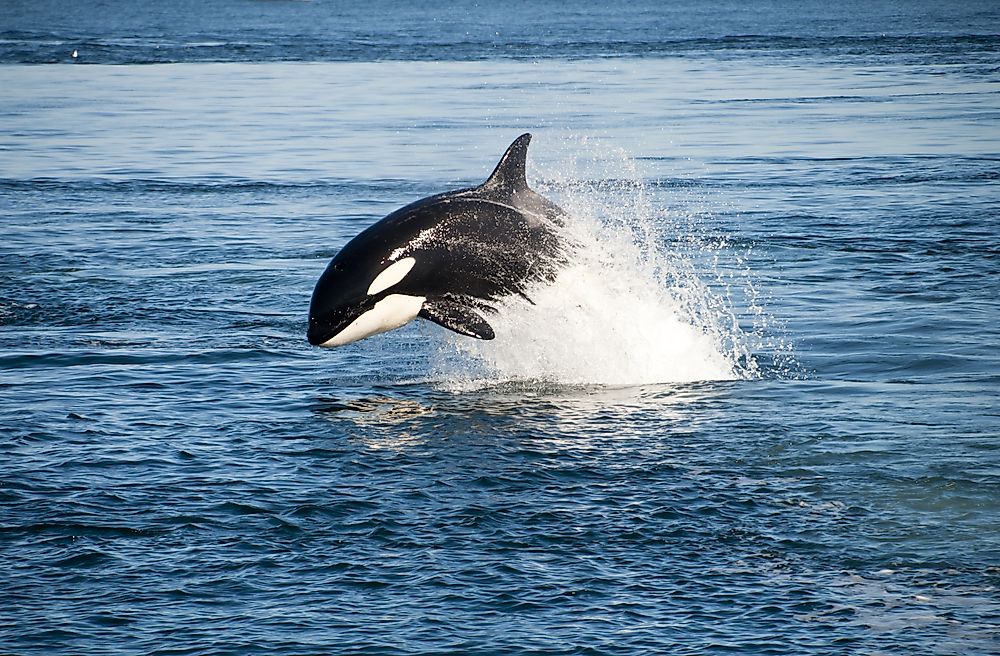
The killer whale, or orca (Orcinus orca), is the largest member of the dolphin family and one of the most widely distributed mammals on the planet, second only to humans in its range. It uses its large pectoral fins to steer and a thick layer of blubber for insulation. A powerful apex predator with no natural enemies, the orca hunts fish, seals, sea lions, squid, seabirds, and even other marine mammals, with different populations specializing in different prey. Adult killer whales can reach nine meters in length and weigh between 3,600 and 5,000 kilograms.
Seahorse
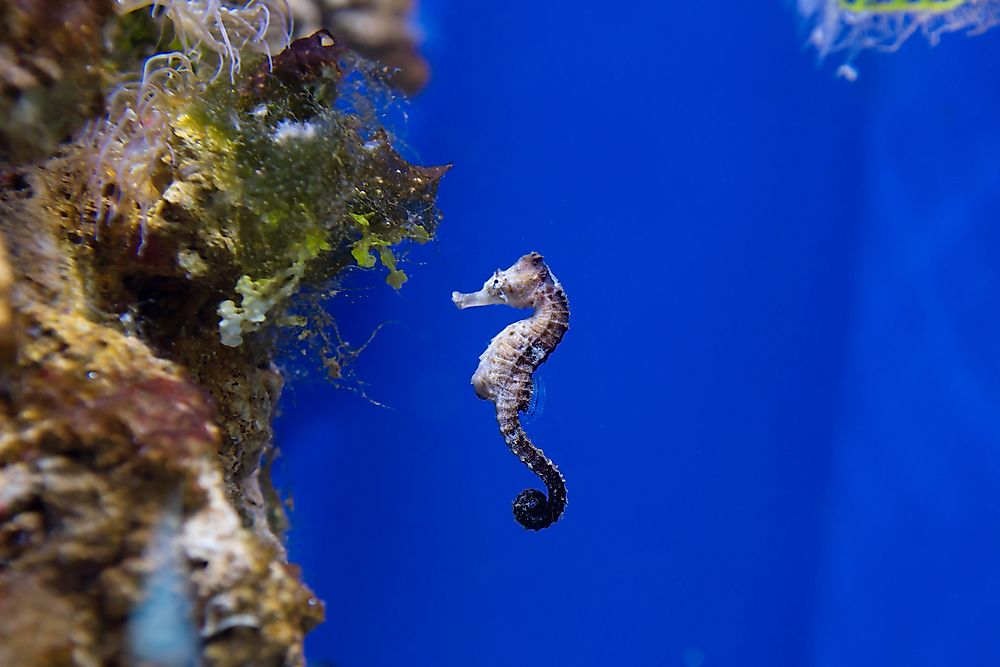
The seahorse (genus Hippocampus) is a small bony fish, related to tuna and salmon despite its unusual shape. It has thin skin stretched over bony plates rather than scales, and a crown-like set of spines on its head called a coronet. Lacking teeth and a stomach, it feeds by sucking tiny crustaceans and plankton through its fused, tube-like snout. Seahorses can change color to camouflage themselves among seagrass and coral. Most famously, it is the male that becomes pregnant, carrying the eggs in a specialized pouch and giving birth to the young.
Mediterranean Monk Seal

The Mediterranean monk seal (Monachus monachus) is one of the rarest marine mammals in the world, with a global population of fewer than 800, and in the Atlantic it survives around Cabo Blanco and the Madeira archipelago. It has a short, broad snout with upward-facing nostrils, short flippers with small claws, and short hair that it sheds every 6 to 8 weeks. Feeding by day on fish, octopus, eels, and squid, the species can live up to about 45 years. Once hunted and now disturbed by coastal development, it has retreated to remote caves and is listed as Endangered by the IUCN.
King Penguin

The king penguin (Aptenodytes patagonicus) is the second-largest penguin species and breeds on sub-Antarctic islands in the southern reaches of the Atlantic, such as South Georgia. Standing up to a meter tall and weighing between 9 and 18 kilograms, it feeds mainly on small fish and squid, diving to depths of 100 to 300 meters and staying submerged for several minutes at a time. Flightless like all penguins, it moves by walking upright or sliding on its belly across the ice. Its main predators are seabirds, which target chicks and eggs, and marine mammals such as leopard seals and orcas at sea.
Lemon Shark

The lemon shark (Negaprion brevirostris) lives in shallow coastal waters, usually not far from shore, and takes its name from the yellow-brown to olive-green color that helps it blend into sandy seabeds. It has a short, rounded snout, comparatively poor eyesight, and a keen sense of smell. A nocturnal hunter, it uses smell and electroreception to locate bony fish, smaller sharks, crustaceans, and mollusks. Lemon sharks can weigh as much as 250 kilograms and grow to between 2.5 and 3 meters long. They are notably social, gathering in groups, and are studied more than most sharks because they tolerate captivity well.
An Ocean Full of Life
From the endemic right whales and horseshoe crabs of its coasts to the wide-roaming tuna, turtles, and orcas that cross its length, the Atlantic Ocean holds an extraordinary diversity of animals. Many of them face mounting pressure from overfishing, ship traffic, pollution, and a warming climate, and several of the species here are already endangered. Protecting the Atlantic's habitats, from Arctic ice to tropical seagrass beds, is essential to keeping this ocean as alive as it is today.