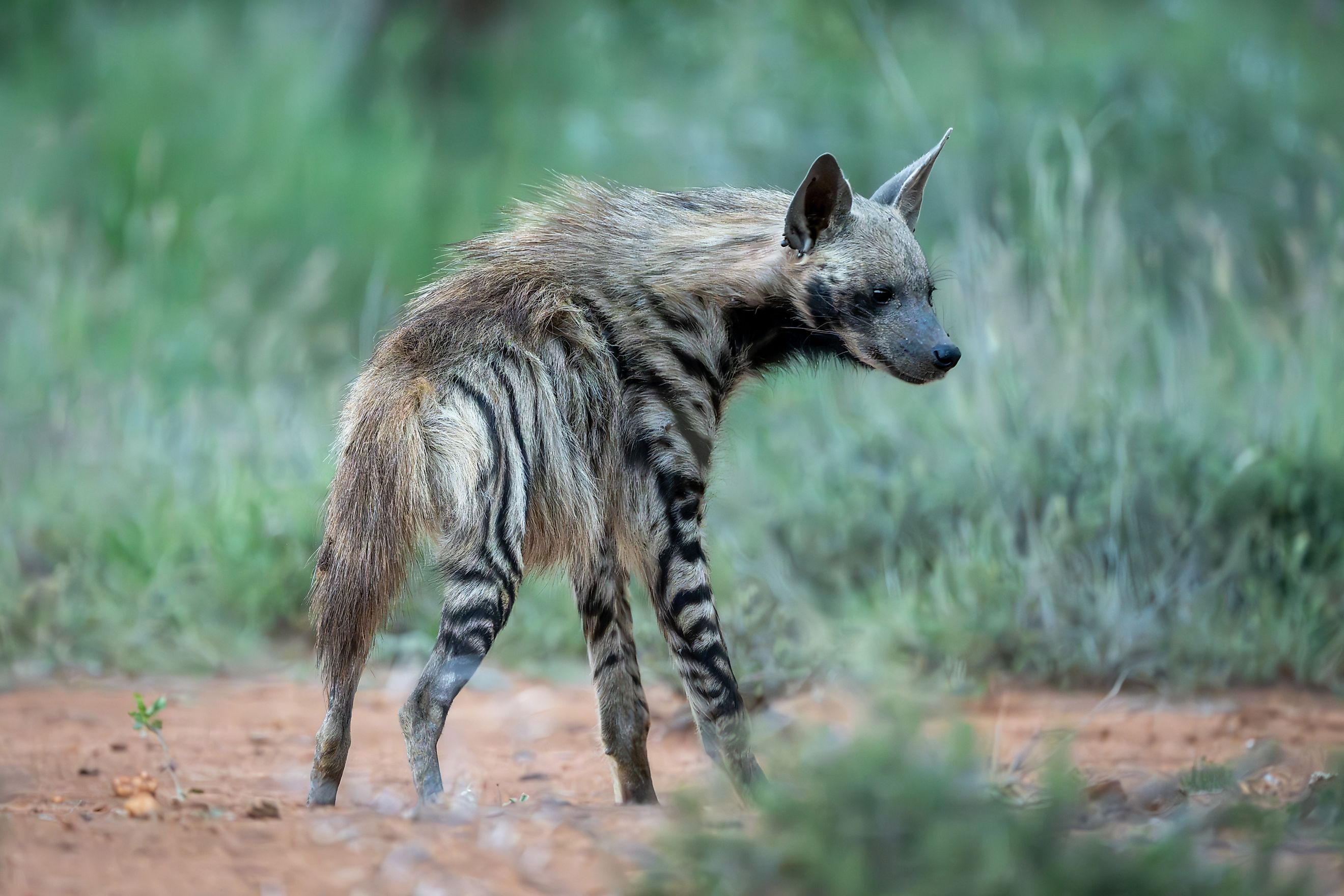
Striped Hyena
The striped hyena (Hyaena hyaena) is the most widely distributed of the world's four surviving hyena species and the only one that lives outside sub-Saharan Africa. It is also the smallest and least studied of the bone-cracking hyenas, a shaggy, dog-faced carnivore that slips through the dark of North Africa, the Middle East, and southern Asia largely unseen. Where its cousin the spotted hyena is famous for its raucous clans and eerie laughter, the striped hyena is a quiet loner, a nocturnal scavenger built to make a living where richer land and stronger predators are absent.
Standing only about knee-high to a person, the striped hyena is easy to underestimate. Yet it plays an outsized role in the arid ecosystems it inhabits, cleaning carcasses down to the bone and recycling nutrients that few other animals can reach. It is a survivor of harsh, dry country, equally at home on the fringes of the Sahara and in the scrublands of India. It carries a mix of ancient and specialized traits that mark it as one of the more curious members of the order Carnivora.
Despite its broad range, the species is thinning out. Classified as Near Threatened by the International Union for Conservation of Nature (IUCN), and Vulnerable across much of the Middle East and Mediterranean, the striped hyena is quietly disappearing from many parts of a map that once looked reassuringly large.
Taxonomic Classification

The striped hyena belongs to the family Hyaenidae, a small and evolutionarily distinct group within the order Carnivora. Despite a superficial resemblance to dogs, hyenas are more closely related to cats, mongooses, and civets. Only four living species belong to the hyena family: the spotted hyena, brown hyena, aardwolf, and striped hyena. The striped hyena is the sole living member of its genus, and its full scientific name, Hyaena hyaena, was assigned by Carl Linnaeus in 1758.
Within the hyena family, the striped hyena is considered the most primitive of the three bone-cracking species. It retains a number of ancestral, civet-like characteristics that the larger spotted and brown hyenas have lost, including a smaller and less specialized skull. Taxonomists generally recognize several subspecies spread across the animal's enormous range, distinguished mainly by coat color, size, and the density of their striping. Because the species occurs at low densities and has been little studied, the exact number and validity of these subspecies remain subjects of ongoing revision.
Physical Description

The striped hyena is a medium-sized carnivore with a distinctive, slightly awkward silhouette. Adults stand roughly 24 to 31 inches (60 to 80 cm) at the shoulder, with a head-and-body length of about 37 to 51 inches (95 to 130 cm) and a bushy tail adding another 10 to 16 inches (25 to 40 cm). Weight varies widely with region and condition, typically falling between 48 and 121 pounds (22 to 55 kg). Males and females are similar in height and length, though males tend to be somewhat heavier.
The animal's most striking feature is its coat. The fur is long and coarse, gray to pale straw in color, and marked with the black stripes that give the species its name. These bands run across the torso and legs, and the muzzle is a solid, sooty black. Running from the neck along the back is a crest of even longer hair, an erectile mane that the hyena can raise when alarmed. When fully erected, this mane can make the animal appear roughly a third larger than its true size, a bluff that helps it face down rivals and predators.
The body itself tells the story of the animal's lifestyle. The forelegs are noticeably longer than the hind legs, giving the back a downward slope toward the tail. The head is large and powerful, equipped with heavy jaws and enlarged premolars capable of crushing dense bone. The ears are big and pointed, providing the acute hearing a nocturnal scavenger needs to locate food and detect danger across open country.
Range and Habitat

Few land carnivores span as much of the globe as the striped hyena. Its range stretches across North and East Africa, through the Middle East and the Caucasus, into Central Asia, and across the Indian subcontinent. This makes it the widest-ranging hyena and the only member of the family found beyond sub-Saharan Africa. The species even lived across parts of Europe during the Pleistocene, where fossil populations were larger than those alive today.
The striped hyena is a specialist of dry country. It favors arid and semi-arid open habitats, including scrub woodland, rocky terrain, savanna, and the edges of true desert. It generally avoids dense forest and extremely open sand desert alike, preferring broken landscapes that offer both foraging opportunity and shelter. Access to caves, rock crevices, and other secure denning sites is important, as is a reliable supply of carrion. Although its range appears vast on a map, the animal lives at very low densities throughout, and it has already vanished or become severely reduced across large stretches of its former territory.
Diet

The striped hyena is first and foremost a scavenger, and its diet reflects a remarkable tolerance for food that other animals cannot use. Carrion forms the core of its intake, and the hyena's powerful jaws and specialized teeth allow it to crack open bones, hooves, and horns to reach the marrow and tissue inside. Little of a carcass goes to waste once a striped hyena has found it.
Beyond carrion, the species is a true omnivore. It readily takes fruit, insects, small vertebrates such as rodents and reptiles, and birds and their eggs. In some regions, it feeds on cultivated crops and human refuse near settlements. Although it is built mainly for scavenging rather than pursuit, a large striped hyena will occasionally kill prey of its own when the opportunity arises. This flexible, opportunistic diet is a large part of why the animal can persist in barren landscapes where more specialized hunters would starve.
Behavior

The striped hyena is largely nocturnal, resting through the heat of the day in a den or shaded shelter and emerging after dark to forage. It covers considerable ground each night in search of food, relying on a keen sense of smell and sharp hearing to locate carcasses across wide territories.
Unlike the highly social spotted hyena, the striped hyena forages alone and is rarely seen in groups. It is not strictly solitary, however. Small family units gather at the den, and the species maintains a loose social organization built around the breeding pair and their offspring. Vocal communication is limited compared with the elaborate calls of spotted hyenas, consisting mainly of soft growls and other close-range sounds. Where scent marking occurs, hyenas deposit secretions from their anal glands along pathways and near feeding sites. When threatened, the striped hyena raises its mane and turns side-on to appear as large as possible, preferring to bluff and retreat rather than fight. It is generally shy toward people and tends to flee human contact.
Reproduction

Striped hyenas breed throughout the year rather than in a fixed season, though the timing of births can shift with local conditions. Both sexes reach sexual maturity at around two to three years of age. In many populations, the animals form monogamous pairs, and the male plays an active role in raising the young, helping to establish the den and bringing food to his mate and cubs. In some cases, the mating system is more flexible, with short-term bonds or several males associating with a single female.
After a gestation of roughly 90 to 92 days, the female gives birth to a litter of one to six cubs, most often two to four. The cubs are born in a sheltered den, cave, or rock crevice, blind and with their ear canals closed but already showing the adult pattern of black stripes. Their eyes open after about a week, and they begin to take solid food at around one month. Weaning is prolonged and variable, sometimes lasting up to a year, during which the young learn to forage. Older siblings may remain with the family and help feed the next litter. In the wild, striped hyenas typically live about 10 to 12 years, though individuals in captivity have reached well over 20 years of age.
Importance to the World

As a scavenger, the striped hyena plays an important ecological role that is often overlooked. By consuming carcasses, including the bones that most other animals leave behind, it recycles nutrients such as calcium back into the ecosystem and helps limit the spread of disease that rotting carcasses can carry. In the arid regions where it lives, this cleanup role is filled by few other species.
The striped hyena also holds a place in human culture across its range. It appears in the folklore, art, and mythology of many societies across North Africa, the Middle East, and South Asia, sometimes feared, sometimes revered. In Lebanon, it is recognized as the national animal. Yet this cultural prominence cuts both ways, because superstition and misplaced blame have driven much of the persecution that now threatens the species.
Threats and Conservation

The IUCN Red List classifies the striped hyena as Near Threatened at the global level, and as Vulnerable within the Mediterranean and Middle Eastern parts of its range. The global population is estimated at fewer than 10,000 mature individuals, with figures commonly cited between 5,000 and 9,999, and the overall trend is one of decline. These estimates carry considerable uncertainty because the animal is so sparse and so little surveyed.
The pressures on the species are largely of human origin. Across much of its range, the striped hyena is persecuted directly, poisoned, trapped, or shot by people who wrongly blame it for killing livestock, robbing graves, or harming children. Road accidents kill many animals, and the loss of prey and habitat to expanding agriculture, grazing, and development steadily erodes the land it needs. Because the striped hyena reproduces slowly, populations recover only gradually once reduced. Conservationists have called for stronger international protection, including proposals to raise the species' status under global wildlife trade and migratory species agreements, alongside efforts to reduce persecution and protect the arid habitats on which it depends.
Takeaway
The striped hyena is a quiet success story of adaptation, a small carnivore that has learned to thrive on the leftovers of harsh, dry landscapes stretching across half the Old World. Its bone-cracking jaws, flexible diet, and discreet, nocturnal habits let it persist where larger and more specialized predators cannot. Yet the same low densities and slow reproduction that suit its austere lifestyle leave it exposed, and centuries of superstition and persecution have pushed it toward the edge across much of its range. Keeping this misunderstood scavenger on the landscape will depend on protecting its arid habitats and, just as importantly, on replacing old fears with an appreciation of the essential cleanup work it quietly performs.
Fun Facts

- Widest-ranging hyena. It is the only hyena species found outside sub-Saharan Africa, with a range that spans three continents and reaches all the way to India.
- A living antique. The striped hyena keeps ancestral, civet-like traits that its larger relatives have lost, making it the most primitive of the bone-cracking hyenas.
- Instant size boost. By raising its mane, it can appear roughly a third larger than its actual size when facing a threat.
- Bone specialist. Its jaws can crush bones, hooves, and horns that almost no other carnivore in its habitat can process.
- National symbol. The striped hyena is the national animal of Lebanon.
Quick Facts
- Scientific name: Hyaena hyaena
- Family and order: Hyaenidae; Carnivora
- IUCN status: Near Threatened (global); Vulnerable in the Mediterranean and Middle East
- Shoulder height: 24 to 31 inches (60 to 80 cm)
- Head-and-body length: 37 to 51 inches (95 to 130 cm), plus a 10 to 16 inch (25 to 40 cm) tail
- Weight: 48 to 121 pounds (22 to 55 kg)
- Lifespan: About 10 to 12 years in the wild; over 20 years in captivity
- Diet: Omnivorous scavenger (carrion, bones, fruit, insects, small animals)
- Range: North and East Africa, the Middle East, the Caucasus, Central Asia, and the Indian subcontinent