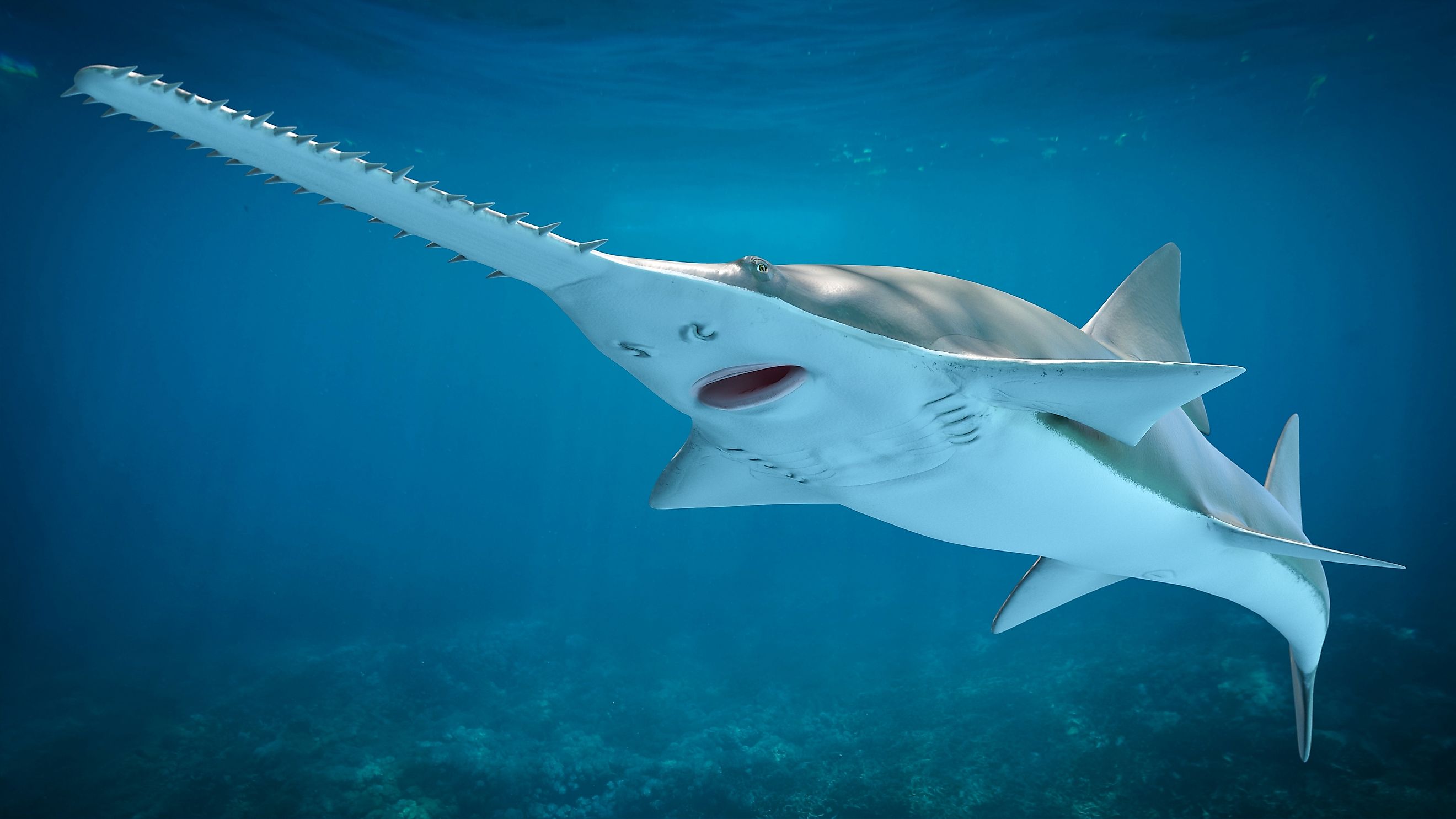
Sawfish
Few fish look as unmistakable as the sawfish. A flat, blade-like snout studded with tooth-like points runs out ahead of the body, giving these animals the look of a living power tool. That snout, called a rostrum, is a precision hunting instrument, and it has made the sawfish one of the most recognizable and one of the most endangered groups of fish in the ocean.
Sawfish are large rays that live in warm coastal waters, estuaries, and even rivers across the tropics. Despite their shark-like profile, they are not sharks at all. Five species survive today, and every one of them is now listed as Critically Endangered. Their story is a striking mix of evolutionary success and modern peril, which makes them worth knowing well.
Taxonomic Classification

Sawfish make up the family Pristidae, part of the order Rhinopristiformes. They are elasmobranchs, the group that also contains sharks, rays, skates, and chimaeras. Their skeletons are built from cartilage rather than bone. Although a sawfish looks like a shark from a distance, it is a true ray. The giveaway is the body plan. The pectoral fins are fused to the head and the gill slits sit on the underside, both hallmarks of rays.
Five living species are currently recognized. These are the largetooth sawfish (Pristis pristis), the smalltooth sawfish (Pristis pectinata), the green sawfish (Pristis zijsron), the dwarf sawfish (Pristis clavata), and the narrow sawfish (Anoxypristis cuspidata). The first four belong to the genus Pristis, while the narrow sawfish stands apart in its own genus, Anoxypristis. Modern DNA work has simplified an older and messier picture. Several forms once treated as separate species of largetooth sawfish, scattered across different oceans, are now folded into the single species Pristis pristis.
Physical Description

The rostrum defines the animal. It is a long, flattened extension of the skull lined on each side with a row of hard, pointed projections. These are often called teeth, yet they are not teeth in the usual sense. They are modified dermal denticles, the same tooth-like scales that cover a shark's skin, and they grow throughout the animal's life. The number and spacing of these rostral teeth differ by species and help scientists tell the species apart. A largetooth sawfish carries roughly 14 to 24 on each side, while a smalltooth sawfish usually has 20 to 30.
Sawfish are among the largest of all rays. The biggest species, the largetooth and green sawfish, can approach 23 feet (7 m) in total length, although animals that size are extremely rare today. The smaller species, the dwarf and narrow sawfish, top out closer to 10 to 11.5 feet (3 to 3.5 m). The body is heavy and shark-like, colored grayish-brown, olive, or yellowish above and pale white below. Tough denticles cover the whole body, giving the skin a rough, sandpaper texture. Females tend to grow larger than males, and males are recognized by the paired claspers on their pelvic fins.
Range and Habitat

Sawfish are tropical and subtropical animals. Historically they ranged across the coastal waters of the Atlantic, Pacific, and Indian Oceans, following warm shorelines around much of the world. They favor shallow, soft-bottomed places, including muddy bays, mangrove-lined estuaries, and river mouths where they can cruise the seafloor in search of food.
One trait sets the largetooth sawfish apart. It is strongly euryhaline, meaning it tolerates a wide range of salinities, and it readily moves far up into freshwater. Young largetooth sawfish spend their first years in rivers and lakes, and the species has been recorded well inland, including in Lake Nicaragua. Most sawfish stay in water shallower than about 33 feet (10 m), though some venture deeper. That preference for coastlines and estuaries places them squarely in the path of human activity, which is central to their decline.
Diet

The sawfish is a predator, and its saw is the key to how it feeds. Along the length of the rostrum sit thousands of tiny sensory pores called ampullae of Lorenzini. These detect the faint electrical fields produced by other living animals, letting the sawfish find prey buried in mud or hidden in murky water where sight is useless.
Once prey is located, the sawfish puts the rostrum to work. It swipes the blade sideways through schools of fish, stunning or slicing them, then pins wounded prey against the bottom before eating. Small schooling fish such as mullet and herring make up much of the diet, along with crustaceans and other bottom-dwelling invertebrates that the sawfish stirs up from the sediment. Behind the mouth sit rows of small, rounded buccal teeth suited to crushing rather than tearing.
Behavior

Sawfish are mostly nocturnal, resting during the day and hunting after dark. They are slow-moving and generally solitary, though they sometimes gather in loose groups. Being negatively buoyant, they spend much of their time on or near the bottom rather than out in open water.
The rostrum doubles as a defense. Sawfish have few natural predators once they reach a large size, but sharks, crocodiles, and dolphins will take smaller individuals. When threatened, a sawfish thrashes its saw back and forth, and a swipe from those denticles can wound an attacker badly. This same weapon, unfortunately, entangles them in fishing nets with fatal ease.
Reproduction

Sawfish are slow to reproduce, a trait that makes their recovery difficult. They give birth to live young through a process called aplacental viviparity. The embryos develop inside the mother and feed on yolk rather than through a placenta. Litters are small, sometimes a single pup and rarely more than a dozen, depending on the species, and females of some species breed only every other year.
To protect the mother during birth, each pup's rostrum is soft and sheathed in a gelatinous covering that hardens shortly after the young sawfish enters the water. Sawfish mature late, often not breeding until they are seven to twelve years old, and they can live for several decades. Depending on the species, lifespans of 30 to 40 years or more have been documented. Late maturity, small litters, and long lives together mean that populations rebuild slowly once they crash.
Importance to the World

As mid-level predators, sawfish help keep coastal food webs in balance by controlling populations of fish and invertebrates. Their long presence in estuaries and rivers makes them an indicator of healthy coastal habitat, since they need clean, connected waterways to thrive. Where sawfish disappear, it often signals wider trouble for mangroves, seagrass, and the fisheries that depend on them.
Sawfish also function as a flagship for coastal conservation. Because they need large stretches of connected estuary, mangrove, and river habitat to complete their life cycle, protecting them tends to safeguard many other species at the same time. Recovery zones and fishing restrictions set up for sawfish shelter the young of commercially valuable fish, which links their survival directly to the health of local fisheries and the communities that rely on them.
Threats

The sawfish is in serious trouble. Following a 2023 reassessment, all five living species are now listed as Critically Endangered on the IUCN Red List, making Pristidae widely regarded as the most threatened family of marine fish in the world. Two of the species had previously been listed as Endangered, and both were moved to the highest threat category as declines continued.
The core problem is the rostrum itself. Those tooth-lined saws snag easily in gill nets, trawls, and fishing lines, so sawfish are caught as bycatch even where no one is targeting them. On top of that, their fins are valuable in the shark-fin trade, their saws are sold as curios, and their coastal habitats are being lost to development. International trade in all sawfish species is banned under CITES, yet illegal trade in saws and fins still persists.
Recent events show how fragile the survivors are. During the winters of 2024 and 2025, a mysterious spinning phenomenon swept the Florida Keys, causing sawfish and dozens of other fish species to swim in tight circles, lose their balance, and sometimes die. The event killed a substantial number of the region's remaining smalltooth sawfish and prompted the first-ever emergency effort to rescue and rehabilitate wild sawfish. Investigators have focused on algal toxins as a likely cause. Strongholds now remain in only a few places, chiefly the southeastern United States and northern Australia.
Takeaway
The sawfish is a survivor of ancient design, a ray that hunts with a sensory blade unlike anything else in the sea. For most of its history that design served it well, spreading the family across warm coastlines around the globe. In the space of a single century, human pressure has reversed that success and pushed every species to the edge. Yet there is reason for guarded hope. Protections in the United States and Australia, the CITES trade ban, and dedicated recovery programs show that decline is not the same as doom. Whether the sawfish endures will depend on how seriously people choose to defend the shallow, muddy waters it calls home.
Fun Facts

- Its saw is a sixth sense. The rostrum is packed with electroreceptors that detect the electrical fields of hidden prey, letting a sawfish hunt in total darkness or muddy water.
- The teeth are not really teeth. The points along the saw are modified skin scales rather than true teeth, and they keep growing throughout the animal's life.
- Some are born without a father. In a Florida population, female smalltooth sawfish have been found reproducing by parthenogenesis, a rare virgin birth that produced healthy pups in the wild.
- Newborns come with a safety cover. A pup's saw is soft and wrapped in a gel-like sheath at birth to protect the mother, and it hardens only after the pup swims free.
- They are rays wearing a shark costume. Despite the shark-like body, sawfish are true rays, with fused pectoral fins and gill slits on the underside.
Quick Facts
- Scientific family: Pristidae
- Order: Rhinopristiformes
- Living species: 5 (largetooth, smalltooth, green, dwarf, and narrow sawfish)
- IUCN status: Critically Endangered (all five species, 2023 assessment)
- Length: up to about 23 feet (7 m) in the largest species
- Weight: several hundred pounds (over 100 kg) in large individuals
- Lifespan: roughly 30 to 40 years
- Diet: fish, crustaceans, and bottom-dwelling invertebrates
- Habitat: shallow coastal waters, estuaries, mangroves, and rivers
- Range: tropical and subtropical Atlantic, Pacific, and Indian Oceans