What Animals Live In The Sahara Desert?
The Sahara is usually pictured as a vast, parched, lifeless stretch of sand, broken only by the odd nomad and a plodding camel. The reality is far livelier. Covering roughly 9,400,000 square kilometers, an area comparable in size to the United States or China, the desert sprawls across much of North Africa and blankets about 31% of the entire continent. That makes it the largest hot desert on the planet, and despite its ferocious reputation, it is anything but empty.
Life here is simply harder to spot. The Sahara is home to somewhere around 70 species of mammals, 90 species of birds, and 100 species of reptiles, along with a whole underworld of spiders, scorpions, insects, and other invertebrates. Some of its residents are world famous, like the dromedary camel and the pocket-sized fennec fox. Others are genuinely alarming, like the deathstalker scorpion and the horned sand viper. And a precious few, including the critically endangered addax and the ghostly Saharan cheetah, are now clinging on in the desert's most remote and unforgiving corners. You can read more about the desert itself on our Sahara Desert page.
Surviving out here takes serious biological engineering. Summer surface temperatures can climb past 120°F, water can disappear for months at a stretch, and shade is a genuine luxury. So Saharan animals cheat the heat in every way evolution allows. Many are strictly nocturnal, sleeping through the murderous midday and emerging to hunt under cooler stars. Others burrow underground, where the sand stays far milder, or aestivate, a summer cousin of hibernation, to wait out the worst of the drought. Pale, sandy coats bounce back sunlight and double as camouflage, oversized ears radiate body heat like living air conditioners, and a remarkable number of species have essentially given up drinking altogether, wringing every drop of moisture they need out of the food they eat.
The result is one of the most specialized animal communities on Earth, a cast of survivors perfectly tuned to a place that would kill most creatures in a day. Here are some of the most iconic species that call the world's greatest hot desert home.
Jump To A Species
- Sand Viper
- Saharan Silver Ant
- Deathstalker Scorpion
- Desert Crocodile
- Monitor Lizards
- Black-Faced Firefinch
- African Silverbill
- Red-Necked Ostrich
- Rock Hyrax
- African Wild Dog
- Gazelles
- Dromedary Camels and Goats
- Desert Foxes
- Saharan Cheetah
- Addax Antelope
Sand Viper

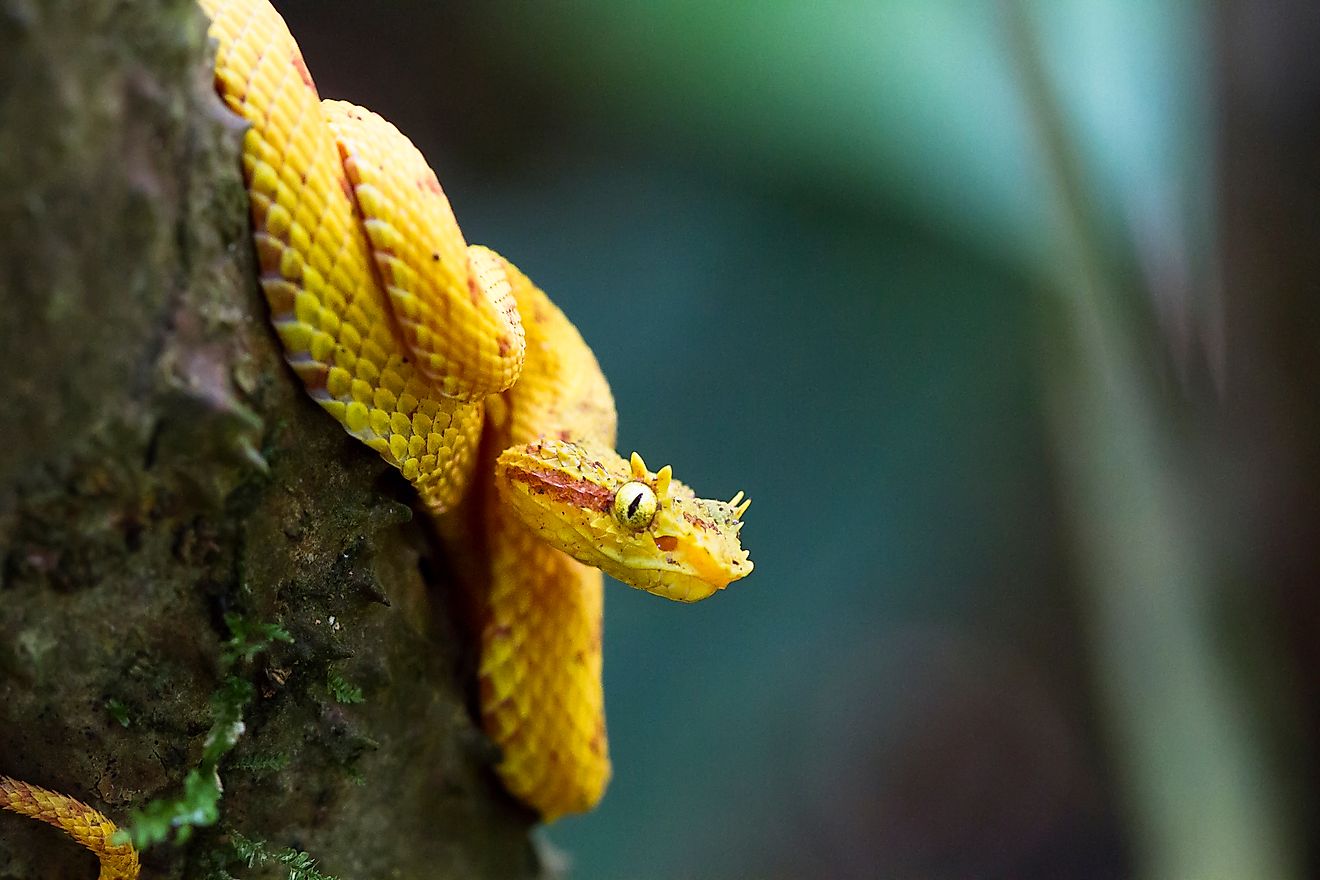
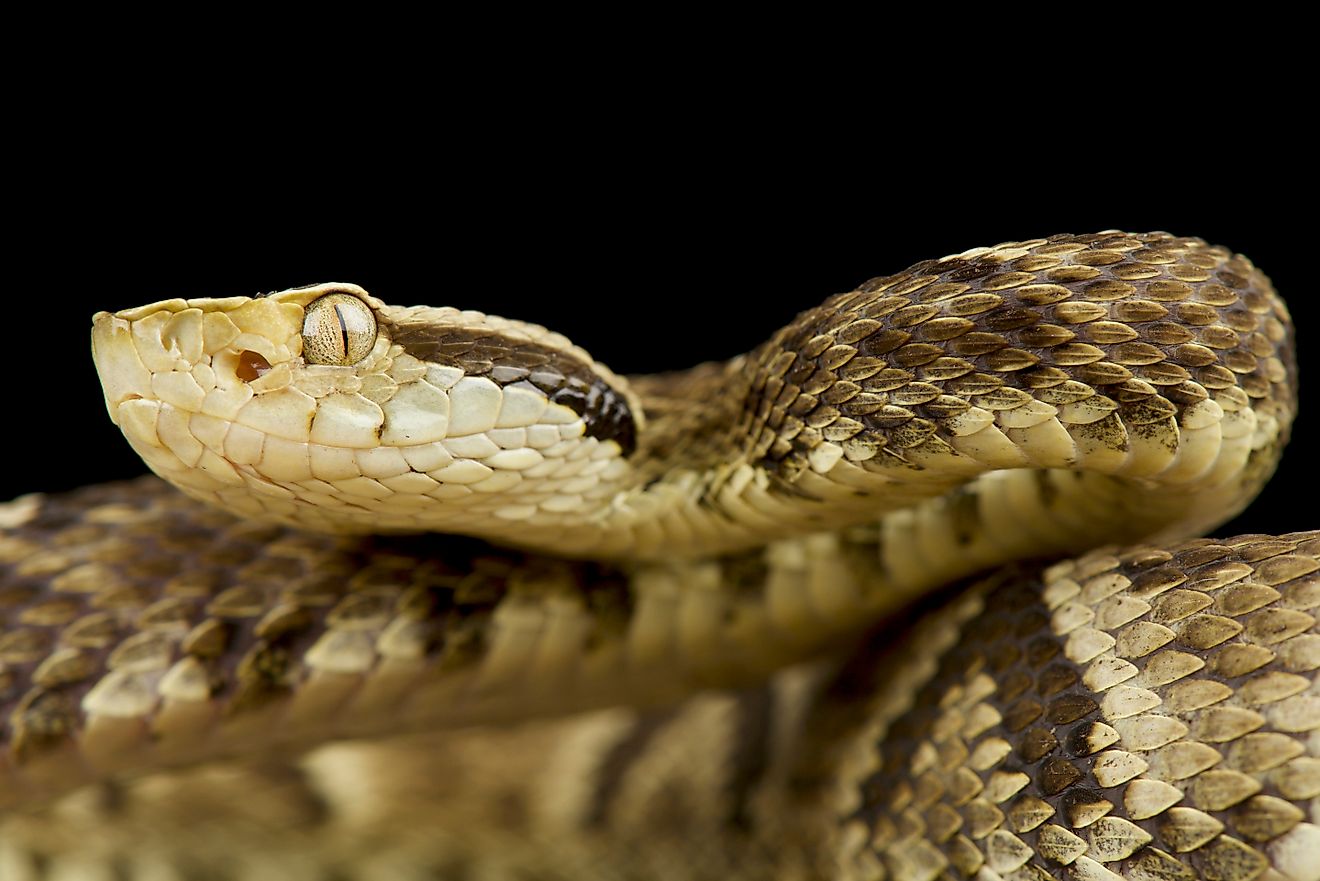
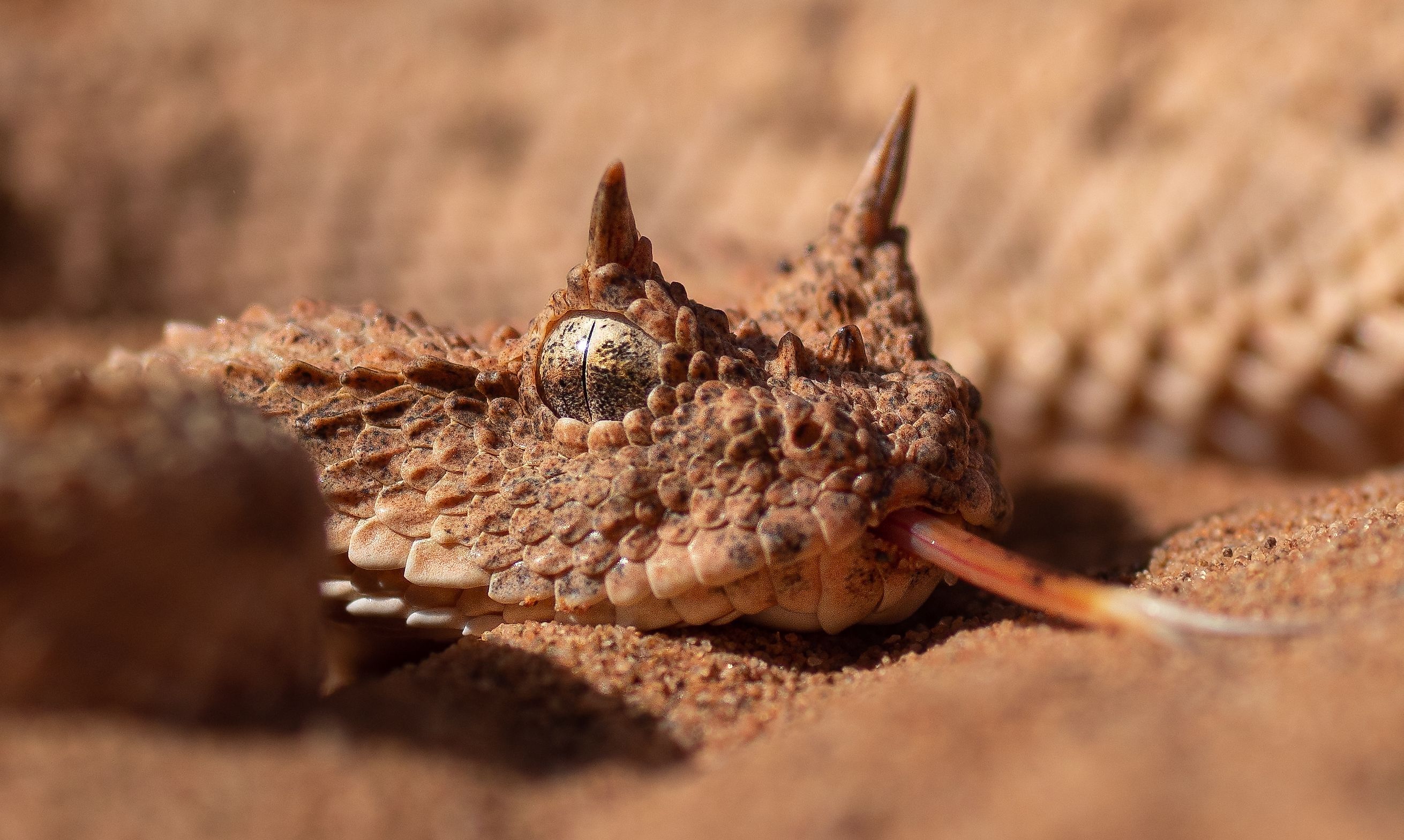
The Saharan sand viper (Cerastes vipera) is a small but formidable snake, usually just 20 to 35 cm long, with a broad triangular head and tiny eyes set high so it can bury itself in loose sand with only its face exposed. From that hidden position, it ambushes passing lizards, small mammals, and birds, delivering a potent venom that quickly overwhelms prey its own size. Its close cousin, the desert horned viper (Cerastes cerastes), pulls off the same trick but is instantly recognizable thanks to the pair of sharp, hornlike scales jutting up above each eye. Both are masters of the sit-and-wait ambush, and both are best admired from a respectful distance.
Saharan Silver Ant

The Saharan silver ant (Cataglyphis bombycina) may be the most extreme heat athlete on this entire list. It ventures out of its burrow for only about ten minutes a day, sprinting across scorching sand during the narrow midday window when its main predators, heat-sensitive lizards, have retreated to shade. To pull this off, the ant is armored with a coat of specially shaped silvery hairs that reflect sunlight and shed heat, giving it its metallic sheen, and it produces heat shock proteins before it emerges to protect its cells from cooking. It is also blisteringly fast, one of the quickest running insects on record relative to its size, because out on that open sand, every second counts.
Deathstalker Scorpion

With a name like that, you already know the deathstalker (Leiurus quinquestriatus) is not to be trifled with. It is widely regarded as one of the most dangerous scorpions in the world, armed with a cocktail of neurotoxins that can cause excruciating pain in a healthy adult who is stung. For children, the elderly, and already sick or weakened individuals, a serious sting can be life threatening. Here is the twist, though: that same venom has become one of the deathstalker's most valuable gifts to humans. A compound in it called chlorotoxin is being studied to help surgeons light up and target tumors, proving that even the desert's scariest residents can have a surprisingly useful side.
Desert Crocodile

When picturing Saharan wildlife, a crocodile is probably the last thing that comes to mind. Yet the West African crocodile (Crocodylus suchus) genuinely lives here, a relic of a wetter, greener Sahara that existed thousands of years ago. To endure the modern desert, it rides out the long dry spells in a state of aestivation, hidden deep inside caves and burrows where it can survive for months with barely any water. When the rains finally arrive, the crocodiles emerge and gather at gueltas, the rock pools that dot the desert's rugged highlands. Notably calmer than the infamous Nile crocodile, this species was so revered by the ancient Egyptians that they mummified it by the thousands.
Monitor Lizards

The desert monitor (Varanus griseus) is the heavyweight of the region's lizards, a powerful carnivore that can stretch to well over a meter in length. Being cold-blooded, it dodges the harshest months entirely, retreating into a long dormancy from roughly September to April and reappearing when conditions ease. When it is active, little is safe: the desert monitor hunts rodents, birds, eggs, fish, and smaller reptiles, and will happily take almost any animal it can overpower. Armed with strong claws, a whipping tail, and a decent turn of speed, it is one of the desert's most effective and opportunistic predators.
Black-Faced Firefinch

Not every Saharan animal is a fearsome survivor. The black-faced firefinch (Lagonosticta larvata) is a small, delicately colored member of the estrildid finch family, found across a broad band of sub-Saharan Africa along the desert's greener southern fringe. Thanks to that wide distribution, the species is currently listed as Least Concern, meaning it is not considered at risk overall. It is a reminder that the Sahara is not a hard wall but a gradient, its arid heart giving way to the semi-arid Sahel, where songbirds like this one flit through the scrub.
African Silverbill

The African silverbill (Euodice cantans) is a small, pale finch built for dry country, a resident of the arid savannas that ring the southern edge of the Sahara. It is an intensely sociable bird, gathering in sizable flocks that perch shoulder to shoulder atop trees and shrubs, often huddled together for long stretches. Silverbills feed mainly on grass seeds and the seeds of low desert plants, and their fondness for company makes them one of the more sociable and companionable birds of the region, rarely seen entirely alone.
Red-Necked Ostrich

The North African, or red-necked, ostrich (Struthio camelus camelus) is the largest living bird on Earth, standing up to about 9 feet tall, with males sporting striking black and white plumage and a flush of pinkish-red on the neck and legs. It cannot fly, but it hardly needs to: an ostrich can sprint at speeds around 45 miles per hour, making it the fastest bird on land and the fastest two-legged animal alive. Sadly, this desert giant is in trouble. Hunting, capture for farming, and habitat loss have caused a steep decline, and the red-necked ostrich now survives in only about 6 of the 18 countries where it once roamed.
Rock Hyrax

Small, stout, and comically grumpy-looking, the rock hyrax (Procavia capensis) is a plant-eating mammal that shelters in rocky crevices and emerges in groups to forage. It lives in colonies of anywhere from 10 to 80 animals, huddling together for warmth and safety. Here is the fact that stops everyone in their tracks, though: despite looking like an oversized guinea pig, the hyrax's closest living relatives are elephants and manatees. Tiny clues give it away, including a pair of ever-growing tusklike incisors, a legacy of a shared ancestor from tens of millions of years ago.
African Wild Dog

Roaming the grasslands south of the desert proper, the African wild dog (Lycaon pictus), also known as the painted wolf for its swirling, mottled coat, is one of Africa's most endangered carnivores. Only around 6,600 adults remain, scattered across roughly 39 subpopulations, with disease outbreaks, human persecution, and habitat loss driving the decline. What they lack in numbers they make up for in teamwork: wild dogs are famously among the most successful hunters on the continent, with pack hunts that succeed a remarkable share of the time. They are intensely social, and in an unusual twist, it is the females rather than the males that leave the pack upon reaching maturity. You can dig into their world on our African wild dog page.
Gazelles (Dorcas, Rhim, and Dama)

The dorcas gazelle (Gazella dorcas) is a small, delicate gazelle of the Sahara and its bordering grasslands, and a marvel of water thrift. Listed as vulnerable, with perhaps 35,000 to 40,000 left, it is so well adapted that it can theoretically go its whole life without drinking, pulling moisture from the leaves, fruits, twigs, and flowers it browses at dawn and dusk. It will drink when water is available, but it does not depend on it.
Rarer still is the rhim, or slender-horned, gazelle (Gazella leptoceros), with fewer than 2,500 individuals left in the wild and an endangered listing to match. It is built for pure sand country, with a pale coat that reflects the sun's glare and broad, splayed hooves that let it move across soft dunes without sinking.
The most imperiled of the trio is the dama gazelle (Nanger dama), now critically endangered and clinging to survival in just Niger, Chad, and Mali after once ranging widely across the region. Relentless hunting for meat and the steady loss of its habitat have pushed this tall, elegant gazelle to the very brink.
Dromedary Camels And Goats

No animal is more synonymous with the Sahara than the dromedary, or Arabian camel (Camelus dromedarius), the single-humped species that has carried people and cargo across these sands for thousands of years. It is the second largest camel after the two-humped Bactrian, and it is a walking masterclass in desert survival. Contrary to the popular myth, that famous hump does not store water at all. It stores fat, an energy reserve the camel can draw on when food is scarce. The real water tricks lie elsewhere: camels can tolerate extreme dehydration, rehydrate at astonishing speed, and seal their nostrils and shield their eyes against blowing sand. Alongside them, Saharan communities keep hardy domesticated goats for milk and meat. Both animals once had wild populations here, but truly wild camels and goats are now exceptionally rare.
Desert Foxes (Fennec, Pale, and Rüppell's Fox)

The fennec fox (Vulpes zerda) is the smallest canid in the world and arguably the most captivating animal in the desert, a sandy-furred sprite with enormous bat-like ears. Those ears are not just adorable, they are survival gear, radiating away excess body heat and picking up the faint sounds of insects and rodents moving beneath the sand. The fennec ranges across North Africa, from Morocco and Egypt south into the northern Sahel and east to the Sinai Peninsula, hunting birds, insects, and small rodents by night.
Sharing the desert are two lesser-known cousins. The pale fox, one of the least-studied canids on Earth, ranges from Senegal eastward toward Sudan, its washed-out sandy coat making it nearly invisible against the terrain. Rüppell's fox (Vulpes rueppellii), meanwhile, is a small, sandy-colored omnivore that rounds out the Sahara's trio of desert foxes.
Saharan Cheetah

At the top of the Saharan food chain prowls one of the rarest big cats on Earth, the Saharan cheetah (Acinonyx jubatus hecki). Fewer than 250 mature adults are thought to survive, mostly in the desert's remote central and western reaches. It is a subtly different animal from its savanna relatives, with a paler, almost washed-out coat and fainter spots and tear stripes that help it vanish into the bleached landscape. Largely solitary and semi-nomadic, ranging over vast territories in search of scarce prey, it hunts mainly under cover of darkness, chasing down gazelles, the occasional addax, and hares. To see one is a near impossibility, which only adds to its ghostly reputation.
Addax Antelope

Few animals embody both the resilience and the fragility of Saharan wildlife like the addax (Addax nasomaculatus). Also called the white antelope for its pale coat, and crowned with a spectacular pair of long, spiraling horns, it is one of the most desert-adapted large mammals alive, able to survive in punishing zones that receive less than 100 mm of rain a year and to go essentially its entire life without drinking, extracting water from the plants it eats and the morning dew. Tragically, this superb survivor could not outrun the rifle. Relentless hunting has devastated its numbers, and the addax is now critically endangered, with likely fewer than 100 left in the wild across its last strongholds in Niger, Chad, and Mauritania. You can learn more in our feature on addax antelopes.
From blood-sucking vipers to elephant cousins the size of a house cat, the Sahara's animals are a testament to how far life will go to make a home in a place that seems determined to prevent it. Many of these species are now endangered, their futures as fragile as the desert is vast, but for now they endure, hidden in the burrows, dunes, and rocky refuges of the largest hot desert on Earth.