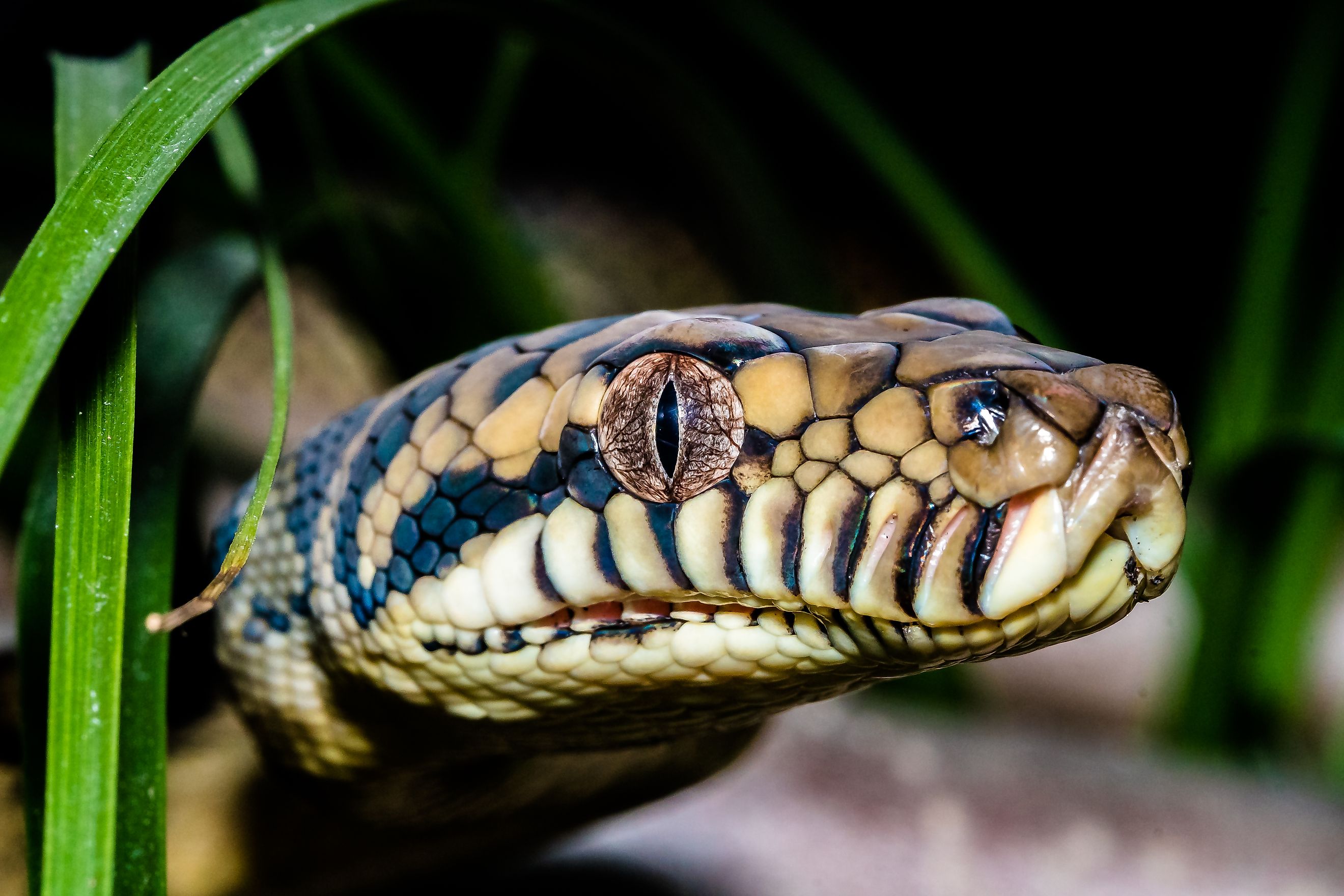
Scrub Python
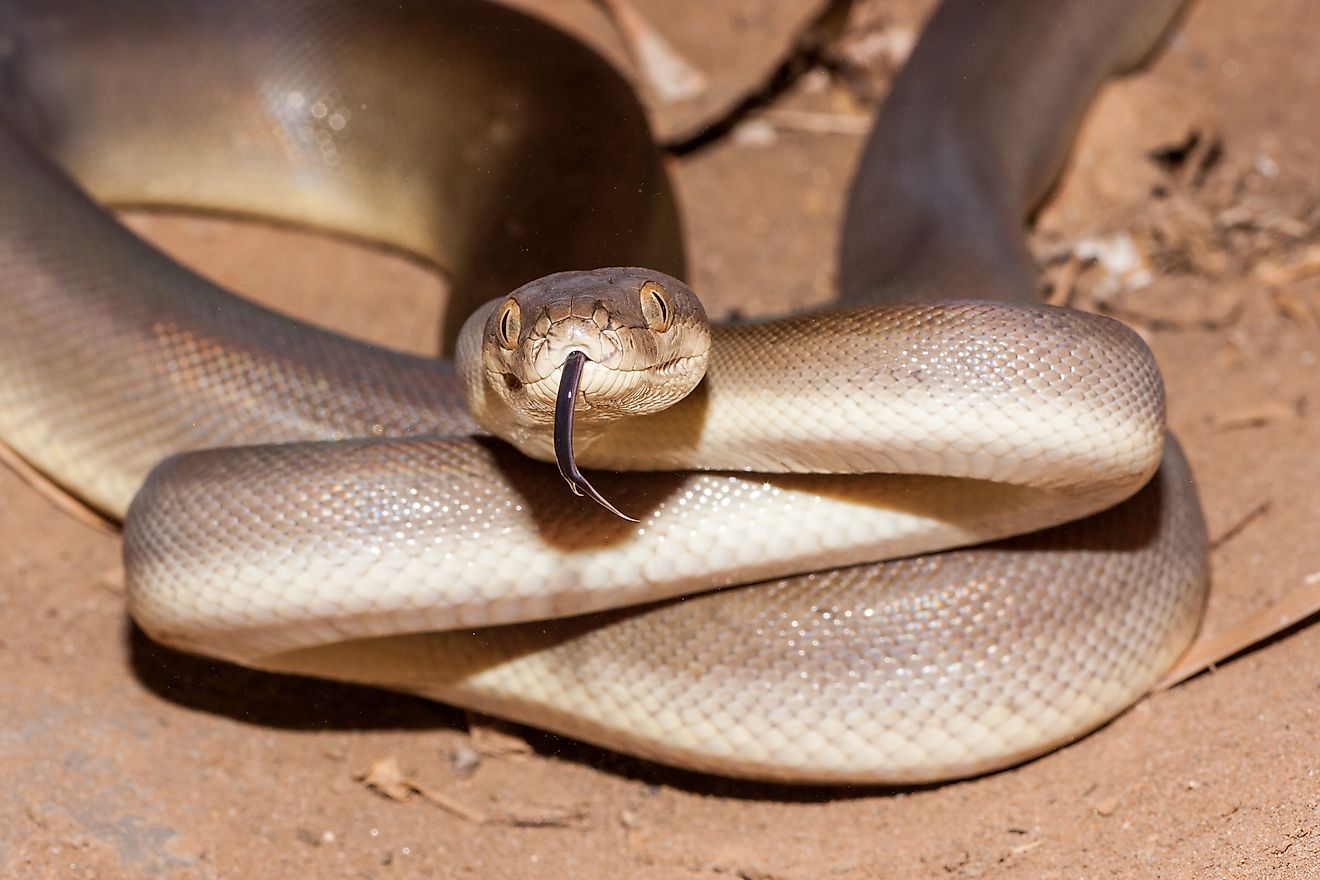
The scrub python ranks among the longest snakes on Earth and holds the title of the longest native snake in Australia. Reaching well beyond 16 feet (5 m) in reliable records, and reported at even greater lengths, this non-venomous constrictor patrols the tropical rainforests of far northern Queensland and the islands of the Torres Strait. Its long, muscular body and shimmering scales make it one of the most remarkable reptiles in the region.
Named for the amethyst-like iridescence that plays across its scales in the right light, the scrub python is a creature of the canopy and the forest floor alike. It is an ambush hunter and an active forager, a capable climber and a strong swimmer. Few animals in the Australian wet tropics command the same mix of size, stealth, and power.
Taxonomic Classification

The scrub python belongs to the family Pythonidae, the group of non-venomous constricting snakes that includes some of the largest serpents alive. Within that family, scrub pythons form the genus Simalia, which currently contains roughly five to six recognized species. All of them were once grouped in the genus Morelia, and the reshuffling of this group stands as one of the clearer examples of how modern genetics has redrawn old boundaries.
For much of the twentieth century, the Australian form was treated as a subspecies of the amethystine python (Simalia amethistina), which ranges across Indonesia and Papua New Guinea. In 2000, researchers elevated the Australian population to full species status, its name honoring the herpetologist James Roy Kinghorn. In 2014 the whole group was moved from Morelia to Simalia on the basis of genetic and morphological evidence. Some older references still use the earlier names, so the same animal may appear under several labels depending on the source.
This tangle matters for a practical reason. Because S. amethistina was long considered the Australian animal, it was frequently described as Australia's largest snake. Under the current classification that distinction belongs to S. kinghorni, since S. amethistina does not actually occur in Australia.
Physical Description

The scrub python is built for length rather than bulk. Its body is long and comparatively slender for such a large snake, an adaptation tied to its partly arboreal lifestyle. Reliable records document individuals exceeding 16 feet (5 m), and one well-measured specimen reached 17.5 feet (5.33 m) with a weight of 42 pounds (19 kg). Heavier animals have been recorded, some topping 60 pounds (27 kg), and unverified reports push the maximum length still higher.
Coloration is where the snake earns its name. The dorsal scales form a mosaic of brown, tan, and olive that dapples the body and helps it disappear against leaf litter and bark. Over this pattern lies a milky, iridescent sheen that catches light in shifting purples and greens, reminiscent of an amethyst gemstone. Running along the jaw are heat-sensing pits, specialized organs that detect the infrared signature of warm-blooded prey and allow the snake to strike accurately in complete darkness.
The scrub python shows an unusual form of sexual dimorphism. In most python species females grow larger than males, but here the pattern is often reversed, with males frequently reaching about a third longer and twice as heavy as females. Hatchlings are large from the start, emerging at around 23 inches (600 mm) and roughly 1.8 ounces (50 g), already bigger than the adults of many other snake species.
Range and Habitat

The Australian scrub python is native to the tropical north of Queensland, spanning the Cape York Peninsula and the Wet Tropics region, and it also occurs on several islands of the Torres Strait. Its close relatives in the genus extend the broader scrub python range north into Papua New Guinea, Western New Guinea, and parts of Indonesia.
Within this range the snake favors warm, humid forest. It is most associated with closed rainforest, though it also uses vine thickets, gallery forest along watercourses, dry sclerophyll woodland, and the edges of savanna. It readily moves into human-modified landscapes as well, turning up in plantations, farm sheds, gardens, and suburban backyards where prey and shelter are plentiful. Its dependence on the wet tropics ties its fortunes closely to a relatively narrow band of habitat.
Diet

As a non-venomous constrictor, the scrub python kills by ambush and coil rather than by bite. It seizes prey with backward-curving teeth, wraps its body in tight loops, and tightens with each exhalation of its victim until the animal can no longer breathe. Its diet is broad and shifts with size. Smaller pythons take rodents, bats, and birds, while large adults are capable of overpowering substantial mammals, including bandicoots, possums, flying foxes, and even wallabies and other macropods.
The species combines two hunting styles. It will actively forage through the forest and along the ground, and it will also wait in ambush, coiled and motionless, for prey to pass. One of its more remarkable feeding habits centers on colonies of metallic starlings. When these birds nest in great numbers in tall rainforest trees, scrub pythons gather beneath the rookeries for months at a time, feeding on nestlings and adults that fall from the canopy. This seasonal bounty shapes the movements of local pythons through much of the year.
Behavior

Scrub pythons are mainly nocturnal, doing most of their hunting and traveling after dark. Juveniles are strongly arboreal and spend much of their time in trees and shrubs, where their slim bodies and gripping coils serve them well. As they grow heavier, adults shift toward a more ground-dwelling existence, though they remain able climbers throughout life. They are also strong swimmers and will cross water without hesitation when moving through their territory.
These snakes are solitary and generally secretive, relying on camouflage and stillness to avoid detection. When cornered they can be defensive, striking and biting to protect themselves, and their size means a bite from a large individual can cause real injury even without venom. Encounters with people are usually uneventful, and the snake's fearsome reputation rests more on its dimensions than on any habitual aggression. A rare documented case in 2014 involved a radio-tracked python attempting to constrict a sleeping woman, an unsuccessful attack that researchers noted was exceptional rather than typical.
Reproduction

Breeding takes place in the cooler months, broadly from late July into September. During this period rival males engage in combat bouts, wrestling and pushing against one another to win access to receptive females. After mating, the female lays a clutch that commonly numbers around a dozen eggs, though clutches of roughly 5 to more than 20 eggs have been recorded.
What follows is one of the most striking behaviors in the species. The female coils tightly around her eggs and stays with them for the entire incubation period of roughly 80 to 90 days, rarely leaving and generally not feeding. She can raise the temperature of the clutch by shivering, a rhythmic muscular contraction that generates metabolic heat, and her body shields the eggs from predators such as goannas and feral pigs. Hatchlings emerge fully formed and independent, already large enough to tackle sizable prey. Scrub pythons are long-lived, commonly reaching 20 to 30 years of age.
Importance to the World

As a large predator, the scrub python plays a meaningful role in the ecology of the Australian wet tropics. By preying on rodents, bats, birds, and mid-sized mammals, it helps regulate the populations of these animals and contributes to the balance of the rainforest food web. Around metallic starling colonies it becomes part of a tightly linked seasonal cycle, one of several predators that depend on the birds' nesting aggregations.
The scrub python has also become a valuable subject for scientific study. Because it grows large enough to carry radio transmitters yet remains secretive in the wild, it has helped researchers understand how giant snakes move, hunt, and use their habitat across the seasons. Long-term tracking of these pythons around metallic starling rookeries has shown how cold-blooded predators shift their foraging in response to changing prey, and studies of brooding females have deepened knowledge of how snakes generate and control their own heat. In this way the species serves as a living window into the ecology of tropical rainforest predators.
Threats

The scrub python is currently listed as Least Concern on the IUCN Red List, and its population is not considered to be in sharp decline. That relatively secure status reflects a reasonably wide distribution within suitable habitat and few natural enemies for large adults. Young pythons face predation from raptors, while adults may occasionally fall to dingoes, large monitor lizards, and crocodiles near water.
The main pressures on the species come from people. Clearing and fragmentation of rainforest reduces the habitat it depends on, and because it is tied to the wet tropics, it is regarded as vulnerable to the longer-term effects of climate change on that narrow biome. Individual snakes are sometimes killed on roads or in retaliation when they take poultry from farms and backyards. None of these pressures currently endangers the species as a whole, yet its restricted range means local populations warrant ongoing attention.
Takeaway
The scrub python holds several unusual distinctions among Australia's snakes. It is the country's longest snake, a patient and versatile hunter, and an attentive parent that can fast for months while guarding its clutch. Changes to its scientific name reflect ongoing questions about its classification rather than uncertainty over the animal itself, while its reputation as a threat to humans is largely undeserved. As a major predator in northern rainforests, it plays an important role in the ecosystems it inhabits. The species remains reasonably secure for now, but its dependence on the shrinking, climate-sensitive Wet Tropics makes habitat protection increasingly important to its long-term survival.
Fun Facts

- Longer than a car. The largest scrub pythons stretch beyond 16 feet (5 m), making them the longest snakes native to Australia.
- Built-in night vision. Heat-sensing pits along the jaw let the snake detect the warmth of prey and strike accurately in total darkness.
- Shivering mothers. A brooding female can generate her own heat by contracting her muscles, warming her eggs while she coils around them for up to three months.
- Amethyst in the scales. The species owes its amethystine name to a purple-green iridescence that shimmers across its scales in the right light.
- Big from birth. Hatchlings emerge at around 23 inches (600 mm), already larger than the adults of many other snake species.
- Starling feasts. Each year the pythons gather beneath metallic starling colonies to feed on nestlings that tumble from the canopy.
Quick Facts
- Common name: Scrub python (Australian scrub python)
- Scientific name: Simalia kinghorni
- Family: Pythonidae
- Genus: Simalia
- IUCN status: Least Concern
- Length: Commonly 10 to 16 feet (3 to 5 m), with reliable records beyond 17 feet (5.3 m)
- Weight: Up to about 60 pounds (27 kg) in the largest individuals
- Lifespan: 20 to 30 years
- Diet: Carnivore (birds, bats, rodents, and mid-sized mammals)
- Reproduction: Egg-laying, clutch of roughly 5 to 21 eggs, incubation 80 to 90 days
- Range: Far northern Queensland, Cape York Peninsula, and Torres Strait islands, Australia
- Habitat: Tropical rainforest, vine thickets, and adjacent woodland