Spotted Hyena
One of the most fascinating animals of Africa is the spotted hyena, a highly successful predator despite its portrayal in popular culture as a cowardly scavenger. It is the largest of the four living species of hyena and is vital to keeping African ecosystems healthy. Thanks to their stamina and their bone-crushing jaws, spotted hyenas are among the continent's most dominant carnivores. These adaptable mammals occur throughout much of sub-Saharan Africa and occupy many different habitats, including open grasslands and mountainous forests. They hunt, scavenge, and live in highly structured clans, which has allowed them to survive in areas where most other large predators have disappeared. Spotted hyenas are best known for their unusual build and their carrying vocalizations, but they rank among the most intelligent and ecologically important mammals on the continent.
Taxonomic Classification

The spotted hyena (Crocuta crocuta) belongs to the family Hyaenidae, a small family of carnivorous mammals with only four living species: the spotted hyena, the striped hyena (Hyaena hyaena), the brown hyena (Parahyaena brunnea), and the aardwolf (Proteles cristata). All four share a common ancestor, but the spotted hyena is by far the largest, strongest, and most specialized hunter. The aardwolf feeds almost entirely on termites, and the striped and brown hyenas rely heavily on scavenging. The spotted hyena is an active predator, able to take down large ungulates such as wildebeest and zebra.
Hyenas are not part of the dog family (Canidae), though their sloping backs, pointed muzzles, and powerful legs give them a dog-like appearance. They are not wolves, foxes, or domestic dogs but belong to the suborder Feliformia, meaning they are more closely related to cats, civets, mongooses, and fossas. Scientists trace hyenas and the other feliform carnivores to a common ancestor that lived tens of millions of years ago. The modern hyena family branched off later, during the Miocene.
The spotted hyena is the sole extant member of the genus Crocuta. Several extinct species of the genus once ranged across Africa, Europe, and Asia during the Pleistocene Epoch. Fossils suggest that ancestral members of the genus were widely distributed and occupied many of the ecological niches held by large carnivores today. Spotted hyenas are the most specialized members of their family, characterized by powerful jaw muscles, enlarged premolars for crushing thick bone, and social behaviors more complex than those of any other hyaenid.
Physical Description

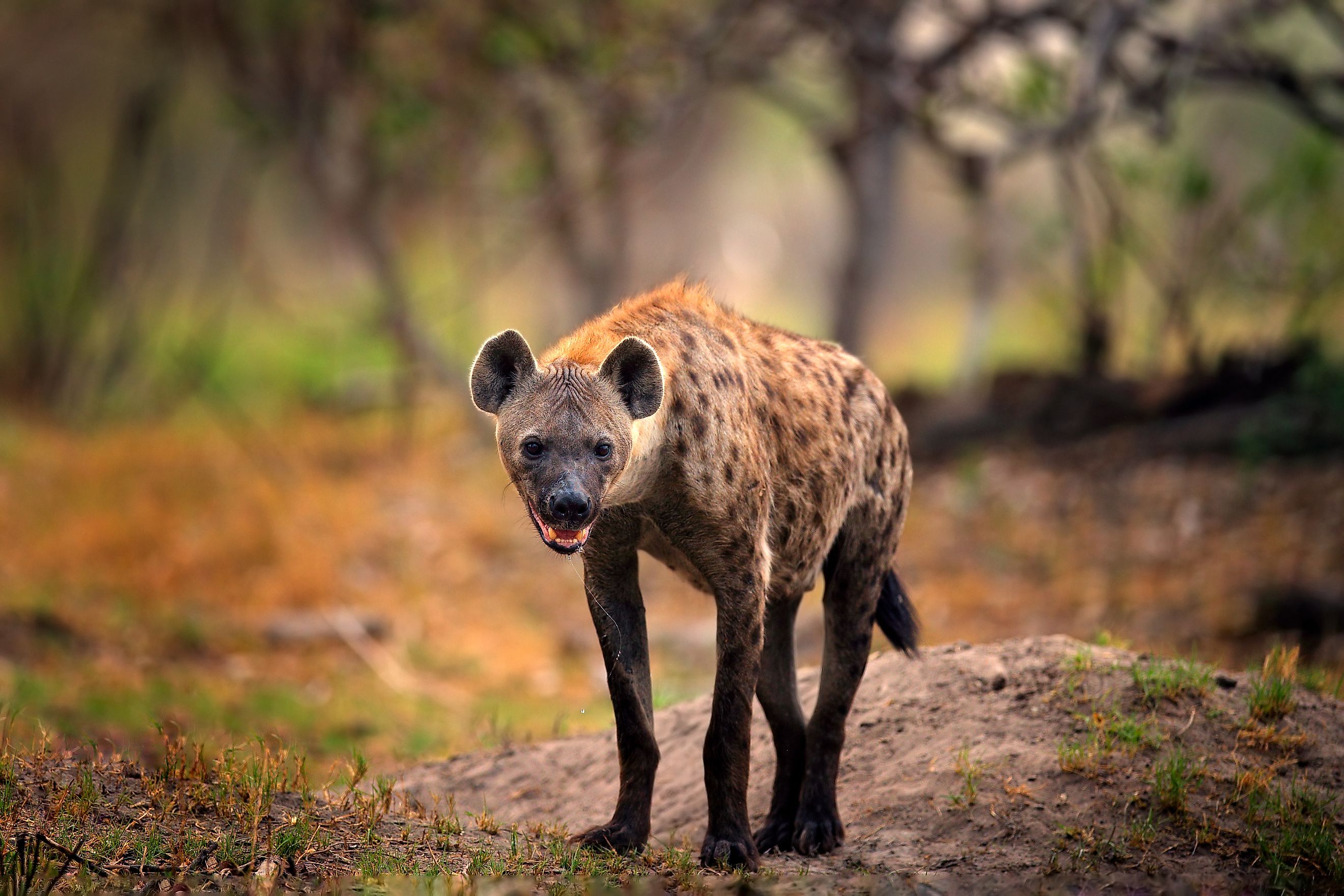
The spotted hyena is a sturdily built mammal with distinctive proportions. Adults typically stand 28 to 36 inches (71 to 91 cm) tall at the shoulder and measure about 4 to 6 feet (1.2 to 1.8 m) long, including the tail. Most individuals weigh between 90 and 190 pounds (40 to 86 kg), and the heaviest recorded females approach 200 pounds (90 kg).
The back slopes downward because the front legs are considerably longer than the hind legs. That posture produces the animal's distinctive gait and supports the endurance it relies on during long pursuits. The head is broad with a short snout and rounded ears, set on a muscular neck, and the jaws generate one of the strongest bite forces of any terrestrial mammal.
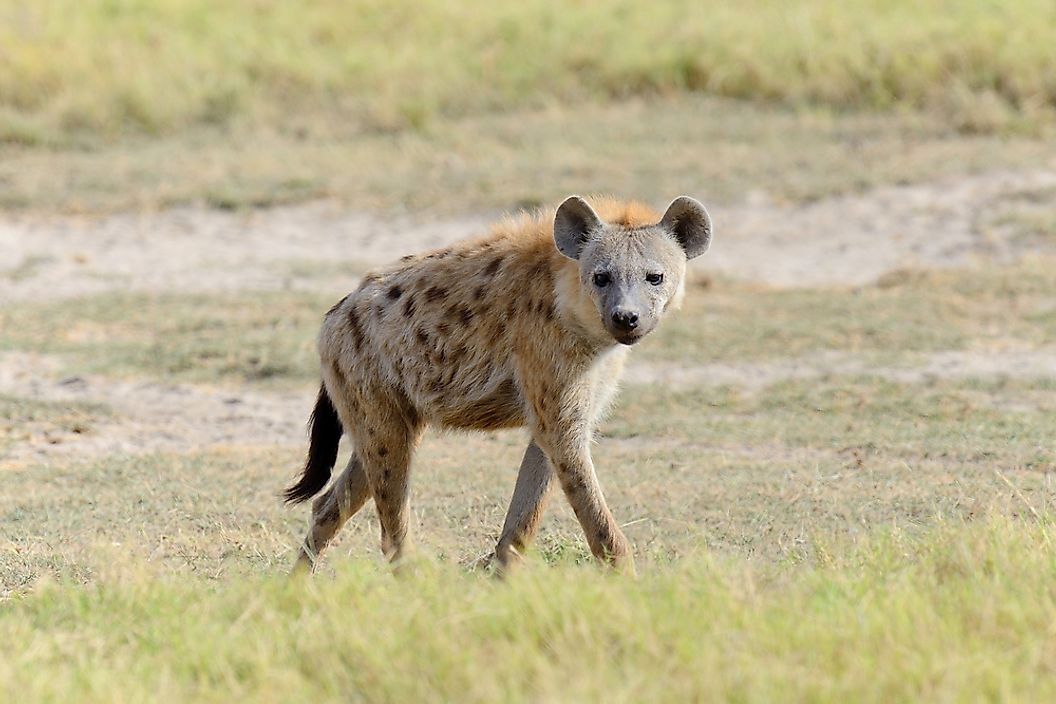
Their coarse fur is sandy yellow or grayish brown, marked with the dark spots that give the species its common name. Each animal carries its own spot pattern, which breaks up its outline in grass and scrub. Spotted hyenas lack the long, fluffy tail common in many mammals, carrying instead a relatively short, bushy tail with a dark tip.
Sexual anatomy is one of the species' most unusual features. Females are about ten percent heavier than males and dominate them socially. Females also possess enlarged external genitalia that closely resemble the male's, which makes the sexes difficult to tell apart without close examination. This rare arrangement, and the female-dominated hierarchy it accompanies, has occupied researchers for decades.
Range and Habitat

Spotted hyenas are resident across much of sub-Saharan Africa. Established populations occur in Kenya, Tanzania, Botswana, Namibia, South Africa, Ethiopia, Zambia, Zimbabwe and Uganda, among many other countries. The species remains one of the most widely distributed large carnivores in Africa, though its range has contracted in parts of West Africa as habitat has been lost.
These predators are highly adaptable and occupy many habitat types. They are most common in open savanna and grassland where prey animals are abundant, but they also occur in woodland, scrubland, semi-desert, wetland, and montane terrain. Some populations live above 13,000 feet (4,000 m) in the Bale Mountains of Ethiopia.
Spotted hyenas are not restricted to any single habitat and do well wherever prey and den sites are sufficient. They typically occupy old aardvark burrows, rocky crevices, caves, or holes they dig themselves. They persist even in human-altered landscapes, including farmland margins and the edges of protected reserves.
Diet and Feeding Habits

Although they are often thought of as scavengers, spotted hyenas rank among the most efficient predators in Africa. In many ecosystems they actively hunt most of their food rather than feeding on kills made by other carnivores. Their diet is broad and shifts with habitat, season and prey availability. Prey includes large herbivores such as wildebeest, zebras, gazelles, antelope, buffalo calves, and warthogs, along with smaller animals such as hares, rodents, birds, reptiles, and insects when the opportunity arises.

That dietary flexibility is a large part of why the species survives across so many African habitats. Spotted hyenas are avid scavengers of carrion as well as predators, and they exploit almost any food source they encounter. Their powerful jaws and specialized bone-cracking premolars let them crush thick bone that other predators leave behind. They digest bone, skin, tendon, hooves and other tough tissue, so a carcass is consumed almost entirely with very little waste. In doing so, they clear the landscape of carcasses that would otherwise become a source of disease, and they return nutrients to the soil.
Spotted hyenas hunt cooperatively when pursuing large prey, driving animals over long distances until they tire and then attacking in a coordinated group. They are also capable solitary hunters, regularly killing smaller animals alone. Sharp hearing, sight, and smell allow them to locate prey or detect a carcass a couple of miles away. Stamina, problem-solving, hunting skill, and scavenging ability together make the spotted hyena one of Africa's most adaptable carnivores, able to persist where food availability swings sharply between seasons.
Behavior

Spotted hyenas display some of the most complex social behavior of any carnivore. They form groups called clans, which may hold as few as ten individuals or more than eighty, depending on habitat quality and prey availability. Every clan maintains a strict social order with females at the top. Female offspring inherit ranks close to their mothers', and immigrant males occupy the lowest positions. Dominant individuals get first access to food, preferred den sites, and reproductive opportunities.
Clans communicate through vocalizations, body language, scent marking, and visual displays. The celebrated "laugh," heard during feeding disputes and moments of excitement, is not laughter at all but a string of rapid giggling notes. Their whooping calls carry for roughly three miles (5 km), allowing clan members to locate one another across large territories.

Spotted hyenas are notably intelligent animals. They solve novel problems, recognize individual clan members, remember social relationships, and coordinate during hunts. Experimental work has found that they perform comparably to some primates on certain tests of social cognition, and better than many other carnivores. Hunting occurs mostly during the cooler evening and night hours, though clans are active by day in protected areas. Territories can extend across hundreds of square miles, and clan members routinely patrol the boundaries to defend resources against neighboring clans.
Reproduction and Life Cycle
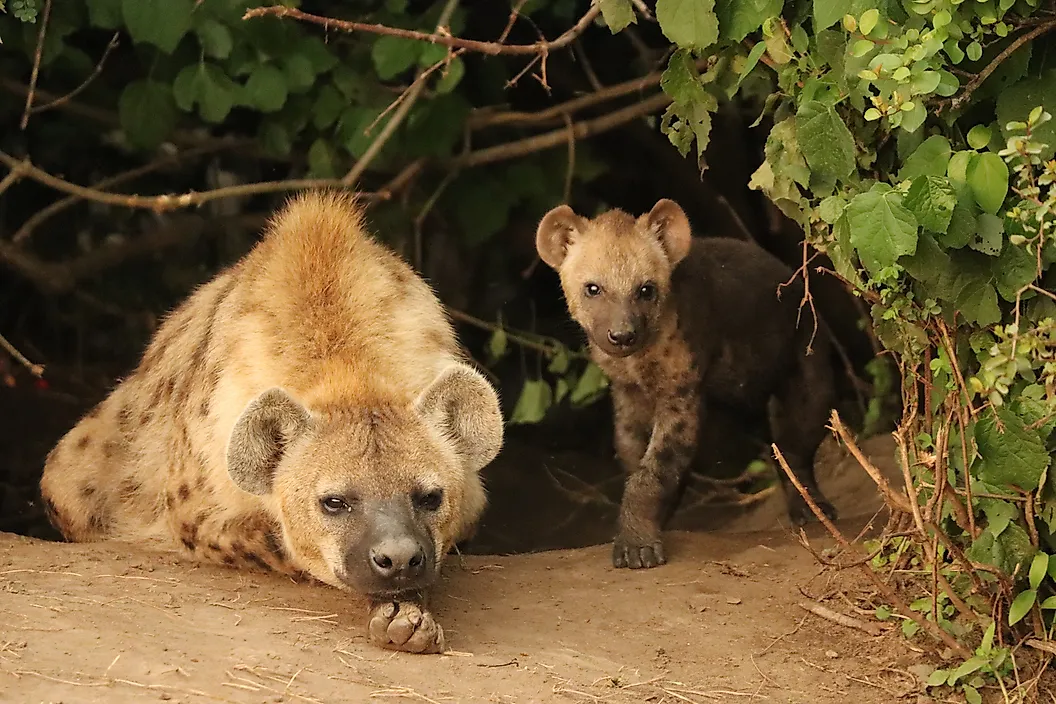
Female spotted hyenas typically reach sexual maturity between two and three years of age, while males often mature slightly later. Breeding occurs throughout the year rather than during a fixed season, although birth peaks may coincide with periods of abundant food. Following a gestation period of approximately 110 days, females usually give birth to one or two cubs inside an underground den. Newborn spotted hyenas are unlike the young of most carnivores. They are born with their eyes open, fully erupted canine teeth, and a dark coat that gradually develops spots as they mature.

Sibling rivalry begins almost immediately after birth. In litters of two, competition can become intense, and one cub may dominate access to nursing. Mothers nurse cubs for an unusually long period, often extending beyond one year and occasionally approaching two years. This prolonged maternal care contributes to high survival rates in stable clans.
Young cubs remain at communal dens while adults forage. As they grow, they begin accompanying older clan members and gradually learn hunting techniques, social behaviors, and territorial boundaries. Females generally remain in their birth clan throughout life, whereas males usually disperse upon reaching adulthood to join unrelated clans. Wild spotted hyenas commonly live between 12 and 20 years, while individuals in managed care have reached more than 25 years of age.
Ecological Importance

Because spotted hyenas both hunt and scavenge, they act on their ecosystems in two ways at once. Predation helps hold herbivore numbers in check, while scavenging removes animal carcasses that would otherwise become reservoirs of disease. They consume nearly every part of a dead animal, which accelerates nutrient recycling and limits the opportunity for harmful bacteria and parasites to multiply.
As apex predators, they also shape the behavior and population dynamics of their prey. That pressure helps keep food webs in balance by preventing any one herbivore species from becoming abundant enough to degrade vegetation. Abandoned hyena dens later shelter smaller mammals, reptiles, and birds, adding another layer of biodiversity to the habitats the species occupies.
Threats and Conservation

Although spotted hyenas remain relatively widespread compared to many African carnivores, they face numerous threats throughout their range. Habitat loss caused by expanding agriculture, urban development, and infrastructure projects continues to reduce available territory. As human population growth has increased competition for space and prey, hyenas have come into closer contact with livestock. Farmers and herders frequently clash with them over livestock predation. Hyenas are poisoned, trapped or shot in response to those losses, sometimes when they were not responsible for them. Illegal snaring intended for other wildlife also injures or kills many individuals.
Fewer wild herbivores mean fewer natural food sources, which pushes hyenas toward livestock and scavenging. Road collisions and persecution rooted in myth and negative cultural belief further threaten some regional populations. Spotted hyenas do occupy many of Africa's national parks and wildlife reserves, and populations inside those protected areas have remained comparatively stable thanks to legal protection and anti-poaching work. The International Union for Conservation of Nature (IUCN) assesses the species as Least Concern, citing its broad distribution and relatively large global population. Local declines nonetheless underscore the importance of ongoing conservation effort.
Relationship With Humans
Many African traditions have long associated the spotted hyena with supernatural power, treachery, or greed, while other cultures credit the animal with intelligence and persistence. Popular media has largely settled on the first view, casting hyenas as skulking scavengers. Scientific research points somewhere else entirely. Studies describe social animals that hunt collaboratively and communicate through a wide vocal repertoire. Researchers continue to examine hyena cognition, female-dominated societies, and clan dynamics for what they reveal about mammalian intelligence and social behavior.
A Carnivore Worth Reassessing
The spotted hyena is a problem-solver, a capable predator, and a working component of the habitats it occupies. Its cooperative hunting, matriarchal social structure, bone-crushing jaws, and layered communication make it one of the more specialized carnivores on the continent, and the gap between that animal and its reputation is unusually wide.
Resilience and ecological flexibility have carried the species across much of sub-Saharan Africa, but habitat loss, conflict with people, and declining prey continue to press on regional populations. Protecting spotted hyenas maintains the balance of ecosystems that support many other plants and animals, and preserves a species whose value has been consistently underestimated.