Star-Nosed Mole
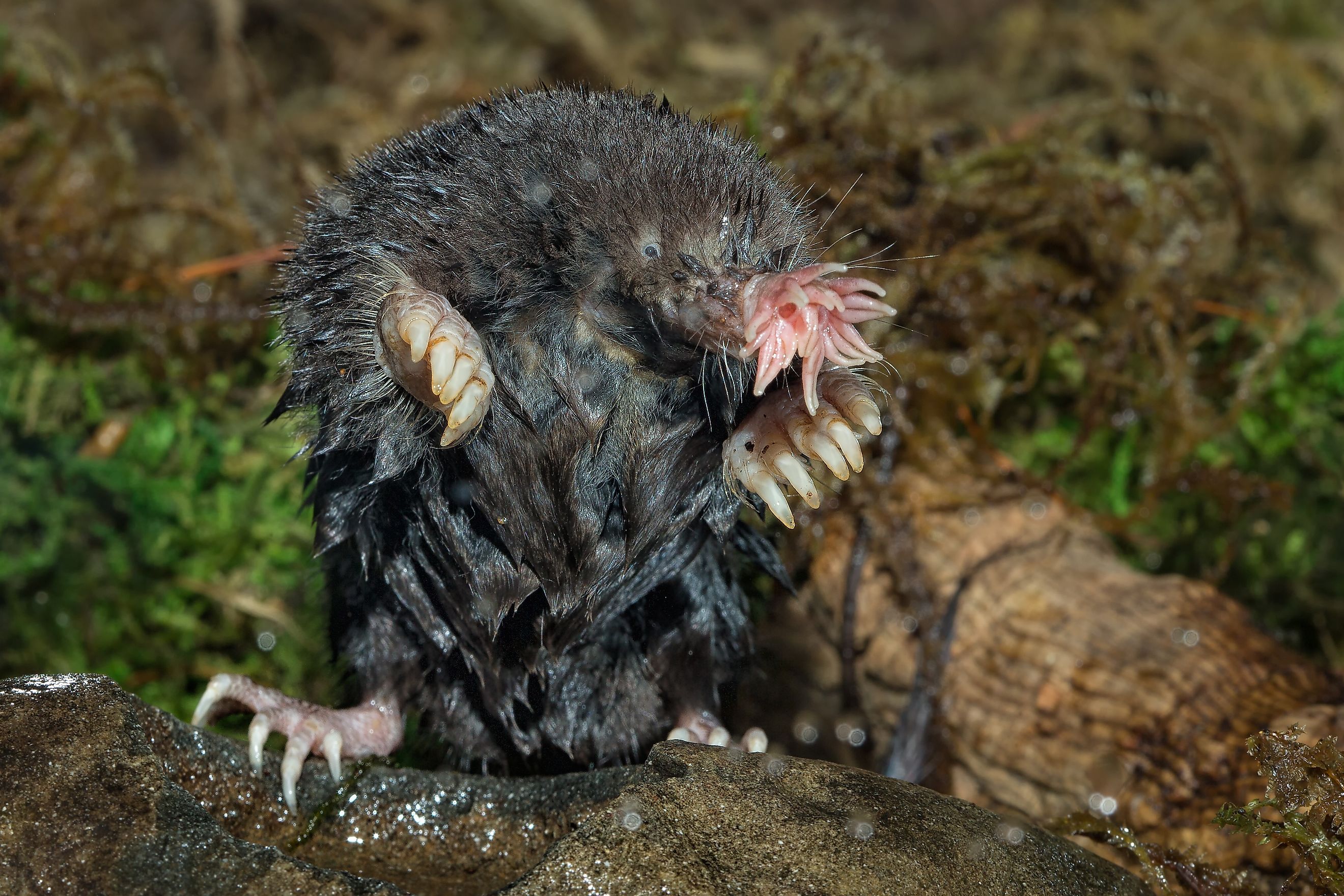
Few mammals look as strange as the star-nosed mole (Condylura cristata), a small, dark, semiaquatic burrower whose snout ends in a ring of 22 pink, fleshy tentacles. That fleshy star is the most sensitive touch organ known in the animal kingdom, and it makes this mole the fastest-foraging mammal ever measured.
The star-nosed mole lives in the wet lowlands of eastern North America, from the marshes and swamps of the northeastern United States into eastern Canada. Though it is rarely seen, it is fairly common across that range, tunneling through soft, waterlogged soil and swimming through the ponds and streams that thread it.
What sets this animal apart is not just its odd appearance but the science packed into that appearance. Researchers have spent decades studying the star, and their findings have reshaped how biologists think about touch, speed, and the limits of the mammalian nervous system.
Taxonomic Classification

The star-nosed mole belongs to the family Talpidae, the true moles, within the order Eulipotyphla, the group of small insectivores that also includes shrews and hedgehogs. Carl Linnaeus first described the species in 1758, originally naming it Sorex cristatus before it was placed in its own genus. The species name cristata means "crested," a nod to the crownlike ring of appendages around its nose.
It is the only living member of both the genus Condylura and the tribe Condylurini, which makes it something of an evolutionary loner among moles. Genetic work suggests its lineage split from the main mole line tens of millions of years ago, possibly 30 to 49 million years back. Two fossil relatives, known from Pliocene deposits in Poland, are the only other members of the genus ever identified. Most authorities recognize two subspecies, a northern form and a southern form, with northern animals tending to run slightly larger.
Physical Description

The star-nosed mole is a compact animal built for a life spent digging and swimming. Head and body length runs about 3.3 to 5.1 inches (85 to 130 mm), with a scaly, hair-covered tail adding another 2.5 to 3.3 inches (65 to 85 mm). Adults weigh roughly 1 to 2.6 ounces (30 to 75 g), and northern individuals are generally heavier than their southern counterparts. The body is cylindrical, the fur dense and coarse, colored dark brown to black above and a shade lighter below.
Everything about the animal reflects its underground and underwater habits. Broad, outward-facing forefeet armed with stout claws work as shovels, while the thick, water-repellent coat lies flat in any direction, letting the mole move forward or backward through a tight tunnel with equal ease. Its eyes are tiny and its vision is poor, probably limited to telling light from dark.
The tail deserves its own mention. Slim for most of the year, it swells to three or four times its normal diameter in late winter and spring, when it appears to store fat as an energy reserve for the breeding season.
And then there is the nose. The star measures only about 1 cm (0.4 in) across, slightly smaller than a human fingertip, yet it carries a sensory payload no other mammal can match. Eleven fleshy rays line each side, each ray between 1 and 4 mm long, and together they never stop moving as the animal explores its surroundings.
The Remarkable Star

The star is not a nose in the ordinary sense, and it plays no part in ordinary smelling. Instead it is a dedicated organ of touch, covered with more than 25,000 tiny sensory receptors called Eimer's organs. Those receptors feed a dense network of nerves that carries information to the brain at speeds close to the physical limits of neurons.
Neuroscientist Kenneth Catania of Vanderbilt University has spent much of his career mapping how the star works. High-speed video shows the rays touching as many as 10 to 15 different points every second as the mole searches through mud. One pair of rays, the eleventh, acts as a high-resolution focus much like the center of the human eye, and the mole swings that pair onto anything worth a closer look. The whole star is mirrored inside the brain, where each ray connects to its own patch of the cortex.
This machinery gives the star-nosed mole a startling talent. It can find, identify, and swallow a small prey item in as little as 120 milliseconds, and it can decide whether something is edible in about 8 milliseconds. No other mammal handles food that fast. The speed lets the mole make a living on prey so tiny that a slower hunter would burn more energy chasing it than the meal would return.
Range and Habitat

The star-nosed mole occupies the northeastern quarter of North America. Its range covers the northeastern and north-central United States and reaches north through eastern Canada to the southern edge of the permafrost, with a separate southern population extending down the Appalachian region and along parts of the southeastern coastal plain.
Throughout that territory the animal sticks to wet, low-lying ground. Marshes, swamps, bogs, wet meadows, and the muddy banks of streams and ponds all suit it, because such places stay soft enough to tunnel and hold the rich supply of invertebrates it needs. Many of its tunnels open directly underwater, giving it quick access to the pond or stream where much of its hunting takes place. Unlike drier-country moles, it stays closely tied to water and is seldom found far from it.
Diet

The star-nosed mole is a hungry, near-constant forager with a high metabolism to fuel. Earthworms and aquatic insect larvae form the core of its diet, supplemented by adult insects, small crustaceans, mollusks, leeches, and the occasional small fish. Near water, a large share of its food comes from below the surface rather than from the soil.
On land it works through shallow tunnels, running the star along the walls to feel for anything that moves. In water it is an accomplished hunter, diving to probe the bottom with its rays and snapping up the invertebrates it finds there. Because its prey is often small, the mole must eat a great many items in a day, which is where its record-breaking speed pays off.
Behavior

Active around the clock and throughout the year, the star-nosed mole does not hibernate. It divides each day between short bouts of energetic foraging and periods of rest, often sleeping curled up with its head bent under its forelimbs. Even deep winter does not stop it. The mole will tunnel through snow and travel across its surface, and it remains a strong swimmer in near-freezing water.
On land its normal pace is slow, but an alarmed mole can scramble in short bursts at 4 to 5 miles per hour (6.4 to 8 km/h). It tolerates its own kind more readily than many moles and has been reported living in loose groupings where habitat is good. Its powerful forelimbs let it excavate long, branching tunnel systems, some of which run just under the surface and others of which open into water.
Reproduction

Star-nosed moles are serially monogamous, pairing with a single mate for one breeding season. Pairs are thought to form as early as autumn and stay together through the spring mating period, which runs from about mid-March into April. Females produce one litter a year, usually of four to six young, though litters of two to seven have been recorded.
Gestation lasts roughly 45 days, and the young arrive in late spring or early summer. Newborns are hairless and helpless, with their eyes, ears, and star sealed shut for the first couple of weeks of life. They grow quickly, leave their mother after around three weeks, and reach sexual maturity at about 10 months. Lifespan in the wild is not well documented, but the animals are thought to live somewhere around three to four years.
Importance to the World

For all its oddity, the star-nosed mole is a working part of the wetland ecosystems it inhabits. As a heavy consumer of earthworms, insect larvae, and other invertebrates, it helps regulate the populations of the small animals that share its habitat. Its constant digging turns and aerates the soil, mixing nutrients and opening channels that help plant roots breathe in ground that would otherwise be waterlogged and low in oxygen.
The mole is also food for a range of predators, including owls, hawks, foxes, skunks, minks, and even large fish such as pike. In that way it helps move energy from the tiny burrowing invertebrates of the marsh up to the larger animals that hunt above it. To science, the animal has proved valuable in a different way, serving as a living model for how nervous systems process touch.
Threats and Conservation

The star-nosed mole is listed as Least Concern on the IUCN Red List, the category that reflects a species in no immediate danger. Its population is considered stable, and the animal is common and widespread across its large range, although no overall population count exists. That healthy status sets it apart from many specialized wetland species.
The chief long-term concern is habitat. Because the mole depends on wet, low-lying ground, the draining and development of marshes and swamps removes the places it can live. Some southern populations, at the edge of the range, are ranked as vulnerable or imperiled at the state level, and the animal has grown scarce in parts of the southeastern coastal plain. For now, though, the loss of individual wetlands has not put the species as a whole at risk, and its wide distribution gives it a strong buffer.
Takeaway
The star-nosed mole shows how evolution can produce extraordinary abilities in an otherwise unassuming animal. Nearly blind and rarely seen, it navigates a dark, wet environment largely through touch, using its sensitive nose to identify and assess its surroundings with remarkable speed. This specialized organ helps make it an exceptionally fast forager and one of the few mammals known to detect odors underwater. Common and stable for now, the species depends on wetlands that support many other forms of wildlife, tying its future to the health of marshes and swamps across eastern North America. Its unusual adaptations make the star-nosed mole a particularly revealing example of how specialized mammals can become for life in challenging environments.
Fun Facts
- The fastest forager on Earth. A star-nosed mole can find, identify, and eat a small prey item in as little as 120 milliseconds, faster than the blink of a human eye.
- It smells underwater. By blowing air bubbles onto objects and re-inhaling them, the mole samples scents beneath the surface, one of the first mammals ever shown to do so.
- The most sensitive touch organ known. The star carries more than 25,000 Eimer's organs, giving it finer touch resolution than any other mammal nose.
- A built-in focus point. One pair of rays works like the center of an eye, swinging onto interesting objects for a closer feel.
- Its tail is a pantry. In late winter and spring the tail swells three to four times thicker as the mole stores fat for the breeding season.
- An evolutionary one-off. It is the only living species in its entire genus and tribe, with its nearest relatives known only from fossils.
Quick Facts
- Scientific name: Condylura cristata
- Family and order: Talpidae, Eulipotyphla
- IUCN status: Least Concern (population stable)
- Length: Head and body 3.3 to 5.1 in (85 to 130 mm), tail 2.5 to 3.3 in (65 to 85 mm)
- Weight: About 1 to 2.6 oz (30 to 75 g)
- Lifespan: Estimated 3 to 4 years in the wild
- Diet: Carnivore, feeding on earthworms, insect larvae, crustaceans, mollusks, and small fish
- Range: Wetlands of eastern North America, northeastern United States and eastern Canada