Harpy Eagle
The harpy eagle is the most powerful bird of prey in the Americas, an apex predator armed with rear talons longer than a grizzly bear's claws. It hunts monkeys and sloths straight out of the rainforest canopy, striking with a grip strong enough to crush bone. Few raptors on Earth match its combination of size, strength, and sheer presence.
Known scientifically as Harpia harpyja, the harpy eagle ranges across the lowland tropical rainforests of Central and South America, reaching as far north as southern Mexico and as far south as northern Argentina. It is a bird built for life inside the forest rather than above it, using short broad wings and a long tail to slip through dense canopy in pursuit of tree-dwelling prey.
Taxonomic Classification

The harpy eagle belongs to the family Accipitridae, the group that includes hawks, kites, and most eagles. Within that family it sits in its own subfamily, Harpiinae, and its own genus, Harpia, which was named by the French ornithologist Louis Pierre Vieillot in 1816. The species itself, Harpia harpyja, was first described by Carl Linnaeus in 1758, who originally placed it in the genus Vultur before it was later reassigned.
The name carries a mythological weight. Both the genus and the common name trace back to the harpies of ancient Greek mythology, wind spirits described as having the body of a bird and the face of a woman. Early naturalists clearly saw something fearsome in this raptor and named it accordingly.
The harpy eagle is monotypic, which means it has no recognized subspecies. It should not be confused with the Papuan eagle (Harpyopsis novaeguineae) of New Guinea, sometimes called the New Guinea harpy eagle, which belongs to a different genus. To avoid this overlap, the South American bird is occasionally called the American harpy eagle.
Physical Description

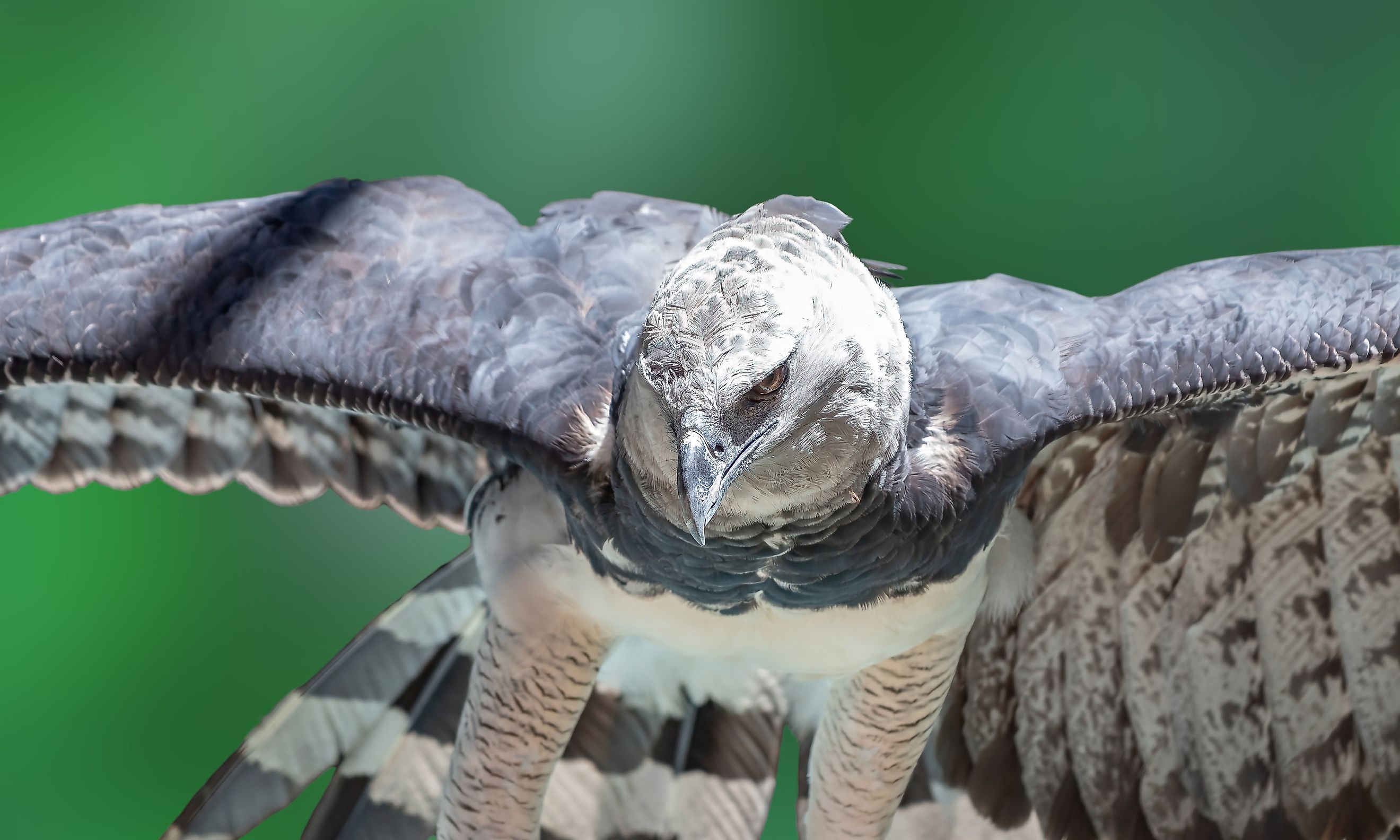
The harpy eagle is one of the largest and heaviest eagles alive, sharing the top rank with the Philippine eagle and the Steller's sea eagle. Adults measure roughly 34 to 42 inches (86 to 107 cm) in body length and carry a wingspan of about 5.7 to 7.4 feet (1.76 to 2.24 m). Compared with other giant eagles, the wings are short and broad, a design that trades soaring efficiency for tight maneuverability among the trees.
Females are far larger than males, a pattern common among raptors but especially pronounced here. A female harpy eagle typically weighs 13 to 20 pounds (6 to 9 kg), while a male weighs closer to 9 to 12 pounds (4 to 5.5 kg). That difference can approach a doubling of body mass, and it allows a mated pair to hunt prey of different sizes across the same territory.
The plumage is striking and easy to identify. Adults have slate-gray to charcoal upperparts, a pale gray head, a broad black band across the chest, and a white lower breast and belly. The legs are barred with fine black lines. A double crest of long feathers sits on the crown, which the bird can raise into a tall fan or sweep flat depending on its mood.
The most formidable feature is the feet. A harpy eagle's rear talons can exceed 5 inches (13 cm) in length, longer than the claws of a grizzly bear and the largest of any living eagle, a record noted by Guinness World Records. Its legs are as thick as a small child's wrist, and its grip can exert several hundred pounds of pressure, enough to crush the bones of monkeys and sloths and kill prey almost instantly.
Range and Habitat

The harpy eagle occupies a wide but shrinking band of the Neotropics. Historically it ranged from southern Mexico through Central America and across the Amazon basin as far south as northeastern Argentina. Today the strongest populations are in South America, particularly Brazil, Venezuela, and the Guianas, while much of the Central American portion of the range has been reduced to scattered remnants.
Its habitat is lowland tropical rainforest, especially large unbroken tracts of mature forest with tall emergent trees. The harpy depends on the canopy and understory for both hunting and nesting, and it needs a great deal of undisturbed space. A single pair may require several square miles of intact forest to support itself, which makes the species highly sensitive to fragmentation.
Panama holds a special place in the harpy's story. The bird is the national bird of Panama, and the country's Darien region shelters the largest breeding population in Central America. In many neighboring countries, including Mexico, Guatemala, Costa Rica, and El Salvador, the harpy eagle has been all but eliminated.
Diet

The harpy eagle is a canopy apex predator, and its diet reflects that role. Tree-dwelling mammals form the core of what it eats, with sloths and monkeys making up the bulk of most recorded diets. It takes both two-toed and three-toed sloths, along with a long list of primates that includes capuchin, howler, spider, squirrel, saki, and titi monkeys.
Beyond these staples, the harpy is an opportunist. It will hunt porcupines, opossums, tamanduas, armadillos, coatis, and large rodents such as agoutis. It also takes reptiles like iguanas and snakes, other birds, and even the young of larger animals such as peccaries and deer. Prey can weigh up to about 17 to 20 pounds (7.7 to 9 kg), which approaches the eagle's own body weight.
Rather than soaring and diving from a great height, the harpy hunts by stealth. It perches silently for long stretches, watches and listens for movement in the canopy, then launches a fast, short-range ambush. A harpy can reach speeds near 50 miles per hour (80 km per hour) in a chase. Because a single kill can feed the bird for several days, harpy eagles do not need to hunt every day.
Behavior

Harpy eagles are diurnal and largely solitary outside of the breeding pair. They are nonmigratory, holding an established territory year-round and hunting the same range continuously. Despite their enormous size, they can be remarkably hard to find, sitting motionless in the canopy for hours and staying quiet for much of the year.
In the dim interior of the rainforest, hearing matters as much as sight. The harpy's facial feathers can be raised into a disk shape that channels sound toward its ears, an adaptation shared with owls that helps the bird pinpoint prey it cannot always see clearly. Vocalizations become more frequent around the nest, where mates and their young communicate with wails and screams.
Territories are large and defended, and a resident pair will often return to the same nesting tree for many years. This attachment to a single home tree is a defining feature of harpy behavior, and it means that the loss of one giant tree can displace a breeding pair for a long time.
Reproduction

Few birds reproduce as slowly as the harpy eagle. Pairs are monogamous and may mate for life, and they typically raise just one chick every two to three years, one of the longest reproductive cycles of any raptor. They build a massive stick nest, often more than 4 feet (1.2 m) across, high in the crown of an emergent tree such as a kapok.
The female usually lays two eggs, but the pair rarely rears more than one chick. Once the first egg hatches, the female stops incubating the second, which then fails. The surviving chick is a form of built-in insurance rather than a second offspring. Incubation lasts about 56 days, with the female doing most of the sitting while the male brings food.
The chick hatches covered in white down and grows slowly. It fledges at roughly five to seven months of age but stays near the nest and continues to beg for food, remaining dependent on its parents for up to a year or more. Full adult plumage takes about three years to develop, and a harpy eagle does not reach breeding maturity until it is four to six years old. In the wild these birds can live 25 to 35 years.
Importance to the World

As an apex predator, the harpy eagle helps hold the rainforest food web in balance. By preying on monkeys such as capuchins, it limits the numbers of mesopredators that would otherwise raid the nests of smaller forest birds. Its presence sends ripples through the entire canopy community, a classic example of top-down ecological control.
The harpy is also treated as an indicator species. A forest healthy enough to support a breeding pair of harpy eagles, with its abundance of sloths, monkeys, and other arboreal mammals, is a forest that remains largely intact and biologically rich. For this reason conservationists often use the harpy as a flagship for protecting large blocks of Neotropical rainforest.
Culturally, the bird looms large. It is the national bird of Panama and appears in the folklore of many Indigenous peoples across its range, some of whom have historically used its feathers in ceremonial dress. Its combination of power and beauty has made it one of the most recognizable symbols of the American tropics.
Threats

The harpy eagle is listed as Vulnerable on the IUCN Red List, and its population is decreasing. The single biggest driver is deforestation. As lowland rainforest is cleared for agriculture, cattle ranching, logging, and roads, the large unbroken tracts the harpy needs are broken into pieces too small to sustain it.
Direct persecution compounds the problem. Because the birds are large and conspicuous, and because some farmers see them as a threat to livestock, harpy eagles are often shot on sight. They are also targeted for the illegal wildlife trade. These pressures fall on a species that already reproduces very slowly, so losses are hard to replace.
That slow recovery rate is what makes the harpy's decline so structural. When a pair raises at most one chick every two to three years, and when maturity takes several years, a local population knocked down by shooting or habitat loss can take decades to rebuild, if it recovers at all. Conservation work now focuses on protecting large forest reserves such as Panama's Darien, reducing shooting near ranches, and running captive breeding and release programs to restore the bird to parts of its former range.
Takeaway
The harpy eagle is a rare combination of raw power and ecological importance. It is the strongest raptor in the Americas, a canopy hunter capable of plucking a sloth from a branch and crushing bone with a single grip, and at the same time a sensitive barometer of rainforest health. Its slow, careful breeding and its need for vast stretches of undisturbed forest are exactly the traits that leave it exposed as those forests shrink. Protecting the harpy eagle means protecting the whole living system it sits atop, which is why its future is tied so closely to the future of the American rainforest itself.
Fun Facts

- Talons bigger than a bear's claws. A harpy eagle's rear talons can top 5 inches (13 cm), longer than the claws of a grizzly and the largest of any eagle on record.
- Named after a monster. Both the bird's genus and its common name come from the harpies of Greek mythology, winged spirits with a bird's body and a woman's face.
- Females outweigh males almost two to one. The larger females take big prey like sloths while the smaller, faster males chase quicker, lighter targets.
- It can carry its own weight. A harpy can lift prey roughly equal to its own body mass, snatching a full-grown sloth straight off a branch.
- A national bird with a stronghold. The harpy eagle is the national bird of Panama, whose Darien forests hold the largest breeding population in Central America.
- Owl-like hearing. Movable facial feathers form a disk that funnels sound to its ears, helping it track prey in the dark forest interior.
Quick Facts
- Scientific name: Harpia harpyja
- Family: Accipitridae (subfamily Harpiinae)
- Order: Accipitriformes
- IUCN status: Vulnerable (population decreasing)
- Length: 34 to 42 inches (86 to 107 cm)
- Wingspan: 5.7 to 7.4 feet (1.76 to 2.24 m)
- Weight: 13 to 20 pounds (6 to 9 kg) for females, 9 to 12 pounds (4 to 5.5 kg) for males
- Lifespan: 25 to 35 years in the wild
- Diet: Carnivore, mainly sloths and monkeys
- Range: Lowland tropical rainforest of Central and South America