Spectacled Caiman
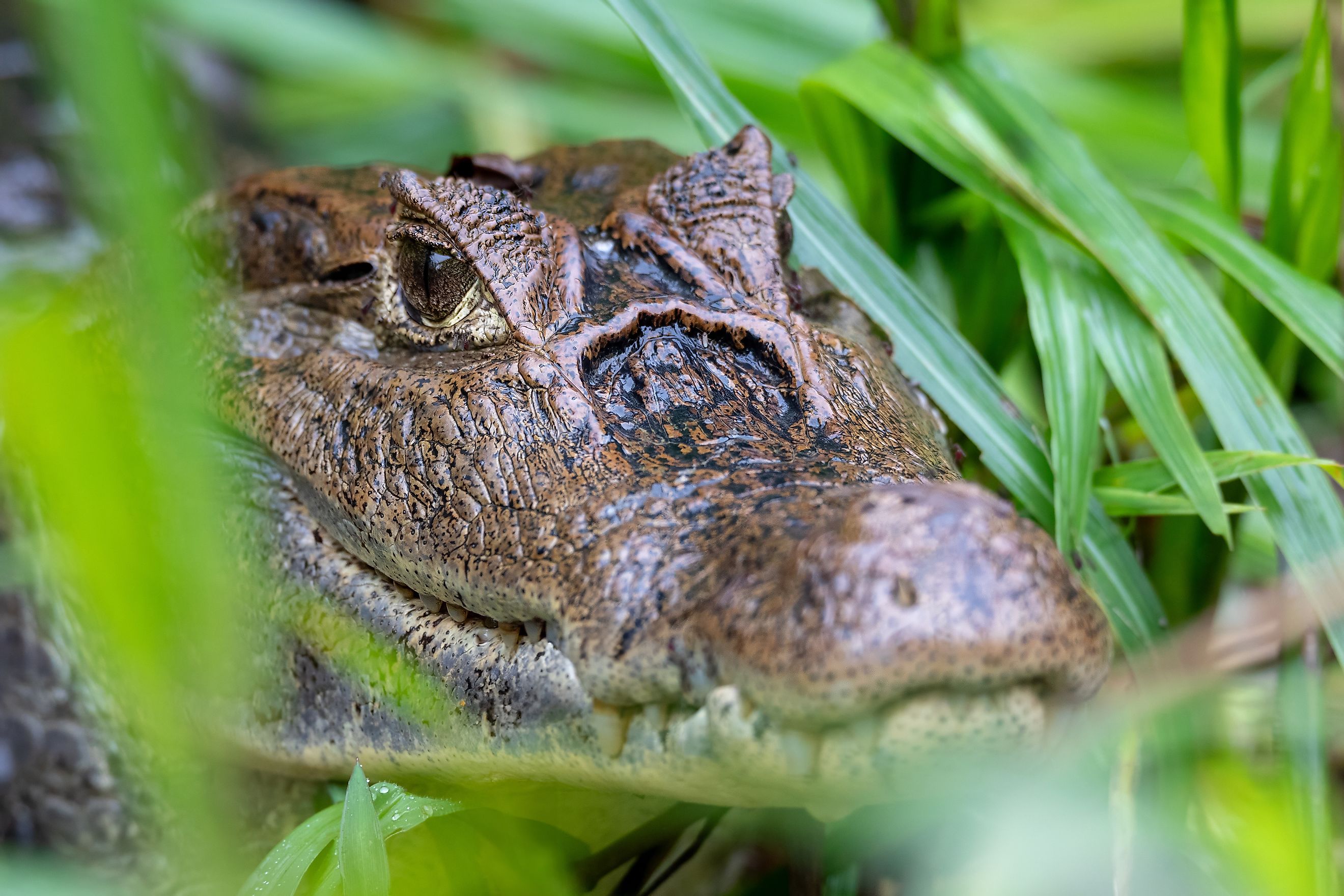
The spectacled caiman (Caiman crocodilus) is a small-to-medium crocodilian in the family Alligatoridae and the most broadly distributed member of that family. First described by Linnaeus in 1758, it occupies lowland freshwater and brackish systems throughout Central and South America and ranks among the most abundant crocodilians on Earth, with a wild population estimated at more than one million mature individuals. Its common name refers to the transverse bony ridge between the eyes, a diagnostic feature that resembles the bridge of a pair of spectacles.
Much of the species' ecological success stems from its physiological and behavioral plasticity. It tolerates fresh, brackish, and saline water, exploits both natural wetlands and human-modified waterways, and can aestivate in burrows through seasonal drought. This generalist strategy has allowed Caiman crocodilus to expand into habitats vacated by heavily hunted competitors and, where introduced beyond its native range, to establish self-sustaining populations.
Taxonomic Classification

The spectacled caiman belongs to the kingdom Animalia, phylum Chordata, class Reptilia, and order Crocodilia. Within that order, it belongs to the family Alligatoridae (alligators and caimans) and the subfamily Caimaninae, alongside relatives such as the black caiman and dwarf caimans. Its genus is Caiman and its species is Caiman crocodilus. Carl Linnaeus first described it in 1758, originally under the name Lacerta crocodilus, and it has been redescribed several times since, including as Caiman sclerops by Schneider in 1801.
The species also goes by common caiman, white caiman, and speckled caiman. Several subspecies are usually recognized, among them the brown caiman (Caiman crocodilus fuscus) of Central America and northwestern South America, and the highly restricted Apaporis River caiman (Caiman crocodilus apaporiensis) of Colombia. Caiman taxonomy is still evolving as genetic research reshapes our understanding of the group. One example is the yacare caiman (Caiman yacare), which was once considered a subspecies of the spectacled caiman but is now generally recognized as a distinct species. Notably, Caiman crocodilus has the widest distribution of any species in the entire alligator family.
Physical Description

The spectacled caiman is a small-to-medium crocodilian. Adults typically measure 4 feet 7 inches to 8 feet 2 inches (1.4 to 2.5 m), with males both longer and heavier than females. Females often top out near 4 feet 7 inches (1.4 m), while large males reach 6 feet 7 inches to 8 feet 2 inches (2.0 to 2.5 m). The largest reliably reported individual measured about 8 feet 8 inches (2.64 m). Most adults weigh 15 to 88 pounds (7 to 40 kg), though exceptionally large males in the Venezuelan Llanos have been recorded at up to 128 pounds (58 kg).
Its upperside is brownish, greenish, or yellowish-gray, marked with dark crossbands, and its underside is paler. The eyes have a greenish iris and wrinkled lids. Like other alligatorids, it has a broad, U-shaped snout and an overlapping upper jaw, and its back is armored with bony plates called osteoderms. The defining feature is the ridge of bone that runs between the eyes, the "spectacles" of its name. A curious feature of its skin can make the animal appear to change color. In colder conditions, black pigment spreads through its skin cells, causing it to become noticeably darker.
Range and Habitat

The spectacled caiman is native to a broad swath of Latin America, occurring in Brazil, Colombia, Costa Rica, Ecuador, El Salvador, French Guiana, Guatemala, Guyana, Honduras, Mexico, Nicaragua, Panama, Peru, Suriname, Trinidad and Tobago, and Venezuela. Introduced populations, many of them descended from released or escaped pets, have established themselves in the United States (notably southern Florida and Puerto Rico) and in Cuba.
It occupies virtually every kind of lowland wetland and riverine habitat within its range, including the rivers of the Amazon Basin, the marshes and flooded savannas of the Orinoco, and the wetlands of the Pantanal. It prefers still or slow-moving water and readily colonizes man-made canals, ponds, and reservoirs. Unusually for a caiman, it tolerates brackish and even salt water, an ability that helped it reach and hold offshore islands. When conditions turn harsh and pools dry up, the spectacled caiman can dig a burrow and aestivate, staying dormant until the rains return.
Diet

The spectacled caiman is a carnivore and an opportunist, and its diet shifts with age, season, and what is available. Hatchlings and juveniles mainly feed on aquatic invertebrates such as insects, crustaceans, and mollusks. As they grow, fish and water snails become staples, along with amphibians, crabs, other reptiles, and water birds. The largest adults can take mammalian prey, including wild pigs and deer. During dry spells, when prey grows scarce and animals crowd together, cannibalism can occur, with larger caimans eating smaller ones.
It hunts mostly at night, lying motionless with only its eyes and nostrils above the surface before striking with a quick lunge. Highly sensitive pressure receptors on its face let it detect the ripples of moving prey even in murky water. Its role in the food web can be surprisingly important. In areas where spectacled caiman populations have declined, fish numbers have sometimes fallen as well, highlighting how closely this predator is connected to the health of its wetland ecosystem.
Behavior

Spectacled caimans are mainly nocturnal and largely solitary, though they gather in loose groups and share small, stable home ranges throughout the year. A typical day follows the sun. They bask along the shore during the morning and early afternoon, retreat underwater during the hottest hours, then become active again after dark to hunt. Despite their stillness, they can react in an instant when prey comes within reach.
Communication is more elaborate than the animal's placid daytime posture suggests. Spectacled caimans use a range of vocalizations and visual displays to coordinate with one another, and both adults and young call to keep the group together. Social rank is largely determined by size, with the largest animals taking the dominant positions. This hierarchy has real consequences, as smaller, lower-ranking individuals may grow more slowly under social stress and have fewer opportunities to breed. During the mating season, males in particular turn territorial and aggressive.
Reproduction

Spectacled caimans reach sexual maturity at roughly 4 to 7 years old, when females are about 3 feet 11 inches (1.2 m) and males about 4 feet 7 inches (1.4 m). They are polygynous, with males attempting to mate with several females. Courtship runs between about May and August and involves swimming together, circling, touching snouts, rubbing backs, blowing bubbles, and vocalizing. The exact timing tracks the local climate, so it varies across the species' vast range.
The female builds a mound nest of soil, leaf litter, and other vegetation, which can be about 3 feet (1 m) high and 6 feet (2 m) across, and lays a clutch that ranges from roughly 10 to 40 eggs, averaging around 22. Incubation lasts 65 to 104 days, and the heat of the decomposing nest helps hold temperatures steady. As in many crocodilians, sex is set by temperature partway through incubation rather than at fertilization. When the eggs hatch, the parents may dig the young out and carry them to water, and juveniles stay near the adults for protection for around a year and a half. Lifespans are not well documented, but wild animals may live 30 to 40 years or more, with the oldest estimated near 60.
Importance to the World

Ecologically, the spectacled caiman functions as a keystone predator across much of its range. By controlling populations of fish and other prey, it helps keep wetland food webs in balance, and its own eggs and young feed a long list of predators, including birds, large fish, anacondas, and jaguars. Its digging, nesting, and movement can help maintain the pools and channels that shelter fish and other wildlife during droughts, and as a scavenger, it recycles nutrients back into the water and soil. It shares these wetlands with animals such as the capybara, part of a densely connected community.
Economically, the species is the most heavily harvested caiman for its hide, which is turned into handbags, shoes, belts, and wallets. That demand has driven both illegal hunting and, in several countries, well-developed sustainable-use and ranching programs designed to keep harvests from depleting wild stocks. The spectacled caiman is also a fixture of the exotic pet trade, where young animals are sometimes sold, misleadingly, as baby alligators.
Threats

The spectacled caiman is listed as Least Concern on the IUCN Red List (assessed in 2016, published in 2019), with a wild population estimated at more than one million mature individuals and an overall stable trend. It is listed on CITES Appendix II, while the restricted Apaporis River subspecies is on the stricter Appendix I. Despite its relatively secure global status, it faces serious regional pressures from illegal hunting for skins, habitat destruction, and pollution, including heavy metal contamination. Some populations have declined sharply, with the species severely depleted in El Salvador and the Apaporis River subspecies restricted to a small area of Colombia.
Part of the species' success comes at others' expense. It has expanded into habitat left open by the overhunting of larger competitors such as the black caiman and the American crocodile. Where it has been introduced, that same adaptability can become a problem for native wildlife. Feral spectacled caimans are believed to have contributed to the disappearance of the Cuban crocodile from Cuba's Isle of Youth. Its long-term future will likely depend on continued habitat protection and on keeping sustainable-use programs genuinely sustainable.
Takeaway
Few reptiles illustrate the payoff of adaptability as clearly as the spectacled caiman. Small compared with other crocodilians and easily overlooked beside the giant black caiman or American alligator, it has nevertheless become the most widespread and abundant crocodilian in the Americas. Its success comes from tolerating conditions that limit other species, including salt water, drought, degraded habitat, and the ecological changes that follow heavy hunting of larger crocodilians. That resilience keeps its overall numbers secure even as particular populations and subspecies remain at risk, and it makes the spectacled caiman both a conservation success story and a reminder of how quickly an adaptable predator can reshape the places it reaches.
Fun Facts

- It wears its glasses on the outside. The bony ridge between its eyes, which gives the species its name, looks like the bridge of a pair of spectacles.
- It can seem to change color. In cold conditions, black pigment inside its skin cells expands, darkening the whole animal.
- Salt water is no obstacle. Unusually tolerant of brackish and salt water for a caiman, it has been able to reach and settle on Caribbean islands.
- It can wait out a drought underground. When wetlands dry up, it digs a burrow and aestivates until the rains return.
- Temperature, not chromosomes, decides sex. Whether hatchlings develop as male or female depends on the nest temperature during incubation.
- Those "baby alligators" may be caimans. Young spectacled caimans have long been sold in the pet trade under the wrong name.
Quick Facts
- Scientific name: Caiman crocodilus
- Family / Order: Alligatoridae / Crocodilia
- IUCN status: Least Concern (stable; assessed 2016)
- Length: 4 ft 7 in to 8 ft 2 in (1.4 to 2.5 m)
- Weight: 15 to 88 lb (7 to 40 kg); up to 128 lb (58 kg)
- Lifespan: Around 30 to 40 years in the wild (up to ~60)
- Diet: Carnivore (fish, snails, crustaceans, amphibians, birds, mammals)
- Range: Central and South America; introduced to Florida, Puerto Rico, and Cuba