Cuban Crocodile
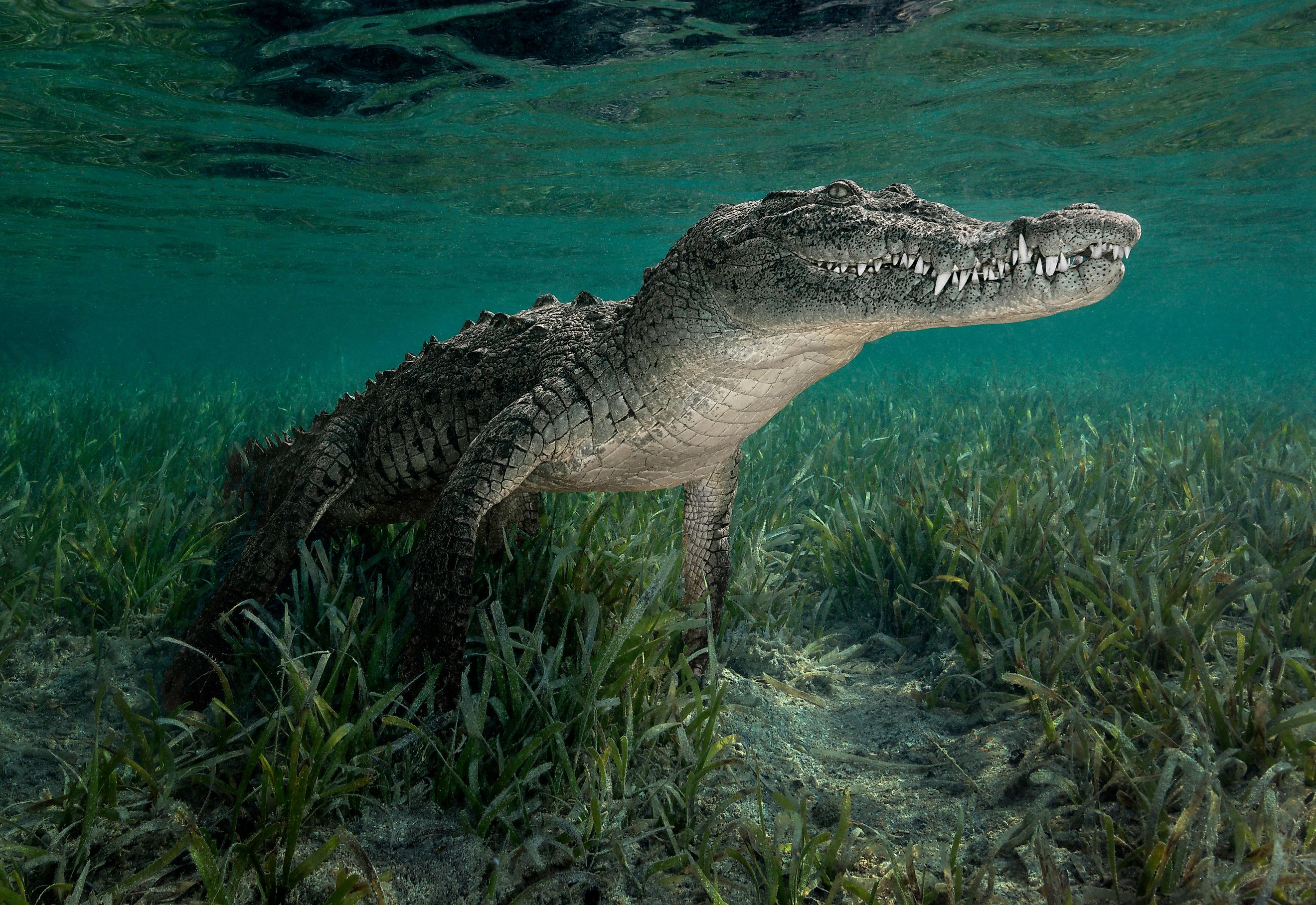
The Cuban crocodile "only" grows to about 10 ft (3 m), but would score much better on an IQ test than larger crocs. It is one of the most intelligent species, not just of crocodiles, but of all the reptiles. It's also the most terrestrial of all the crocs, and can "gallop" incredibly quickly on the land. Now, it lives only in Cuba, though once it could be found across the Carribean. And it is also critically endangered.
Taxonomic Classification

The species was formally described in 1807 by the French naturalist Georges Cuvier. Its scientific name, Crocodylus rhombifer, roughly means “rhombus-bearing crocodile,” referring to the dark, diamond-shaped markings visible across parts of its body. The Cuban crocodile is a member of Crocodylus, the genus commonly described as containing the “true crocodiles.” It would be inaccurate, however, to call it an immediate descendant of the first true crocodile. Modern evolutionary studies instead indicate that the living members of Crocodylus diversified much more recently.
Once crocodiles reached the Americas and Caribbean, populations became geographically separated and developed distinct traits. The Cuban crocodile’s unusual body proportions and behavior probably arose as the species adapted to island wetlands and a comparatively terrestrial way of life. Fossil and historical evidence indicates that Cuban crocodiles or closely related populations once occurred more widely in the Caribbean, including parts of the Bahamas and Cayman Islands. Today, the species survives naturally only in Cuba.
Physical Description

Adult Cuban crocodiles commonly reach lengths of approximately 10.5 feet (3.2 meters), although some historical individuals reportedly grew larger. Males are generally longer and heavier than females. The Cuban crocodile has a relatively short, broad head and a prominent bony ridge behind each eye. Adults usually have a dark olive, greenish-black, or nearly black upper body patterned with yellow or cream-colored spots. Some of these markings create a diamond-like appearance. The underside is much paler, while the tail often carries contrasting dark bands.
Cuban crocodiles are heavily armored. Bony deposits called osteoderms are embedded beneath the scales of the back and neck. These structures protect the animal and may also play a role in heat exchange and temperature regulation. Large, strongly keeled scales occur along the legs, adding to the crocodile’s rugged appearance. Its limbs are especially distinctive. Compared with many aquatic crocodilians, the Cuban crocodile has relatively long, muscular legs and reduced webbing between its toes. These features allow it to hold its body high above the ground and travel efficiently across firm land. It can walk, run, leap, and use asymmetrical gaits often described as bounding or galloping.
The Cuban crocodile is sometimes called the only galloping crocodile, but that description is misleading. Researchers have documented bounding or galloping movements in several crocodilian species. Newly hatched Cuban crocodiles are usually golden or yellowish with dark spots and bands. Their bodies gradually become darker as they mature. Individuals kept under human care may live for approximately 50 to 75 years, although the lifespan of most wild crocodiles is difficult to measure precisely.
Behavior

Cuban crocodiles are active, observant animals with a reputation for being more assertive than many other crocodilians. Individuals establish dominance relationships, particularly when several crocodiles occupy the same enclosure or feeding area. Displays involving posture, movement, vocalization, and physical contact help determine access to food, nesting sites, and mates.
Their behavior also demonstrates a substantial capacity for learning. Crocodilians can distinguish between people, become accustomed to routines, associate particular signals with food, and respond to training. Cuban crocodiles under professional care have learned to move to designated areas, remain still for examinations, and respond to behavioral cues. Though intelligence is difficult to accurately gauge, the Cuban crocodile appears to be behaviorally flexible and capable of solving problems, remembering routines, and exploring unfamiliar objects. Researchers have recorded Cuban crocodiles pushing, carrying, biting, and otherwise manipulating balls and other objects. One observation involved a smaller crocodile riding on the back of a larger individual without an obvious feeding or reproductive purpose. These behaviors have been proposed as examples of object play and social play.
Biting a ball could be exploratory or predatory behavior, and climbing onto another crocodile could have a social explanation unrelated to play. Even so, the collected observations support the broader conclusion that crocodilian behavior is more varied than was once assumed. Cuban crocodiles communicate through movements, visual displays, water vibrations, and sounds. Hatchlings call from inside their eggs shortly before hatching, which may help synchronize the emergence of the clutch and alert the mother. Adults can produce bellows and other low-frequency sounds, particularly during courtship and territorial encounters.
Feeding

Cuban crocodiles are carnivorous, but their diet changes as they grow. Hatchlings and juveniles eat insects, crustaceans, aquatic invertebrates, frogs, and small fish. As the crocodiles increase in size, they begin taking larger fish, water birds, and small mammals. Adults possess broad rear teeth that are well suited to crushing hard objects, including turtle shells. Turtles may therefore form a more important part of their diet than they do for crocodilians with narrower jaws and more slender teeth. Cuban crocodiles will nevertheless consume a variety of prey whenever an opportunity arises.
Like other crocodilians, Cuban crocodiles frequently hunt by ambush. An individual may remain almost entirely submerged, leaving only its eyes and nostrils above the surface. When a fish, bird, or mammal comes within range, the crocodile propels itself forward with a rapid movement of its tail and jaws.
Its powerful legs give it additional hunting options. Cuban crocodiles can lunge upward from the water and may capture birds or small mammals positioned on low vegetation. However, they should not be portrayed as regularly jumping from the ground into trees. Most attacks on arboreal prey probably begin from the water or shoreline and target animals resting on low branches. Cuban crocodiles may also cooperate or tolerate one another around concentrated food sources. There have been reports of coordinated hunting, but evidence for regular, organized group hunting remains limited.
Range And Habitat

No other living crocodile has a smaller natural range. Wild Cuban crocodiles are concentrated primarily in the Zapata Swamp on Cuba’s main island. A second population occurs in the Lanier Swamp on the Isle of Youth, where conservation programs have helped reestablish the species. The Zapata Swamp is one of the Caribbean’s largest and best-preserved wetland systems. It contains freshwater marshes, seasonally flooded grasslands, swamps, mangroves, forested areas, and networks of natural and artificial waterways.
Cuban crocodiles generally favor freshwater or mildly brackish environments. They may enter saltier water, but they are less strongly associated with coastal and marine habitats than American crocodiles. They can spend significant periods traveling or resting on land, especially in places where pools, channels, grassy marshes, and solid ground occur close together. Historically, the species had a wider Caribbean distribution. Fossil evidence and historical reports associate it with the Bahamas and Cayman Islands as well as Cuba. Its modern restriction to two small wetland areas makes it particularly vulnerable.
Reproduction

Wild Cuban crocodiles generally breed during a period beginning around May and lasting approximately three to four months. The exact timing can vary with water levels, temperature, and local environmental conditions. Captive populations may breed at different times because their lighting, feeding schedules, and water conditions differ from those in the wild. Females can construct either mound nests or hole-like nests, depending on local conditions.
A typical clutch contains approximately 30 to 40 eggs, although larger clutches have been documented. The eggs are generally around 2.5 inches (6 centimeters) long. Incubation usually lasts between eight and ten weeks, with temperature and nest conditions influencing the exact period. As in other crocodilians, the sex of Cuban crocodile hatchlings is determined by incubation temperature rather than sex chromosomes of the kind found in humans.
The female may guard the nest and respond to calls from the hatchlings. After the young emerge, she may carry them in her mouth or remain close to them during their most vulnerable period. Even with maternal protection, mortality is high. Eggs and hatchlings may be eaten by any range of predatory animals. Cannibalism is natural in crocodilian populations, although it can become a serious problem where breeding habitat is restricted or crocodiles are concentrated into small areas.
Importance To The World
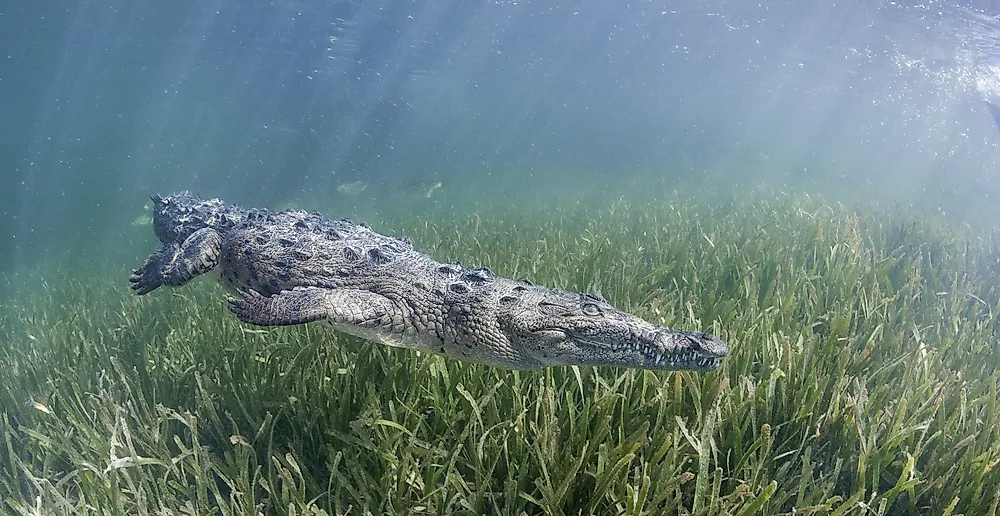
As a top wetland predator, the Cuban crocodile helps shape the ecological community in which it lives. It consumes fish, turtles, birds, mammals, and other animals, while its eggs and young provide food for smaller predators. Crocodilians can also function as indicators of wetland health. A population needs suitable nesting ground, adequate prey, dependable water conditions, and enough space for adults and young. A decline in crocodile numbers may therefore signal broader changes in water quality, habitat structure, or prey populations.
The Cuban crocodile is also important because it represents a unique evolutionary lineage. If the species disappeared or lost its genetic identity through widespread hybridization, those characteristics could not simply be replaced by another crocodile.
Threats

The Cuban crocodile is classified as Critically Endangered on the IUCN Red List and is included in Appendix I of the Convention on International Trade in Endangered Species of Wild Fauna and Flora. Appendix I generally provides the strictest level of regulation for international commercial trade in listed wildlife. Historically, hunting was one of the greatest causes of decline. Cuban crocodiles were killed for their hides, meat, and other products. Although they are now legally protected, illegal killing and wildlife trafficking remain concerns.
Habitat change is another major threat. Rising sea levels and saltwater intrusion may gradually change freshwater areas, while extreme storms can damage nests and alter water systems. Because the crocodile’s distribution is so limited, it has few alternative habitats into which it can expand. Hybridization with the American crocodile is one of the species’ most complicated conservation problems. The two species can interbreed where their ranges overlap. A genetic study found evidence of hybrid ancestry in 49.1% of the sampled wild crocodiles and 16.1% of the sampled captive crocodiles.
Future Goals For Cuban Crocodiles
Long-term recovery will require more than producing crocodiles in captivity. Conservation programs must preserve freshwater marshes, limit illegal hunting, and manage introduced predators, while also monitoring hybridization, maintaining genetically suitable breeding groups, and ensuring that released crocodiles have protected habitat in which to survive. Cooperation among Cuban conservationists, local communities, researchers, and international zoological institutions remains essential to preserve this unique genetic variation of the crocodile.