The World’s Largest Eagles
The largest wingspan ever verified on a living eagle did not belong to a bald eagle or a harpy. It belonged to a wedge-tailed eagle from Australia, measured at 2.84 meters (9 feet 4 inches), a bird wide enough to shade a compact car. Eagles hunt on every continent except Antarctica, and the biggest of them are measured three ways: by wingspan, by weight, and by sheer force. This ranking runs the ten widest, counted down by maximum recorded wingspan, then turns to the heavyweights, where a fish-eating giant from coastal Asia takes the crown.
The World's Largest Eagles By Wingspan
10. Steppe Eagle - 2.1 m (6 ft 11 in)

The steppe eagle (Aquila nipalensis) is a bird built for country with no trees to speak of. A member of the "booted" eagles, with legs feathered to the toes, it nests directly on the ground or on low outcrops across the grasslands of Central Asia, and its fortunes rise and fall with one animal above all: the ground squirrel, which anchors its diet.
Twice a year, steppe eagles stage one of the great raptor migrations, funneling in the thousands over the Middle East, the Red Sea, and the Himalayas. The spectacle hides a crisis. Steppe fires, nest failures, persecution, and electrocution on power lines have cut the population by more than half, and the IUCN now lists the species as Endangered.
9. Eastern Imperial Eagle - 2.1 m (6 ft 11 in)

The Eastern imperial eagle (Aquila heliaca), described in 1809, breeds across a huge sweep of Eurasian steppe, with the bulk of the population in Russia and Kazakhstan and a closely watched European stronghold in the Carpathian Basin, centered on Hungary and Slovakia. Females run noticeably bulkier than males, and pairs favor lone trees in open grassland where they can see trouble coming.
The menu is dominated by susliks, the local ground squirrels, along with hamsters and other small mammals. Nearly driven out of Europe by the 1970s, the imperial eagle has been pulled back through decades of protection under the EU Birds Directive and CITES, though the IUCN still classes it as Vulnerable. Young birds wander widely; adults increasingly skip migration altogether when winters allow.
8. Philippine Eagle - 2.2 m (7 ft 3 in)

The Philippine eagle (Pithecophaga jefferyi) is the longest eagle in the world, at up to 102 centimeters (3 feet 4 inches) head to tail, and by wing surface area the largest of all. Once called the monkey-eating eagle, it turned out to be less picky than advertised, taking flying lemurs, civets, snakes, and hornbills across the dipterocarp forests of Luzon, Samar, Leyte, and Mindanao, the only four islands where it survives.
Deforestation has reduced the wild population to a few hundred breeding pairs, placing it among the most endangered raptors on Earth, listed as Critically Endangered by the IUCN. The Philippines has responded by putting the bird on its 1,000-peso banknote and its statute books: killing one carries penalties of up to 12 years in prison. Few national symbols come with harder legal teeth.
7. Harpy Eagle - 2.24 m (7 ft 4 in)

The harpy eagle (Harpia harpyja), named by Carl Linnaeus in 1758 for the storm spirits of Greek myth, is the raptor other raptors would cross the street to avoid. Its rear talons reach about 13 centimeters (5 inches), longer than the claws of a grizzly bear, and it uses them to pluck monkeys and sloths straight out of the rainforest canopy anywhere between southern Mexico and northern Argentina.
Females weigh 6 to 9 kilograms (13 to 20 pounds), roughly twice the male, and the wings, at up to 224 centimeters, are actually short and broad for a bird this size, a design tuned for slaloming through dense forest rather than soaring over it. Logging has made the harpy rare across much of Central America, and the IUCN lists it as Vulnerable.
6. Bald Eagle - 2.3 m (7 ft 7 in)

The bald eagle (Haliaeetus leucocephalus) is not bald; the name comes from an old English word for "white-headed." What it is, is a builder. Bald eagles construct the largest nests of any North American bird, reusing and enlarging them year after year, and the all-time record, built in Florida, weighed roughly two tons, about as much as a pickup truck parked in a tree.
Ranging across Canada, the contiguous United States, and northern Mexico, this fish-first opportunist came within reach of extinction in the DDT era, then staged one of conservation's most famous comebacks, leaving the endangered species list in 2007. Its wingspan tops out around 2.3 meters, which means the national symbol of the United States does not crack the top five.
5. Golden Eagle - 2.34 m (7 ft 8 in)

The golden eagle (Aquila chrysaetos) is the most widely distributed eagle on Earth, hunting across the entire Northern Hemisphere, and it may be the most formidable athlete on this list. In a hunting stoop it can pass 240 kilometers per hour (150 mph), putting it among the fastest animals alive, and it uses that speed to hit rabbits, marmots, and ground birds with force few predators can match.
Golden eagles pair for life, defend enormous home ranges, and nest on cliffs where they can survey all of it. Pushed out of heavily settled regions over the centuries, they remain a fixture of the remote mountains and open country of Eurasia and North America, dark brown at a distance and gold-naped up close.
4. White-Tailed Eagle - 2.45 m (8 ft)

The white-tailed eagle (Haliaeetus albicilla) is the bald eagle's Old World counterpart, an apex fish-and-waterfowl hunter of coasts and big lakes across temperate Eurasia, with a wingspan reaching 2.45 meters. It needs the same things everywhere: open water, big old trees or cliffs to nest in, and to be left alone.
For a long time it got none of the three. Persecution and pesticide poisoning erased the species across swaths of Europe, but decades of protection and reintroduction have brought it back to old haunts, including Britain, where it now breeds again after a century's absence. Part hunter and part unapologetic scavenger, it fills the same niche its American cousin holds across the Atlantic.
3. Steller's Sea Eagle - 2.5 m (8 ft 2 in)

Steller's sea eagle (Haliaeetus pelagicus) looks engineered for drama: near-black plumage, blazing white shoulders and tail, and an enormous hooked beak in traffic-cone yellow. It breeds only along the coasts of the Russian Far East, with the population concentrated around the Kamchatka Peninsula, and winters south to Japan and Korea, where crowds gather on Hokkaido's ice floes to watch it fish.
With a wingspan up to 2.5 meters and weights reaching about 9 kilograms (20 pounds), this is the heaviest eagle in the world, out-massing both the harpy and the Philippine eagle. The IUCN lists it as Vulnerable; with only a few thousand birds in a narrow coastal range, every salmon run matters.
2. Martial Eagle - 2.6 m (8 ft 6 in)

The martial eagle (Polemaetus bellicosus) is Africa's largest eagle and its most ambitious hunter. Cruising high over the savanna woodlands of sub-Saharan Africa on a wingspan of up to 2.6 meters, it attacks in a long, shallow dive that can end badly for monitor lizards, monkeys, jackals, and even small antelope, prey that can outweigh the eagle itself.
That appetite is also its problem. Farmers and game managers have long persecuted the martial eagle over livestock and gamebird losses, and combined with shrinking habitat, the decline has been steep enough that the IUCN uplisted the species to Endangered in 2020. Africa's mightiest eagle is now one of its most threatened.
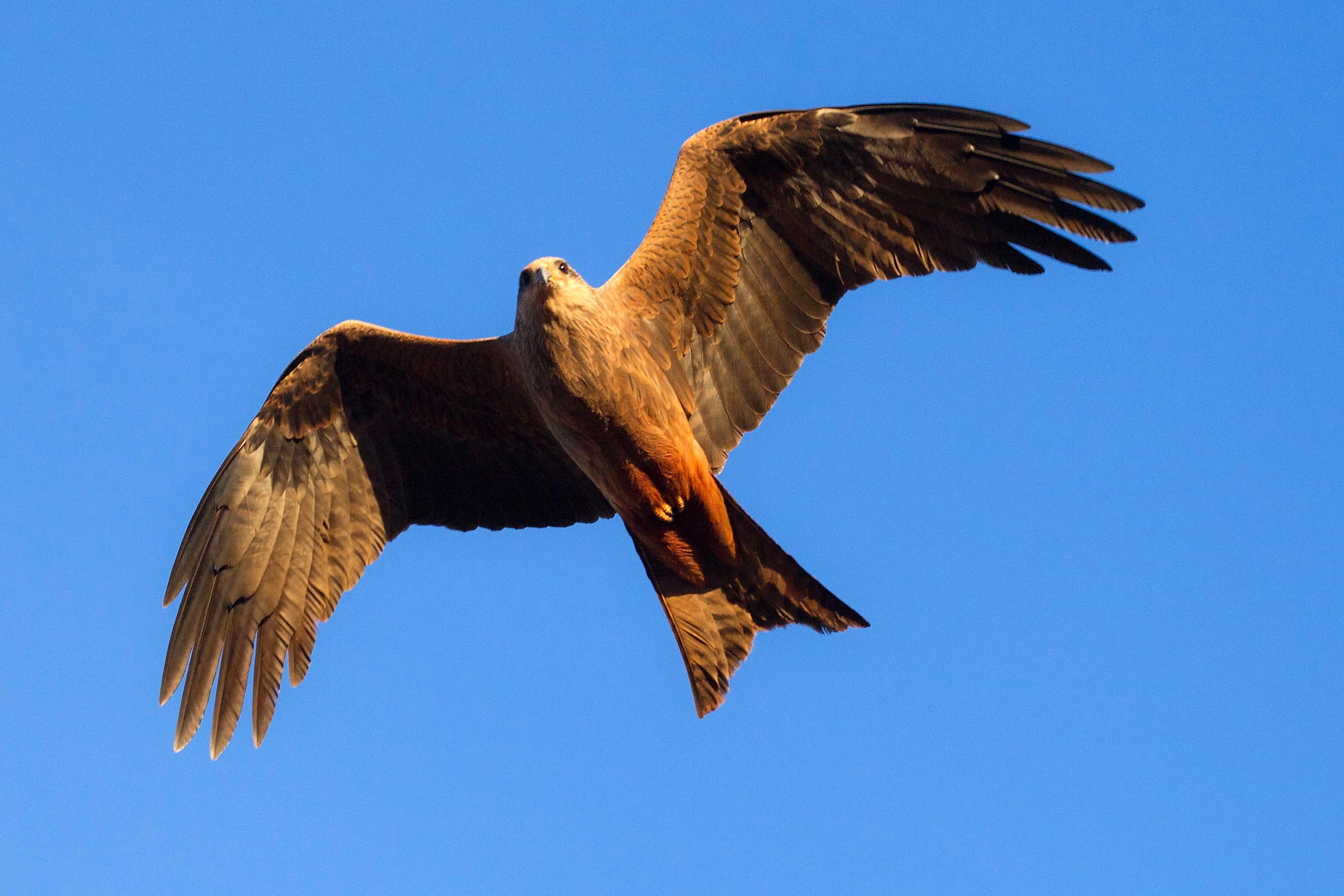
1. Wedge-Tailed Eagle - 2.84 m (9 ft 4 in)

The wedge-tailed eagle (Aquila audax), Australia's largest bird of prey, holds the record that heads this list: a verified wingspan of 2.84 meters, the widest ever measured on any eagle. Known locally as the eaglehawk and recognizable by the long diamond-shaped tail, it thrives everywhere on the continent, in rainforest, desert, and mountains alike, plus southern New Guinea, hunting rabbits and marsupials and cleaning up roadkill, which modern highways supply in quantity.
Once shot in large numbers over exaggerated claims of lamb-killing, the wedge-tail has rebounded and reasserted its opinion of the airspace: Australian surveyors have lost drones to wedge-tailed eagles that treat the machines as intruders and hit them mid-flight. Its closest relatives are Verreaux's and Gurney's eagles, in a lineage that also includes the golden eagle, which makes the family portrait an intimidating one.
The World's Largest Eagles By Weight
Rank eagles by mass instead of wingspan and the podium reshuffles. The martial eagle, for all its reach, weighs a relatively lean 3 to 6.2 kilograms (6.6 to 13.6 pounds), and the white-tailed eagle comes in at 3.1 to 6.9 kilograms (6.8 to 15.2 pounds). The wide-winged wedge-tail, built for soaring rather than bulk, drops out of the medals entirely.
The heavy classes belong to the forest ambushers and the fish specialists. The Philippine eagle weighs 4.5 to 8 kilograms (10 to 18 pounds), and the female harpy reaches about 9 kilograms (20 pounds), double her mate, with the muscle to haul a sloth off a branch. Heaviest of all is Steller's sea eagle, at up to 9 kilograms and occasionally beyond, a bird so front-loaded with beak and breast muscle that it looks overbuilt even standing still.
Wingspan buys range, and weight buys power. The eagles at the top of each list made different bets, and every one of them is winning somewhere.