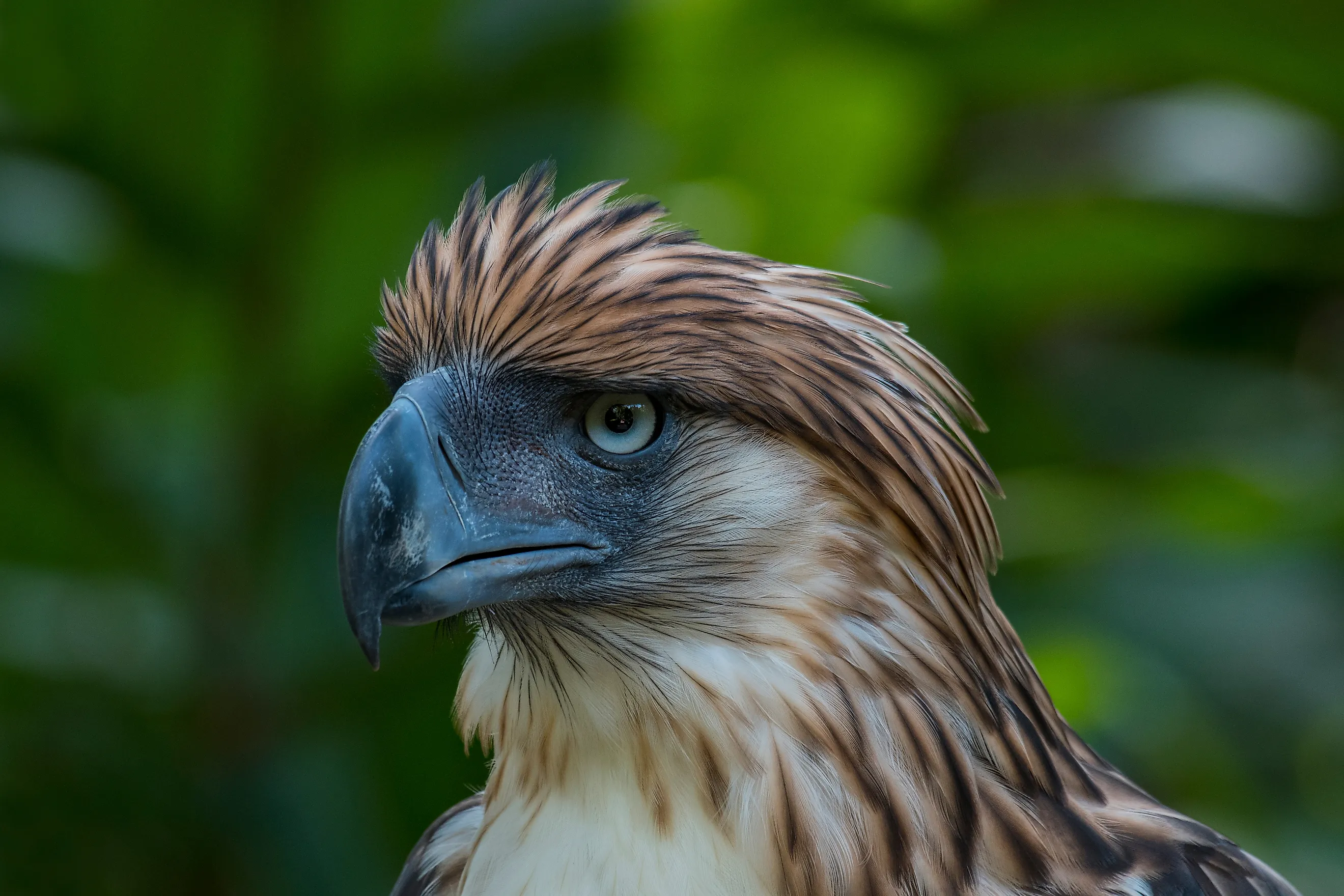
Philippine Eagle
The Philippine eagle stands as the largest eagle in the world by length and wing surface area, a raptor so powerful that local legend once cast it as a bird big enough to carry off a child. Known to science as Pithecophaga jefferyi, it rules the canopy of a handful of rainforested islands and nowhere else on Earth. This is a bird built for ambush, with a wingspan that can stretch beyond seven feet and talons strong enough to seize monkeys, flying lemurs, and other sizable prey from the treetops.
Found only in the Philippines, the eagle has become the national bird and a living emblem of the country's vanishing forests. Fewer than a few hundred breeding pairs remain in the wild, which makes every sighting a rare event and every nest a conservation priority. Its story is one of raw predatory strength set against a backdrop of shrinking habitat, and that tension is exactly what makes it worth understanding.
Taxonomic Classification

The Philippine eagle belongs to the family Accipitridae, the broad group that contains hawks, kites, and most eagles, within the order Accipitriformes. Its genus, Pithecophaga, comes from Greek words meaning "monkey eater," a nod to the diet that earned the bird its older common name. The species Pithecophaga jefferyi was formally described in 1896 by the British ornithologist William Robert Ogilvie-Grant, who named it after Jeffery Whitehead, the father of the naturalist who collected the first specimen.
The eagle has no close living relatives. Genetic work places it nearest to the snake eagles of Africa and Asia rather than to the large forest eagles it superficially resembles, such as the harpy eagle of Central and South America. That similarity in build and hunting style is a case of convergent evolution, two unrelated birds shaped by the same job of hunting mammals in dense forest. No subspecies are recognized, so every Philippine eagle alive belongs to a single, genetically isolated population.
Physical Description

Size is the first thing that sets this eagle apart. Adults measure roughly 34 to 40 inches (86 to 102 cm) crown to tail, and the wingspan commonly spans 6 to 7.2 feet (184 to 220 cm). Females run noticeably larger than males and can weigh up to about 17.6 pounds (8 kg), while males typically stay lighter at around 10 to 11 pounds (4.5 to 5 kg). By length and wing area, no living eagle is bigger, though the Steller's sea eagle and the harpy eagle both outweigh it.
The bird's most striking feature is its crest, a shaggy mane of brown and cream feathers that flares up behind the head and gives the face a fierce, lion-like frame when raised. The upperparts are dark brown, the underparts pale cream, and the face is darker, lending the eye a piercing look. That eye is a pale blue-gray, unusual among eagles, and backed by sharp vision suited to spotting prey through forest cover.
The beak is enormous, a deep, high-arched hook of blue-gray that rivals the Steller's sea eagle as the largest bill of any living eagle. The legs are long and yellow, tipped with dark talons thick enough to crush bone. The tarsus, the lower leg bone, ranks among the longest of any eagle, an adaptation that helps the bird reach into vegetation and grip large, struggling animals.
Range and Habitat

The Philippine eagle lives only in the Philippines, on four major islands. These are Luzon in the north, then Samar, Leyte, and Mindanao toward the south. Mindanao holds the great majority of the remaining birds, with far smaller numbers scattered across the other three. The eagle is found nowhere else in the world, which makes the country wholly responsible for the species' survival.
Its home is tropical moist forest, mostly primary dipterocarp rainforest on steep mountain slopes. Birds have been recorded from the lowlands up to elevations near 6,000 feet (1,800 m), though they favor forested terrain with tall, mature trees for nesting and hunting. Each breeding pair needs an enormous range, often between 10,000 and 27,000 acres (4,000 to 11,000 hectares) of forest to supply enough prey. That demand for large, unbroken woodland is a key reason the bird struggles as its forests are cleared and carved into fragments.
Diet

As the top predator of its forests, the Philippine eagle hunts a wide range of animals. Its older name, monkey-eating eagle, came from reports of it taking long-tailed macaques, but monkeys make up only part of its menu. Flying lemurs, also called colugos, are a favorite across much of its range, along with flying squirrels, giant cloud rats, fruit bats, and palm civets. The eagle will also take snakes, monitor lizards, hornbills, owls, and other birds, and it has been known to seize young pigs and small deer.
The bird hunts mostly by perching quietly in the canopy and watching, then dropping onto prey in a fast, short strike. Pairs sometimes hunt together, with one bird distracting a group of monkeys while the other attacks from behind. Prey can be heavy, and the eagle's strength lets it carry sizable animals back to a perch or nest. By keeping populations of rats, monkeys, and other mammals in check, the eagle shapes the balance of the whole forest community.
Behavior

Philippine eagles are active by day and spend much of their time perched high in the canopy, scanning for movement. They are powerful, agile fliers despite their size, able to maneuver through gaps in the trees rather than soaring in the open the way many eagles do. Each pair defends a large territory and tends to stay within it year-round, since the species does not migrate.
For such a large and fearsome bird, its voice is surprisingly thin, a series of high, drawn-out whistles that carry through the forest. These calls help mates keep contact across their wide territory and warn off intruders. Outside of the bond between a mated pair, the eagles are solitary, and a young bird will spend its early years alone before finding a mate and a territory of its own.
Reproduction

The Philippine eagle mates for life. A pair bonds through aerial displays and shared nest-building, then returns to the same nesting area year after year. Nests are vast platforms of sticks, often built high in a large emergent tree where the surrounding canopy gives cover and a clear flight path.
The female usually lays a single egg, and both parents share incubation over roughly two months. After hatching, the chick depends on its parents for a long stretch, fledging at around four to five months but staying close and being fed for more than a year. Because raising one chick takes so long, a pair breeds only once every two years. Birds reach breeding age slowly, with females mature around five years and males around seven. This slow pace of reproduction means the population recovers only gradually, which deepens the danger when adults are lost. In captivity the eagle is long-lived, and birds at the Philippine Eagle Center in Davao City have lived more than 40 years.
Importance to the World

As an apex predator, the Philippine eagle sits at the top of its food web and helps regulate the animals below it. By preying on rodents, monkeys, and other mammals, it keeps those populations from growing unchecked, which in turn protects the trees and plants those animals feed on. A healthy eagle population is a sign of a healthy, intact forest, so the bird serves as a barometer for the condition of the rainforest as a whole.
The eagle also functions as what conservationists call an umbrella species. Because a single pair needs thousands of acres of unbroken forest, safeguarding enough habitat for the eagle automatically shelters the countless plants, insects, and smaller animals that live beneath the same canopy. Those protected forests do practical work for people too, holding soil on steep slopes and feeding the rivers and watersheds that supply farms and towns downstream. In that sense the eagle's survival is tied not only to the health of the rainforest but to the human communities that depend on what the forest provides.
Threats

The Philippine eagle is listed as Critically Endangered on the IUCN Red List, the highest risk category before extinction in the wild. BirdLife International places the wild population at roughly 180 to 500 mature individuals, and a 2021 modeling study estimated a few hundred breeding pairs across the eagle's range. Every figure points the same way, toward a small and shrinking number.
Habitat loss is the gravest threat. Decades of logging, mining, and farming have stripped away much of the old-growth forest the eagle depends on, and what remains is often broken into patches too small to support a breeding pair. Hunting and trapping add to the toll, since birds are shot, caught in snares set for other animals, or taken as trophies despite legal protection. Killing a Philippine eagle is punishable under Philippine law by up to 12 years in prison and heavy fines, yet enforcement in remote forests is hard.
Conservation work is led by the Philippine Eagle Foundation, which runs a captive breeding and research center in Davao City, monitors wild nests, releases captive-bred birds, and works with local communities to protect forest. These efforts have slowed the decline in places, but the bird's survival still hangs on keeping its forests standing.
Takeaway
The Philippine eagle is one of the most impressive raptors in the world, ranking as the largest eagle by length and wing area. It is an apex predator in the forests of the Philippines and among the rarest birds of prey on Earth. Its powerful build, distinctive crest, and position at the top of the forest food web reflect its adaptation to life in the country's remaining rainforests. But those forests continue to shrink, leaving the eagle increasingly dependent on protected habitat and conservation efforts. Its survival will ultimately depend on whether enough of the Philippines' remaining forests can be preserved to support viable wild populations.
Fun Facts

- It was once named for eating monkeys. The species was long called the monkey-eating eagle, until a 1978 proclamation renamed it the Philippine eagle after studies showed its diet was far broader than monkeys alone.
- No other eagle is longer. Measured crown to tail, the Philippine eagle is the longest eagle alive today, though the Steller's sea eagle and harpy eagle are heavier.
- Its scientific name means "monkey eater." The genus Pithecophaga comes from Greek roots for monkey and eating, preserving the old reputation in formal taxonomy.
- Pairs mate for life. A bonded pair stays together across many years and raises just one chick every two years, one of the slowest breeding rates among large raptors.
- Killing one can mean prison. Under Philippine law, killing a Philippine eagle carries a penalty of up to 12 years behind bars, a measure of how fiercely the country guards its national bird.
Quick Facts
- Scientific name: Pithecophaga jefferyi
- Family: Accipitridae (order Accipitriformes)
- IUCN status: Critically Endangered
- Length: 34 to 40 inches (86 to 102 cm)
- Wingspan: 6 to 7.2 feet (184 to 220 cm)
- Weight: 10 to 17.6 pounds (4.5 to 8 kg)
- Lifespan: more than 40 years in captivity
- Diet type: Carnivore (monkeys, flying lemurs, bats, rodents, reptiles, birds)
- Range: Endemic to the Philippines (Luzon, Samar, Leyte, Mindanao)