The Northern Limit Of The Alligator Snapping Turtle
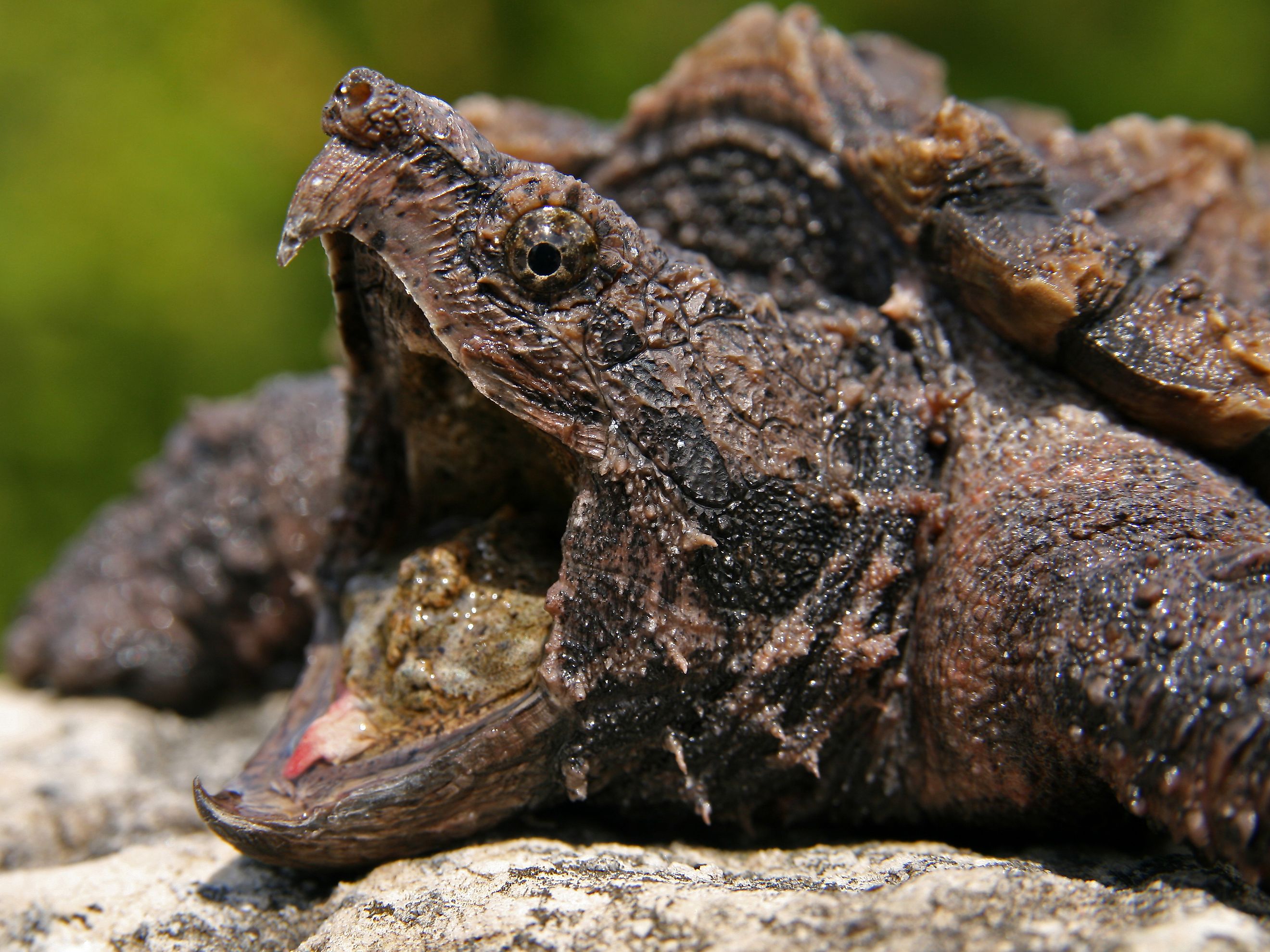
The alligator snapping turtle (Macrochelys temminckii) is the largest freshwater turtle in North America. It has a heavily ridged shell, a hooked beak and a powerful bite, with large males reaching about 155 pounds (70 kilograms) in the wild and heavier still in captivity. The species spends much of its life on river bottoms, waiting motionless with its mouth open and using a pink, worm-like lure on its tongue to draw in fish. It is native to warm, slow-moving rivers across the southeastern United States that drain into the Gulf of Mexico. Naturalists have spent nearly two centuries documenting the northern limits of its range. Establishing that boundary matters because reports of these turtles much farther north often involve animals released or abandoned by people, rather than naturally occurring populations. One example was a turtle pulled from a lake in England by a councillor in 2024.
Where The Line Actually Sits

The alligator snapping turtle is native to the Gulf drainages of northern Florida and southern Georgia, extends west into eastern Texas, and follows the Mississippi River north into southern Illinois, southeastern Iowa, southwestern Indiana, and southeastern Kansas. The biggest and oldest turtles come from the southern part of this range, which is why the largest snapping turtles are found well south of the northern edge. As you go farther north, records of these turtles become less common, and the species eventually disappears in the upper Mississippi Valley. There is a story about a 403-pound turtle supposedly caught in the Neosho River in 1937, which would make it the largest freshwater turtle ever recorded, but there is no specimen, photo, or verified weight to prove it.
The Record Behind The Range

Gerard Troost gave the species its scientific name in 1835, publishing his description through Philadelphia anatomist Richard Harlan. He named it temminckii to honor Dutch zoologist Coenraad Jacob Temminck (1778-1858). Over time, northern records of the species were collected slowly and with some confusion. In 1892, Samuel Garman called the alligator snapping turtles of Illinois Macroclemys lacertina, but this name was later dropped when it was found to be a duplicate of an already described animal. This shows how cataloging errors can affect range maps. The classification became more complicated in 2014, when Travis Thomas and nine colleagues used physical traits and mitochondrial DNA to split the single species into several, identifying the Suwannee alligator snapping turtle in Florida and Georgia as a separate species. After this split, the name temminckii applied only to the western populations, so the turtles at the northern edge of the range, in the Mississippi drainage, are Macrochelys temminckii, not the Gulf-coast forms that had received most attention. This classification is still debated. In 2015, Brian Folt and Craig Guyer argued for recognizing fewer species, so the question of how many types of alligator snapper exist remains unresolved.
Illinois, The Edge Of The Map

In October 2014, Chris Phillips, a herpetologist with the Illinois Natural History Survey, pulled a 22-pound female alligator snapping turtle from the bottom of Clear Creek in Union County. This was the first wild turtle of its kind found in Illinois in thirty years, almost exactly since the last one in 1984. Illinois listed the species as state endangered in 1999, after years of fewer sightings and shrinking habitats, mostly limited to the undammed part of the Mississippi in the far southwest. Since then, the Survey has released head-started turtles to help the population, including 97 juveniles released into a southern Illinois creek, since a self-sustaining wild population may no longer exist. The situation is even worse to the east. In Indiana, the species is extremely rare and may be gone altogether, known mostly from old shells and a single turtle found near the White River in Morgan County in 1991. That animal is one of the last solid records from the northeastern edge of their range.
Why The Turtle Stops Where It Does

The animal determines how far north it can live by its habits. The alligator snapping turtle spends almost all its time in the water, only coming onto land when a female needs to nest. It relies on long, warm seasons to eat, grow, and lay eggs that take months to hatch. Cold northern winters make that window too short for the species to reproduce reliably, which is why its range stops in the lower Mississippi Valley instead of reaching the Great Lakes. In 1988, Ed Moll looked at Illinois records and decided that nearly every sighting north of St. Louis was probably just a lone turtle that had traveled upstream through the big rivers, not a sign of a breeding population. Biologists still use this idea when they look at northern sightings on the map. The same need for warmth and water explains another pattern: freshwater turtles have become rare in the American Southwest, but there it's because there isn't enough water, not because it's too cold. In both cases, the edge of the range shows where the animal can survive. Other southern reptiles also reach their northern limits along this corridor, which is why there are often reports of crocodilians moving up the Mississippi.
The False North

In February 2024, Denise Chamberlain, a parish councillor who had lived in Florida and recognized the animal, waded into Urswick Tarn near Ulverston in Cumbria. Wearing three pairs of builders' gloves, she carried an alligator snapping turtle out of the lake in a shopping basket. Veterinarians Dominic Moule and Kate Hornby treated the turtle, named it Fluffy, and sent it to a specialist reptile center in Cornwall. They concluded that someone had kept the turtle as a pet, realized they couldn't provide the right heat and space, and released it into the nearest pond. Alligator snapping turtles don't migrate or cross oceans, so finding one in an English tarn, in Oregon, or anywhere outside the Mississippi system means it was released by someone, not that the species' range has changed. These turtles should be respected, not feared. Their bite can cause serious injury to anyone who isn't careful. That's why, near southern rivers, people give large snapping turtles plenty of space, never try to pick them up, and keep children and dogs away. Anglers who catch one are advised to cut the line instead of trying to handle it. The best thing an owner can do with an unwanted exotic pet is to surrender it to a rescue or wildlife center, not release it. Otherwise, the animal may die in the cold or, if it survives, become a problem for local wildlife.
Where The Species Stands Now

In 2021, the U.S. Fish and Wildlife Service proposed listing the alligator snapping turtle as threatened under the Endangered Species Act, citing long-term declines in about twelve states where it still survives. That proposal is still under consideration. The main reasons for the decline are familiar: decades of heavy hunting for meat during the mid-twentieth century, along with dammed and dredged rivers and turtles drowning in fishing gear. The turtle's slow biology also makes recovery difficult. It takes more than ten years to mature and can live over fifty years, so it cannot quickly replace lost numbers. Conservation efforts have focused on captive breeding. Since 1999, the Tishomingo National Fish Hatchery in Oklahoma has raised young turtles for release, a method now used at the northern edge of the species' range in Illinois. The northern limit is not a new frontier for the species. Instead, it is a boundary the turtle is struggling to maintain, set by cold water and long winters at the top of the Mississippi system. Any sightings far beyond this line are usually the result of human intervention.
The Bottom Line
The northern edge of the alligator snapping turtle's range has taken nearly two centuries to document. Gerard Troost described the species in 1835, and in 2014 Chris Phillips pulled a lone wild turtle from Clear Creek. The evidence points to a species concentrated in the lower Mississippi Valley, where warm summers give it enough time to feed, grow and reproduce. Farther north, the shorter active season may limit its ability to sustain populations. Reports from places well beyond its native range, including an English lake or a pond in Oregon, often involve turtles released by people rather than naturally established populations. Distinguishing these isolated sightings from genuine populations is important for conservation. Some northern states now have reintroduced turtles, but the species matures slowly, often taking more than a decade to reproduce. That makes it especially vulnerable to population losses and means that conservation decisions depend on knowing where wild populations actually persist.