How Far North Fire Ants Have Spread
Cold is one of the main limits on where the red imported fire ant can survive. Native to the seasonally flooded grasslands of South America, Solenopsis invicta ranges south through Argentina, reaching Santiago del Estero Province. Winter temperatures help determine how far beyond this native range it can establish colonies. Across the southeastern United States, parts of Europe, and East Asia, its spread has been shaped by both human activity and the climate it encounters. Records from the past two decades show the ant appearing in new areas, raising concerns about how much farther it could spread.
For travelers and people who garden, hike or work outdoors, knowing where fire ants have established themselves can help prevent painful encounters. Areas once considered too cold for the species may no longer be safe from it, although the pace and extent of its spread vary by region.
The North American Frontier

The ants first showed up at the port of Mobile, Alabama, in the 1930s, likely brought in with ship ballast or dunnage. From there, they spread quickly across the Gulf states. By May 6, 1958, when the federal government set up Quarantine 301.81 to control the movement of nursery stock and sod, the ants were already in eight southern states. The quarantine slowed them down but didn't stop them. Now, they cover more than 350 million acres in thirteen states, reaching areas that scientists once thought were too cold for them.
The ants' eastern edge is in Virginia, which is their northernmost established area in North America, near the 37th parallel. Fire ants first showed up at a golf course in Hampton in 1989 and stayed in the Tidewater region for almost thirty years. That's why the state set up an eleven-locality quarantine zone in 2009 to slow their spread. But the ants didn't stay put. In 2023, a study led by Morgan Malone found that the ants had recently spread west through Southside Virginia into Pittsylvania County, moving faster than expected. Eric Day, an entomologist at Virginia Tech, says researchers are still figuring out how far the ants will go in the state. In 2025, the Virginia Department of Agriculture and Consumer Services added three more southwestern and Southside areas to the quarantine.
Two main reasons explain why the ants are spreading faster now. First, milder winters let colonies survive in places where cold used to kill them. This change has been seen along the northern edge in states like Kentucky, North Carolina, and West Virginia. The second reason is more unusual. Some ants moving into colder parts of Virginia are hybrids of S. invicta and the black imported fire ant, Solenopsis richteri. These hybrids handle cold better than either parent, which is why an insect from a warm floodplain can now survive in the Appalachian foothills. Isolated colonies have even been found farther north in Maryland, including one at the University of Maryland campus. But it's still unclear if these northern colonies can last through several harsh winters, since there isn't much data yet.
The ants' move west and northwest is just as important as their spread north. USDA Agricultural Research Service models, based on soil temperatures from over 4,500 weather stations, predict the ants will move 50 to 100 miles farther north in Oklahoma and Arkansas and keep spreading in Maryland and Delaware. Recent studies suggest the lower Midwest, including parts of Missouri, could be the next area to open up as the climate warms. The main rule is simple. On the northern edges, cold limits the ants' range, and as cold areas shrink, the ants move in.
Europe's New Arrival

For years, fire ants appeared in Europe only as occasional strays, found in greenhouses or among imported goods, but never breeding outdoors. That changed on September 11, 2023, when Mattia Menchetti and Roger Vila from the Institute of Evolutionary Biology in Barcelona, along with their colleagues, reported in Current Biology that they had confirmed the first established population on the continent. Using photographs from a contact in Italy, the researchers went to Sicily and found 88 nests spread over 4.7 hectares near a river close to the city of Syracuse, just a few kilometers from a freight port.
The discovery also raised concerns about how long the ants had gone unnoticed. Residents had reported frequent stings as early as 2017, suggesting the colony had been established for years before researchers identified it, possibly for more than eight years. A follow-up survey found that the infestation extended at least 23 kilometers along the coast. Menchetti warned that the finding showed how a highly invasive species could establish itself and spread across Europe long before anyone recognized the scale of the problem.
Syracuse is near the 37th parallel, putting Europe's edge at about the same latitude as Virginia. The Menchetti team's models suggest that conditions in roughly half of Europe's urban areas are already suitable for the ant. As temperatures rise, that range could expand farther north, exposing more cities to potential colonization. The European Union lists S. invicta as an invasive alien species of Union concern under Regulation 1143/2014, which means member states must detect, contain, and remove new populations. The discovery in Sicily turned this from a precaution into an urgent issue. Wind patterns around Syracuse also show how the ant's winged queens could help it spread further.
The Asian Push Toward The Yangtze

China is seeing the fastest spread of this ant, making it the best place to track its northward movement. The insect first appeared in Taiwan's Taoyuan and Chiayi areas in 2003, then reached Guangdong on the mainland in 2004. Genetic studies show it likely arrived with imported logs and wastepaper, mostly from the United States. From its starting point in the south, the ant has moved northwest at a rapid pace. Since 2004, it has spread more than 26.5 kilometers per year across southern China, much faster than its progress in the United States.
A 2026 study in Insect Science, led by Jian Huang, pinpointed the ant's current northern limit with impressive accuracy. The ant now lives along the Yangtze River coast at 30.8 degrees north latitude, mainly spread by the horticultural trade, especially through shipments of the ornamental plant Cycas revoluta. Researchers measured how quickly the ant moves on its own at different points along the frontier. In warm Guangdong, it spreads 118 to 186 meters a year, but in cooler northern Zhejiang, it only moves about 40 meters a year, showing that cold slows it down. Their model predicts the next northern limit will be near southern Shandong. Recent counts show the ant is now in twelve to thirteen provinces and more than 500 counties, and it is still spreading quickly. National models say the main suitable area is between 18 and 32 degrees north, and as the climate warms, this zone is expected to shift even farther north.
Australia's Contained But Growing Edge

Australia stands out because it is investing heavily to stop the spread of fire ants, not just track them. The ants were first found in 2001 at the Port of Brisbane and in Richlands, a suburb in southwestern Brisbane, Queensland. Since then, there have been seven separate incursions, most of which have been wiped out. However, the main population in southeast Queensland has been much harder to control. Now, the infestation covers more than a million hectares. The ants have reached the New South Wales border, with nests discovered just 550 meters from the state line at Bilinga in April 2025. Outbreaks have also appeared at a coal mine near Moranbah, over 700 kilometers from the nearest known infestation.
Efforts to contain the ants have limited their natural spread to about five kilometers a year. This is much less than the tens of kilometers a year seen in China and the United States, showing the impact of steady funding and hard work. The National Fire Ant Eradication Program hopes to eliminate the pest by 2032, when Brisbane will host the Olympic Games. For the first time, crews kept baiting through the mild Queensland winter of 2025 instead of stopping. No country has ever removed an infestation as large as the one in southeast Queensland, so this effort is breaking new ground.
Why The Cold Still Holds The Line, For Now

On every continent, the same stubborn fact sets the northern boundary. Shannon James at the University of Tennessee found in lab tests that exposing ants to long periods of cold, not just a single freezing night, is what kills colonies. S. invicta is less cold-tolerant than related species. This winterkill keeps the native range pinned to Santiago del Estero in the south and, until recently, limited the invaded ranges near the 37th parallel in the northern hemisphere. The ant's own biology set this limit.
Two changes are removing this limit. First, winters are getting warmer, so ants can survive more nights at higher latitudes. Second, the ants themselves are adapting. Cold-hardy invicta-richteri hybrids are moving into the Virginia mountains, and researchers have found high-elevation populations surviving in the southern Blue Ridge above where models predicted. This shows the ants are spreading farther and handling cold better than expected. The truth is, the upper limit is rising, and no one knows where it will end up.
Staying Clear Of The Sting

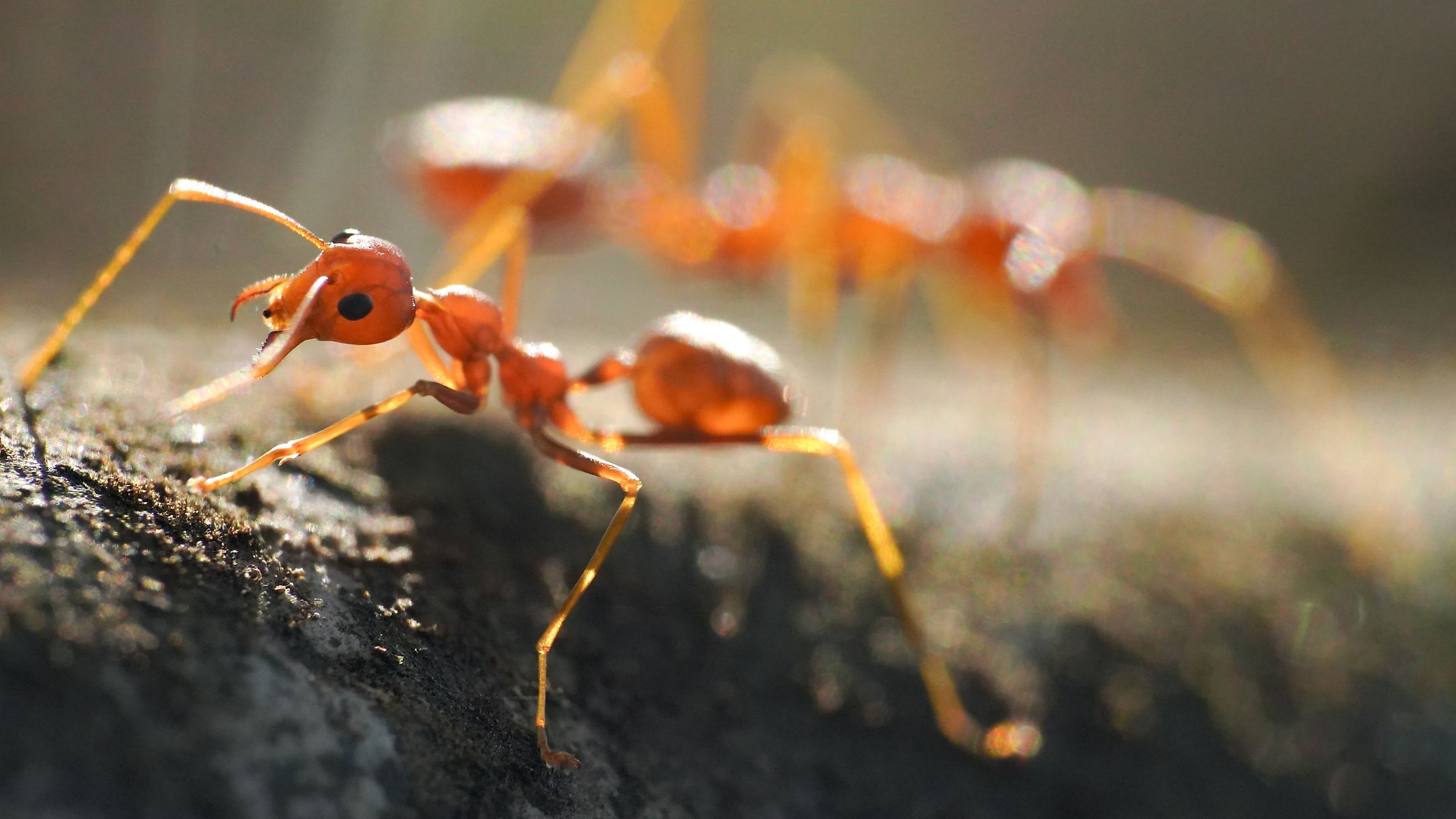
Fire ant stings are different from those of most other ants. The ant grips the skin with its jaws, then pivots its body to sting repeatedly, injecting venom made up largely of alkaloids. Most people develop an itchy bump within an hour, followed by a small white blister that can last a day or longer. Some reactions are far more serious. Fire ant venom can trigger anaphylaxis, a potentially life-threatening allergic reaction. Research by Dean Metcalfe and colleagues found that in U.S. states where fire ants are established, anaphylaxis caused by their stings occurs more often than anaphylaxis caused by stings from bees, wasps and hornets combined. Across the United States, insect-sting anaphylaxis of all kinds causes an estimated 90 to 100 deaths each year.
Fire ants build dome-shaped mounds of earth without a visible central entrance. The best way to stay safe is to spot these mounds and keep your distance, since the colony only attacks in large numbers if the nest is disturbed. If you are walking, camping, or working in soil where fire ants might live, always check the ground before kneeling, sitting, or putting down your gear. Be especially careful in sunny, open, disturbed areas, which fire ants prefer. If you do get stung, medical advice is to move away from the mound right away, wash the area with soap and water, and use a cold compress on the welts. Leave the blisters unbroken to avoid infection. Anyone who has had a severe reaction to any insect sting should carry prescribed epinephrine and treat a fire ant sting as a medical emergency if there are breathing problems, throat swelling, or widespread swelling.
What Comes Next
The northern limit of the red imported fire ant will likely shift as conditions change. For now, established populations reach roughly the 37th parallel in parts of Virginia and Sicily, while in China they extend to around 30.8 degrees north near the Yangtze River. The details differ from one region to another, but the broader trend is clear. As winters become milder, the cold that once kept this ant in check may no longer be enough to stop it spreading farther north.