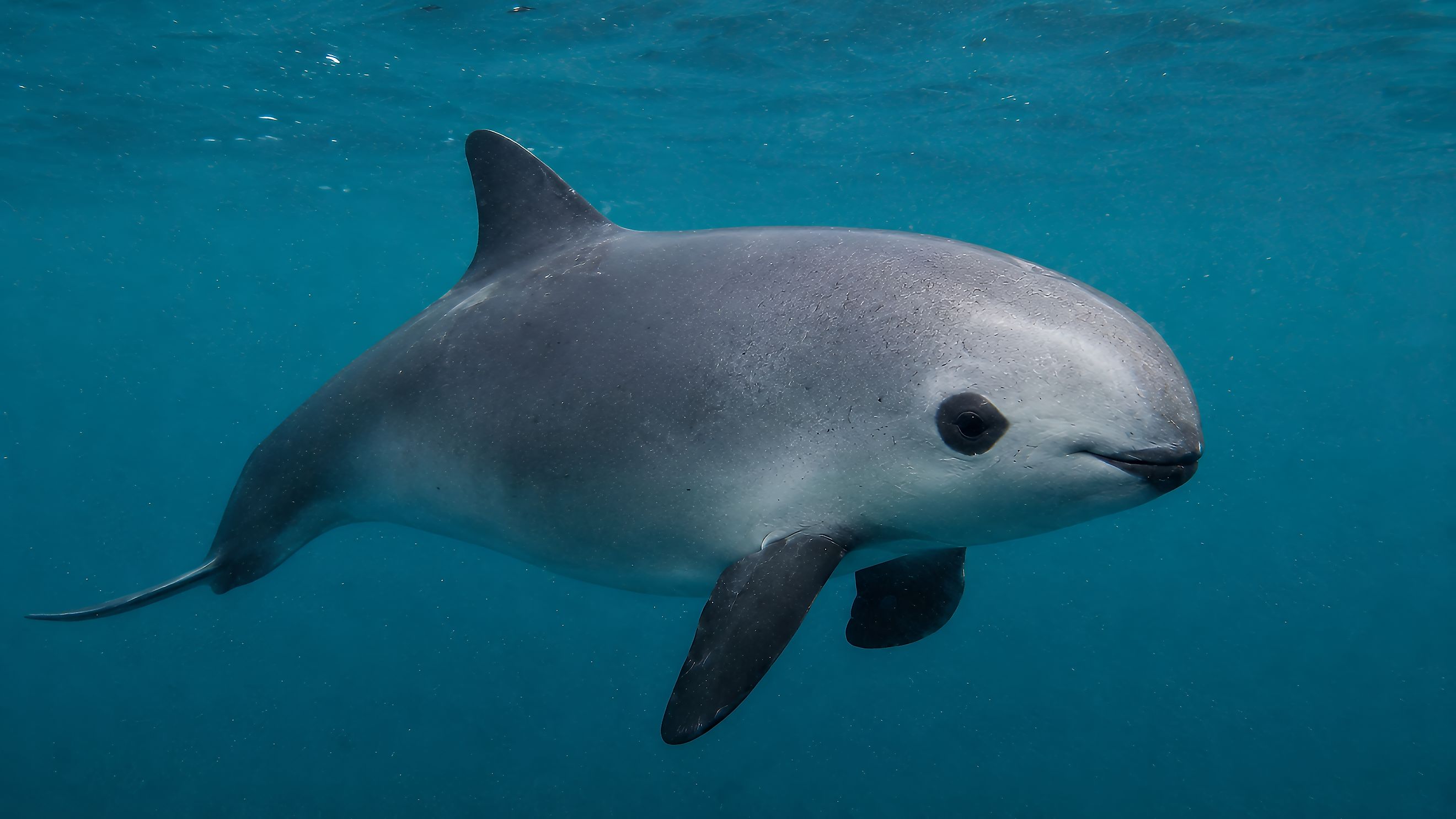
Vaquita
The vaquita is the smallest porpoise on Earth and the smallest of all living cetaceans, the group that includes every whale, dolphin, and porpoise in the ocean. A full grown adult rarely exceeds five feet (1.5 m) in length, and its shy habits keep it almost invisible to the people who share its waters. For most of its history it went unnoticed by science, and now it may vanish before most people ever learn its name.
Found only in the northern Gulf of California off the coast of Mexico, the vaquita (Phocoena sinus) has the most restricted range of any marine mammal. That tiny home, roughly 1,500 square miles (4,000 sq km) of murky, shallow water, has become the center of one of the most urgent conservation stories of the modern age. Fewer than a dozen vaquitas are thought to remain in the wild.
Taxonomic Classification

The vaquita belongs to the family Phocoenidae, the porpoises, within the order Cetacea. Its scientific name is Phocoena sinus, placing it in the same genus as several other small porpoises found around the world. The species name sinus is Latin for gulf or bay, a nod to the single body of water it calls home, while the common name "vaquita" is Spanish for "little cow." Local fishermen in the region also call it cochito.
Science came to the vaquita remarkably late. Two American zoologists, Kenneth S. Norris and William N. McFarland, formally described the species in 1958 after studying weathered skulls found on beaches in the upper Gulf. A living animal would not be well photographed for decades afterward, and much of the vaquita's basic biology is still poorly understood. Genetic and anatomical work places its closest relatives in the Southern Hemisphere, chiefly Burmeister's porpoise (Phocoena spinipinnis) and the spectacled porpoise (Phocoena dioptrica), suggesting its ancestors moved north into the Gulf long ago and became isolated there.
Physical Description
No other cetacean is built quite like the vaquita. Adults reach a maximum length of about five feet (1.5 m) in females and closer to four feet seven inches (1.4 m) in males, which makes females the larger sex. Most adults weigh roughly 95 pounds (43 kg), with the heaviest approaching 120 pounds (54 kg). That compact, robust body is small enough that a single person could cradle a calf.
The vaquita is easy to recognize for anyone lucky enough to see one. Dark rings circle its eyes and dark patches mark its lips, giving the animal a distinctive facial pattern that has earned it the nickname "panda of the sea." The back is a dull grey that pales to white on the belly, and there is no beak, only a smoothly rounded head. Its dorsal fin stands unusually tall and triangular, proportionally larger than that of any related porpoise, a feature thought to help shed heat in the warm Gulf waters. Females tend to have larger heads and wider flippers than males. Together these traits make the vaquita unmistakable at close range, though its habit of surfacing quietly and briefly means close views are rare.
Range and Habitat
The entire world population of vaquitas lives in a single corner of a single sea. The species is endemic to the northern end of the Gulf of California, also called the Sea of Cortez, the narrow arm of ocean that separates the Baja California peninsula from mainland Mexico. No vaquita has ever been confirmed anywhere else.
Its range covers only about 1,500 square miles (4,000 sq km), the smallest of any marine mammal. Within that area the vaquita favors shallow, turbid waters less than about 150 feet (45 m) deep, often clouded with nutrients and sediment carried in from the surrounding desert coast. These productive shallows support the fish and invertebrates the porpoise depends on. The animal is non-migratory, spending its whole life within this compact patch of water, and recent surveys show that most remaining vaquitas cluster inside a small protected zone near San Felipe. That loyalty to one small place is part of what makes the species so vulnerable, because every threat to those waters is a threat to the entire population at once.
Diet

The vaquita is an opportunistic hunter of the sea floor and the water column just above it. Its diet is varied for such a small animal and includes small fish such as croakers and grunts, along with squid and crustaceans like shrimp. Rather than specializing, it takes a wide range of prey that live in the murky bottom waters of the upper Gulf.
Like all toothed cetaceans, the vaquita finds its food using echolocation, sending out rapid clicks and reading the echoes that bounce back from prey hidden in cloudy water where eyesight is of little use. This ability lets it hunt effectively in an environment where visibility is often measured in inches. The same sensitivity to sound, unfortunately, does little to help it detect the thin nylon gillnets that have become its greatest danger.
Behavior and Reproduction
Vaquitas are shy and secretive, and they go out of their way to avoid boats. They usually travel alone or in small groups of two or three, surfacing with a slow, quiet roll that barely breaks the water before they slip under again. This retiring nature, combined with their small numbers, means few people have ever watched a wild vaquita for long, and clear photographs of living animals were almost nonexistent until recent decades.
Reproduction is slow, which is a central problem for a species in crisis. Vaquitas are what biologists call a K-selected species, investing heavily in a small number of young rather than breeding quickly. Females carry a single calf for about 10 to 11 months and generally give birth only once every two years. Calves are born a darker grey than adults and stay with their mothers through an extended period of care. Individuals are thought to live around 20 years. With so few animals left and such a measured pace of breeding, even a healthy, gillnet-free habitat would take decades to rebuild the population.
Importance to the World
As a top-level predator of the upper Gulf, the vaquita helps keep the food web of its small ecosystem in balance, feeding on the fish and invertebrates that are abundant in these shallow waters. Its presence is also a sign of a healthy marine environment, since the same clean, productive shallows that sustain the vaquita support the fisheries that local communities rely on.
Beyond ecology, the vaquita has taken on an outsized role as a symbol. It has become the face of the global fight against bycatch and the illegal wildlife trade, and the effort to save it has drawn scientists, governments, and conservation groups from around the world into one shared cause. The story of this little porpoise now stands for a much larger question about whether people can halt an extinction already in motion.
Threats and Conservation

The vaquita has never been hunted on purpose. Every step of its decline has come from accidental drowning in fishing nets, a problem known as bycatch. The deadliest of these are gillnets, walls of nearly invisible mesh set in the water to catch fish and shrimp. A vaquita that swims into one becomes tangled and cannot reach the surface to breathe.
The single greatest driver of the crisis is illegal fishing for the totoaba (Totoaba macdonaldi), a large fish whose dried swim bladder sells for enormous sums in parts of Asia, where it is used in traditional medicine. Because the totoaba is close to the vaquita in size, the gillnets set for it are especially lethal to the porpoise. This illegal trade has persisted despite bans, and it continues to kill vaquitas inside waters that are supposed to be protected.
The numbers tell the story. A 1997 survey estimated around 567 vaquitas. By 2015 the population had collapsed to about 59 animals, a drop of roughly 80 percent in only a few years, and by 2024 observers estimated just six to eight remained. The International Union for Conservation of Nature lists the species as Critically Endangered, the highest risk category before extinction.
There is, against the odds, a thread of hope. A survey carried out between May and September 2025 by Mexican authorities and the Sea Shepherd Conservation Society estimated between seven and ten vaquitas and documented new calves, a slight rise from the year before and a sign that the animals are still reproducing. Conservation efforts now center on removing gillnets, enforcing a core protected zone, and pressuring authorities to shut down the illegal totoaba trade. Whether those measures come fast enough remains the open question on which the vaquita's survival depends.
Takeaway
The vaquita is a small, quiet animal that asks little of the world beyond a single stretch of murky water. Its fate now rests almost entirely in human hands. If the gillnets disappear and the illegal trade that drives them is finally stopped, this resilient little porpoise has shown that it is willing to hang on. The coming years will decide whether it becomes a conservation success story or a cautionary one.
Fun Facts
- Smallest of them all. The vaquita is the tiniest cetacean on Earth, smaller than any other whale, dolphin, or porpoise.
- A cow in name only. "Vaquita" means "little cow" in Spanish, a name used by the fishermen who shared its waters long before scientists took notice.
- The panda of the sea. Dark rings around its eyes and dark patches on its lips give the vaquita a face that inspired this affectionate nickname.
- Discovered astonishingly late. The species was not formally described until 1958, and that description was based on skulls found on a beach rather than a living animal.
- Never hunted, still vanishing. Unlike many threatened cetaceans, the vaquita has never been targeted by hunters. Its entire decline comes from accidental entanglement in nets.
- The most restricted range of any marine mammal. Every vaquita that has ever lived was found in one small corner of the Gulf of California.
Quick Facts
- Scientific name: Phocoena sinus
- Family / Order: Phocoenidae / Cetacea
- Common names: Vaquita, Gulf of California harbor porpoise, cochito
- IUCN status: Critically Endangered (estimated 7 to 10 individuals, 2025 survey)
- Length: Up to about 5 feet (1.5 m) in females, 4 feet 7 inches (1.4 m) in males
- Weight: Around 95 pounds (43 kg), up to about 120 pounds (54 kg)
- Lifespan: Around 20 years
- Diet: Carnivore, feeding on small fish, squid, and crustaceans
- Range: Northern Gulf of California, Mexico, roughly 1,500 square miles (4,000 sq km)