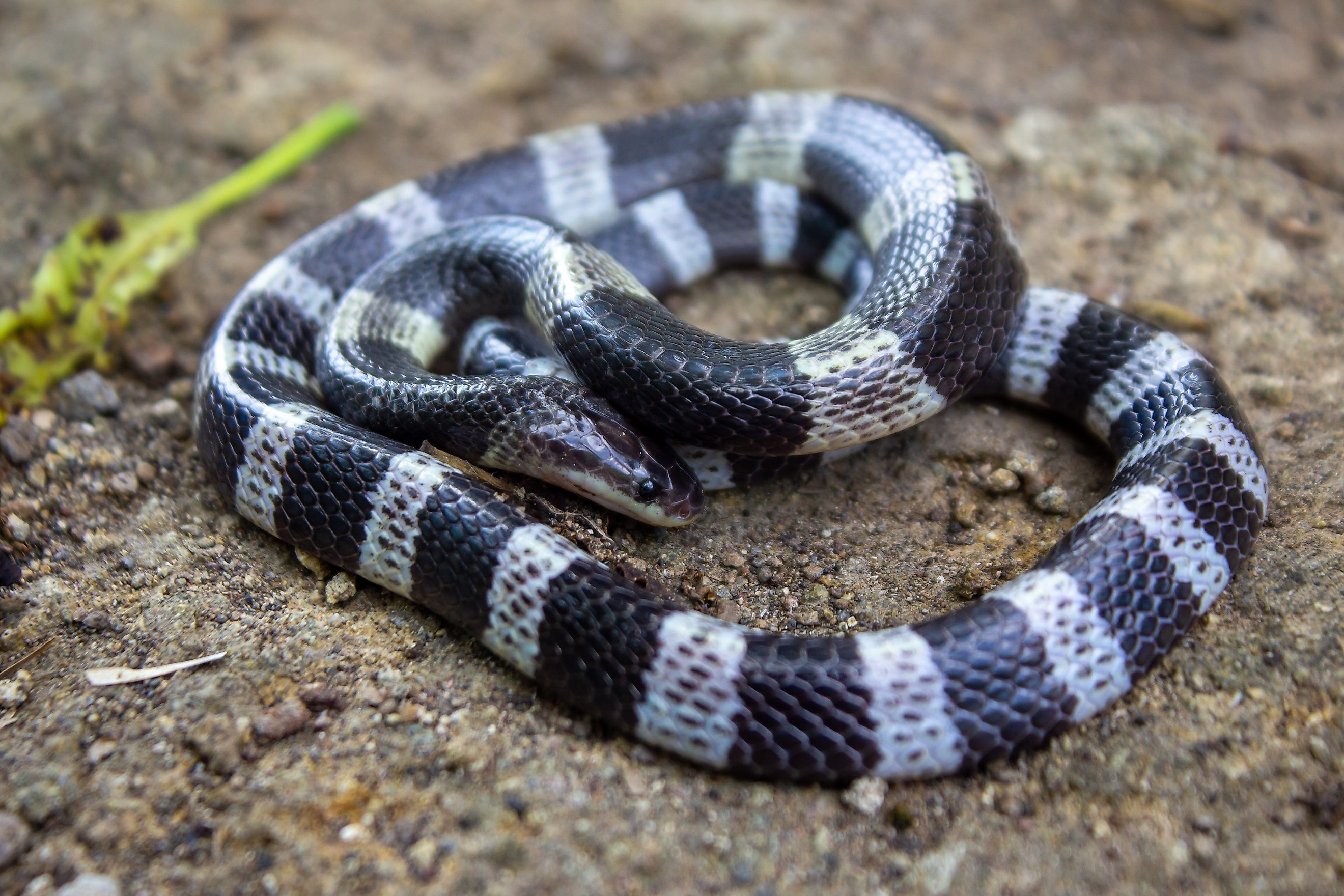
Malayan Blue Krait
The Malayan blue krait ranks among the most dangerously venomous land snakes in Southeast Asia, and much of that danger comes from how quietly it operates. Drop for drop, its venom is far more potent than that of many cobras, yet the snake itself is slender, secretive, and reluctant to strike unless pressed hard. Many people who cross paths with one never know it was there.
Bungarus candidus is a mid-sized elapid marked by bold dark and pale banding, active almost entirely after nightfall. It ranges across mainland Southeast Asia and the larger islands of Indonesia, hunting other snakes through the dark and sheltering by day in burrows, leaf litter, and the cracks of human structures. Because it is calm by temperament and most active while people sleep, it accounts for a disproportionate share of serious snakebite cases across parts of its range.
This profile covers the animal's classification, its appearance, where it lives, what it eats, how it behaves and breeds, and the potent neurotoxic venom that makes it a species of real medical importance.
Taxonomic Classification

The Malayan blue krait belongs to the family Elapidae, the group of front-fanged venomous snakes that also includes cobras, mambas, sea snakes, and coral snakes. Within that family it sits in the genus Bungarus, the kraits, which contains roughly a dozen and a half species spread across South and Southeast Asia. The species was first described by Carl Linnaeus in 1758 under the name Coluber candidus, and later moved into Bungarus, giving it the accepted scientific name Bungarus candidus.
Three kraits occur in Peninsular Malaysia, and the blue krait shares that territory with the banded krait (Bungarus fasciatus) and the red-headed krait (Bungarus flaviceps). Modern DNA work has complicated the picture. Bungarus candidus and the closely related Bungarus wanghaotingi are so similar in appearance that researchers cannot reliably tell them apart in the field, and the two are often treated together as a species complex until further study resolves the boundaries. That kind of cryptic diversity is common in kraits, so the taxonomy here should be read as current best understanding rather than the final word.
Physical Description

This is a slender, cylindrical snake of moderate length. Adults typically reach a total length of about 3.5 feet (108 cm), of which the tapering tail makes up roughly 6.3 inches (16 cm). The build is lean rather than heavy, and the head is only slightly distinct from the neck, which helps the snake push through soil and dense cover.
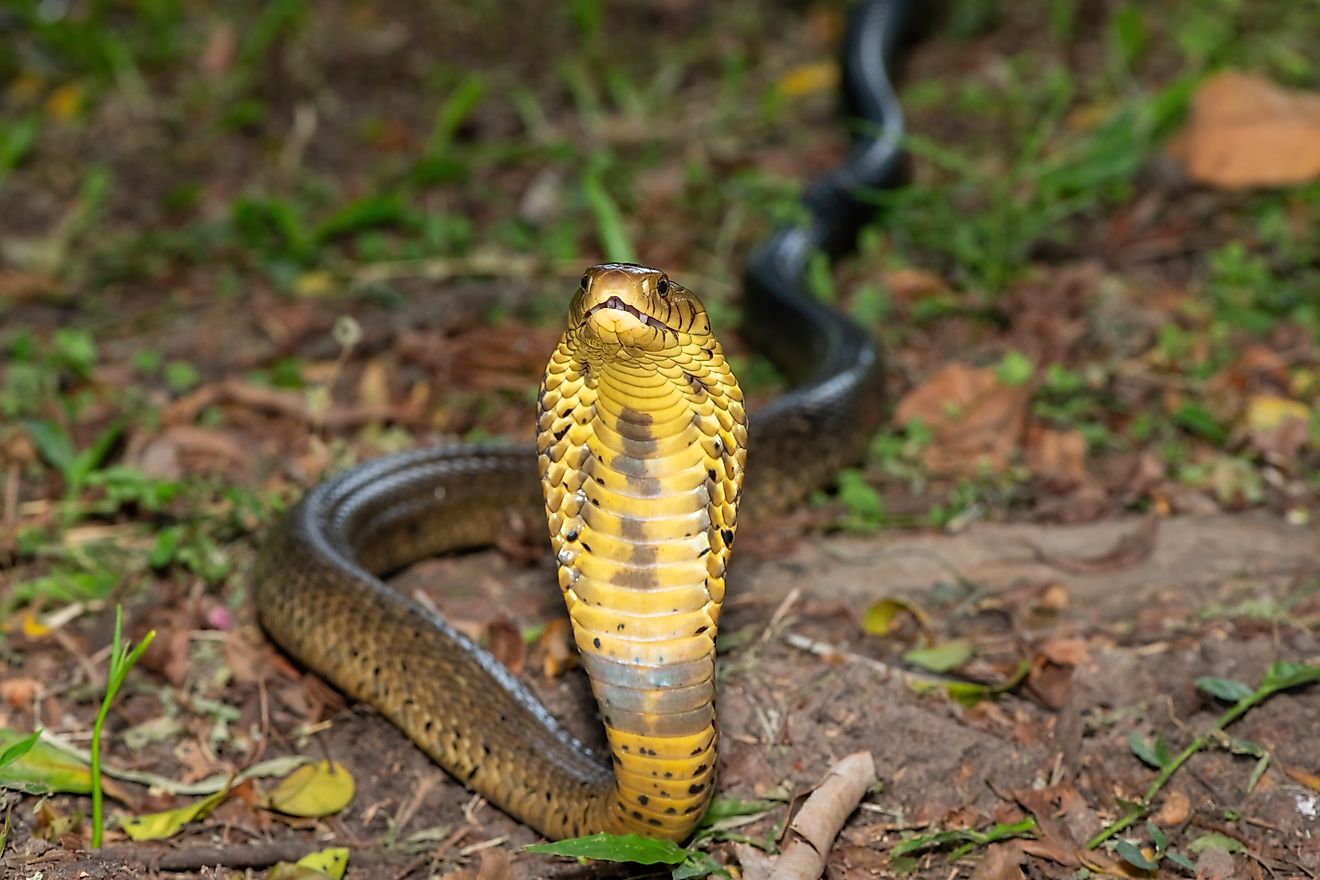
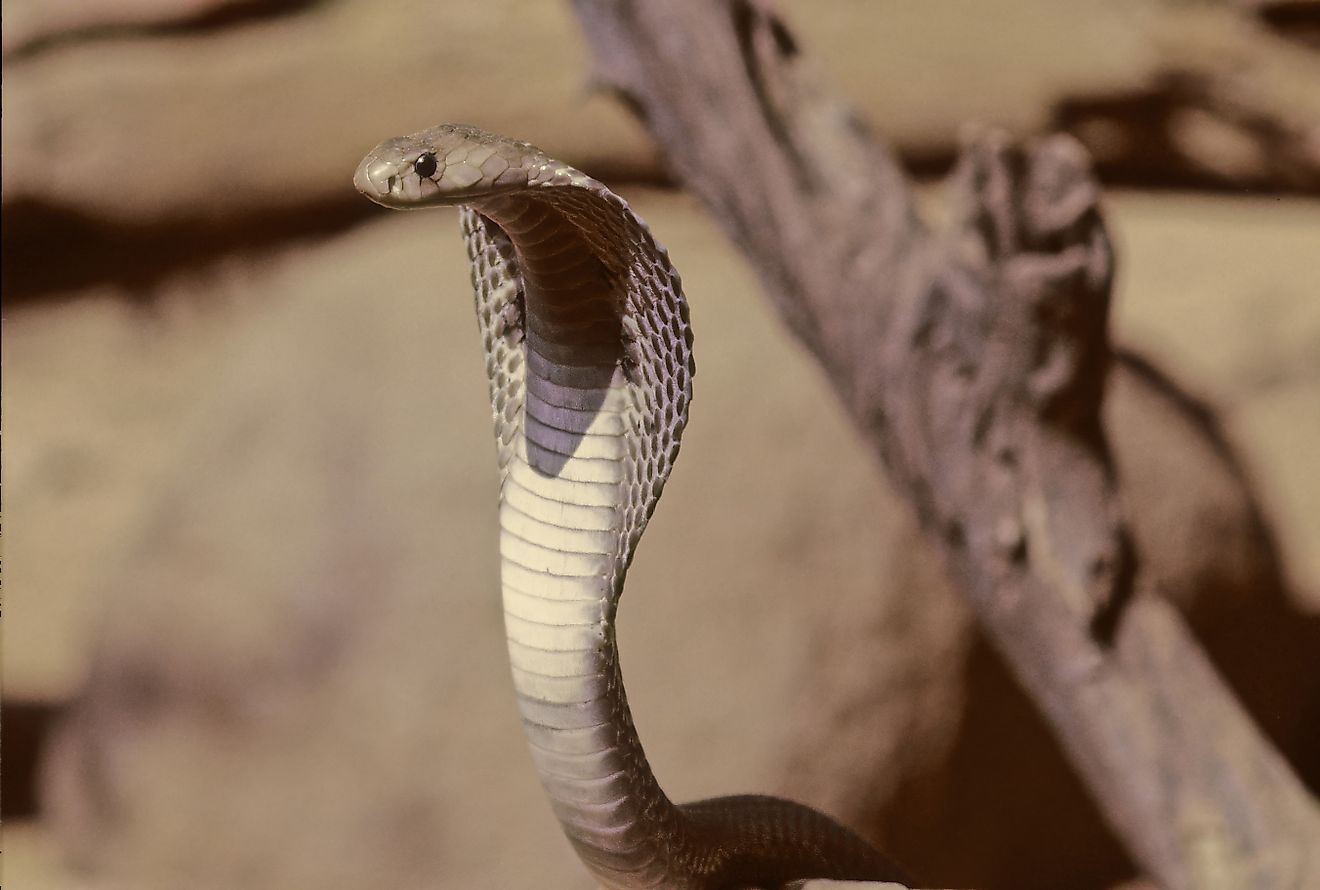
The classic pattern is a series of 27 to 34 dark crossbands running down the body and tail. These bands may look dark brown, black, or a deep bluish black, the last shade giving the animal its "blue krait" name. The bands narrow and round off along the sides, and the first one connects with the dark cap of the head. Between the dark bands sit broad, yellowish white interspaces, sometimes flecked with black, while the belly is a clean uniform white. Not every population wears the same coat. In West and Central Java, an all-dark, unbanded form occurs, which can make identification harder in exactly the places where a mistake carries the highest cost.
A close look at the scales reveals a feature shared across the genus. The smooth dorsal scales are arranged in 15 rows, and the row running down the spine is markedly enlarged. That enlarged vertebral ridge gives kraits a subtly triangular cross-section and a distinct raised backbone line that seasoned observers use as a field clue. The ventral scales number 195 to 237, the anal plate is undivided, and the single row of subcaudal scales beneath the tail numbers 37 to 56.
Range and Habitat

The Malayan blue krait is a Southeast Asian species that runs from Indochina in the north down through the Thai-Malay peninsula and onto the larger Indonesian islands. Confirmed range countries include Thailand, Vietnam, Peninsular Malaysia, and Indonesia, where it occurs on Sumatra, Java, and Bali. This is a wide distribution, which is part of why the species remains reasonably secure despite local pressures.
Within that range the snake favors lowland moist forest, agricultural land, and plantations, usually close to water. It is far from a wilderness specialist. Radio-tracking studies in Thailand have shown that blue kraits take readily to human-modified landscapes, spending time in and around buildings, drainage lines, and other structures on a busy university campus. Rats and other prey concentrate near people, and the krait follows the food. That overlap between snake habitat and human living space is the single biggest reason the species matters to public health, because a nocturnal snake resting in a warm, sheltered spot may end up sharing a room with someone who never sees it.
Diet

The blue krait is, above all, a snake-eater. Other snakes form the core of its diet, and it will take smaller kraits and unrelated species alike, swallowing prey that can be surprisingly long relative to its own body. It rounds out that menu now and then with a lizard or a small mammal, but the ophiophagous habit (feeding on other snakes) is the defining feature of how it makes a living.
Its hunting style sets it apart from many venomous snakes. Vipers and many other elapids tend to sit and wait, ambushing prey and letting venom do the work before swallowing. The blue krait instead moves through its territory after dark, actively searching out prey rather than waiting for it to wander past. When it finds a target it delivers a quick, potent bite, and the fast-acting neurotoxins subdue the prey before it can retaliate. Feeding, courtship, and most movement all happen under cover of night.
Behavior

Few snakes are as thoroughly nocturnal as this one. Through daylight hours the blue krait stays hidden in burrows, under logs, in leaf litter, or inside the crevices of human structures, and it becomes active only once the sun is down. By day it is notably placid, often reluctant to bite even when handled, which lulls people into treating it as harmless. That daytime calm reverses somewhat after dark, when the animal is alert and on the move.
This behavior pattern shapes the entire risk profile of the species. Bites from kraits are often close to painless, and a striking number of them happen at night, sometimes to people who are asleep on the floor or on low bedding and never wake fully until symptoms set in. A victim may not realize a serious envenoming has occurred until paralysis begins hours later. The snake is not aggressive by nature. The problem is that its quiet, low-key defense can be missed entirely at the moment it matters most.
Reproduction

Like most elapids, the blue krait is egg-laying. Breeding is seasonal, with eggs generally laid in spring and hatchlings emerging in summer. Females deposit a modest clutch, commonly around four to ten eggs, and often choose a ready-made shelter such as a rodent burrow, sometimes the very burrow of an animal they have eaten. Males have been reported to engage in ritual combat, wrestling for the chance to mate rather than fighting to injure.
The young hatch as miniature adults. A newborn blue krait already measures roughly a foot (about 30 cm) long, wears the adult banding, and carries a working supply of venom from its first day out of the egg. There is no extended parental care. Hatchlings are independent immediately and are dangerous immediately, a reminder that a small krait deserves the same caution as a large one.
Venom and Medical Importance

The venom of Bungarus candidus is what earns the species its formidable reputation. It is dominated by neurotoxins, including both presynaptic and postsynaptic types that attack the junctions where nerves meet muscle. The result of a serious bite is progressive neuromuscular paralysis, which can climb from drooping eyelids and difficulty swallowing to full respiratory failure as the muscles that drive breathing shut down. Reports also describe cardiovascular disturbances such as high blood pressure and shock, along with muscle damage and kidney injury in some cases.
Laboratory measures underline how toxic this venom is. In mice the median lethal dose by intravenous injection is commonly cited at around 0.1 milligrams per kilogram, a figure that places the blue krait among the more lethal snakes drop for drop, ahead of many species people fear far more. Because the bite itself is often mild and painless, the danger is easy to underestimate in the crucial early hours.
The public-health picture varies by country. In Thailand the Malayan krait is a leading cause of snakebite death and has been recorded with one of the highest fatality rates of any snake there. It is treated as a top-priority medically important species in both Thailand and Indonesia. In Malaysia, by contrast, envenoming by this species is relatively uncommon, and it is ranked a notch lower in medical priority. The World Health Organization classified snakebite as a neglected tropical disease in 2017, and species like the blue krait sit at the center of that concern. Prompt hospital care, antivenom where appropriate, and mechanical ventilation to carry a patient through the paralysis are the pillars of treatment, and outcomes improve dramatically when victims reach care early.
Threats and Conservation Status

Despite the threat it poses to humans, the Malayan blue krait is not itself a threatened animal. The IUCN Red List assesses the species as Least Concern, a rating that reflects its very wide distribution across mainland and island Southeast Asia. No firm global population estimate exists, but the species is considered widespread rather than rare.
That security is not absolute. The same assessment notes that the snake is heavily collected in parts of its range, harvested for its meat, its skin, and for use in traditional medicine, and unsustainable collection is a real local pressure. Habitat conversion adds to the strain in some areas, even though the species tolerates disturbed and agricultural land better than many snakes. For now the broad range keeps the outlook stable, but the trend in collection intensity is worth watching over time.
Takeaway
The Malayan blue krait combines a remarkably calm daytime temperament with some of the most potent venom found in any terrestrial snake. After dark, it becomes an efficient and stealthy hunter. Its nocturnal habits and tendency to shelter near human dwellings make it especially significant in areas where its range overlaps with settlements. Understanding when and where the snake is active can help reduce the risk of serious bites, while prompt medical treatment greatly improves the chances of recovery.
For the species itself the outlook remains stable, helped by a broad distribution and an unusual tolerance for farmland and disturbed ground, though heavy collection in some countries is a pressure worth watching. Respected from a distance and left undisturbed, the blue krait is far more valuable to its ecosystems as a predator of other snakes than it is a danger to the people who learn to share ground with it.
Fun Facts

- It eats its own kind. The blue krait is a specialist snake-eater and will readily hunt and swallow other snakes, including smaller kraits.
- Its bite can be painless. Many victims feel little or nothing at the moment of the bite, and some are struck in their sleep, which delays the alarm until paralysis begins.
- Drop for drop it outguns many cobras. Laboratory toxicity measures rank its venom among the deadliest of any land snake, well ahead of several species with scarier reputations.
- Newborns are armed from day one. Hatchlings emerge about a foot long, patterned like adults, and fully venomous, with no parental care at all.
- It hunts, rather than ambushes. Unlike many venomous snakes that lie in wait, the blue krait actively prowls after dark in search of prey.
- It may be more than one species. The blue krait is so similar to a close relative that scientists struggle to tell them apart, and the name likely covers a species complex still being untangled by DNA studies.
Quick Facts
- Common names: Malayan blue krait, Malayan krait, blue krait
- Scientific name: Bungarus candidus
- Family: Elapidae (order Squamata, suborder Serpentes)
- IUCN status: Least Concern
- Length: up to about 3.5 feet (108 cm)
- Coloration: dark and pale crossbands, with an all-dark form on Java
- Lifespan: several years in the wild, longer in captivity
- Diet: mainly other snakes, occasionally lizards and small mammals
- Activity: nocturnal and terrestrial
- Reproduction: egg-laying, roughly four to ten eggs per clutch
- Range: Thailand, Vietnam, Peninsular Malaysia, and Indonesia (Sumatra, Java, Bali)
- Habitat: lowland moist forest, plantations, and farmland near water, often close to human settlement
- Venom: potent neurotoxin causing progressive paralysis and possible respiratory failure