Where Bull Sharks Swim Farthest Inland
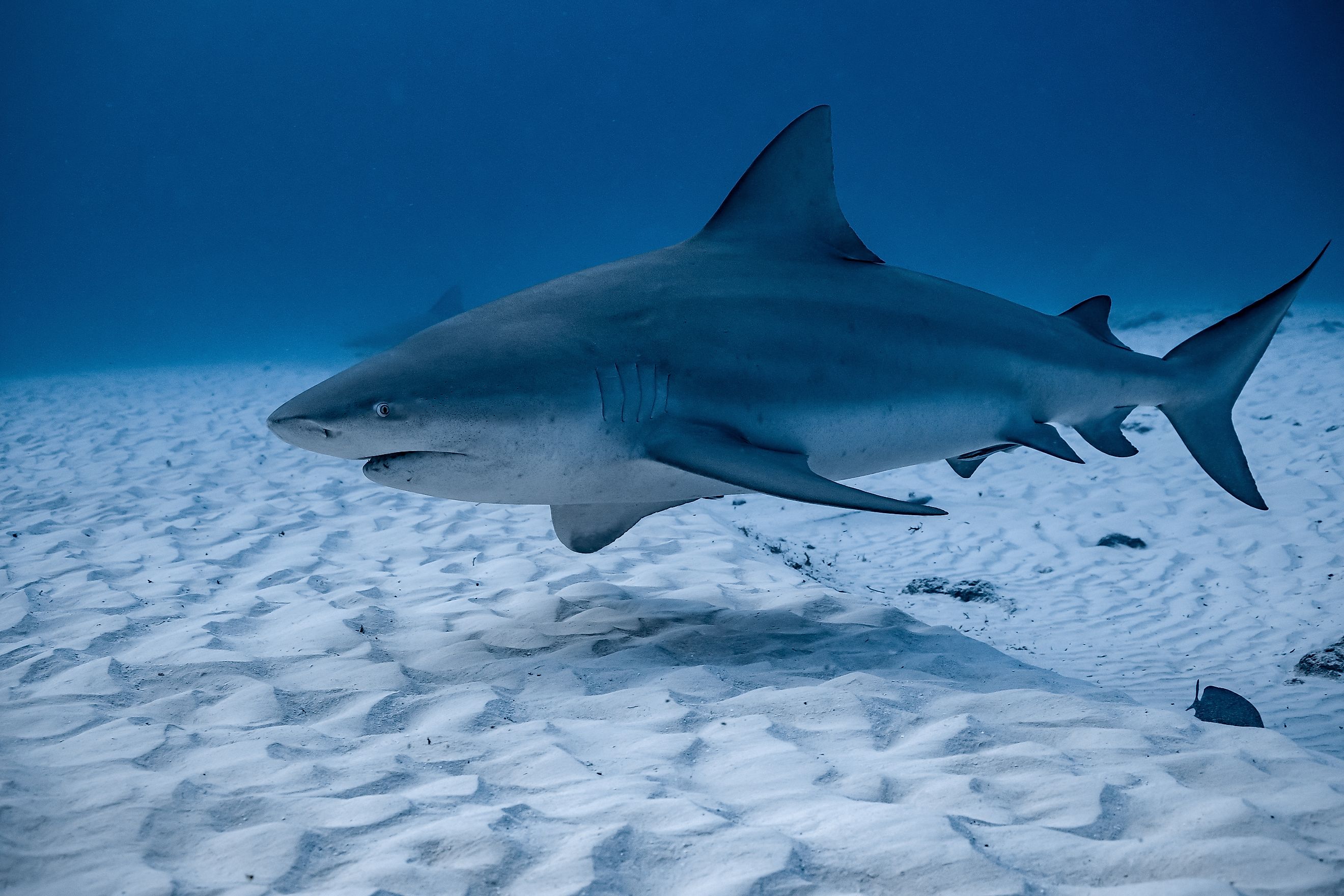
The farthest inland a shark has ever been found is a bull shark caught in the Amazon near Iquitos, Peru. That's about 4,000 kilometers, or 2,500 miles, from the Atlantic Ocean, in a port town deep in the rainforest with no road to the coast. While the exact distance has been repeated for years without a precise measurement, and the record itself is a bit shaky, the main point stands: the bull shark is the only large shark that regularly shows up this far into fresh water. It gets there on its own, swimming up the Amazon from the sea, something no other big shark can do.
Bull sharks (Carcharhinus leucas) can do this because their bodies have a unique chemistry that great white or tiger sharks don't have. Seen through this chemistry, these inland sightings seem less like oddities and more like a normal part of bull shark behavior. They are native to warm coastal shallows worldwide, in the river mouths of South America and the estuaries of Australia alike, and from those shallows the adults push upstream, sometimes for months, sometimes for years.
The Chemistry That Lets a Saltwater Shark Go Inland

Marine sharks typically maintain higher concentrations of salt and urea in their blood than the surrounding seawater, which preserves osmotic balance. When most sharks enter freshwater environments, this equilibrium is disrupted as water enters their tissues, salts are lost, and they are unable to compensate. In contrast, bull sharks exhibit remarkable tolerance to a wide range of salinities. Upon entering freshwater, bull sharks decrease blood urea levels and their kidneys excrete significantly more diluted urine, sometimes up to twenty times the normal volume. Their gills actively absorb sodium and chloride ions from river water to offset losses. In freshwater, the rectal gland, responsible for salt excretion in marine conditions, reduces its activity, and the liver becomes less dense, aiding buoyancy in less saline water. As bull sharks mature, their ability to tolerate varying salinities increases, and even neonates are physiologically prepared for freshwater habitats. This adaptation is critical, as adult bull sharks migrate upstream to reproduce. Females give birth in rivers and estuaries, environments inaccessible to larger oceanic sharks that might prey on juveniles. This evolutionary advantage likely explains the presence of bull sharks far from marine environments.
The Farthest Reaches

The Amazon run to Iquitos is the longest known journey for bull sharks, but other major rivers have their own stories. In southern Africa, bull sharks swim hundreds of kilometers up the Zambezi, so often that locals call them Zambezi sharks. In India and Bangladesh, they enter the Ganges and Brahmaputra, reaching Assam, where people often mistake them for the much rarer river sharks of the genus Glyphis. Fishermen have spotted bull sharks in the Tigris as far as Baghdad, Iraq, since at least 1924. This pattern shows up on four continents, all because the sharks' body chemistry lets them travel wherever warm rivers meet the sea.
One Animal, Many Names

The way regional names spread shows how long it took scientists to realize these were all the same shark. This confusion gave bull sharks on three continents different surnames. Johannes Müller and Jakob Henle first described the species in 1839 from a specimen in the Antilles and gave it the name still used today, but that didn't stop others from naming it again. In 1852, Wilhelm Peters examined a specimen from the Zambezi and called it Carcharias zambezensis, as if the African shark was a separate species. In 1877, Theodore Gill and naturalist John Bransford studied sharks in Lake Nicaragua, named them Eulamia nicaraguensis, and thought they were a landlocked species from the Pacific, trapped when volcanic activity closed off the lake from the sea. This idea lasted for most of a century, and taxonomists kept naming the same shark as a new species whenever it appeared in a new place. It's the kind of mistake that only seems obvious after someone finally checks.
Eventually, someone checked. In 1961, Henry Bigelow and William Schroeder found that the Lake Nicaragua sharks were no different from marine Carcharhinus leucas. Later, Thomas Thorson, a zoologist at the University of Nebraska-Lincoln, confirmed this with careful tagging and observation. Between 1966 and 1972, Thorson and his team caught and tagged over 1,600 adult and 1,200 juvenile bull sharks in Lake Nicaragua and the Rio San Juan. By early 1973, the results were clear: tagged sharks traveled the full length of the river in both directions, passing three sets of rapids between the lake and the Caribbean. The lake's sharks were not a separate species. They were marine bull sharks that entered and left Nicaragua's waters, and the so-called "freshwater shark" that had puzzled scientists since 1877 was the same species found in the Amazon.
The Mississippi Catch, And A Hoax Ruled Out

The North American record for a shark caught farthest up the Mississippi belongs to Alton, Illinois, about 25 miles above St. Louis and roughly 1,740 miles from the Gulf of Mexico. On September 6, 1937, two commercial fishermen caught a five-foot, 84-pound bull shark there. That catch is still the farthest a shark has ever been verified up the Mississippi. In 2021, paleontologist Ryan Shell and librarian Nicholas Gardner reviewed hundreds of reports of sharks in the river, dismissing hoaxes and misidentifications. They found only two credible cases: the Alton shark and another reportedly caught in 1995 at a power-plant intake at Rush Island, near Festus, Missouri. However, the second case did not hold up under scrutiny. In 2023, Shell, Gardner, and Robert Hrabik found new evidence suggesting the 1995 Rush Island case was likely a hoax. This leaves the 1937 catch as the only verified record that far upriver. It's the example people remember whenever someone claims to see a shark fin in the Midwest. While bull sharks do swim up several North American rivers, including the Potomac, the Atchafalaya, and Florida's coastal rivers, finding one a thousand miles up the Mississippi is still extremely rare.
How Often Inland Bull Sharks Turn Dangerous

The danger is real, but the chances of a shark attack are still very low. Bull sharks, great whites, and tiger sharks are responsible for most serious bites on people. Bull sharks get extra attention because they hunt in shallow, warm, murky water near the shore where people often wade. In these conditions, their small eyes are less of a disadvantage and they may bite quickly to investigate. The numbers help put the risk in perspective. The International Shark Attack File at the Florida Museum of Natural History confirmed 47 unprovoked bites worldwide in 2024, which is the lowest count in about 28 years. Four of those bites were fatal. Of the total, 28 happened in the United States and 14 in Florida, with bull sharks responsible for most bites where the species could be identified. In February 2024, a man wading in the Vaitarna River in Maharashtra, India, was bitten by a medium-sized bull shark, which is rare so far from the coast. The next year saw more incidents but the numbers were still low compared to the past, with 65 unprovoked bites in 2025 and nine deaths. Of those, 25 were in the United States and 11 in Florida. To put it in perspective, the odds of being bitten by a shark in any given year are tiny, smaller even than the odds of being struck by lightning.
Staying Safe Where Fresh Water Meets The Sea

Bull shark safety comes down to knowing where and when encounters are more likely. Take extra care around murky estuaries, river mouths and coastal creeks, particularly after heavy rain, when runoff can carry fish into shallow water. Avoid swimming at dawn and dusk, when bull sharks may be more active, and stay clear of areas where people are fishing or cleaning their catch. Leave shiny jewelry on shore, swim with others rather than alone and avoid venturing far from shore. It's also best to stay out of the water if you have an open wound. These precautions do not mean rivers and estuaries are places to fear. The risk of an encounter is low, but understanding how bull sharks use these habitats can help people make safer decisions around the water.
The Bottom Line
The bull shark’s ability to regulate the salt in its body explains how it can move between the ocean and freshwater rivers, sometimes traveling hundreds of miles inland. This adaptation helps make sense of sightings that once seemed impossible, from sharks in Lake Nicaragua, which Theodore Gill described as a separate species in 1877, to a large bull shark caught at Alton, Illinois, in 1937. Researchers still track bull sharks in river systems such as the Potomac and the Zambezi to better understand their movements. For people who live, work or travel near these waters, there is no need to treat every river mouth as a danger zone, but neither should the shark's presence be dismissed. Bull shark attacks are uncommon, yet the species remains a powerful predator, even far from the coast.