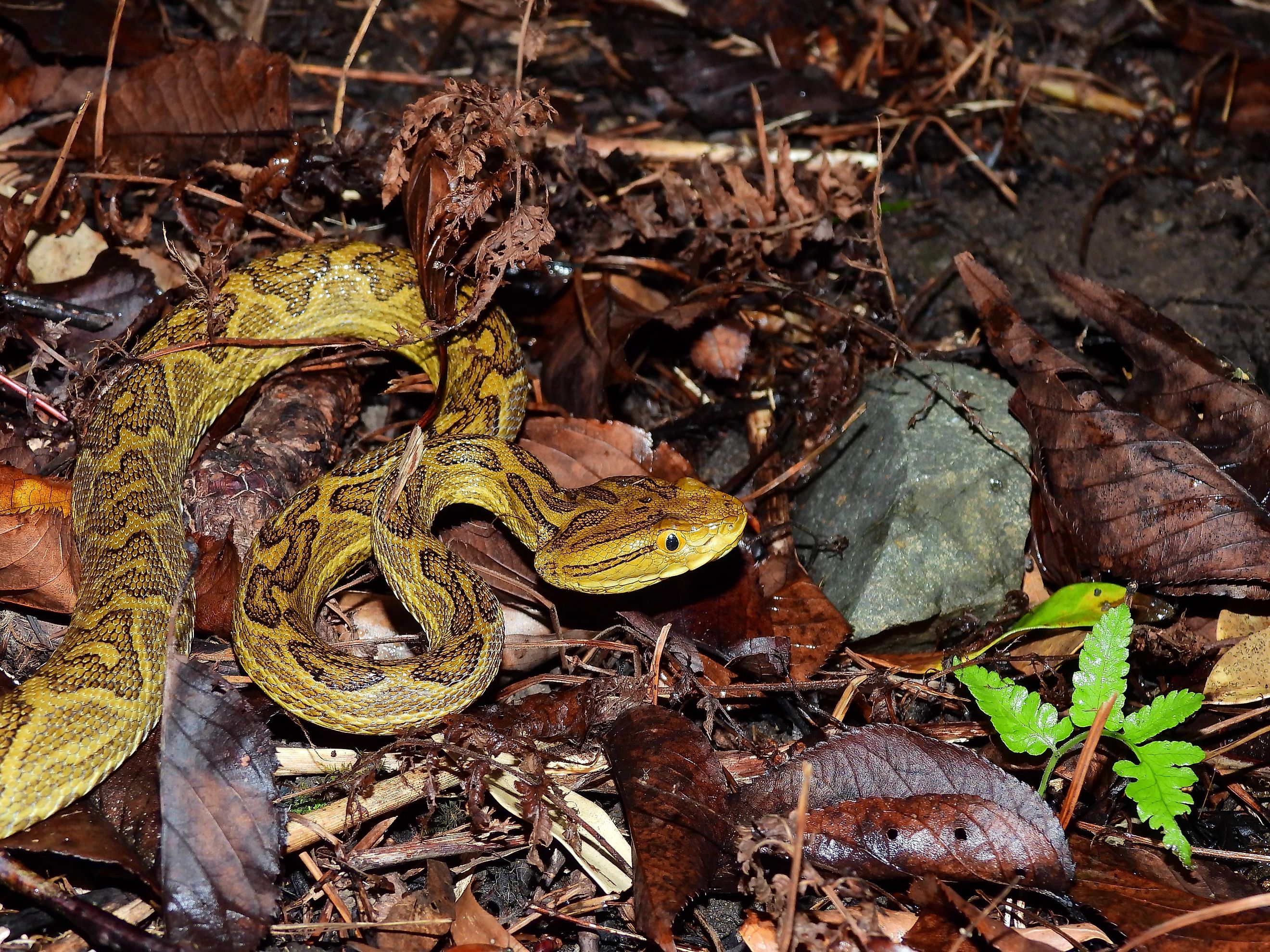
Okinawa Habu
The Okinawa habu has a long history with the people of Japan's Ryukyu Islands, where it is both feared and woven into local culture. This large pit viper is familiar to generations of Okinawans, appears preserved in traditional liquor, and even gave its name to one of the fastest aircraft ever built. Known scientifically as Protobothrops flavoviridis, it is the largest and most infamous of several venomous snakes commonly called habus.
The Okinawa habu is a night hunter built for ambush, armed with long fangs, potent venom, and heat-sensing organs that let it find warm prey in total darkness. It is common enough on the larger islands that human encounters are a regular fact of life, yet its bite is rarely fatal when treated promptly. Understanding this snake means understanding both its biology and its unusual place in Okinawan culture, agriculture, and history.
Taxonomic Classification

The Okinawa habu belongs to the family Viperidae and the subfamily Crotalinae, the pit vipers, a group defined by the heat-sensing facial pits that give them their name. Within that group it sits in the genus Protobothrops, and its full scientific name is Protobothrops flavoviridis. The species epithet flavoviridis translates roughly as yellow-green, a nod to the snake's coloration.
The American herpetologist Edward Hallowell first described the species in 1861, originally placing it in the genus Bothrops. For much of the twentieth century it was widely known as Trimeresurus flavoviridis, and that older name still appears in some references. Modern classification assigns it to Protobothrops, a genus of Asian pit vipers, and the Okinawa habu stands as the largest member of that genus. No subspecies are currently recognized as valid, which makes the species a relatively clean taxonomic unit compared with many widespread snakes.
Physical Description
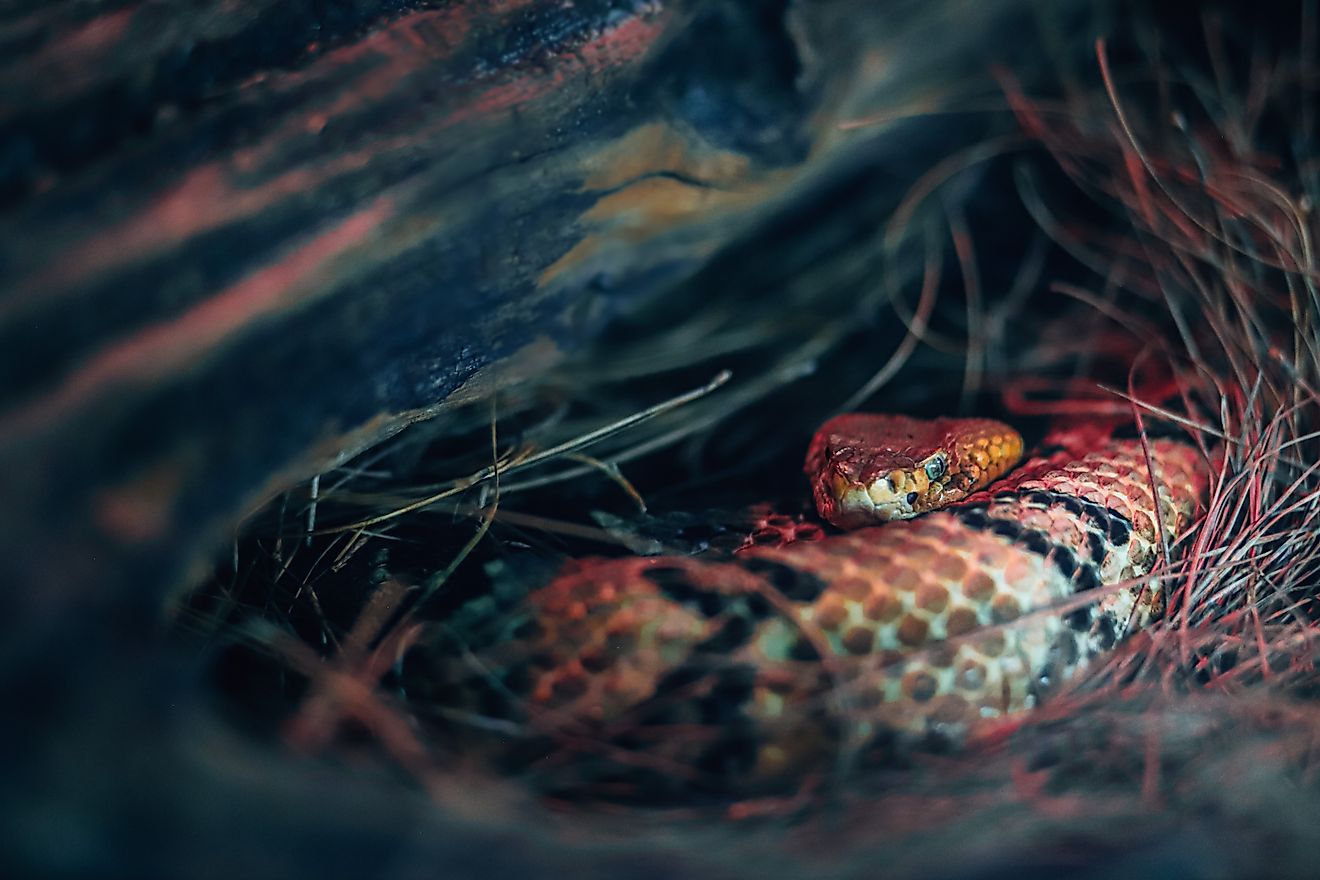
The Okinawa habu is a long, slender snake with a strikingly large, triangular head set on a narrow neck. Adults commonly reach a total length of 4 to 5 feet (120 to 150 cm), and exceptional individuals have measured as long as 7.9 feet (240 cm). That maximum size makes it not only the largest Protobothrops but one of the larger vipers in eastern Asia. Despite its length, the body is gracefully proportioned rather than heavy, an unusual trait among thick-bodied vipers.
Its ground color ranges from light olive to brown, overlaid with elongated dark green or brownish blotches. These blotches carry yellow edges, sometimes enclose yellow spots, and often merge into wavy stripes that run down the body. The belly is whitish with darker mottling along the margins. The crown of the head is covered in small scales rather than the large plates seen in many other snakes, a feature that helps distinguish it. Between each eye and nostril sits a heat-sensing pit, the hallmark of the pit viper, paired with long, hinged fangs that fold flat against the roof of the mouth until a strike drives them forward.
Range and Habitat
The Okinawa habu is endemic to the Ryukyu Islands of Japan, a chain that stretches southwest from the main Japanese archipelago toward Taiwan. Its stronghold includes Okinawa Island and the Amami Islands. The snake is common on the larger volcanic islands of the group but absent from the smaller coral islands, a distribution tied to the richer soils, denser vegetation, and larger prey base of the volcanic terrain.
Within these islands the habu favors the transition zone where palm forest meets cultivated fields. It also shelters in rock walls, old tombs, caves, and the dense vegetation along field edges. The traditional stone walls and burial tombs of Okinawa offer cool, dark crevices that suit the snake well, which is one reason encounters happen even in settled areas. Okinawa's warm subtropical climate keeps the habu active for most of the year, and it does not truly hibernate, though it slows during the coolest winter weeks.
Diet

The Okinawa habu is an ambush predator that feeds mainly on small mammals, especially the rats and mice that thrive around farms and homes. It rounds out its diet with birds, frogs, and lizards, taking whatever prey it can overpower. This appetite for rodents draws the snake toward human settlements, where grain stores and cane fields concentrate its favorite meals.
Hunting happens mostly after dark. The habu relies on its heat-sensing pits to detect the body warmth of prey in low light, a sense that works even when its eyes cannot. When a target comes within reach, the snake strikes fast, driving its long fangs deep and injecting venom that quickly subdues the animal. The habu then waits for the prey to stop struggling before swallowing it whole, a caution that spares the snake injury from a cornered rodent.
Behavior
The Okinawa habu is terrestrial and mostly nocturnal, spending its active hours on the ground rather than in trees or water. It has a reputation among residents for being bold and quick-tempered, willing to stand its ground and strike with a long reach that catches many victims by surprise. Unlike a shy snake that flees, the habu often holds position, which raises the odds of a dangerous encounter when a person disturbs it.
Its habit of entering homes, sheds, and outbuildings in pursuit of rats brings it into frequent contact with people. Activity rises during Okinawa's rainy season in May and June, when damp conditions draw out both the snakes and the animals they hunt. For most of the year the habu is a solitary, patient forager, relying on stillness and camouflage rather than sustained speed to make its living.
Reproduction
Reproduction sets the Okinawa habu apart from most of its pit viper relatives. While the majority of pit vipers give birth to live young, the Okinawa habu is oviparous and lays eggs. Mating takes place in early spring, and the female deposits her clutch in mid-summer. A single clutch can contain as many as 18 eggs, a large number for a viper.
The eggs hatch after an incubation period of about 5 to 6 weeks. Hatchlings emerge at roughly 10 inches (25 cm) in length and already resemble miniature adults, complete with functional venom and the instinct to hunt. This early independence means young habu need no parental care and begin taking small prey almost at once. In the wild the species can live for well over a decade, with reported lifespans reaching around 15 years.
Importance to the World

For all the fear it inspires, the Okinawa habu plays a useful ecological role. As a major predator of rats and mice, it helps keep rodent numbers in check across farmland and forest edge alike. Rodents damage crops and spread disease, so a healthy population of habu provides a natural form of pest control that benefits agriculture on the islands.
The Okinawa habu has a prominent place in local culture and the regional economy. It is used to make habushu, a traditional liquor produced by steeping the snake in awamori, a distilled rice spirit historically associated with medicinal and invigorating properties. Bottles containing a coiled habu have become a familiar souvenir and a recognizable symbol of the Ryukyu Islands. The snake is also important to public health research in the region, as scientists study its venom and antivenom production helps protect people from potentially fatal bites.
Threats
The Okinawa habu is currently listed as Least Concern on the IUCN Red List, based on a 2018 assessment. Even so, its population is described as decreasing. The main pressures come from human activity rather than natural predators. Large numbers of habu are collected for the habushu trade, and habitat change across the islands continues to alter the environments the snake depends on.
One chapter in the snake's history stands as a cautionary tale in wildlife management. In 1910 the small Indian mongoose (Herpestes javanicus) was introduced to Okinawa in the hope that it would reduce the habu population and cut the number of bites. The plan failed. Later studies suggest the mongoose did little to control the habu and instead preyed heavily on native birds, mammals, and reptiles, becoming a serious conservation problem in its own right. The episode is now cited around the world as an example of how introducing a predator can backfire.
Conclusion
The Okinawa habu is far more than a dangerous snake. It is a large, adaptable pit viper superbly equipped for nocturnal ambush, an egg-laying oddity among its live-bearing relatives, and a valuable rodent hunter on the islands it calls home. Its venom commands respect, yet prompt medical care makes fatal bites rare, and the snake gives back to the ecosystem far more than casual fear would suggest. Woven into liquor, language, and even the nickname of a Cold War spy plane, the habu remains one of the most recognizable animals of the Ryukyu Islands. With its numbers slowly declining, keeping this striking viper part of Okinawa's living landscape will depend on balancing human safety with respect for the role it plays.
Fun Facts
- A spy plane borrowed its name. When Lockheed SR-71 Blackbird reconnaissance aircraft flew out of bases on Okinawa, local residents thought the sleek, dangerous-looking jets resembled the snake, and the nickname "Habu" stuck among the crews.
- It breaks the pit viper mold. Most pit vipers give birth to live young, but the Okinawa habu lays eggs, making it an unusual egg-laying member of its subfamily.
- A famous conservation blunder involves this snake. The mongoose brought in to control the habu in 1910 barely touched it and instead devastated native island wildlife.
- Its bite is serious but rarely deadly. Habu venom can cause severe pain, swelling, and lasting tissue damage, yet the fatality rate sits below one percent when victims receive treatment.
- It hunts with built-in heat vision. Paired pits between the eyes and nostrils detect the body heat of prey, letting the habu strike accurately in complete darkness.
Quick Facts
- Scientific name: Protobothrops flavoviridis (formerly Trimeresurus flavoviridis)
- Family and subfamily: Viperidae, Crotalinae (pit vipers)
- IUCN status: Least Concern (2018), population decreasing
- Length: 4 to 5 feet (120 to 150 cm) on average, up to 7.9 feet (240 cm)
- Lifespan: up to around 15 years
- Diet: rats, mice, birds, frogs, and lizards
- Reproduction: oviparous, up to 18 eggs per clutch
- Range: endemic to the Ryukyu Islands of Japan, including Okinawa and the Amami Islands