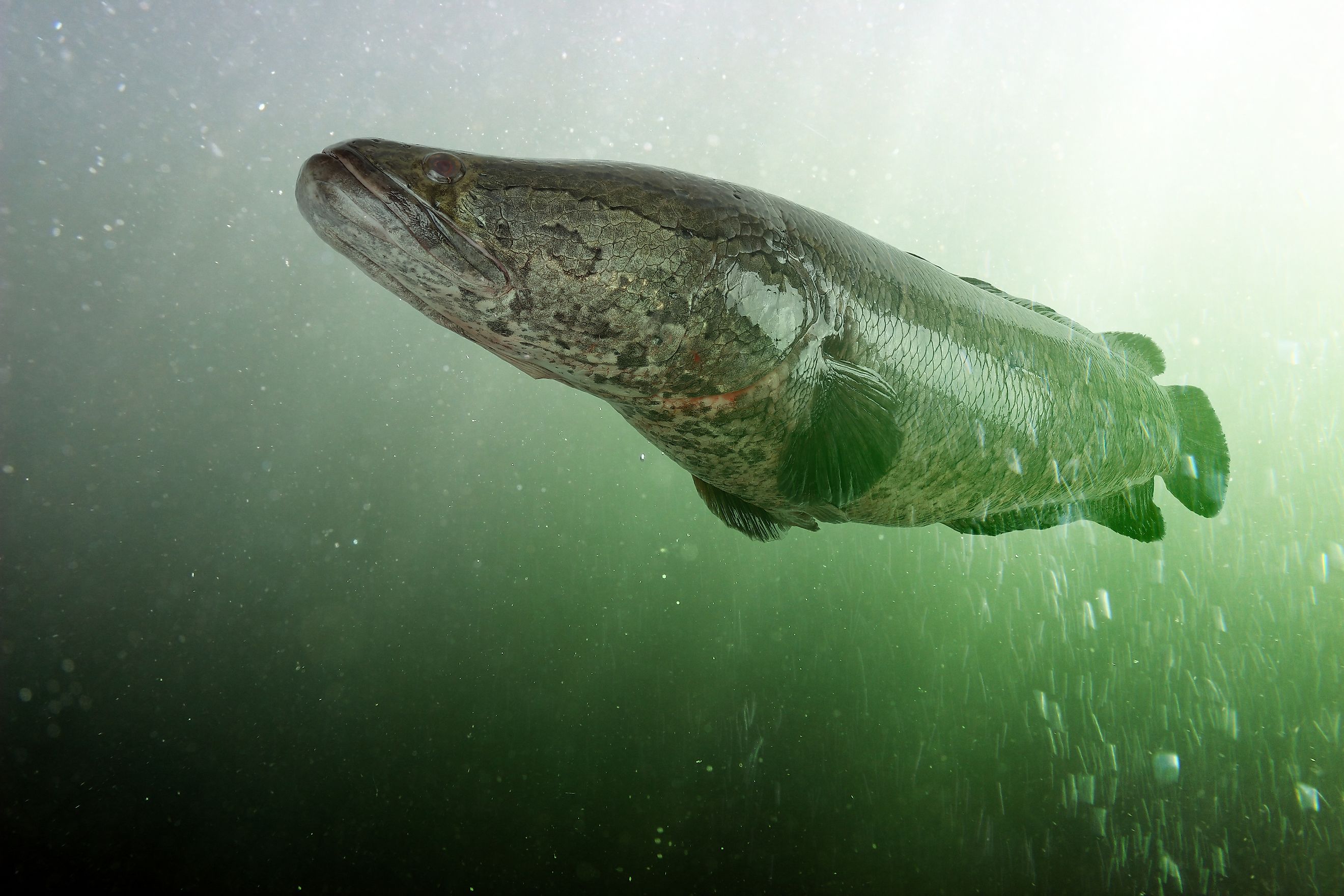
Northern Snakehead
The northern snakehead has earned a reputation as one of the more unusual freshwater predators. It can breathe air, survive out of water for several days under suitable conditions and move short distances across damp ground to reach another body of water. Its long, mottled body and flattened head give it a snake-like appearance. Native to eastern Asia, the northern snakehead (Channa argus) has become a closely monitored invasive species in North America, where it has picked up nicknames such as "Frankenfish" and "Fishzilla."
This is a fish built for survival. It tolerates low oxygen, wide temperature swings, and crowded, muddy water that would kill many other species. In its homeland it is a prized food fish and a normal part of balanced river systems. Carried far outside that range, the same toughness makes it a formidable competitor that can reshape the waters it invades.
Taxonomic Classification

The northern snakehead belongs to the family Channidae, the snakeheads, within the order Anabantiformes. Its genus, Channa, contains about fifty described species spread across Asia, while a related genus, Parachanna, holds three African snakeheads. The northern snakehead carries the scientific name Channa argus, assigned by the naturalist Theodore Cantor in 1842. The species name argus refers to Argus, the hundred-eyed watchman of Greek mythology, a nod to the pattern of dark blotches along the fish's flanks.
Several subspecies have been recognized over the years, including a larger northern form from the Amur River basin once treated as Channa argus warpachowskii and sometimes called the Amur snakehead. Modern work continues to refine these boundaries, and genetic studies have clarified which introduced American populations trace back to which source regions. For most practical purposes, the fish encountered in North America is Channa argus, the northern snakehead proper.
Physical Description
The northern snakehead has a long, cylindrical body that tapers toward a flattened, scaly head. That scaled head, which looks more like a snake than a fish, is the feature that gives the whole family its name. A single long dorsal fin runs most of the length of the back, paired with a long anal fin beneath, and the fish lacks the divided dorsal fin seen in some look-alikes. The body is tan to dark brown, overlaid with irregular darker blotches that help it blend into weedy, silty shallows.
In its native range the species can reach about 39 inches (100 cm) and weigh up to roughly 18 pounds (8 kg), though most adults are smaller. Fish in introduced American waters tend to run smaller still, averaging around 19 inches (48 cm) in the Potomac, though the largest individuals can approach 33 inches (84 cm). Juveniles and adults can look quite different because northern snakeheads change color as they mature, which sometimes leads to confusion with native species such as the bowfin and the burbot. One reliable way to tell them apart is the scaling. Scales continue smoothly from the body onto the head of a snakehead, whereas a bowfin's head is smooth and scaleless.
The most remarkable feature sits just above the gills. A chamber called the suprabranchial organ lets the northern snakehead gulp and process atmospheric air, so it can survive in stagnant, oxygen-poor water and stay alive out of water for a surprisingly long time. That single adaptation underlies much of the fish's success, both at home and abroad.
Range and Habitat

The northern snakehead is native to the river systems of eastern Asia. Its homeland reaches from the Amur basin shared by Russia and China southward through much of eastern China, and across the Korean Peninsula in both North Korea and South Korea. Within that range, it occupies a band of temperate and subtropical climates and tolerates water temperatures between near-freezing and about 85 degrees Fahrenheit (30 degrees Celsius).
Habitat preference leans toward slow or still freshwater. The fish favors shallow, weedy ponds, swamps, canals, and the sluggish margins of rivers, often in muddy or vegetated water where its air-breathing gives it an edge. Beyond its native range it has been introduced to parts of Central Asia, Japan, and eastern Europe, and most famously to the United States, where it has established breeding populations in several states. Maryland and Virginia share the best-known American stronghold along the Potomac River, and reproducing or recorded populations have also turned up in Arkansas, Pennsylvania, New York, and Delaware, among others.
Diet
The northern snakehead is a voracious predator with a broad appetite. Young fish start on zooplankton and small invertebrates, then shift as they grow toward a diet dominated by other fish. Adults will also take frogs, crayfish and other crustaceans, aquatic insects, and the occasional small reptile, bird, or mammal that strays within reach. Sharp teeth and a wide, hinged mouth let a large snakehead tackle sizable prey.
This feeding style is part of what makes the fish such a concern outside its native waters. A hungry, fast-growing predator that eats across so many groups can put heavy pressure on native fish and amphibians, competing with them for food and, in some cases, eating them outright. In a balanced native ecosystem that pressure is part of the normal order. In a newly invaded watershed it can tip the balance against species that did not evolve alongside such a competitor.
Behavior

Northern snakeheads are hardy, adaptable, and tied closely to shallow cover. They are most active in warmer months and become sluggish as water cools, and in the coldest parts of their range they can overwinter in deeper water or in the mud of a frozen pond. Their best-known behavior is the ability to move overland. Using body movements and their pectoral fins, adults can wriggle short distances across wet ground, which lets them shift between water bodies and spread on their own once established.
The air-breathing habit shapes daily life as well. Because the fish can take oxygen from the air, it survives in water that would suffocate many competitors, and it can be held out of water for several days as long as it stays moist. Young snakeheads often travel in loose groups, a behavior known as shoaling, while guarding adults can turn aggressive near a nest. Together these habits make the species difficult to remove once it takes hold.
Reproduction
Northern snakeheads are prolific breeders, and their reproductive output is a central reason they spread so readily. Spawning generally takes place in the warmer months, often from around June into midsummer, though populations in introduced waters have at times spawned repeatedly through a single season. Along the Potomac River, biologists have recorded northern snakeheads spawning up to five times in one year, well above the one to three bouts reported from much of the native range.
To breed, the fish build and defend a rough nest in vegetated shallows. The female releases her eggs over the nest and the male fertilizes them from behind. The eggs are small, yellow, and buoyant, roughly 2 millimeters (0.08 inch) across, and they float at the surface until they hatch, often within one to two days in warm water. A single female can release on the order of fifteen thousand eggs in one session and, across several spawns, as many as one hundred thousand in a year. Both parents guard the eggs and the young fry, a level of parental care that boosts survival. Wild northern snakeheads can live to about seven or eight years.
Importance and Ecological Impact

In its native range, the northern snakehead is valuable rather than villainous. It is an important food fish across much of eastern Asia and the most widely farmed snakehead in China, raised in large numbers and sold fresh in markets at home and abroad. As a native predator, it helps regulate populations of smaller fish and invertebrates, filling an ordinary ecological role in rivers and wetlands that have hosted it for millennia. The IUCN Red List assessed the species in 2020 and lists it as Least Concern, reflecting a wide distribution and a large, stable population in its homeland.
The story changes sharply where the fish is introduced. In North America, the northern snakehead is treated as an aggressive invader with the potential to outcompete and prey on native wildlife, and biologists worry it could also carry parasites or diseases harmful to local fish. A reproducing population discovered in a pond in Crofton, Maryland, in 2002 drew national headlines, and the pond was poisoned to kill the fish before they could escape. Soon after, the species was given injurious wildlife status under the federal Lacey Act, which bans importing live northern snakeheads and moving them across state lines. Many states now prohibit possessing them alive, and wildlife agencies encourage anglers who catch one to kill and keep it rather than release it. Despite those efforts the fish has established itself in the Potomac system and several other watersheds, and management now focuses on limiting its spread rather than eliminating it.
Takeaway
The northern snakehead's impact depends largely on where it lives. In eastern Asia, it is a familiar food fish and a natural part of the freshwater ecosystem, with a conservation status of Least Concern. Its ability to tolerate harsh conditions, breathe air and reproduce quickly has helped it thrive there. In the United States, however, those same traits make it difficult to control once it establishes itself outside its native range. Understanding its feeding habits, breeding cycle and ability to survive in different environments is essential to managing existing populations and preventing further spread.
Fun Facts
- It can breathe air. A special chamber above the gills, the suprabranchial organ, lets the northern snakehead take oxygen straight from the air and survive in water that would suffocate other fish.
- It can travel on land. Adults can wriggle short distances across wet ground to reach new water, a trick that helps the species spread without any help from people.
- It earned a monster nickname. American media dubbed the invasive snakehead "Frankenfish" and "Fishzilla" after breeding populations turned up in Maryland.
- Its name points to a hundred eyes. The species name argus honors Argus, the hundred-eyed giant of Greek myth, a reference to the dark spots scattered along its sides.
- One female is a population in waiting. A single northern snakehead can release up to one hundred thousand eggs in a year, and both parents guard the nest to protect them.
Quick Facts
- Common name: Northern snakehead
- Scientific name: Channa argus
- Family: Channidae
- Order: Anabantiformes
- IUCN status: Least Concern (2020 assessment)
- Length: Up to about 39 inches (100 cm)
- Weight: Up to about 18 pounds (8 kg)
- Lifespan: About 7 to 8 years
- Diet: Carnivorous, including fish, crustaceans, frogs, insects, and small vertebrates
- Native range: Freshwater rivers and wetlands of eastern Asia, including China, Russia, and the Korean Peninsula