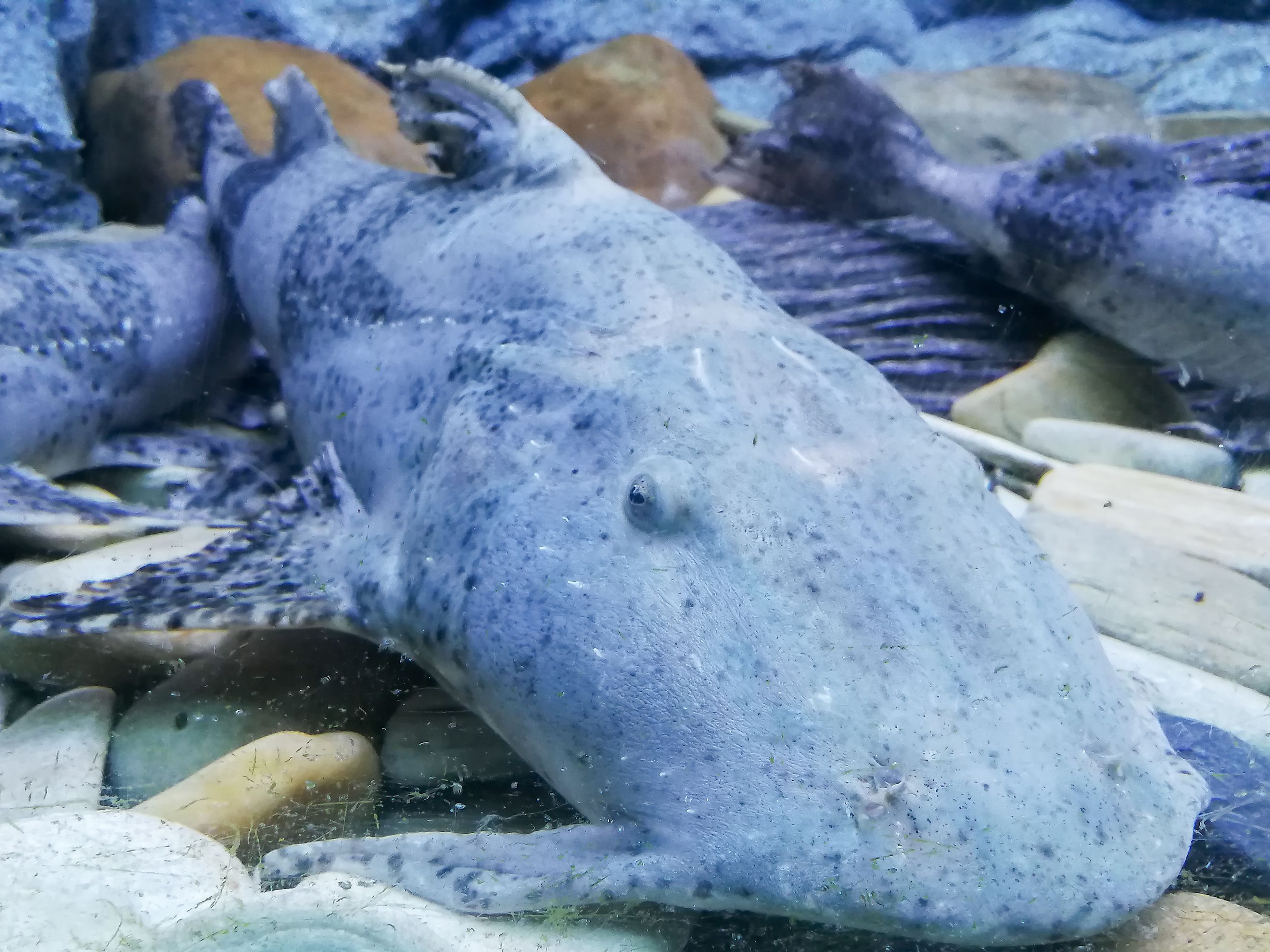
Goonch Catfish
Few freshwater fish carry a reputation as fearsome as the goonch catfish. This bottom-dwelling giant is built like a living battering ram, with a broad flattened head, a wide downturned mouth, and rows of sharp, backward-curving teeth. Large individuals can grow longer than a person is tall and outweigh a grown man, which makes the goonch one of the heaviest predatory fish in the rivers it calls home.
The goonch belongs to the genus Bagarius and is often called the giant devil catfish. It lives only in Asia, in the powerful, rock-strewn rivers of the subcontinent that tumble out of the Himalayas and drain toward the Bay of Bengal. For most of its life it stays hidden in deep pools and rocky crevices, ambushing whatever drifts past. That secretive habit, combined with its size and strength, has made the goonch the subject of folklore, television documentaries, and more than a few exaggerated tales.
Taxonomic Classification

The goonch is a ray-finned fish in the order Siluriformes, the group that contains all catfishes. Within that order it sits in the family Sisoridae, the sisorid or hillstream catfishes, a group adapted to fast-flowing water. Its genus is Bagarius, and the large goonch has long been known by the scientific name Bagarius yarrelli, described by the naturalist William Henry Sykes in 1839 and named in honor of the English zoologist William Yarrell.
The taxonomy of the group is unsettled. A detailed revision published in 2021 concluded that Bagarius yarrelli is best treated as a junior synonym of Bagarius bagarius, the species named by Francis Hamilton in 1822, which would make the older Hamilton name the valid one for the giant goonch. Several closely related species share the common name, including Bagarius suchus, Bagarius rutilus, and Bagarius vegrandis, the last of these described from Indochina only in 2021. Because the different forms look broadly similar and overlap in parts of their range, museum specimens and older records are still being reassessed, and the exact number of valid species remains a moving target.
Physical Description
The goonch has a body plan built for life pinned to the bed of a strong river. The head is wide and flattened, the eyes are small and set high, and four pairs of barbels (the whisker-like feelers common to catfish) fan out around a broad mouth. Inside that mouth sit bands of fine, recurved teeth angled to hold rather than slice, so prey that is seized rarely slips free.
Adults are among the largest freshwater fish in their range, in the same heavyweight class as the wels catfish of Europe and the Mekong giant catfish of Southeast Asia. Reliable records put the maximum length at roughly 6.5 to 7.5 feet (2 to 2.3 m), and the heaviest verified individuals have topped 300 pounds (140 kg). Such sizes are typical of the rivers where catfish grow largest. A famous specimen landed for a television program weighed about 161 pounds (73 kg) at close to 6 feet (1.8 m) long, and a goonch reported in 2017 reached roughly 308 pounds (140 kg).
Coloration ranges from gray-green to brownish, often mottled with darker blotches that break up the fish's outline against a rocky bottom. The skin is thick and loose rather than scaled. Powerful, upturned pectoral fins and a muscular, tapering tail let the goonch hold station in current that would sweep most fish downstream, and its flattened shape lets it press low against the substrate where the flow is weakest.
Range and Habitat
The goonch is a fish of big, fast rivers. Its core range runs across the northern subcontinent, centered on the Ganges, Brahmaputra, and Meghna river systems that drain toward the Bay of Bengal. It is well documented in India and Nepal, where it haunts both lowland rivers and the rocky gorges of the Himalayan foothills, and it is common in the delta waters of Bangladesh. Its range also extends west into the Indus basin of Pakistan and east into the Yunnan region of China.
Populations attributed to the goonch and its close relatives reach further into Southeast Asia, including the Mekong and Chao Phraya basins of Thailand and river systems in Myanmar, although recent taxonomic work suggests some of those fish belong to separate Bagarius species.
Within these rivers the goonch favors swift, clear, well-oxygenated stretches with beds of rock, boulder, and sand. It shelters in deep holes, undercut banks, and the scoured pools below rapids, moving into faster water to feed. It can also tolerate the brackish, lower reaches of the great deltas, which lets it range across a wide band of habitats from cold mountain torrents to warm tidal rivers near the sea.
Diet
The goonch is a formidable ambush predator. Rather than chasing prey across open water, it lies still on the riverbed and waits, then lunges with a sudden surge to engulf whatever comes within reach. Its wide mouth and gripping teeth are suited to seizing large, slippery prey and holding on, and once a goonch takes hold it tends not to let go.
The bulk of its diet is other fish, but it is an opportunist that will take almost any animal it can overpower. Shrimp, crabs, insects, frogs, and smaller fish all feature, and larger goonch are known to take sizeable prey that drifts or falls into the water. In the lower reaches of its rivers it also scavenges, feeding on carrion and refuse carried by the current. This willingness to eat both living prey and whatever the river delivers is central to the stories that surround the fish, and it is also what allows big individuals to pack on weight in rivers rich with food.
Behavior
Goonch are largely solitary and secretive. They spend the daylight hours hidden in deep cover and become more active in low light and at night, when they move out to hunt. Built for holding position in heavy current, a goonch can wedge itself among boulders and wait out even the strongest flow, which is one reason the species is so rarely seen despite its size.
Little is firmly known about how far individuals travel, but the goonch is considered potamodromous, meaning it migrates within freshwater rather than moving between rivers and the sea. Seasonal rises in water level, particularly during the monsoon, appear to trigger movement upstream and into feeding grounds. Because the fish lives in turbid, fast, and often dangerous water, much of its day-to-day behavior has been pieced together from catches and brief observations rather than sustained study, and it remains one of the less understood large fish of the region.
Reproduction
Reproduction in the goonch is poorly documented, a common gap for large river fish that are hard to observe in the wild. Spawning is thought to coincide with the monsoon, when rising, faster water and fresh flooding create the conditions many river catfish use for breeding. Adults are believed to move upstream to spawn over rocky or gravelly beds in flowing water.
The number of eggs a female produces, the way the young develop, and the role, if any, that parents play in guarding them have not been clearly established for this species. Growth appears to be slow compared with many other large catfish, which means individuals take years to reach the sizes that make the goonch notable. Slow growth and late maturity also make the fish vulnerable to overfishing, because populations recover slowly once large, breeding adults are removed.
Importance to the World
As an apex predator, the goonch helps regulate the fish and invertebrate populations of its rivers, and as a scavenger it helps clear carrion from the water. Removing a large predator of this kind can ripple through a river community, so the goonch plays a real part in keeping its ecosystem in balance.
The goonch is also an important fish for the people who live along its rivers. It is caught for food and sold in local markets, while its size makes it an appealing catch for both sport and subsistence fishers. More recently, it has attracted international attention, drawing anglers and film crews to remote Himalayan rivers in search of a giant catch. That interest can bring income to local communities, but it comes at a cost. The goonch grows slowly, leaving populations little time to recover when fishing pressure becomes too high.
Threats and Conservation
The goonch is in trouble across much of its range. The International Union for Conservation of Nature (IUCN) has assessed the species as Vulnerable, in a 2022 review carried out under the name Bagarius bagarius, after earlier listings had rated it as Near Threatened. The population trend is judged to be decreasing.
Overfishing is the central problem. The goonch is heavily targeted for food and for the aquarium trade, and because it grows slowly and matures late, large adults are stripped from rivers faster than they can be replaced. Dams and barrages add to the pressure by blocking the upstream movements the fish relies on and by changing the flow and temperature of the water below them. Pollution, sand mining, and the general degradation of river habitat further shrink the clean, fast, rocky stretches the species needs.
Conservation measures are patchy. Some countries list the goonch among their threatened freshwater fish, and there are calls for catch limits, protected river reaches, and better management of the fisheries that target it. Reliable population figures remain scarce, which makes the fish harder to protect, so improved monitoring is widely seen as an urgent first step.
The Kali River Legend

The goonch is also known for a disturbing legend tied to the Kali River, which flows along the Himalayan border between India and Nepal. Several fatal incidents involving swimmers and bathers between the late 1980s and 2007 were blamed on an unusually large goonch, with one suspected fish estimated to weigh around 200 pounds (90 kg).
The incidents drew the biologist and angler Jeremy Wade, who investigated them for the television series River Monsters and landed a goonch of about 161 pounds (73 kg) in the river. A popular theory holds that the stretch of water, where Hindu funeral rites release partially burned remains into the river, may have given resident goonch an unusual food source, allowing a few individuals to grow very large and perhaps to associate people with food. The theory is hard to prove, and attacks by large catfish on humans are rare and poorly understood. Still, the episode cemented the goonch's status as one of the most storied freshwater fish in the world and turned a little-known river predator into a household name among anglers.
Takeaway
The goonch catfish is an impressive predator, but its reputation often overshadows the animal itself. Adapted to life in the fast-flowing rivers of the Indian subcontinent, it has a flattened body, powerful jaws and the strength to hunt in challenging currents. It is a specialized river fish, shaped by its environment over countless generations.
Yet its size and strength offer little protection against the pressures people put on its habitat. Overfishing, dam construction and pollution are changing the rivers it depends on, putting local populations at risk. Its future will depend on whether these waterways can remain healthy enough to support it. The goonch may continue to inspire stories about a giant river monster, but protecting the real animal matters far more than preserving its legend.
Fun Facts
- It inspired a hit television episode. The goonch was the star of one of the most popular installments of the series River Monsters, which helped turn a little-known catfish into an internet legend.
- Its grip is the stuff of nightmares. Rows of fine, backward-curving teeth are built to hold rather than cut, so prey seized by a goonch rarely wriggles free.
- It has earned some vivid nicknames. Across its range the fish is known as the giant devil catfish, the giant painted catfish, and even the sand shark.
- Big ones outweigh a grown man. The heaviest verified goonch have exceeded 300 pounds (140 kg), making them among the largest freshwater fish in their rivers.
- It thrives where other fish cannot. The goonch can hold its position in rushing, boulder-strewn water that would sweep most fish downstream.
Quick Facts
- Common name: Goonch, also called giant devil catfish, giant painted catfish, or sand shark
- Scientific name: Bagarius yarrelli, often treated as a synonym of Bagarius bagarius
- Family: Sisoridae (order Siluriformes)
- IUCN status: Vulnerable (assessed 2022, earlier listed as Near Threatened), population decreasing
- Length: Up to about 6.5 to 7.5 feet (2 to 2.3 m)
- Weight: Heaviest verified individuals over 300 pounds (140 kg)
- Lifespan: Not well documented, slow-growing, with large adults taking many years to develop
- Diet: Carnivore and scavenger, feeding on fish, invertebrates, frogs, and carrion
- Range: Fast rivers of the subcontinent, including India, Nepal, Bangladesh, Pakistan, and parts of China, with related populations in Southeast Asia
- Habitat: Swift, clear, well-oxygenated rivers with rocky and sandy beds, deep pools, and gorges