Sea Krait
The potent neurotoxic venom of sea kraits, marine snakes in the genus Laticauda, can be up to ten times more powerful than a rattlesnake's. Found across tropical and subtropical coastal waters of the eastern Indian and western Pacific Oceans, sea kraits are among the most distinctive reptiles found along Indo-Pacific coasts. Unlike fully aquatic sea snakes, sea kraits are semiaquatic and routinely return to land to rest, digest meals, slough their skin, reproduce, and lay eggs. As amphibious marine predators, sea kraits typically use their venom to immobilize marine prey like fish and eels. Encounters with humans rarely result in bites, but sea krait envenomation can be medically serious and requires immediate treatment. Here's a primer on the eight species of this fascinating marine predator.
Taxonomic Classification

Sea kraits are members of the genus Laticauda in the family Elapidae, which also contains cobras, mambas, coral snakes, and fully aquatic sea snakes. The Reptile Database currently recognizes eight species of Laticauda. Modern evolutionary studies indicate that the sea krait lineage originated from terrestrial elapid ancestors roughly 16 million years ago and evolved adaptations that allow these snakes to forage extensively in marine habitats while retaining a strong dependence on land.
The taxonomic position of sea kraits has been debated. Some researchers have proposed treating the group as a separate family, Laticaudidae, or dividing it between Laticauda and Pseudolaticauda. These arrangements have not become the dominant modern treatment, and major reptile databases continue to recognize the eight species within the single genus Laticauda in Elapidae.
Physical Description

Sea kraits are medium-sized snakes, although adult size varies by species and sex. Females are often considerably larger than males, particularly in species such as the yellow-lipped sea krait. Many sea kraits reach around 3 to 5 feet in length. As semiaquatic animals, they combine traits suited to terrestrial movement with adaptations for swimming. Their streamlined bodies are commonly marked with conspicuous dark bands alternating with pale, bluish, gray, or yellowish areas, although coloration differs among species.
Like fully aquatic sea snakes, sea kraits have a vertically flattened, paddle-shaped tail that propels them through the water. In yellow-lipped sea kraits, researchers have proposed that similarities in the coloration and movement of the head and tail may help confuse potential predators while the snake's head is hidden inside reef crevices.
Sea kraits also possess valvular nostrils that can be closed underwater and an elongated lung suited to an air-breathing reptile that spends long periods at sea. Some individuals have been recorded diving to depths of roughly 262 feet (80 meters), although dive depth and duration vary by species. Unlike fully aquatic sea snakes, sea kraits retain broad ventral scales that provide traction when slithering across rocks and beaches.
Another important marine adaptation is a specialized sublingual salt gland. This gland secretes highly concentrated salt solution into the tongue sheath, and extension of the tongue helps expel the fluid. However, the gland does not eliminate the snakes' dependence on freshwater. Research has shown that sea kraits dehydrate without freshwater and rely heavily on rainfall and freshwater sources when they return to land. Their short, fixed front fangs deliver venom containing powerful neurotoxins that rapidly disable prey.
Range And Habitat

Sea kraits habitually inhabit the littoral zone of coastal waters aside from spending time shorewards in the shallow waters around coral reefs, rocky coastlines, coastal caves, lagoon systems, mangrove forests, small rocky islets, and coral islands. They are found throughout the tropical and warm temperate waters of the eastern Indian and western Pacific Oceans.
The yellow-lipped sea krait has the widest distribution in the genus, extending from the Bay of Bengal and Andaman region through Southeast Asia and many western Pacific islands, north to southern Japan and east through areas including Fiji, Vanuatu, the Solomon Islands, and Tonga. Other species have far smaller ranges. Sea kraits also occasionally reach areas outside their normal breeding range. Individuals sometimes appear in New Zealand waters, for example, but no resident breeding sea krait population is known there.
Key Sea Krait Species

Around eight species of sea kraits are currently recognized. These include:
Yellow-lipped sea krait (Laticauda colubrina): widely distributed, semiaquatic venomous snake species identified by a yellow-colored snout and upper lip scales and characteristic bold black crossbands around a dark blue-grey ground color body.
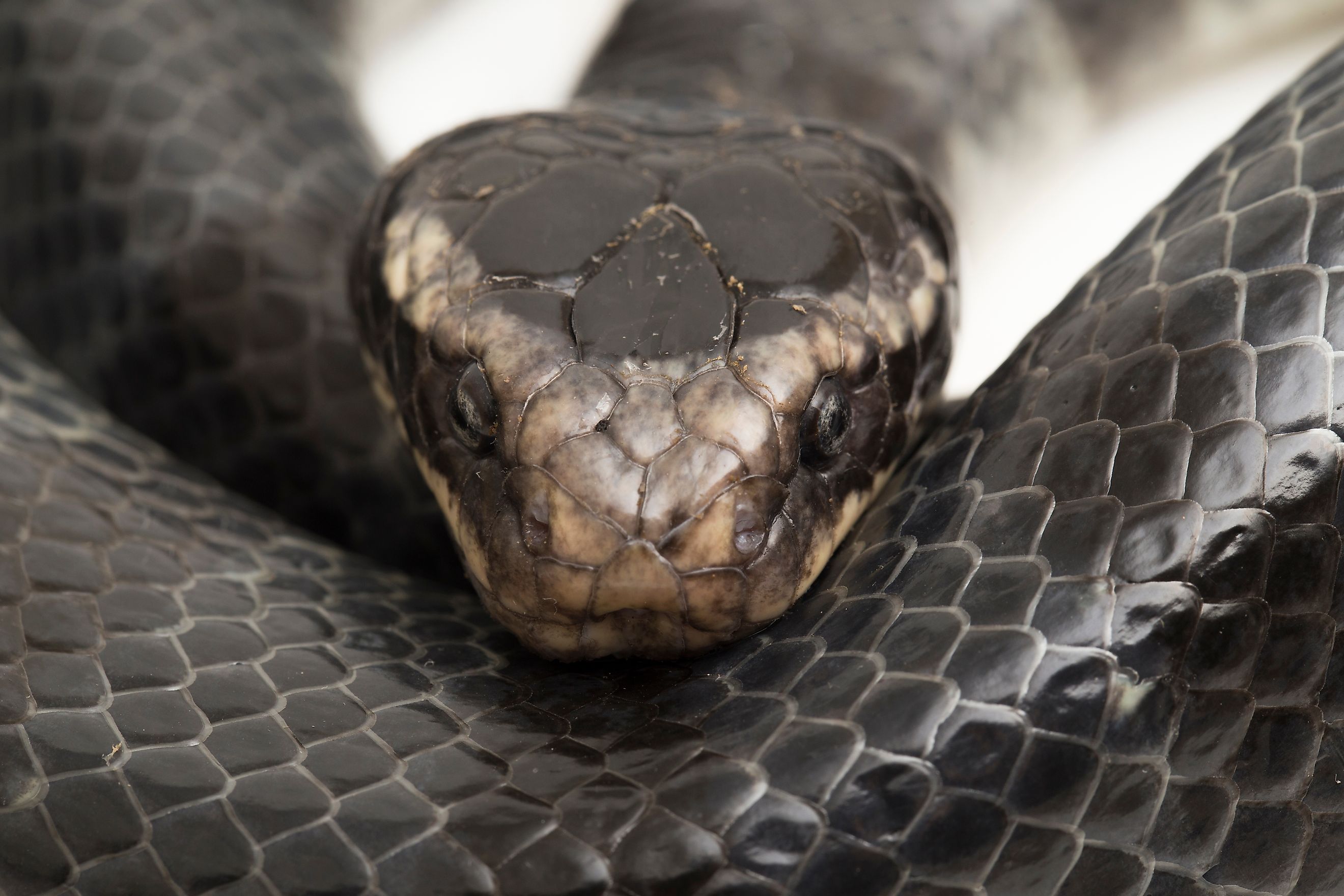
Crocker’s sea snake (Laticauda crockeri): A melanistic freshwater-adapted sea krait endemic to Lake Tenggano on Rennell Island in the Solomon Islands. Has distinct sexual dimorphism, with females being longer and heavier than males. Listed as ‘Vulnerable’ in the IUCN Red List.
Black-banded sea krait (Laticauda semifasciata): Detected by its conspicuous black-and-white bands, this extremely venomous snake species is found in the western Pacific’s warm coastal waters. Listed as ‘Near Threatened’ in the IUCN Red List.
Flat-tail sea snake or katuali (Laticauda schistorhyncha): This venomous back-and-white striped sea krait is found solely in the sea caves and coastal waters around Niue in the southern Pacific. Listed as ‘Vulnerable’ in the IUCN Red List.
New Caledonian sea krait (Laticauda saintgironsi): Clearly identified by alternating bands of dark black and lighter fawn and a yellow snout and upper lip, this sea krait species is endemic to the marine and coastal zones of New Caledonia, and is regularly observed nesting together in 'nurseries.'
Blue-lipped sea krait (Laticauda laticaudata): Has a unique dark brown upper lip scale area, a creamy-yellow band across the snout, and a cyan to blue body wholly encircled by thick black bands.
Guinea’s sea krait (Laticauda guineai): A rare sea krait native to the coastal waters of southern New Guinea. Listed as ‘Near Threatened’ in the IUCN Red List.
Laticauda frontalis: A dwarf sea krait species found in sympatry with the yellow-lipped sea krait in the waters off Vanuatu and New Caledonia’s Loyalty Islands. Listed as ‘Near Threatened’ in the IUCN Red List.
Food

Sea kraits are specialized marine carnivores that hunt underwater. They are primarily piscivorous, and eels are particularly important prey for several species. Yellow-lipped and blue-lipped sea kraits feed almost exclusively on moray and conger eels in many studied populations, while other Laticauda species consume different types of reef fish.
Their relatively small heads and slender bodies allow them to probe narrow coral and rocky crevices that larger predators cannot enter. Once prey is located, the sea krait bites and injects venom containing neurotoxins that rapidly impair the animal's movement. The snake then swallows its prey whole. Sea kraits commonly return to land after feeding, where they can remain sheltered while digesting large meals.
Behavior

Sea kraits divide their lives between marine and terrestrial environments. They forage at sea but return ashore to rest, digest prey, drink freshwater, slough their skin, and reproduce. Many populations are particularly active around dusk, dawn, or nighttime, although activity patterns vary by species and local conditions.
Some sea kraits also display unexpectedly complex hunting behavior. Observations of black-banded, or erabu, sea kraits in Indonesia documented communal hunts involving multiple sea kraits and predatory fishes. Despite possessing powerful venom, sea kraits generally avoid confrontation. However, they should never be handled. Envenomation can cause serious neurological and muscular effects, and any suspected sea snake or sea krait bite requires immediate medical assessment.
Reproduction

Unlike fully aquatic sea snakes, which give birth to live young in the water, sea kraits are oviparous. Females must return to land to deposit leathery eggs in sheltered terrestrial sites such as rock crevices and coastal caves. Suitable nesting locations appear to be quite specific, and wild sea krait nests are encountered surprisingly rarely.
Clutch size varies among species and even among populations of the same species. Yellow-lipped sea kraits, for example, have been reported laying clutches of four to 10 eggs in Fiji and 14 to 20 in New Caledonia. Black-banded sea kraits have been reported laying smaller clutches. Incubation also varies, with periods of roughly four to five months reported for some species.
Courtship and mating behavior also varies. Studies of yellow-lipped sea kraits in Fiji found courtship occurring on land, where one or more males may accompany a much larger female for extended periods. Males align their bodies with the female and periodically twitch during courtship. After eggs are laid, females provide no parental care, and hatchlings emerge as independent, venomous snakes capable of hunting for themselves.
Threats

Conservation pressures differ considerably among the eight sea krait species. Some species remain widespread, whereas others occupy exceptionally restricted ranges. Crocker's sea krait and the Niue sea krait, for example, are both listed as Vulnerable, while the black-banded sea krait, L. frontalis, and Guinea's sea krait are listed as Near Threatened.
Human exploitation has had particularly severe effects in some areas. Historical harvesting of black-banded sea kraits for skins and food was associated with major population declines in the Philippines. Marine snakes can also be caught incidentally in fisheries.
Habitat alteration presents another concern because sea kraits require both marine feeding habitat and suitable terrestrial sites. Coastal development can remove shelters, freshwater sources, and potential nesting habitat. Climate change and rising sea levels may create additional risks for species that depend on low-lying islands and narrow coastal zones, while degradation of coral reefs can alter marine foraging habitat. These combined land-and-sea requirements make sea kraits particularly dependent on conservation measures that protect both sides of the shoreline.
Importance to the World
Sea kraits occupy an unusual position among living reptiles because their lives are divided so clearly between land and sea. Their paddle-shaped tails and other aquatic adaptations allow them to forage effectively underwater, while their broad belly scales, egg-laying reproduction, and dependence on terrestrial shelter preserve strong connections to life on land. Their physiology has consequently made them valuable subjects for scientists studying marine adaptation, locomotion, and the repeated evolution of marine lifestyles among reptiles.
Ecologically, sea kraits are specialized predators functioning within coastal and reef food webs. Protecting sea kraits therefore requires more than preserving seawater habitat alone. Their survival depends on connected marine feeding areas, terrestrial shelters and nesting locations, and reliable access to freshwater.