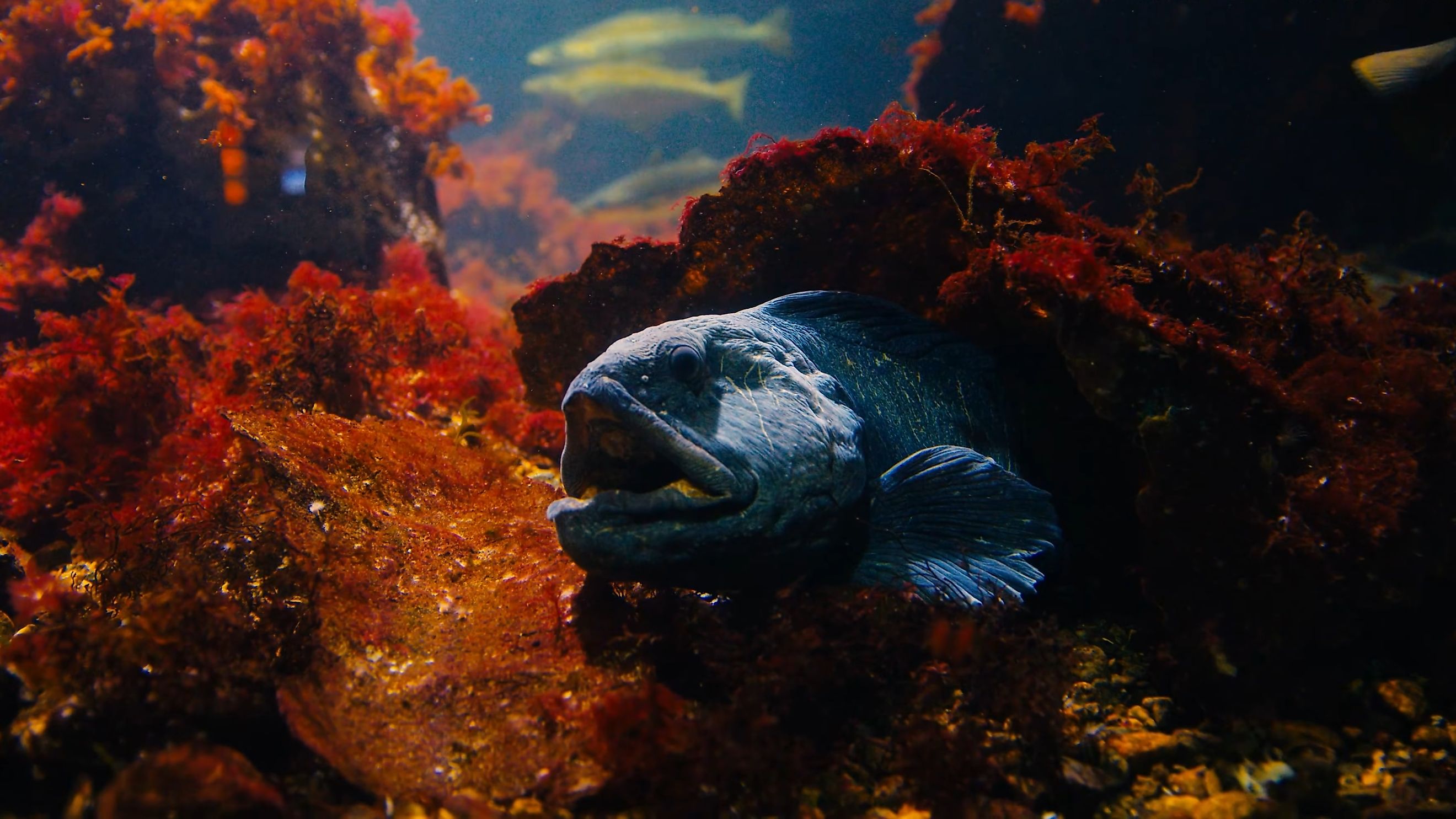
Atlantic Wolffish
The Atlantic wolffish looks like a predator assembled from the wrong parts, a heavy eel-shaped body fronted by a blunt head and a mouth full of fangs. Yet this fish rarely chases anything. It is a slow, deliberate, bottom-dwelling hunter of the cold North Atlantic, built to crush rather than pursue. Known also as the seawolf, ocean catfish, or devil fish, the Atlantic wolffish (Anarhichas lupus) earned its name from the canine-like teeth that jut from its jaws even when its mouth is closed.
Found on rocky seafloors along the coast of New England and north into the Arctic, and in the eastern Atlantic along the Scandinavian coast south to the Bay of Biscay, the wolffish plays a role far larger than its modest numbers suggest. It keeps sea urchins and crabs in check, and where it thrives, kelp forests tend to thrive with it. It is also one of very few fish that produces its own antifreeze, a trait that lets it live in water cold enough to kill most other species.
Taxonomic Classification

The Atlantic wolffish belongs to the family Anarhichadidae, a small group of cold-water fishes commonly called wolffishes. Carl Linnaeus described the species in 1758 and placed it in the genus Anarhichas, of which it is the type species. The specific name lupus is Latin for wolf, a nod to the animal's toothy grin rather than any resemblance in behavior.
The wolffish is placed in the order Perciformes (suborder Zoarcoidei), alongside eelpouts and pricklebacks, though some classifications instead assign the family to the order Scorpaeniformes. The family contains a handful of species, including the spotted wolffish and the northern wolffish, plus the Pacific wolf eel, which is a close relative rather than a true eel. Genetic work has confirmed that the Atlantic wolffish is a single species across its wide range, even though populations in different regions show measurable genetic differences.
Physical Description

The Atlantic wolffish has a long, subcylindrical body that tapers toward a compressed tail, a shape it shares with the small blennies it distantly resembles. The largest reliably recorded specimen stretched about 5 feet (1.5 m) and weighed close to 40 pounds (18 kg), although most adults are smaller. A single long dorsal fin runs almost the entire length of the back, and the fish has no pelvic fins at all. Its skin is smooth and slippery, with rudimentary scales buried so deep they are nearly invisible.
Coloration varies through purplish brown, dull olive green, and blue gray, often marked with ten or more dark vertical bars along the sides. The head is large and rounded, and the whole animal moves with a slow, side-to-side undulation rather than the darting speed of open-water fish.
The teeth are the defining feature. At the front of the mouth sit strong, conical canines that protrude even when the jaws are shut. Behind them lie clusters of smaller canines and, on the roof of the mouth and along the jaws, rows of blunt crushing teeth built like molars. This combination lets the wolffish seize a hard-shelled animal, wrench it loose, and grind it apart. The jaw muscles behind this apparatus are powerful enough to shatter a sea urchin or a thick clam shell with ease.
Range and Habitat

The Atlantic wolffish lives on both sides of the North Atlantic and into the Arctic. In the western Atlantic it occurs as far north as southern Labrador and western Greenland and as far south as Cape Cod, Massachusetts, with occasional records reaching New Jersey. In the eastern Atlantic it reaches north to Spitsbergen and the White Sea and extends south through the Scandinavian coasts, the North Sea, and the British Isles to the northern Bay of Biscay, along with Iceland and southeastern Greenland.
This is a bottom-dwelling fish that favors hard ground, rocky reefs, boulder fields, and areas riddled with crevices where it can shelter. It is usually found at depths of roughly 60 to 360 feet (18 to 110 m), though it has been recorded just below the surface and as deep as about 2,000 feet (600 m). The wolffish tolerates a wide temperature range, roughly minus 1.5 to 13 degrees Celsius (about 29 to 55 degrees Fahrenheit), but it concentrates in colder water and generally prefers temperatures between 3 and 6 degrees Celsius (37 to 43 degrees Fahrenheit). Water temperature appears to be one of the main factors deciding where the fish settles.
Diet

The Atlantic wolffish is a specialist in hard food. Its diet centers on shelled and spiny invertebrates that slower or softer-mouthed predators cannot easily handle. Sea urchins, crabs (including the invasive green crab), whelks, cockles, clams, and other mollusks make up the bulk of its meals, along with starfish and other echinoderms. It hunts by moving methodically across the seafloor and crushing whatever it finds, using the front canines to pry prey loose and the rear molars to grind through shell and spine.
Despite a face that suggests otherwise, the wolffish is not a fast-swimming fish eater. Adults take little in the way of other fish, and their reputation rests on power rather than speed. This crushing diet takes a toll on the teeth, which wear down heavily over a season of shell breaking. The fish replaces them regularly, growing fresh sets to keep its equipment sharp.
Behavior

The Atlantic wolffish is largely solitary and sedentary. Rather than roaming widely, an individual tends to hold to a home area of rocky bottom, retreating into a den or crevice between feeding bouts. It does not migrate over long distances in the way many commercial fish do, and its limited movement is one reason local populations recover slowly once reduced.
For all its fearsome look, the species is not aggressive toward divers or other animals outside of feeding and nest defense. Its slow metabolism suits the cold, dark environment it inhabits, where energy is conserved and meals may be spaced far apart. The wolffish is most active near the bottom and relies on its crushing bite rather than pursuit, an approach well matched to prey that cannot flee quickly.
Reproduction

Reproduction sets the Atlantic wolffish apart from most fish. It reaches sexual maturity late, generally between 8 and 10 years of age in the northwest Atlantic, which is old for a fish and a major reason the species is slow to rebound. Pairs form bonded relationships in spring and summer and, unusually, fertilize their eggs internally rather than releasing sperm and eggs into open water. Spawning occurs in the fall, often in September and October.
A female lays a large, cohesive cluster of eggs, commonly numbering several thousand and reported as high as 12,000 in large individuals. The eggs are among the biggest produced by any fish, reaching around 6 millimeters across, and are deposited in a sheltered spot under boulders or in a rock crevice. From there the male takes over. He guards the nest for the full incubation period, which can last several months, and during that time he largely stops feeding and becomes far more defensive. Once the large larvae hatch, they linger near the nest before drifting up into the water column, where they spend weeks to months before settling to the bottom as juveniles. This level of parental care is rare among fish and contributes to a relatively low but well-protected reproductive output.
Importance to the World

The Atlantic wolffish functions as a keystone predator on cold rocky reefs. By eating large numbers of sea urchins, it keeps urchin populations from exploding and grazing kelp forests down to bare rock. Healthy kelp forests, in turn, shelter countless other species and help store carbon, so the wolffish's appetite has effects that ripple well beyond its immediate prey. Where wolffish decline, urchin numbers can surge and kelp can collapse, a pattern documented in parts of the North Atlantic.
The fish also helps control green crabs, an invasive species damaging to many coastal habitats. Because it depends on stable bottom communities, the health of wolffish populations serves as an indicator for the condition of other seafloor species, including Atlantic cod. Commercially the species is modest. It is valued as food and has been the subject of limited aquaculture, but there is no large targeted fishery for it in United States or Canadian waters.
Threats

The main pressures on the Atlantic wolffish come from fishing and habitat disturbance. Though few boats target it directly, the species is caught frequently as bycatch in bottom trawls and traps set for other groundfish. Its late maturity, slow growth, sedentary habits, and dependence on specific rocky habitat make it especially vulnerable, because populations reduced by fishing take a long time to recover. Bottom trawling can also damage the reef structure the fish needs for shelter and nesting.
Conservation status varies by region. In United States waters the Atlantic wolffish is listed as a Species of Concern by the National Marine Fisheries Service. A 2008 petition to protect it under the Endangered Species Act was reviewed and, in November 2009, found not warranted. A 2017 stock assessment concluded the species was overfished in the region, although overfishing was no longer occurring. In Canada, it is designated Special Concern by the Committee on the Status of Endangered Wildlife in Canada. The IUCN has assessed the species as Data Deficient in Europe, and the Baltic Sea population has been classified as endangered on the regional Red List. Warming seas add a further long-term concern, since this is a cold-water animal with limited ability to shift its range.
Takeaway
The Atlantic wolffish may look intimidating, but it spends much of its time crushing shellfish and guarding its nest. It grows slowly, matures late and invests considerable effort in protecting its eggs, leaving it poorly equipped to recover from heavy fishing pressure. Bottom trawling can damage its habitat, while warming waters add another challenge. The wolffish also plays a useful role in its ecosystem by feeding on sea urchins and other hard-shelled animals. Protecting it means preserving the rocky reefs and kelp beds of the North Atlantic, where it finds food and shelter.
Fun Facts

- It makes its own antifreeze. The wolffish produces antifreeze proteins that stop ice crystals from forming in its blood, letting it survive water below the normal freezing point of seawater.
- It grows new teeth constantly. Crushing shells wears its teeth down badly, so the fish sheds and regrows them regularly throughout its life.
- Fathers do the babysitting. The male guards the egg mass for months and mostly stops eating during that time, unusually devoted behavior for a fish.
- Its eggs are giants. At around 6 millimeters across, wolffish eggs rank among the largest laid by any fish.
- It fertilizes internally. Unlike most fish, which spawn into open water, wolffish pairs fertilize their eggs inside the female before she lays them.
- It defends kelp forests by eating urchins. By keeping sea urchin numbers down, the wolffish helps prevent kelp forests from being grazed to bare rock.
Quick Facts
- Common name: Atlantic wolffish (also seawolf, ocean catfish, devil fish, sea cat)
- Scientific name: Anarhichas lupus
- Family: Anarhichadidae
- Order: Perciformes (suborder Zoarcoidei)
- Conservation status: Data Deficient in Europe (IUCN), Species of Concern in the United States, Special Concern in Canada
- Length: up to about 5 feet (1.5 m)
- Weight: up to about 40 pounds (18 kg)
- Lifespan: around 20 years
- Diet: hard-shelled invertebrates such as sea urchins, crabs, mollusks, and whelks
- Range: North Atlantic and Arctic, both eastern and western coasts
- Depth: usually 60 to 360 feet (18 to 110 m), down to about 2,000 feet (600 m)
- Sexual maturity: 8 to 10 years of age