Mekong Giant Catfish
The Mekong giant catfish is among the largest exclusively freshwater fish ever reliably documented, a scaleless behemoth capable of reaching the length of a small car and the weight of a grizzly bear. In 2005, fishermen in northern Thailand landed a female that stretched nearly 9 feet (2.7 m) and tipped the scales at 646 pounds (293 kg), a catch that earned the species a Guinness World Record and cemented its reputation as a true river giant.
Native to a single river system in Southeast Asia, this pale, whiskerless animal glides through the murky main channels of the Mekong, feeding on plants and algae despite its enormous frame. It is a fish of superlatives and paradoxes, a shark-shaped swimmer that grows faster than almost any other fish yet now teeters on the edge of extinction.
For biologists and conservationists, the Mekong giant catfish (Pangasianodon gigas) is far more than a record holder. It is a living symbol of one of the planet's great rivers and a warning sign of what happens when dams, nets, and pollution collide with a species that needs hundreds of miles of open water to survive.
Taxonomic Classification

The Mekong giant catfish belongs to the animal kingdom, the phylum Chordata, and the class Actinopterygii, the ray-finned fishes. Within that class it sits in the order Siluriformes, the catfishes, and the family Pangasiidae, a group often called the shark catfishes for their sleek, streamlined bodies and strong swimming in large rivers. Its scientific name is Pangasianodon gigas, and the species was formally described by the French ichthyologist Pierre Chevey in 1931.
The genus name Pangasianodon sets this fish apart from the closely related Pangasius catfishes that share the Mekong, and older references sometimes list it under the synonym Pangasius gigas. It is one of only two species in its genus, alongside the striped catfish (Pangasianodon hypophthalmus), a much smaller and far more common relative that is widely farmed across the region. Juvenile Mekong giant catfish can be difficult to tell apart from that relative, which has complicated efforts to estimate how many young fish survive in the wild.
Physical Description

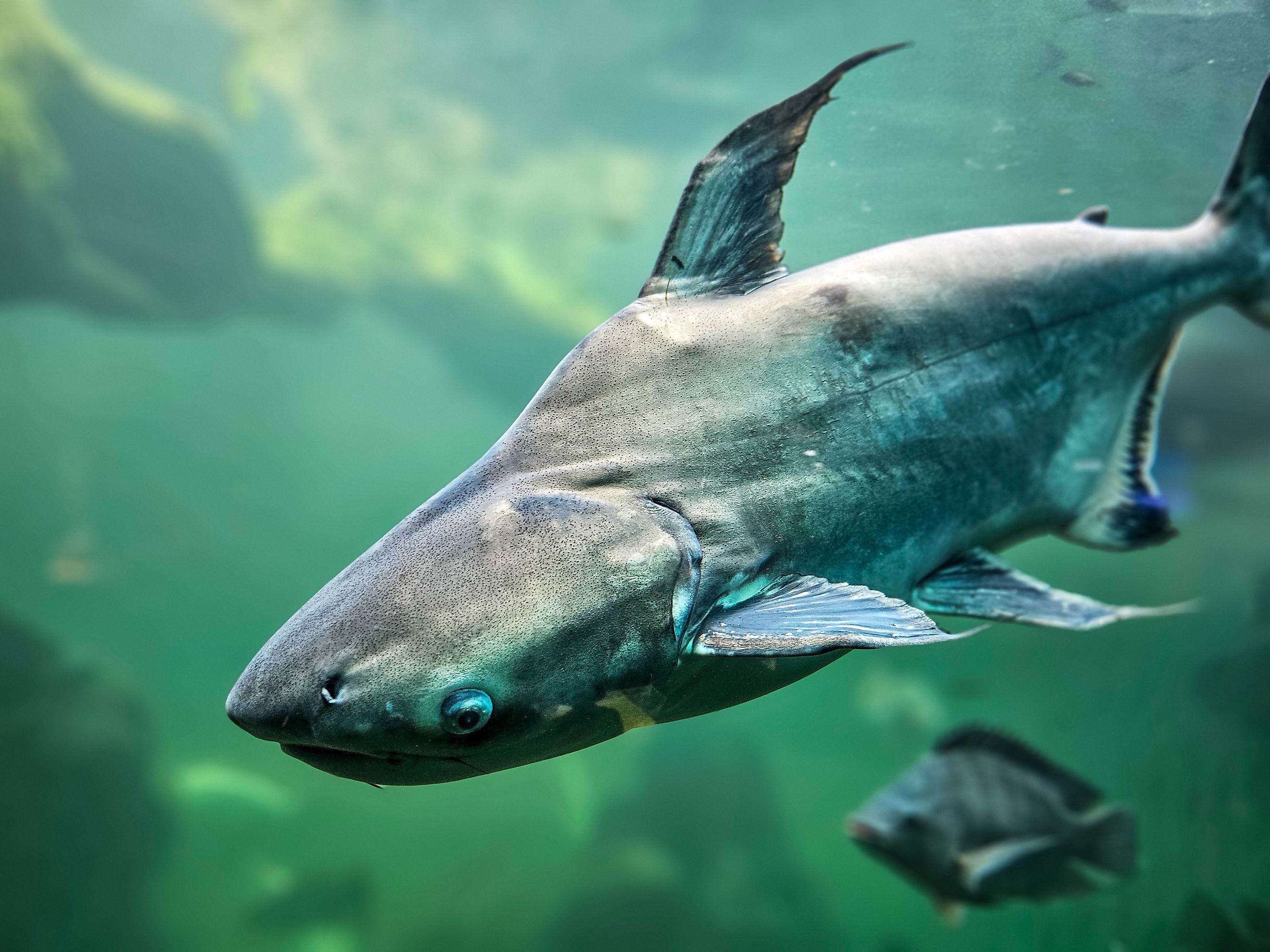
Size is the first thing anyone notices about this fish. Adults commonly reach 6.5 to 10 feet (2 to 3 m) in length, and the species can weigh up to about 770 pounds (350 kg), although fish that large are exceptionally rare today. The record 2005 specimen measured 8 feet 10 inches (2.7 m) and weighed 646 pounds (293 kg), roughly the mass of an adult grizzly bear.
What makes the Mekong giant catfish so striking, beyond its bulk, is what it lacks. Unlike most catfish, adults have almost no barbels, the sensory whiskers that give the group its name, and they carry no teeth at all. Juveniles hatch with both barbels and oral teeth, but these features shrink and vanish by the time the fish reach roughly 12 to 20 inches (30 to 50 cm) in length. The result is a smooth, blunt-headed giant with a broad mouth and no obvious hardware for seizing prey.
Coloration is understated. The body is gray to white, usually darker along the upper half and paler underneath, with no stripes or bold markings. The eyes sit unusually low on the head, below the line of the mouth, which gives the animal a slightly downcast expression. The overall shape is muscular and torpedo-like, well suited to holding position and moving steadily through the powerful currents of a large tropical river. Males and females look broadly similar outside the spawning season, with only subtle differences between the sexes.
Range and Habitat

The Mekong giant catfish is endemic to the Mekong River basin, which means it lives nowhere else on Earth. The Mekong runs for thousands of miles from the Tibetan Plateau through China, Myanmar, Laos, Thailand, Cambodia, and Vietnam before emptying into the South China Sea, and this fish once ranged across a huge stretch of that system.
A century ago the species was found along much of the river, from the delta in Vietnam far upstream toward southern China. Today its range has collapsed. The fish now survives in small, scattered populations concentrated in the middle and lower Mekong, particularly in Cambodia, Laos, and Thailand. Cambodia's Tonle Sap Lake, a vast seasonal wetland connected to the river, appears to be an important feeding ground for the species.
Adults favor the deep water of the main river channel, often in stretches where the depth exceeds 33 feet (10 m). They rely on long, uninterrupted runs of flowing water rather than still ponds or narrow tributaries. That dependence on the open main channel is one reason the fish has proven so vulnerable to structures that break the river into fragments.
Diet

For a fish this large, the Mekong giant catfish has a surprisingly gentle diet. Adults are largely herbivorous, feeding on algae, plant matter, and other organic material scraped from the riverbed and drifting through the water. The absence of teeth fits this lifestyle well, since the fish has no need to grab or tear struggling prey.
This diet marks a sharp departure from most giant catfish around the world, which tend to be aggressive predators that swallow fish and other animals whole. The Mekong giant catfish instead behaves more like an enormous grazer, filtering and browsing its way along the bottom of the channel.
Young fish start life differently. Newly hatched larvae feed on tiny drifting animals known as zooplankton, and when food runs short they will sometimes turn on one another and cannibalize their siblings. After about a year they switch over to the plant-based diet that will sustain them for the rest of their lives. That early move off animal food and onto a plant diet is unusual and helps explain the species' extraordinary early growth.
Behavior

The Mekong giant catfish is a highly migratory animal whose life revolves around the seasonal rhythm of the river. As the rainy season begins and water levels rise, adults gather and travel upstream in search of spawning grounds, a journey that can cover hundreds of miles. Fish that spend part of the year feeding in Cambodia's Tonle Sap system are thought to migrate far north into Thailand to breed.
This is not a fish built for small spaces. It needs long, connected stretches of river to complete its annual movements, along with specific conditions of flow, depth, and temperature that trigger and guide the migration. Much of the detail remains poorly understood, and scientists have never confirmed the exact locations of the main spawning sites.
Outside the migration season, adults tend to stay in the deep main channel, moving steadily through the current rather than lingering in one spot. The species is not territorial in the way many predatory fish are, and its schooling and social behavior remain difficult to study given how few animals now remain.
Reproduction

Reproduction in the Mekong giant catfish is tied tightly to the flood pulse of the river. Adults reach breeding condition at around six years of age and migrate upstream as the monsoon rains arrive, typically in the late spring and early rainy season. Spawning takes place in the upper reaches of the fish's range, after which the current carries eggs and larvae downstream toward feeding areas.
Females can carry large numbers of eggs, but survival in the first days and weeks of life is very low, so only a small fraction of hatchlings ever reach adulthood. Those that do survive grow at a remarkable pace, reaching 330 to 440 pounds (150 to 200 kg) within about six years, one of the fastest growth rates recorded in any fish. Individuals that live out a full life span may reach 60 years of age.
Importance to the World

The Mekong giant catfish has become an important symbol of the Mekong's ecological health. Alongside the Irrawaddy dolphin, it serves as a flagship species for the wider river system, drawing public attention and conservation efforts toward the protection of the river and its biodiversity. Its decline can also indicate broader changes in the Mekong, making the species a useful measure of the condition of one of the world's most biologically diverse freshwater ecosystems.
Ecologically, a large plant-eating fish that migrates across huge distances plays a part in moving nutrients and energy through the river. Culturally and economically, the species has long held deep significance for communities along the Mekong. For generations it was a prized catch wrapped in local ritual and tradition, and in some areas fishing for the giant catfish was surrounded by ceremony. Today the fish is worth far more alive than dead, both as a conservation icon and as a draw for people who value the idea that river giants like this still exist.
Threats

The Mekong giant catfish is classified as Critically Endangered on the IUCN Red List, the last category before extinction in the wild. Population figures are difficult to pin down because so few fish are seen, but estimates based on catch records suggest the population has fallen by around 90 percent in recent decades, and some experts believe only a few hundred mature adults may remain. A century ago fishers harvested hundreds of these giants each year, whereas recent annual catches have at times dropped to single digits.
Several forces have driven this collapse. Overfishing removed large numbers of adults before protections were in place, and the fish's huge size and predictable migrations made it an easy target. Dams built across the Mekong and its tributaries pose an especially severe threat, because they block the long migration routes the species depends on and can cut populations off from their spawning grounds. Additional pressures come from the destruction of spawning habitat through channel blasting and construction, along with pollution, shifting sediment loads, and the growing effects of climate change on river flows.
Conservation efforts are underway across Cambodia, Laos, and Thailand, coordinated among national fisheries agencies, the Mekong River Commission, and groups such as the World Wildlife Fund. Thai hatcheries have achieved captive breeding using hormone-induced spawning, and a large captive population now exists, offering at least some insurance against total loss.
Takeaway
The Mekong giant catfish is one of the largest freshwater fish in the world, a scaleless and toothless species capable of reaching enormous sizes. Yet its biology also makes it highly vulnerable to environmental change. Its large body, long-distance migrations, and dependence on a free-flowing Mekong leave it particularly sensitive to dams, fishing pressure, and other disruptions to the river system. Its survival will depend in large part on how development across the Mekong basin is managed alongside the ecological needs of the river. The future of this giant fish is closely linked to the continued health and connectivity of the Mekong itself.
Fun Facts

- A grizzly bear in fish form. The record 646-pound (293 kg) individual caught in 2005 weighed about as much as a large adult grizzly bear.
- Losing its whiskers. Although it is a catfish, the adult loses the barbels and teeth it is born with, ending up smooth-faced and toothless.
- A gentle giant. Despite its enormous size, the adult eats mostly algae and plants rather than hunting other animals.
- Built for speed. It ranks among the fastest-growing fish on Earth, packing on hundreds of pounds in roughly six years.
- A dethroned champion. It long held the title of largest freshwater fish, until a giant freshwater stingray weighing 661 pounds (300 kg) was caught in Cambodia in 2022.
Quick Facts
- Common name: Mekong giant catfish
- Scientific name: Pangasianodon gigas
- Family: Pangasiidae (shark catfishes)
- Order: Siluriformes
- IUCN status: Critically Endangered
- Length: up to 10 feet (3 m)
- Weight: up to about 770 pounds (350 kg), with a record catch of 646 pounds (293 kg)
- Lifespan: up to 60 years
- Diet: herbivorous as an adult, feeding mainly on algae and plants
- Range: endemic to the Mekong River basin in Southeast Asia
- Habitat: deep main channels of the lower and middle Mekong