Wels Catfish
The wels catfish (Silurus glanis) is one of the largest freshwater fish native to Europe, a scaleless, whiskered giant capable of exceeding 8 feet (2.4 m) in length and outweighing an adult human. It lurks on the beds of slow rivers and warm lakes across much of the continent, hunting after dark with a battery of sensory barbels that let it track prey in water far too murky for sight.
Also known as the sheatfish, this species has fascinated anglers, biologists, and folklorists for centuries. Old accounts described monsters that swallowed dogs and even people, and while most of those tales are exaggerated, the reality is impressive enough. A large wels is an apex predator that takes fish, waterfowl, amphibians, and small mammals, and in a few French rivers it has learned to lunge onto gravel banks to snatch pigeons.
This profile covers what the wels catfish is, where it lives, how it hunts and breeds, and why a fish once restricted to central and eastern Europe now turns up in rivers as far apart as Britain and western China.
Taxonomic Classification

The wels catfish belongs to the family Siluridae, the sheatfishes, within the large order Siluriformes that contains all catfishes. Its genus, Silurus, also includes several other sizeable Eurasian species such as the Amur catfish and Aristotle's catfish. The Swedish naturalist Carl Linnaeus formally described the wels in 1758, giving it the binomial name Silurus glanis.
The genus name traces back to a Greek word for a large river fish, and the common name "wels" comes from German, a word that shares an ancient root with the English word "whale." Like all catfishes, the wels has a heavy bony head, bare skin without scales, and the fleshy sensory barbels that give the group its name. No widely recognized subspecies are accepted, though populations across the enormous range differ in growth rate and appearance.
Physical Description

Most adult wels catfish measure 4 feet 3 inches to 5 feet 3 inches (1.3 to 1.6 m) long. Fish longer than 6 feet 7 inches (2 m) are uncommon and appear only where food is plentiful and the growing season is long. The largest reliably measured individual on record, an unweighed fish measured and released on the Po in 2023, stretched about 9 feet 4 inches (2.85 m), and the heaviest authenticated wels, caught in Italy's Po River in 2010, weighed roughly 297 pounds (135 kg). Older claims of fish 16 feet (5 m) long and 660 pounds (300 kg) circulated for generations but were later shown to rest on measurement errors and mistaken identity.
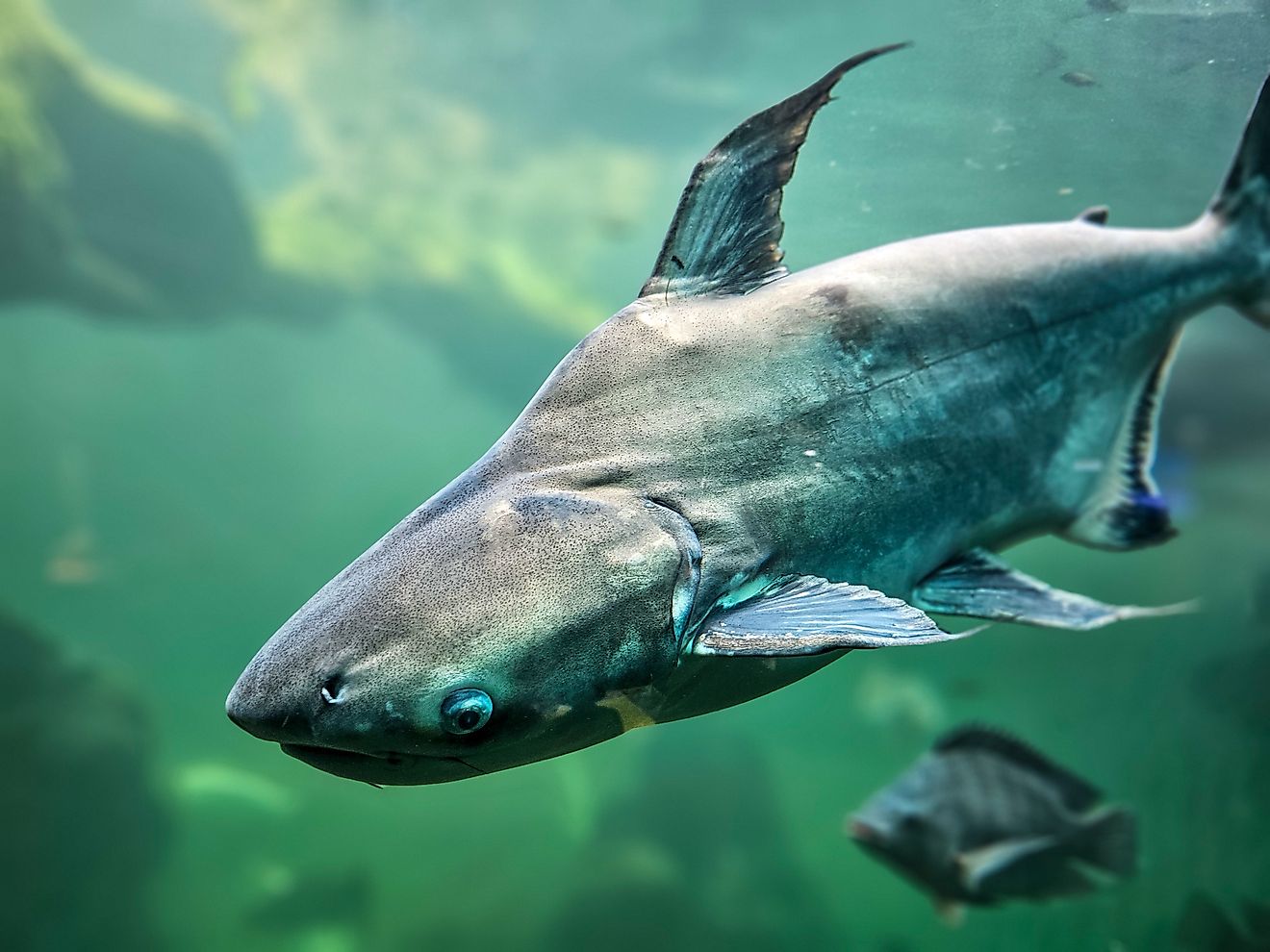
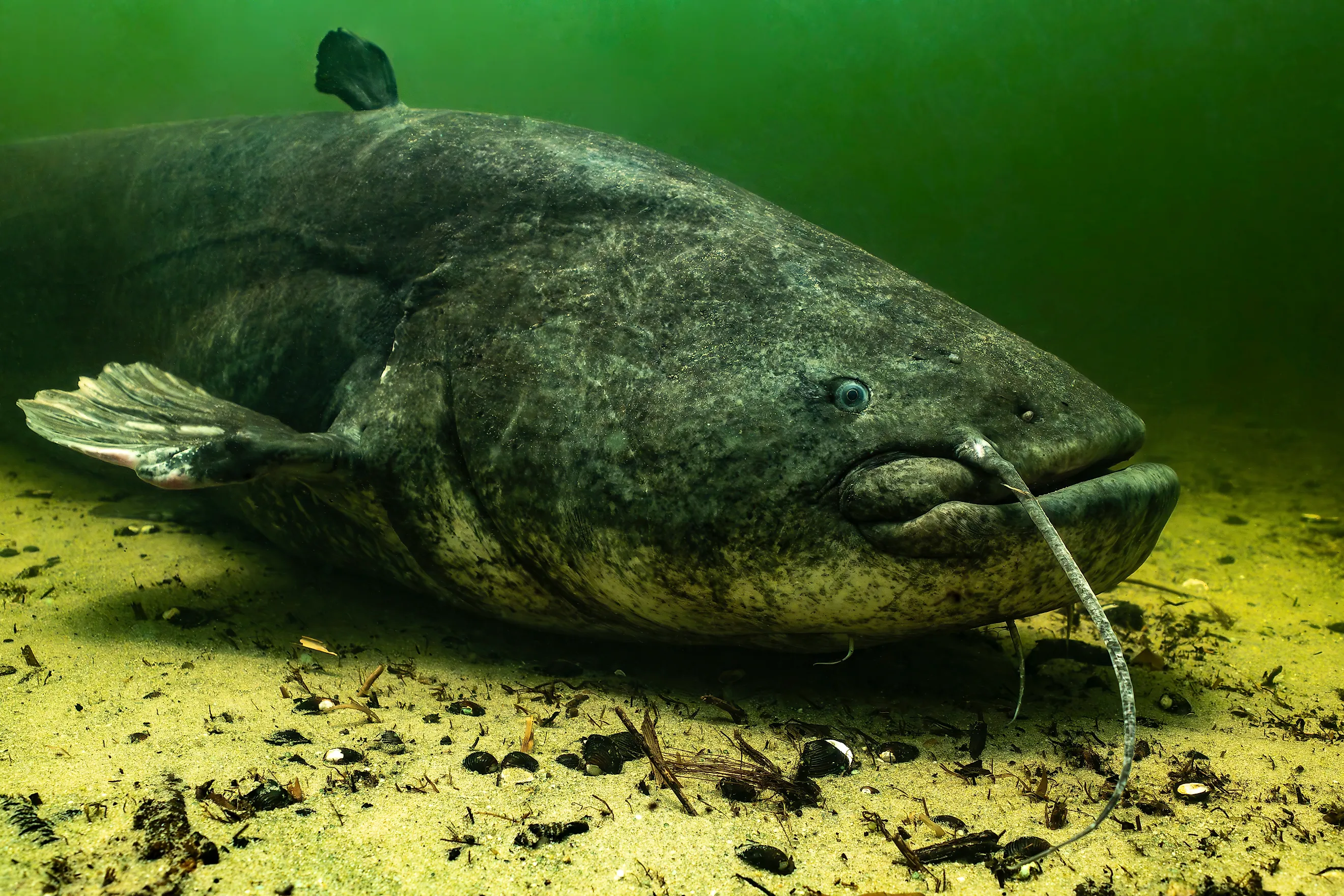
The body is long and powerful, thick and rounded at the front and laterally flattened toward the tail. The skin carries no scales and is coated in a thick layer of mucus, usually mottled dark green to black above with a paler, marbled belly. The head is broad and flat, set with small eyes and a huge mouth lined with bands of tiny, backward-facing teeth that grip rather than cut.
Six barbels ring the mouth, two long ones on the upper jaw and four shorter ones below. The dorsal fin is tiny and sits far forward, while the anal fin is extraordinarily long, running most of the length of the underside with 79 to 96 soft rays before merging near the rounded tail. Males and females look much alike, although females tend to grow longer and heavier.
Range and Habitat

The wels catfish is native to central, southern, and eastern Europe, in the drainages of the Baltic, Black, Caspian, and Aral Sea basins. Its historical range reached as far north as southern Sweden and Finland and as far south as Greece and Turkey, extending eastward into western Asia.
Anglers prized the fish so highly that it has been carried far beyond that native range. Introductions during the twentieth century established it across western Europe, including France, Spain, Italy, and Britain, and populations now reach east into Kazakhstan and western China. Individual wels have even turned up in rivers of southern Brazil, most likely escapees from fish farms thousands of miles from home, though whether a breeding population has established there is still unclear.
Wels favor large and medium lowland rivers, backwaters, weedy lakes, and the deep still water behind dams. They prefer soft, muddy bottoms and shelter in riverbed holes, under overhanging banks, and among sunken timber. Although a freshwater species, the wels tolerates the low salinity of the Baltic and Black Seas and can be found at depths down to roughly 100 feet (30 m).
Diet

The wels catfish is a nocturnal ambush predator that feeds close to the bottom and in open water. Young fish start on insects, worms, and other invertebrates, then shift to a broad carnivorous diet as they grow. Adults take whatever they can swallow, which, given their size, is a great deal. Fish make up the bulk of the diet, alongside crayfish, frogs, waterbirds such as ducks, small mammals, and carrion.
Poor eyesight is no handicap in the turbid water the wels prefers. It hunts by feel and smell, sweeping its long barbels through the water and detecting the faint chemical and vibration cues given off by prey. Once a target is within range, the catfish opens its cavernous mouth and creates a powerful suction that pulls the animal in whole.
Behavior

Wels catfish are largely solitary and most active at night. By day they rest in deep holes and under cover, emerging after dusk to patrol their stretch of river or lake. Their reliance on non-visual senses makes them formidable in dark, silty conditions where other predators struggle.
The species' most remarkable behavior appears in a handful of introduced French populations. In the Tarn River at Albi, large wels have learned to hurl the front half of their bodies onto gravel bars to grab pigeons that gather to drink and bathe. Researchers who documented the behavior in 2012 compared it to killer whales beaching themselves to catch seals, and they recorded a success rate near 28 percent. Only some individuals in the river perform these raids, which suggests the tactic is a learned habit passed among part of the population rather than an instinct shared by every wels.
Reproduction

Wels catfish reach sexual maturity at two to three years of age, usually once they pass about 34 inches (87 cm) in length. Spawning happens once a year in late spring and early summer, usually between May and July, when water temperatures climb.
The male clears a shallow nest in vegetation or on the bottom, where the female lays tens of thousands of sticky eggs. The male then guards the clutch, fanning fresh water over the eggs and driving off intruders until the young hatch a few days later. This active parental care is unusual among large freshwater fish and helps explain the species' success. Wels are long-lived, commonly reaching 20 to 30 years, with some individuals reported at far greater ages.
Importance to the World

In its native waters the wels catfish sits at the top of the food web as the dominant freshwater predator, shaping the numbers and behavior of the fish below it. It has long been valued by people as well. The species is farmed in aquaculture across parts of Europe, its firm, largely boneless flesh is eaten in many countries, and it draws anglers from around the world who travel to rivers such as the Po and the Ebro in pursuit of a record catch.
Where it has been introduced, though, the same qualities make it a problem. As a large, adaptable predator with few natural enemies, the wels can reshape ecosystems by preying heavily on native fish and other wildlife, and several countries report ecological damage after its arrival.
Threats

The wels catfish is listed as Least Concern on the IUCN Red List, a rating that reflects a wide distribution and large, stable populations across its range. Globally the species faces no serious risk of extinction, and in many areas numbers are rising, helped by warming waters and deliberate stocking for sport.
Conservation concern therefore runs in the opposite direction from most large predators. Rather than needing protection everywhere, the wels is managed as an invasive threat in parts of western Europe, where fisheries agencies weigh its popularity with anglers against its impact on native species. Within its true native range, local populations can still suffer from habitat loss, pollution, and river engineering, so its status differs by region.
Takeaway
The wels catfish is one of Europe's largest freshwater fish, capable of growing to impressive sizes, hunting in darkness with poor eyesight, and guarding its young with unusual dedication. In a few rivers, it has even developed the ability to hunt birds on land, an unusual behavior that highlights its adaptability. Its size and flexible hunting habits have made it both a prized catch and, outside its native range, an ecological problem. Although it remains secure across much of its natural range, its spread into new waters highlights the need to monitor its effects on local ecosystems.
Fun Facts

- A freshwater killer whale. In France's Tarn River, wels catfish beach themselves on gravel banks to snatch pigeons, a tactic scientists likened to orcas hunting seals.
- A name shared with whales. The word "wels" descends from an ancient root that also gave English the word "whale," a fitting link for one of Europe's largest freshwater fish.
- Debunked giants. Historic reports of wels reaching 16 feet (5 m) and 660 pounds (300 kg) were later traced to measurement mistakes and mistaken identity.
- Devoted fathers. The male alone builds the nest and guards the eggs, fanning them with fresh water until they hatch.
- A long-distance escapee. Wels catfish have turned up in rivers of southern Brazil, most likely stray fish from farms, thousands of miles from home.
Quick Facts
- Scientific name: Silurus glanis
- Family: Siluridae (order Siluriformes)
- IUCN status: Least Concern
- Length: commonly 4 ft 3 in to 5 ft 3 in (1.3 to 1.6 m), maximum about 9 ft 4 in (2.85 m)
- Weight: up to about 297 lb (135 kg)
- Lifespan: commonly 20 to 30 years, sometimes much longer
- Diet: carnivorous (fish, crayfish, amphibians, waterbirds, and small mammals)
- Range: native to central, southern, and eastern Europe, now introduced widely across Europe and Asia