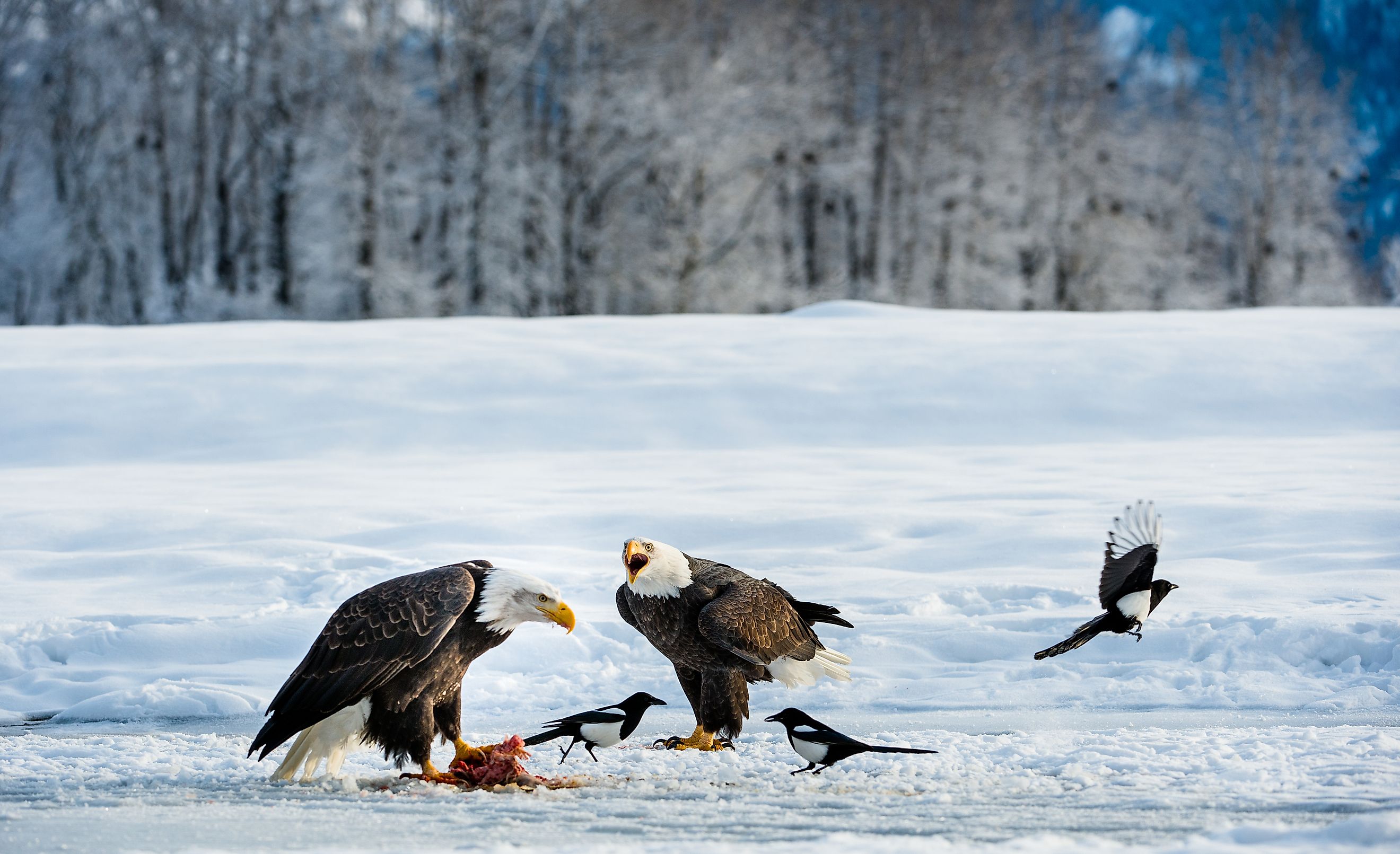
Why Thousands Of Bald Eagles Gather On One Alaska River Every November
Every November, a five-mile stretch of one Alaska river hosts more bald eagles than most American states see in a year. Along the Chilkat River near Haines, in the Alaska Chilkat Bald Eagle Preserve, the cottonwoods fill until branches sag under white heads, the gravel bars stand shoulder to shoulder with seven-foot wingspans, and counts in peak seasons have run past 3,000 birds, the largest congregation of bald eagles on Earth. Nothing about the gathering is random. The eagles are answering two overlapping miracles of timing and plumbing, a salmon run that arrives absurdly late and a river that refuses to freeze, and the place where those miracles intersect has been drawing eagles, and people, for as long as either has lived here.
The River That Refuses To Freeze

The engine of the whole spectacle is buried under gravel. Where the Tsirku River meets the Chilkat, millennia of glacial outwash have piled up an enormous alluvial fan, a sponge of sand and gravel hundreds of feet deep. All summer, river water and snowmelt percolate down into that fan and sit there, holding the season's warmth the way a storage heater holds an afternoon of sun. When winter clamps down on southeast Alaska, the fan pays it back out: groundwater several degrees warmer than the surface river seeps steadily up into the Chilkat's braided channels.
The result is a hydrological loophole. While every river around it locks up in ice, roughly five miles of the Chilkat below the fan stay open all winter, steaming gently on the coldest mornings, water and gravel bars exposed in a landscape otherwise sealed white. Biologists call the upwelling area a thermal refuge. The eagles call it the only open restaurant in 500 miles.
The Last Salmon Run Of The Year

An open river would mean little without something in it, and the Chilkat's second miracle swims in on cue. The warm upwelling water does not just resist ice; it incubates salmon eggs beautifully, and chum salmon have built one of the latest spawning runs in Alaska around it, pushing up the Chilkat in October, November, and December, with stragglers spawning into the new year, months after the great runs elsewhere have finished and gone.
Pacific salmon die after spawning, and on the Chilkat they die conveniently: thousands of spawned-out chum, fish that can run ten pounds and more, wash onto open gravel bars in the one season when an eagle's usual menu has vanished under ice. No hunting required, no fishing skill, no risk, just protein lying on the bar in December. For a scavenger-minded bird facing the leanest months of the year, the Chilkat in November is not a destination. It is a rescue.
The Winter Economics Of An Eagle

The gathering makes sense once you audit a bald eagle's winter books. Eagles are magnificent fliers and reluctant spenders: flapping flight burns calories ferociously, winter offers few thermals to soar on, and a bird that cannot refuel steadily will burn through its fat reserves in weeks. So wintering eagles live like misers, perching for hours, gliding when they must, and choosing a guaranteed carcass over a sporting chase every single time. A river serving free salmon beside comfortable perching timber is the best balance sheet in the North.
Word, in the loose way of eagle biology, gets around. The Chilkat's November crowd is not a local flock but a continental drawdown, birds funneling in across hundreds of miles, with banding and tracking showing visitors arriving out of the Alaska interior, British Columbia, and the Pacific Northwest. They squabble theatrically over carcasses, pirate each other's meals, which eagles do enthusiastically even in good times, and pack the cottonwoods until a single tree may hold dozens of birds. By late winter, as the last chum are picked to bone, the congregation dissolves back across the map as quietly as it assembled.
The Council Grounds

People noticed the phenomenon long before biologists named it. The heart of the gathering lies beside Klukwan, the ancient Tlingit village on the Chilkat's bank whose name translates to the eternal village, and the eagle-thick flats nearby have long been known as the Council Grounds, as if the birds were convening. For the Chilkat Tlingit, the river's late salmon and its winter eagles are not a curiosity but a calendar, part of a relationship with this valley that runs back thousands of years, and the village's Jilkaat Kwaan Heritage Center now tells that story beside the river that wrote it.
The name is better science than it sounds. The eagles really are drawn to council by the land itself, summoned annually by the fan's warm water and the salmon's late clock, and Klukwan sits where it sits for a related reason: a river that feeds you in winter is a river worth building a civilization on.
How The Preserve Got Drawn

The modern chapter began with a fight. In the 1970s and early 1980s, proposals to log and mine in the Chilkat Valley collided with growing evidence that the eagle gathering depended on a fragile, specific mechanism, disturb the fan's hydrology or the spawning channels, and the whole spectacle could unravel. After years of hard negotiation among the state, conservationists, industry, and local communities, Alaska established the Alaska Chilkat Bald Eagle Preserve in 1982: roughly 48,000 acres protecting the river flats and the critical fan, while surrounding lands stayed open to traditional use and carefully managed development.
The compromise has held for four decades, and it protected exactly the right thing. The preserve does not fence eagles in; it fences the plumbing off, keeping the warm upwelling, the spawning gravel, and the cottonwood perches intact so the invitation goes out every fall on schedule.
Seeing It

The gathering is also among the most accessible wildlife spectacles in Alaska. The Haines Highway runs directly along the preserve, with the densest eagle traffic between roughly miles 18 and 24, where pullouts overlook the Council Grounds flats; peak numbers arrive in November, and the town of Haines throws the Alaska Bald Eagle Festival that month, a small-town celebration of lectures, art, and a lot of very large binoculars. Mornings are best, when eagles work the bars before settling into their long daily perch.

The etiquette protects the economics. Visitors stay off the river flats and watch from the pullouts, because every unnecessary flush costs a fasting bird calories it budgeted for survival, and in an eagle's winter ledger, a few panicked takeoffs are real money. The rule of the Chilkat is the rule of any good restaurant: let the regulars eat.
The Loudest Quiet Place In Alaska
Strip the spectacle to its parts and the Chilkat gathering is a chain of perfect dependencies: a gravel fan that banks summer heat, water warm enough to keep five miles open, salmon that evolved their calendar around that warmth, and eagles that mapped the whole arrangement into their winters, with a human community woven through it for millennia and a 1982 compromise guarding the machinery. Pull any link and the cottonwoods empty. Keep them all, and every November, one small river in southeast Alaska quietly hosts the greatest meeting of America's national bird anywhere on the planet, steam rising off the water, white heads in the gray trees, the whole thing running on warm gravel and good timing.