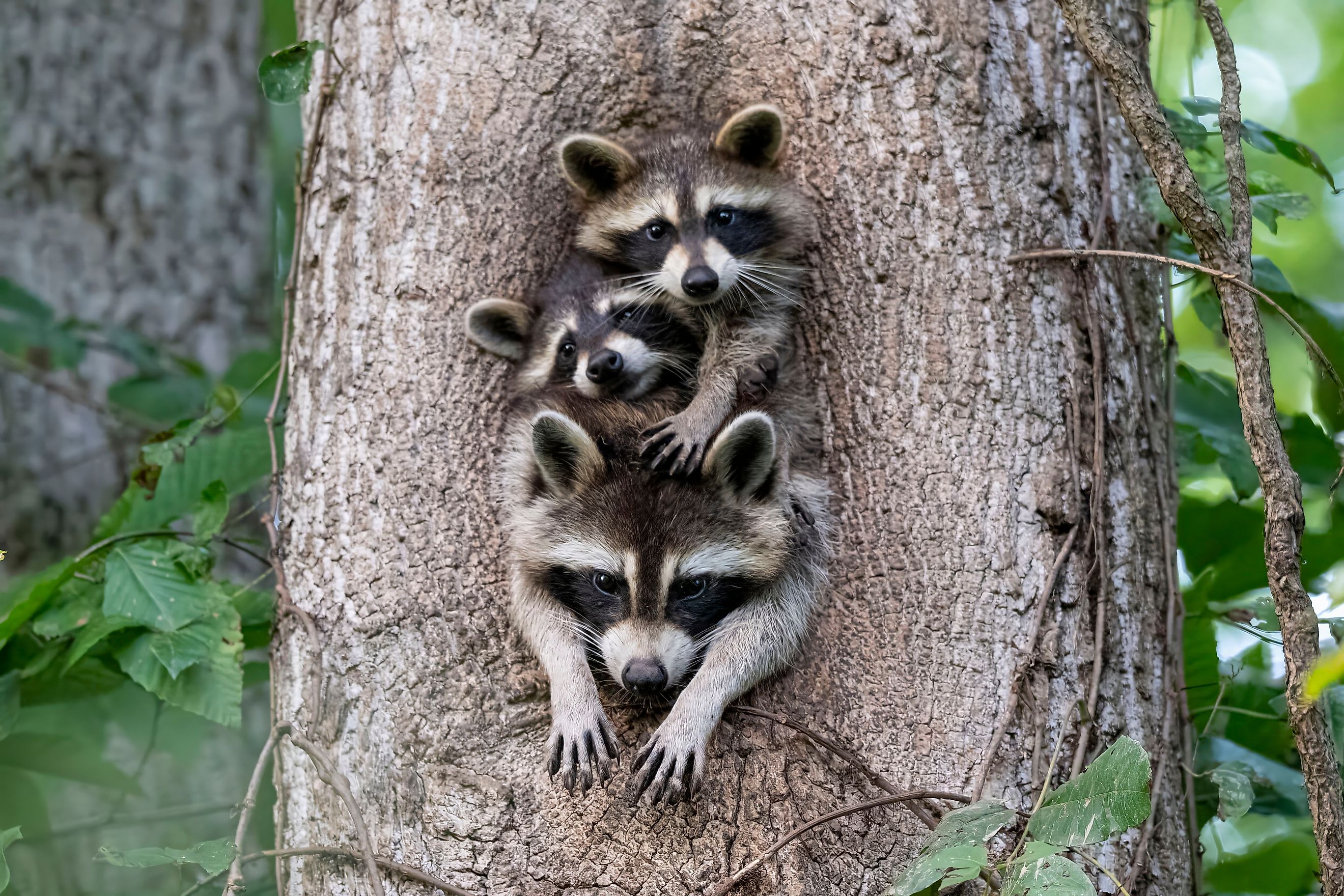
Where Raccoons Go In The Winter
When the first hard frosts settle across North America, raccoons seem to vanish. The nightly raids on gardens and garbage cans stop, tracks in the snow grow scarce, and the animals look as though they have left the region entirely. They have not gone far. A raccoon in December is almost always within its usual home range, resting in a sheltered den only a short distance from where it spent the summer. What changes is not its address but its behavior. The animal shifts into a season of deep rest and reduced movement that reads as disappearance but is really a careful strategy for saving energy through the lean months.
Resting, Not Hibernating
Raccoons do not hibernate in the strict biological sense. True hibernators such as woodchucks let body temperature, heart rate, and metabolism fall dramatically and keep them low for months at a stretch. A raccoon does something milder. It enters a state of winter dormancy that biologists sometimes describe as torpor or carnivorean lethargy, in which activity drops sharply while the body stays close to its normal working condition. Physiological monitoring makes the difference plain. When researchers tracked raccoons through Iowa winters, they recorded no real suppression of body temperature even in severe cold, though heart rates measured inside the den fell far below active daytime levels. The animal is resting and burning less fuel, yet it can rouse within minutes and walk out on a mild night. That flexibility is the entire point. A committed hibernator is locked into a long sleep, but a raccoon keeps the option to forage whenever the weather turns in its favor.
The Autumn Fat Build-Up

Through late summer and fall, raccoons eat heavily and bank the surplus as fat across the whole body, even around the base of the tail. The reserve can reach up to about an inch thick (2.5 cm) on the back, and by late fall roughly half of the animal's weight can be fat. Over a long northern winter, a raccoon may burn through a large share of that store, with documented losses of about fourteen to fifty percent of body mass depending on latitude and severity. This is why autumn feeding is so consequential. Raccoons that fail to build adequate reserves, mostly late-born juveniles, may starve before winter ends. The fat is not simply insulation. It is the fuel that sustains a resting raccoon across the hungry stretch between the last abundant meal of fall and the first reliable food of spring.
Where They Actually Go

So where does a raccoon spend those months? The practical answer is anywhere that holds warmth and keeps out wind and predators. Hollow trees and tree cavities are the classic retreat, and in several studied populations they dominate den selection. Where large hollow trees are scarce, raccoons turn to rock crevices, ground burrows abandoned by other animals, brush piles, and log tangles. Rock dens are favored because they hold a steadier temperature, staying cooler in summer and warmer in winter than other resting sites. A raccoon usually maintains several dens across its range and rotates among them through the year, but in deep cold it settles into one good shelter. That shelter does measurable physiological work. The Smithsonian study of raccoon metabolism modeled the den as a thermal buffer and identified a clear metabolic advantage to denning, meaning a raccoon spends less energy holding its temperature inside a cavity than it would in open air.
Sharing the Den

Raccoons are largely solitary animals, but winter changes their behavior. In cold spells, several raccoons will crowd into a single den and press together so that their shared body heat lowers the energy each one must spend staying warm. These groupings are most common in the harshest weather and the northern parts of the range, where the savings count for the most. The behavior is pragmatic rather than social. Once the cold eases, the animals separate and return to their own quarters.
The Weather Sets the Schedule

A raccoon's winter runs on the thermometer more than the calendar. Field observations cluster around a threshold near the freezing mark. Raccoons tend to den up and sleep soundly once temperatures fall below about 25 degrees Fahrenheit (-4 degrees Celsius), then emerge at different times during warm spells. Heavy snow or a deeper freeze keeps them inside, while a thaw pushing conditions back toward or above freezing draws the same animals out to hunt and scavenge before they retreat again. This stop-and-start rhythm explains why fresh raccoon tracks still appear in January and why the animals turn up at bird feeders and trash cans during warm winter weeks. They never fully shut down for the season.
North Versus South

Since the entire strategy depends on temperature, geography changes it completely. In southern areas, raccoons stay active year-round, while in northern areas they remain in a den for much of the winter and emerge only during relatively warm weather. Where freezes are brief and food stays available, a raccoon behaves like a year-round forager. Where winters are long and resources vanish under snow, the same species becomes a long-resting den dweller that surfaces only for short foraging trips during milder intervals. Every gradation between those extremes exists across the continent, which is part of why raccoon winter behavior is so often misunderstood. The answer genuinely depends on where the raccoon lives.
Raccoons in Town

Raccoons living near people now have more food sources in winter, and they take advantage of these opportunities without hesitation. Chimneys, attics, crawl spaces, sheds, and the hollows beneath decks and porches all serve as dens, frequently warmer and drier than any tree cavity. Towns also provide food that wild habitats lack in the cold, such as unsecured garbage and outdoor pet bowls, which lets urban raccoons stay active on nights when their rural counterparts would remain denned. The same flexibility that defines raccoon winter behavior is exactly what makes the species thrive alongside people.
A Season of Waiting, Not Leaving
Raccoons can survive at the cold edge of their range thanks to their unique physiology. They have evolved metabolic adaptations, like a higher basal metabolic rate than their tropical relatives, that let them live across a wide range of climates, reaching as far south as Panama and well into Canada in the north. Along with these traits, their heavy fat storage, thick winter coat, communal denning, and opportunistic eating help them get through winter. During the cold months, raccoons are rarely far away. They rest in a good den within their territory, living off the fat they stored in summer, and wait for the next mild night to come out again.