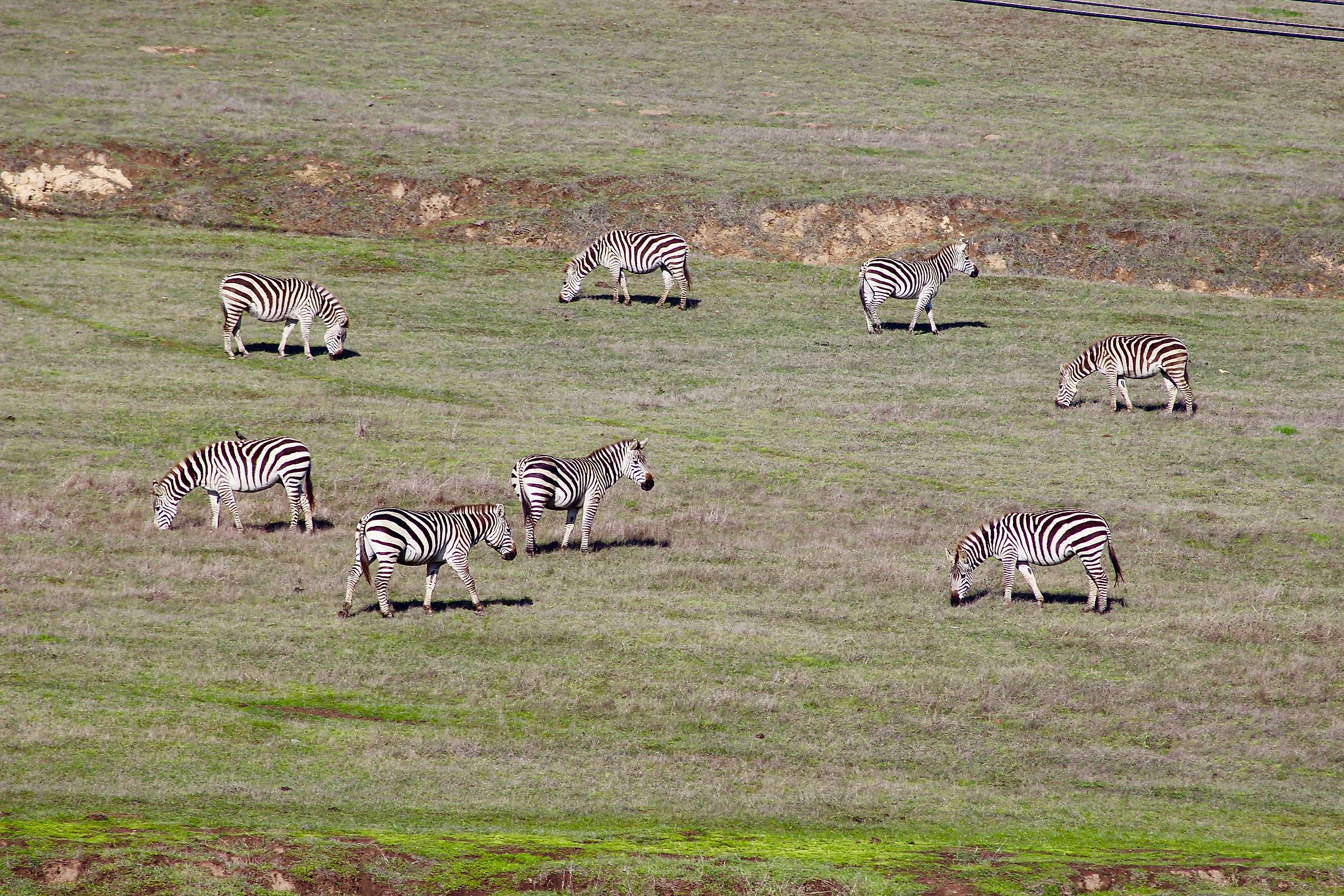
The Wild Zebras Grazing Beside California’s Highway 1
Drivers on California's Highway 1 near San Simeon regularly perform the same maneuver: a double-take hard enough to risk the shoulder, because grazing among the cattle on the golden coastal hills, with the Pacific glittering behind them, are zebras. Actual zebras, striped and unbothered, a herd generally counted these days at somewhere between 80 and 150 animals, free-roaming on the open rangeland of the Hearst Ranch and often called the largest wild zebra herd in the United States. They are not escapees from anywhere recent and not a hallucination brought on by the drive. They are the great-great-grandchildren of the most extravagant private zoo ever built in America, still living on the property nearly a century after their owner's fantasy ran out of money, and their story is the strangest surviving exhibit of the Hearst Castle era, the one that never closed.
The Hilltop Zoo

The zebras exist because William Randolph Hearst did nothing by halves. While building his 165-room castle on the Enchanted Hill above San Simeon through the 1920s and 1930s, the newspaper tycoon assembled around it what was widely described as the largest private zoo on Earth, with lions, leopards, a polar bear, and chimpanzees in hilltop enclosures, and, more consequentially, some 2,000 hoofed animals turned out across thousands of fenced acres, zebras, camels, giraffes, kangaroos, bison, llamas, antelope, and exotic deer grazing a California cattle ranch dressed as the Serengeti. Guests driving the five-mile entrance road passed signs warning that animals had the right of way, which, on that road, might mean waiting for an emu.
It was never meant to be an institution; it was landscaping on a tycoon's scale, a collection kept because its owner could. Which meant it lived exactly as long as the owner's cash flow did.
When The Money Ran Out, The Animals Stayed

The Depression caught up with even Hearst, and in 1937 his empire's financial crisis forced brutal economies on the Enchanted Hill, the zoo first among them. Through the late 1930s and 1940s the collection was broken up, with animals sold and donated to public zoos across the country, the dangerous carnivores necessarily first, but rounding up fast, half-wild grazing herds scattered across a ranch bigger than some counties proved somewhere between impractical and pointless, and a number of the pasture species were simply left to the land. Most faded over the decades. The zebras did not.
Plains zebras turned out to be nearly purpose-built for the assignment, since coastal California's mild, grassy hills ask far less of a zebra than the predator-rich African savanna it evolved for, and the ranch offered year-round forage, water, cattle for company, and effectively nothing that eats a healthy adult zebra. The herd settled into the long grass of the coastal terraces and simply carried on, breeding generation after generation, until the exotic became a fixture.
The Commute Past The Stripes

Today the herd belongs to the landscape of the drive. The zebras roam the Hearst Ranch's working cattle country on both sides of Highway 1 around San Simeon, a few miles south of the castle visitor center, and sightings are a routine roadside event, stripes mixed into the cattle on the green winter hills or standing against the summer gold, sometimes near enough to the fence line to stop traffic for a mile. The herd runs its own society out there, organized zebra-fashion into small harems, each a stallion with his mares and foals, and the foals matter: this is a breeding population, born striped on California grass every year, not a remnant running down. The animals are managed essentially as the ranch's most unusual livestock, left to run wild, counted every so often, and occasionally making local news when one slips a fence and tours a neighbor's pasture.

The viewing etiquette is the ranch's one firm ask: the zebras live on private working land, so the show is strictly a pullout-and-binoculars affair, no fence-hopping and no feeding, and the animals, though postcard-calm at distance, are genuinely wild, with a kick and a bite that ranch hands treat with more respect than they give the bulls. Watch the hills between San Simeon and the castle entrance, especially in the cooler green months when the grass draws the herd toward the road, and the odds are honestly good. Patience beats speed: the stripes read as shadow at highway pace, and half the sightings begin with a passenger shouting at the driver.
The Zoo's Other Ghosts

The zebras headline a thin surviving cast. Of the hilltop menagerie's hundreds of exotics, the other pasture species dwindled away over the mid-century decades, interbred into cattle country lore, were gathered off, or simply aged out, leaving the occasional claim of a strange deer in the hills and a legacy of stories, while the castle itself passed to California as a state park in 1958 and became one of the most visited house museums in the country. The zoo's cages still stand along the hilltop road, holding nothing, pointed out on every tour.
That is what makes the zebra herd remarkable rather than merely odd: it is the only part of the whole Xanadu fantasy that proved self-sustaining. The art needed curators, the castle needed the state, the lions needed shipping out, and the zebras needed nothing at all but the grass, which the ranch had in continental quantities. Hearst built the most expensive collection in America, and the piece that survived him cost nothing to keep.
The Serengeti Of San Simeon
So the wild zebras beside Highway 1 are a living estate sale that never closed: descendants of a press baron's private savanna, left behind when the Depression dismantled the world's grandest backyard zoo, thriving for nearly 90 years on a coastline that turned out to suit them better than it suits most Californians. They graze with the cattle, stop the traffic, and ask nothing of anybody, the last exhibit of the Enchanted Hill still on display and still free, provided you watch from the pullout. Every castle tour ticket buys the story of what Hearst built. The zebras, a few minutes down the highway, are the part of it that is still alive.