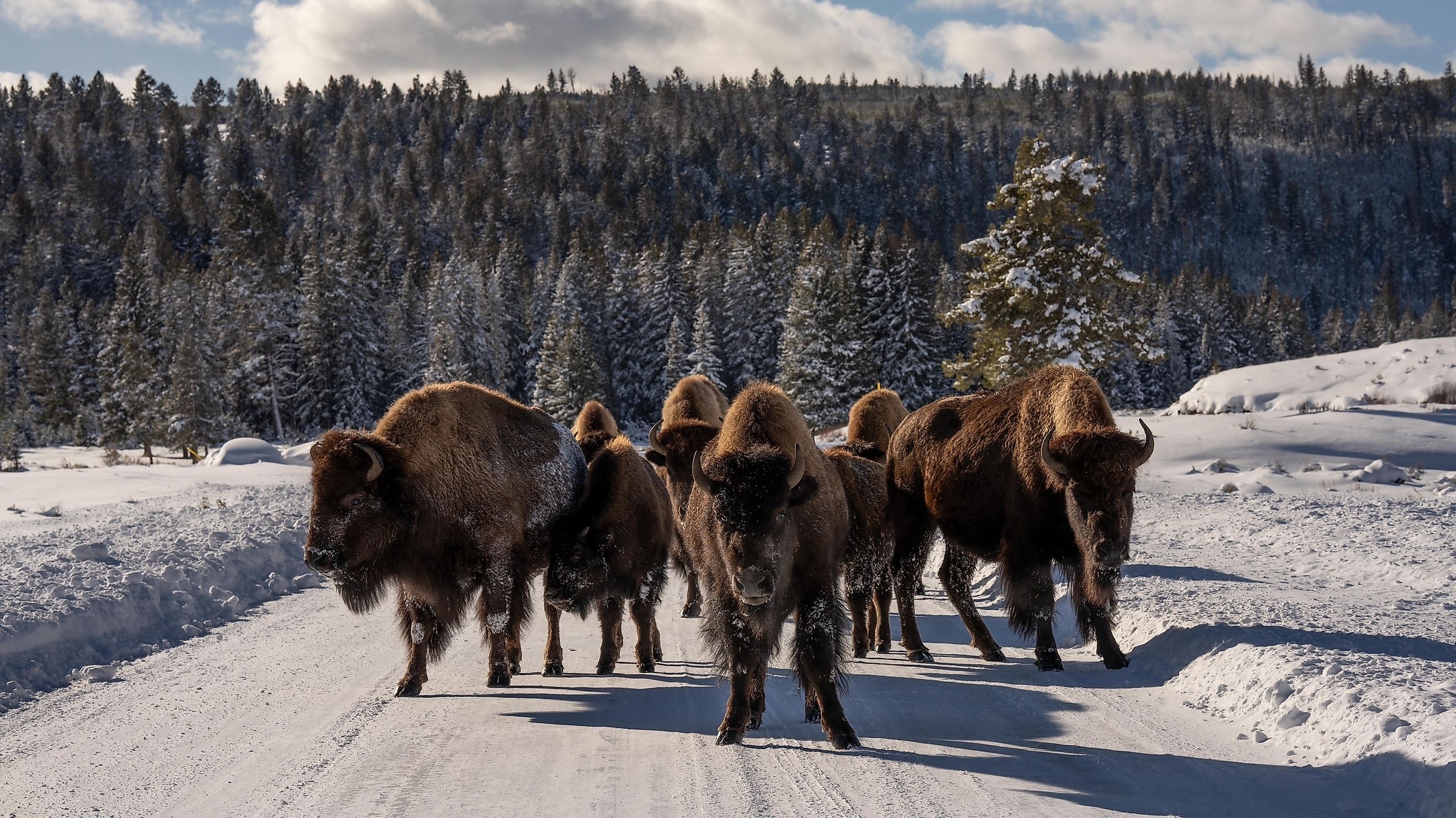
What Bison Do In A Yellowstone Blizzard
Every other hoofed animal in Yellowstone scrapes snow away with its front feet. The bison uses its head. Large shoulder and neck muscles, supported by the long vertebrae that form the hump, let it swing side to side and sweep snow off a feeding patch, and it will do that through drifts four feet deep for a few mouthfuls of dried grass. At minus 30 degrees Fahrenheit it does this without shelter of any kind.
The Hump Is A Shovel Mount
The animal's most recognizable feature turns out to be a piece of winter equipment.

A bison's massive hump is made of muscle supported by long vertebrae, and the Park Service describes the arrangement directly: it allows a bison to use its head as a snowplow in winter, swinging side to side to sweep aside the snow.
That is a structural difference rather than a behavioral quirk. Other ungulates scrape with their hooves because they have no equivalent machinery.
The Reward Is A Tuft Of Dead Grass
The effort-to-food ratio is the part that stays with anyone who watches it.

One observer in Lamar Valley described bison taking several powerful sweeps of the head to push enough snow aside to reach what amounted to a tiny tuft of dried brown grass, and spending hours doing it.
A bull can weigh over 1,500 pounds. The winter diet is dormant grass under snow, obtained a mouthful at a time.
Insulation Does The Rest
Standing out in a blizzard is survivable because of what the animal is wearing.

Bison carry thick skin and underfur, long guard hairs and layers of fat. The combination is effective enough that they remain warm at minus 30 without seeking shelter.
Frost settles on the coat and stays there, which is the giveaway. Heat is not escaping fast enough to melt it.
They Slow Themselves Down
The other half of the energy equation is reducing what gets spent.

Bison naturally reduce their activity in winter, conserving energy and relying on stored fat. Herds bed down in deep snow and chew cud for long stretches rather than moving.
Movement costs calories that the available forage cannot replace. Doing less is a strategy rather than lethargy.
They Walk In Each Other's Tracks
Herd behavior in deep snow is about efficiency rather than company.

Herds often follow one another's paths through snow, reducing the energy needed to move and reach food. The lead animal pays the cost of breaking trail and the rest do not.
Across a winter of travel through drifts, that saving is substantial.
They Migrate Further Than Anything Else There
Bison do move with the snow, and the distances are larger than their reputation suggests.

They shift from summer ranges to lower elevations as snow accumulates and dense snowpack develops, migrating up to 70 miles between summer and winter ranges. That is a greater distance than any other ungulate in the Greater Yellowstone Ecosystem.
When and where depends on a combination of bison abundance, the quality and quantity of summer forage, and the winter snowpack.
Some Head For The Geysers
One subset of the population has found a shortcut that comes with a cost.

Some herds move into the geothermal basins around Old Faithful, where heat from springs and geysers keeps the ground clear of snow and grass accessible without digging.
It sounds like an obvious advantage. Research has found these herds often live shorter lives than those wintering north with more snow and less thermal activity.
Nine In A Hundred Do Not Make It
The Park Service publishes a figure that puts the whole performance in context.

On average, 9 out of 100 adult bison die during the winter. Bison look notably bony by spring, which is the visible result of months spent burning fat reserves.
That is the baseline mortality for a species exceptionally well adapted to this. A hard winter raises it.
The Sweeping Shapes The Grassland
Repeated grazing on the same patches has an effect that outlasts the winter.
The Park Service notes that the behavior keeps plants growing, although they never appear more than a few inches tall, and allows bison to keep getting highly nutritious food.
A heavily grazed patch stays in a young, nutrient-dense growth stage. The animals are maintaining their own pasture.
Wolves Take Very Few Of Them
Deep snow favors predators, and bison are largely exempt from the consequence.

Wolves hunt more efficiently in winter because snow slows their prey. Even so, bison make up only about 3 to 4 percent of a Yellowstone wolf's winter diet against more than 96 percent elk.
Size and the willingness to stand and fight explain the gap. A wolf pack takes the animal that runs.
The Short Answer
In a blizzard a bison stands in it. It sweeps snow aside with its head using muscles anchored to the hump, eats dormant grass a mouthful at a time, slows its metabolism, beds down in the drifts and follows the trail the animal in front has already broken.

Thick skin, underfur, guard hairs and fat keep it warm at minus 30 without shelter. It may walk up to 70 miles to lower ground, further than any other ungulate in the ecosystem. And roughly nine in every hundred adults still do not survive the winter.