Amazon River Dolphin
The Amazon river dolphin is the largest freshwater dolphin on Earth, and one of the few whose adults can turn a vivid shade of pink. Known across South America as the boto, this river-dwelling cetacean glides through the murky channels and flooded forests of the Amazon and Orinoco basins, navigating a world where sight counts for little and sound counts for almost everything.
Scientifically named Inia geoffrensis, the boto belongs to a small family of river dolphins that split from their ocean-going relatives millions of years ago. It is found only in the rivers of tropical South America, and it has adapted to that habitat in ways no marine dolphin has. With an unfused, flexible neck and a diet spanning more than fifty species of fish, the Amazon river dolphin is a study in specialization.
It is also a species under pressure. Once considered abundant, the boto is now listed as Endangered, its numbers falling across much of its range. Understanding what makes this animal remarkable is the first step toward understanding why its survival matters.
Taxonomic Classification

The Amazon river dolphin carries the scientific name Inia geoffrensis, first described by the French zoologist Henri Marie Ducrotay de Blainville in 1817. It sits within the family Iniidae, and Inia is the only living genus in that family. In the broader tree of life it is a toothed whale, part of the infraorder Cetacea nested within the order Artiodactyla, the group that also contains hippos and other even-toed mammals.
Three subspecies are usually recognized. Inia geoffrensis geoffrensis occupies the main Amazon basin, Inia geoffrensis boliviensis lives in the upper Madeira River drainage of Bolivia, and Inia geoffrensis humboldtiana inhabits the Orinoco basin. Taxonomy here is not fully settled. In 2014 researchers proposed a separate species, the Araguaian river dolphin (Inia araguaiaensis), based on genetic and skeletal differences in the isolated Araguaia-Tocantins system, though not all authorities accept the split. Modern DNA work continues to reshape how these populations are classified, which is common among animals separated by river geography.
Physical Description

The boto is the largest of the world's river dolphins. Large males reach roughly 8.2 feet (2.5 m) in length and can weigh up to about 408 pounds (185 kg), with some individuals reported larger still. Females are noticeably smaller. This is one of the animal's more unusual traits, because in most river dolphin species the females outsize the males. Adult males can be up to about 55 percent heavier than females, a striking degree of sexual dimorphism for a cetacean.
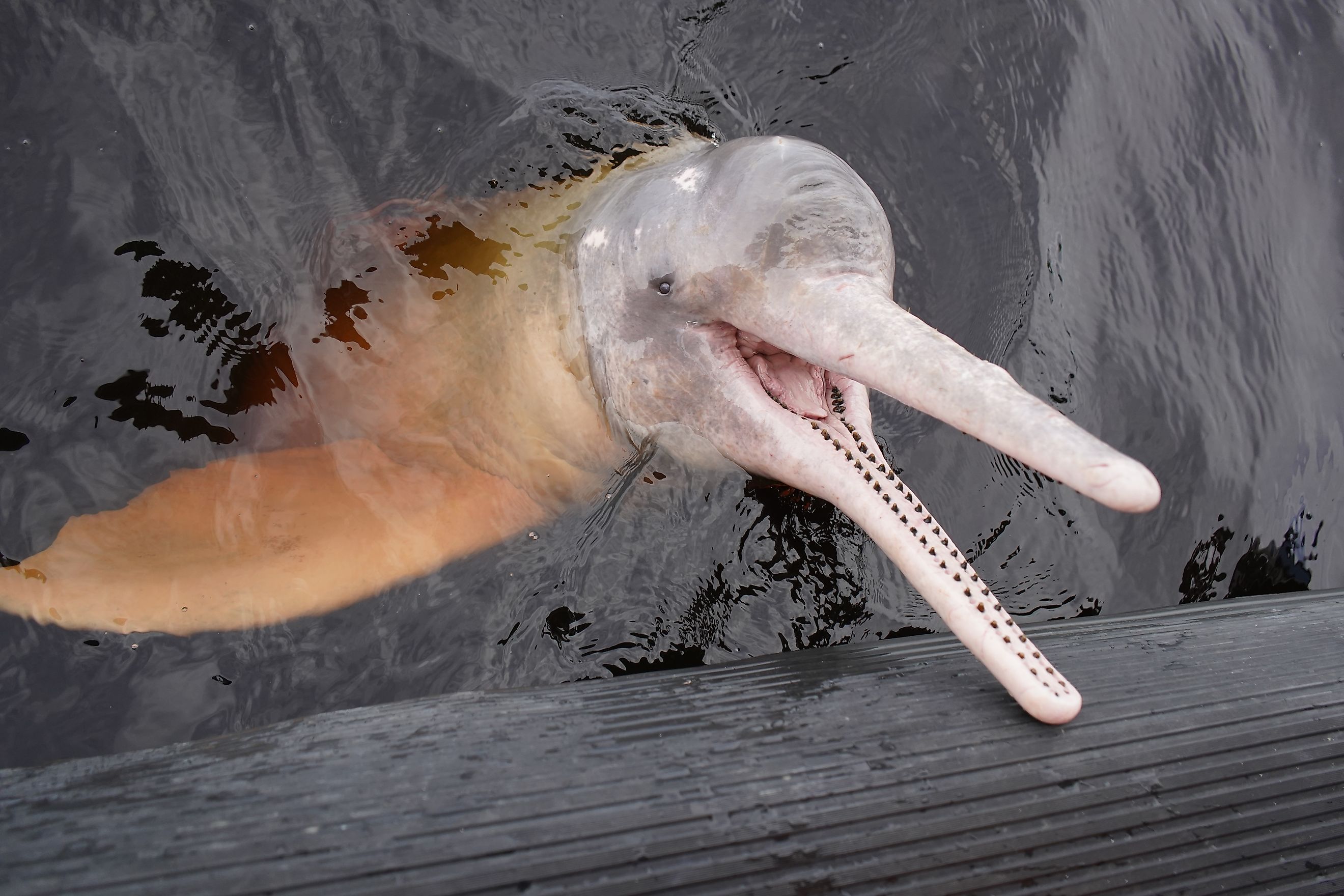
Then there is the color. Calves are born grey and gradually turn pinker with age, and adult males are often the pinkest of all. Researchers believe much of the pink comes from scar tissue built up through years of rough play and fighting, so a heavily marked, bright pink male is usually an older, battle-tested one. The exact shade can shift with water temperature, activity, and blood flow near the skin.
The body itself is built for tight, tangled water rather than open speed. The boto has a plump, flexible trunk, broad paddle-shaped flippers, and a long, keel-like ridge in place of a tall dorsal fin. Its snout is long and slender, lined with teeth suited to both grasping and crushing. Crucially, its neck vertebrae are not fused as they are in ocean dolphins, allowing the animal to turn its head close to 90 degrees. Small eyes complete the picture, a reflection of how little vision matters in the silt-heavy rivers it calls home.
Range and Habitat

The Amazon river dolphin lives across the Amazon and Orinoco river systems of tropical South America. Confirmed populations occur in Bolivia, Brazil, Colombia, Ecuador, Peru, and Venezuela, with more recent evidence pointing to a presence in Guyana. Within that vast area the boto occupies a wide range of freshwater habitats, including main channels, tributaries, smaller streams, lakes, and deltas.
What sets its habitat apart is the yearly flood. Each rainy season the rivers overflow their banks and drown thousands of square miles of surrounding rainforest, turning solid ground into a submerged, tree-filled world. The boto moves directly into this flooded forest, threading between trunks and through tangles of roots and branches to hunt. Its flexible neck and rotating flippers make this possible in a way that would defeat a stiffer, faster ocean dolphin. When the waters fall again, the dolphins retreat to the permanent river channels until the next flood returns.
Diet

Few toothed whales eat as broadly as the boto. Its diet has been recorded to include more than fifty species of fish, among them croakers, catfish, tetras, and piranhas. It also takes freshwater crabs, shrimp, small turtles, and other prey when the opportunity arises, giving it one of the widest diets of any toothed whale.
Hunting happens largely by sound. In water so murky that eyes are close to useless, the boto relies on echolocation, sending out rapid streams of clicks and reading the echoes that bounce back off nearby prey. Its long snout is well suited to probing river mud and darting after fish hiding among submerged branches. The teeth toward the back of its jaws are broad and molar-like, letting it crush armored catfish and hard-shelled prey that softer-toothed dolphins would struggle with. A large adult needs a substantial daily intake to fuel its bulk, and the flexibility of its diet helps it adjust as different prey become available through the flood cycle.
Behavior

Unlike the tight, social pods of many ocean dolphins, the boto tends toward a solitary life. It is most often seen alone or in small, loose groups, though larger gatherings can form where food is plentiful. It is active throughout the day and is often described as curious, sometimes approaching boats or investigating unfamiliar objects in the water.
Communication runs on sound. Alongside the clicks used for echolocation, botos produce whistles that researchers think help them coordinate, particularly while foraging. Their unfused necks give them a maneuverability that shapes much of their behavior, letting them pick through flooded forest and shallow, cluttered water with a precision that suits an ambush-style hunter more than a high-speed chaser. That trade of speed for agility defines how the animal moves and feeds.
Reproduction

Reproduction in the boto is slow and closely tied to the river's flood cycle. Females reach breeding age at around six to ten years old, and courtship can involve unusual displays. Males have been observed picking up objects such as sticks, clumps of vegetation, or even turtles and lifting them out of the water, behavior thought to signal fitness to watching females.
Timing lines up with the water. Births tend to cluster around the season when floodwaters begin to recede, which concentrates dolphins and their prey together in the shrinking channels. Gestation lasts roughly eleven to thirteen months, and a female usually gives birth to a single calf. The mother invests heavily in that calf, nursing and caring for it over an extended period before it becomes independent. This slow pace of reproduction, with long gaps between calves, means populations recover very slowly from losses, a fact that carries real weight for the species' conservation.
Importance to the World

As a large predator near the top of its food web, the Amazon river dolphin plays an important part in keeping freshwater ecosystems in balance. By preying on a broad spread of fish species, it helps regulate the populations of those fish and, indirectly, the health of the wider river system. Its presence or absence is often read by scientists as a signal of how healthy a stretch of river is, which makes the boto a useful indicator species for one of the most biodiverse regions on the planet.
The boto also contributes to local economies through wildlife tourism. In parts of the Amazon, visitors pay to observe the dolphins and, in some places, swim alongside them, generating income for riverside communities and creating an economic incentive to protect local populations. The species also serves as a flagship for conservation, attracting funding and public attention that can benefit the wider network of rivers, fish, and forests on which it depends. Conservation efforts focused on the boto can therefore extend well beyond the dolphin itself, helping protect one of the world's richest freshwater ecosystems.
Threats and Conservation

The Amazon river dolphin is listed as Endangered on the IUCN Red List, a status confirmed in the group's 2018 assessment after earlier years spent as Vulnerable and then Data Deficient. Long-term monitoring in parts of Brazil has recorded steep, sustained declines, with some studied populations falling fast enough to alarm researchers.
Several pressures drive that decline. One of the most damaging is the illegal hunting of botos for use as bait in the piracatinga catfish fishery, a practice that removed large numbers of animals before governments began to act. Dolphins also drown after becoming tangled in gillnets set for fish. Beyond direct killing, mercury pollution from gold mining contaminates the rivers and the fish the dolphins eat, while dams fragment river systems and cut populations off from one another. Habitat loss and general pollution add further strain.
Conservation efforts are underway across the boto's range. Every country where the species lives now has some form of management plan for river dolphins, and protected reserves, research programs using satellite tagging, and fishing regulations all aim to slow the losses. The scale of the challenge remains large, and the dolphin's slow reproduction means recovery, where it happens at all, will be gradual.
Takeaway
The Amazon river dolphin is a creature shaped entirely by its river. Its flexible neck, its reliance on sound over sight, its pink hue, and its taste for flooded forest all trace back to a life spent in the murky, shifting waters of tropical South America. It is at once the largest of the river dolphins and one of the most specialized, a predator fitted to a habitat that few other cetaceans could survive.
That same specialization is part of what makes its decline so concerning. An animal so tied to one river system has nowhere else to go when that system is degraded. Whether the boto continues to swim through the flooded forests of the Amazon will depend on how seriously the threats of hunting, pollution, and habitat loss are confronted in the years ahead. For a species that has long lived at the meeting point of biology and legend, its future now rests firmly in human hands.
Fun Facts

- They can turn their heads almost sideways. Because their neck vertebrae are not fused like those of ocean dolphins, botos can rotate their heads close to 90 degrees to weave through submerged branches.
- The pink is often scar tissue. Adult males tend to be the pinkest, and much of that color is thought to come from scarring built up through years of rough play and fighting.
- Males show off with turtles. During courtship, male botos have been seen lifting sticks, weeds, and even live turtles out of the water, apparently to impress nearby females.
- Local legend calls them shapeshifters. In Amazonian folklore the boto is an encantado, a magical being said to transform into a handsome human at night and hide its blowhole beneath a hat.
- They eat armored fish whole. Broad, molar-like back teeth let botos crush hard-shelled catfish and other tough prey that most dolphins avoid.
Quick Facts
- Scientific name: Inia geoffrensis
- Family: Iniidae (order Artiodactyla, infraorder Cetacea)
- Other names: Boto, bufeo, pink river dolphin
- IUCN status: Endangered (assessed 2018)
- Length: Up to about 8.2 feet (2.5 m)
- Weight: Up to about 408 pounds (185 kg)
- Lifespan: Roughly 25 to 30 years in the wild
- Diet: Carnivore, feeding on 50-plus fish species plus crabs, shrimp, and small turtles
- Range: Amazon and Orinoco river basins of South America
- Subspecies: Three recognized (geoffrensis, boliviensis, humboldtiana)