The Endangered Animals That Can Still Kill You
In the tidal channels of the Sundarbans, a tiger can swim across a creek, climb into a fishing boat, and drag a honey collector into the mangroves before anyone nearby understands what has happened. The animal that does this is also one of the rarest large predators on Earth. That pairing sits at the heart of a quiet contradiction in wildlife conservation, because several of the species most capable of killing a person are the same species that scientists are racing to save. Protecting a dangerous animal and protecting the people who live beside it can pull in opposite directions, and the places where the two overlap are where most human deaths occur.
Tigers in the Sundarbans

The Bengal tiger is the big cat most consistently tied to the hunting of humans in modern times, and the center of that history is the Sundarbans, the mangrove delta shared by India and Bangladesh. Tigers here swim between islands, tolerate salt water, and have learned to treat people who enter the forest for honey, wood, and fish as prey. Not every tiger here is a man-eater, and biologists such as Ullas Karanth caution that the reputation outruns the real numbers, yet the toll is steady enough to support a folklore of tiger widows and forest guardian deities. Across Asia, the Sundarbans holds one of the densest tiger populations anywhere, which is exactly why encounters persist.
The threat extends well beyond the mangroves. Indian government figures recorded about 110 human deaths in tiger attacks in 2022, up from 59 in 2021. Maharashtra reported the highest number of fatalities, where expanding human settlements and farmland increasingly overlap with tiger habitat. Bengal tigers remain Endangered, and revenge killings after an attack remove breeding adults from an already small population. Field responses have included measures both practical and strange, such as rubber masks worn on the back of the head, since tigers prefer to strike an unaware target from behind. Travelers should never enter core tiger habitat alone or on foot, and should keep to licensed boats and guides. The experience of the people who live beside wild tigers is one of constant, low-grade risk rather than cinematic ambush.
Asian Elephants and the Daily Toll

No wild mammal kills more people in India than the elephant. The country holds roughly 30,000 wild Asian elephants, and as farmland, railways, and new settlements cut through old migratory ground, people and elephants collide with grim regularity. A 2026 analysis in Frontiers in Conservation Science counted 7,868 human deaths from elephant attacks across sixteen Indian range states between 2009 and 2024, an average of 492 lives a year. India's environment ministry puts the figure at about 500 deaths annually, alongside roughly 100 elephants lost to retaliation, electrocution, poisoning, and train collisions. States such as Odisha, Assam, and West Bengal carry the heaviest burden, and the worst months are the harvest season, when farmers sleep in their fields to guard crops.
The Asian elephant is Endangered, and the conflict is as much a conservation emergency as a human-safety one. Fragmented habitat forces herds through villages and across tracks they would once have skirted. The safest rule in elephant country is distance. A herd with calves, or a lone bull in musth, will charge with little warning, and no person on foot outruns an elephant over open ground.
Lions in Southern Tanzania

Between 1990 and 2004, lions killed more than 563 people in Tanzania and injured at least 308 more, a wave of attacks documented by Craig Packer and colleagues in the journal Nature in 2005. Tanzania holds more of Africa's African lions than any other country, and the study found that attacks tripled over fifteen years as the human population grew and wild prey thinned outside protected areas. Nearly two in five attacks came during the March-May harvest, when farmers slept in their fields to fend off bush pigs, the same pigs that drew hungry lions in behind them. Children were frequent victims, making up almost a fifth of those killed.
Later research in the same region tracked more than 1,000 people attacked between 1988 and 2009 and showed that lions hunt humans most often on dark nights, in the days after a full moon when the moon rises late. The lion is listed as Vulnerable, and each retaliatory hunt after an attack chips away at a species already in decline. Visitors on safari face almost none of this risk if they stay in vehicles and follow guides, and places such as Serengeti National Park are managed with that separation in mind. The danger falls on rural residents, not tourists, which is why mitigation focuses on fencing, livestock enclosures, and keeping people out of fields after dark.
The Hippopotamus, Africa's Deadliest Heavyweight

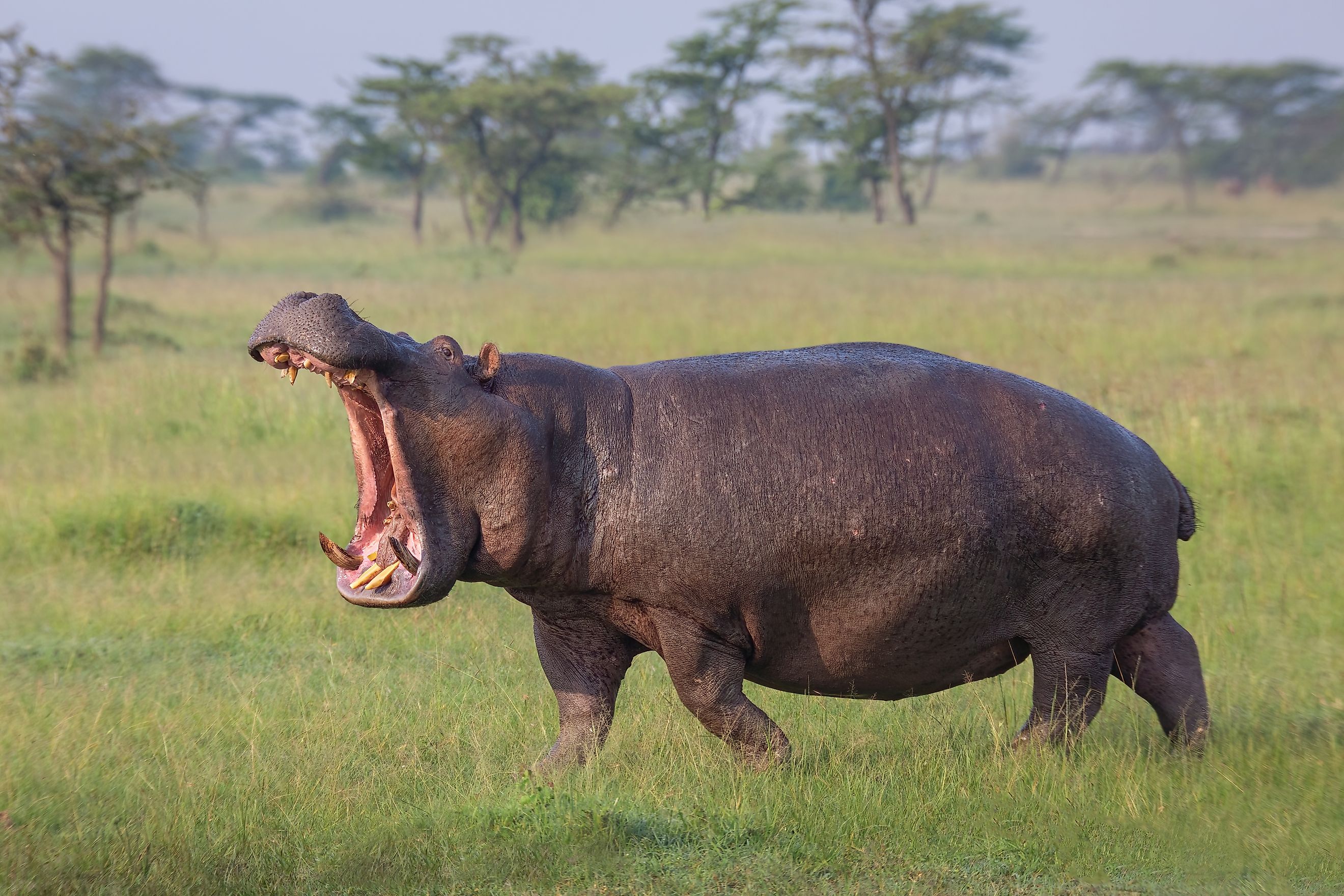
Few animals are as badly misjudged as the hippopotamus. It eats grass, spends its days resting in rivers and lakes, and looks slow, yet it is widely regarded as the deadliest large land mammal on the continent. Estimates cited by conservation groups put the number of people killed by hippos across Africa at around 500 each year, more than lions and crocodiles, though the figure is hard to verify and the true toll is poorly tracked. Hippos are fiercely territorial in water, can reach about 30 kilometers per hour (19 miles per hour) on land, and will capsize boats or bite a person nearly in half with teeth built for fighting rivals.
The common hippo is listed as Vulnerable, with somewhere between 115,000 and 130,000 left in the wild and the population falling. A 2022 review in Frontiers in Conservation Science called it a neglected giant, understudied despite both its danger and its decline. Most deaths happen when people and hippos meet at the water, so the core safety rule is to never block a hippo's path back to the river and to give any animal on a bank a wide margin, above all at dawn and dusk.
Great White Sharks and the Rarity of the Bite

The great white shark carries a fearsome name that the statistics rarely support. The International Shark Attack File, maintained by the Florida Museum of Natural History, confirmed 65 unprovoked bites worldwide in 2025 and nine unprovoked fatalities, close to the ten-year averages of roughly 72 bites and six deaths a year. These animals patrol cool, prey-rich waters off Australia, South Africa, and the western coast of the United States. Australia alone accounted for about a third of all bites in 2025 and most of the year's deaths, nearly all of them great white attacks on surfers.
The great white is listed as Vulnerable, its numbers thinned by decades of fishing and slow reproduction. The single fatal bite in American waters in 2025 killed an open-water swimmer in Monterey Bay, off the coast of California, a reminder that the risk is real even though it is tiny. For perspective on how often shark bites actually happen, the odds stay far lower than for almost any land animal in this article. Simple habits cut the risk further, such as staying out of the water at dawn and dusk and keeping clear of murky areas, seals, and fishing activity.
Polar Bears on Thinning Ice

The polar bear is the only bear that will reliably hunt a human as prey, and a warming climate is slowly raising the odds of an encounter. A 2017 study in the Wildlife Society Bulletin gathered every recorded wild polar bear attack between 1870 and 2014 across the five range states, Canada, Greenland, Norway, Russia, and the United States, and found only 73 attacks in that span, with 20 deaths and 63 injuries. Rare as that is, the attacks clustered in the years of lowest sea ice, and nearly nine in ten happened between July and December, when the ice that bears hunt from has retreated and the animals are stranded ashore.
The bears that attack are usually young adult males in poor condition, driven by hunger rather than temper. Their habitat loss is the same force that endangers them, which is why the polar bear is listed as Vulnerable and why the threats these bears face read like a climate report. Communities around Hudson Bay and on the Svalbard islands now train bear spotters and rely on deterrents. Anyone traveling in polar bear country should move in groups, carry bear spray, store food and waste securely, and learn to recognize a thin, desperate bear.
The Komodo Dragon's Chemical Weapon

The Komodo dragon is the largest lizard alive and lives in the wild in only a handful of places, all of them in Indonesia. For years its bite was blamed on filthy, bacteria-laden saliva, but a 2009 PNAS study led by Bryan Fry overturned that idea. The dragon carries venom glands in its lower jaw that deliver anticoagulants and blood-pressure-lowering compounds through deep, serrated wounds, sending large prey into shock. The same arsenal can prove deadly to people, though attacks are rare.
Human fatalities are few but real, including an eight-year-old boy killed on Komodo Island in 2007 and scattered deaths of villagers and fishermen over recent decades. The species was reclassified as Endangered on the IUCN Red List in 2021, up from an earlier Vulnerable listing, as rising seas and habitat loss squeezed its range, and recent estimates count only around 1,400 mature animals in the wild. Readers curious about how few of these lizards remain will find the population far smaller than the species' fame suggests. Inside Komodo National Park, visitors stay with trained rangers for good reason, since a dragon can sprint at about 20 kilometers per hour (12 miles per hour) over short distances.
The Bottom Line
The survival of the world's most dangerous endangered animals depends on finding a way for people and wildlife to share an increasingly limited space. Habitat loss brings tigers, elephants, lions, and polar bears closer to human settlements, raising the risk of attacks and the retaliatory killings that further threaten their populations. Protecting these species requires more than setting aside land in national parks. Local communities must also have the means to protect their homes, livestock, and livelihoods without resorting to killing wildlife. Fencing, fair compensation, and effective conflict management are all part of that effort. Conservation cannot succeed if it ignores the people living alongside these animals, just as human safety cannot come at the expense of the species that remain in the wild.