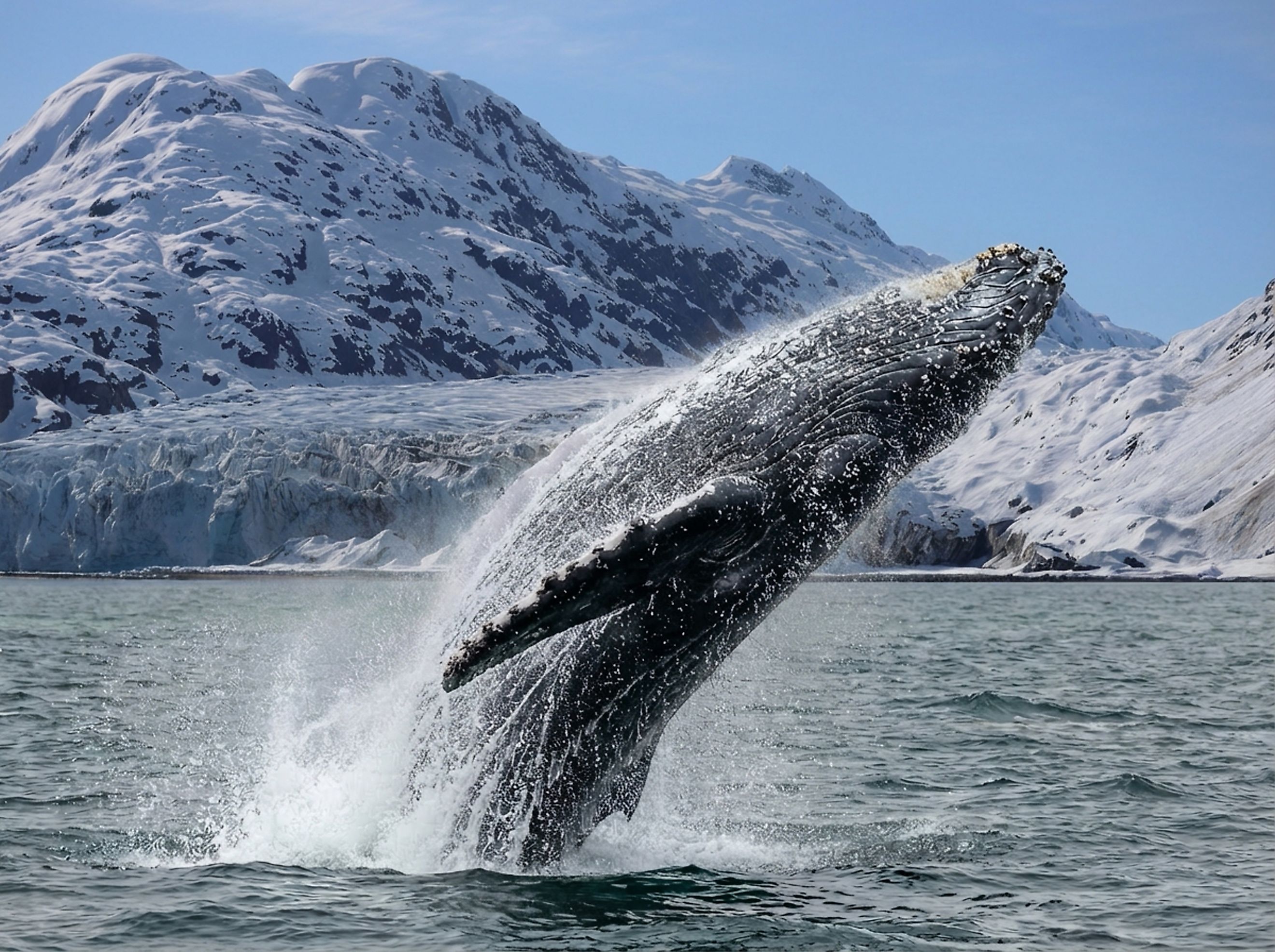
Where Humpback Whales Go In The Winter
Humpback whales spend the summer in cold water eating almost continuously, then swim up to 5,000 miles to the tropics and stop eating entirely for four to six months. They do not go south to find food. They go south because a newborn calf has no blubber and would lose heat too fast to survive in polar water. The adults pay for that with a fast that lasts most of the winter, funded by whatever they managed to store before leaving.
The Distances Are Mammal Records

NOAA describes the humpback migration as one of the longest of any mammal on the planet, and the figures support it.
Some populations swim 5,000 miles each way between tropical breeding grounds and high-latitude feeding grounds. In the North Pacific, whales running from Alaska to Hawaii cover about 3,000 miles, and NOAA records the trip being completed in as few as 28 days.
That works out at better than 100 miles a day, sustained for a month, without stopping to eat.
They Fast The Whole Time

This is the part that separates whale migration from most others.
Humpbacks may spend four to six months fasting during migration and the breeding season, sustained entirely by fat reserves built up over the summer. They are living on blubber from the moment they leave.
Atlantic Whales puts the oddity plainly: migrating humpbacks do not feed during the winter even though their breeding grounds teem with a vast diversity of fish and marine life. What the tropics lack is not life but the dense krill and schooling-fish aggregations that make bulk filter feeding worth the effort.
The Calves Are The Reason

Every element of the migration follows from one physiological problem.
Calves are born without the thick blubber adults carry, so they cannot regulate temperature in frigid water. Warm, shallow, sheltered tropical seas give a newborn its best chance, and they are largely free of major predators.
A calf arrives at about 13 to 16 feet and two tons, nurses for five to seven months, and makes its first migration to polar water within months of birth. It has to grow fast enough to survive the destination.
Alaska To Hawaii Is The Famous Route

The North Pacific route is the best studied and the easiest to watch.
Whales feed through the summer in the Aleutians and Bering Sea, the Gulf of Alaska, southeast Alaska and northern British Columbia, then move to the main Hawaiian Islands. The season there runs roughly November through April.
Other North Pacific populations winter off Mexico, and others again off Japan and the Philippines. The same feeding grounds feed several different wintering destinations.
The Atlantic Goes To The Caribbean

North Atlantic humpbacks follow the same logic toward a different set of islands.
Populations feeding off New England, Greenland, Iceland and Norway head south in late September for the West Indies, with Silver Bank north of the Dominican Republic the best-known gathering point. Others winter off Cape Verde near West Africa.
The Silver Bank season runs January through March. A 5,000-mile Atlantic crossing at better than 100 miles a day takes upward of six weeks.
The Southern Hemisphere Runs Six Months Behind

There are seven populations south of the equator, and their calendar is the mirror image.
All seven feed in Antarctic or sub-Antarctic waters and head north to breed off Australia, Tonga, Fiji, Madagascar, Mozambique and Brazil. Northern Hemisphere whales feed from June to October; Southern Hemisphere whales breed from July to October.
The two halves of the species therefore occupy the tropics at opposite times of year and rarely encounter each other, despite both using equatorial waters.
They Go Back To The Same Place

Humpbacks do not simply head for warm water. They head for a specific patch of it.
The species shows strong site fidelity to particular breeding grounds, which keeps migration routes stable across years and divides the global population into distinct breeding stocks with limited exchange between them.
Fourteen populations are recognized worldwide. A whale from one stock is unlikely to turn up in another's wintering ground, which makes the exceptions remarkable.
One Whale Broke Every Record

Site fidelity makes one documented individual extraordinary.
A male humpback photographed off Colombia's Pacific coast in 2013 was identified again near Zanzibar in 2022. The two breeding grounds sit more than 13,000 kilometers apart, the greatest distance ever recorded between two breeding sites for the species.
It is also the first recorded case of a humpback alternating between Pacific and Indian Ocean breeding grounds. Separately, a whale tracked from Brazil to Madagascar covered roughly 6,100 miles, published as the longest recorded migration of any mammal.
Nobody Knows How They Navigate

For an animal crossing open ocean to a specific bank, the mechanism remains unresolved.
National Geographic reports that how humpbacks know where to travel during migration still has scientists stumped. Candidate explanations include magnetic sensing, sun position and memory, with none established.
Whatever it is, it is accurate enough to put a 40-ton animal on the same shallow bank in the Caribbean year after year.
The Economics Of The Whole Thing

One researcher framed the migration as a loop rather than a journey with a purpose at each end.
The whale feeds heavily in preparation for migrating, and the migration is driven by the fact that it can only feed heavily during part of the season. Summer pays for winter, and winter is what makes summer necessary.
Bubble-net feeding and the other cooperative techniques the species is famous for exist to make that summer as productive as possible, because there is no second chance at it.
The Short Answer

Humpbacks winter in warm shallow tropical water, in the main Hawaiian Islands, off Mexico and Japan, around Silver Bank and the West Indies, off Cape Verde, and across Australia, Tonga, Madagascar, Mozambique and Brazil. They travel up to 5,000 miles each way and arrive at the same bank their stock has used for generations.
They do it to give calves water warm enough to survive in, and they pay for it with a four to six month fast. The species makes one of the longest migrations of any mammal, in order to spend the winter somewhere it deliberately does not eat.