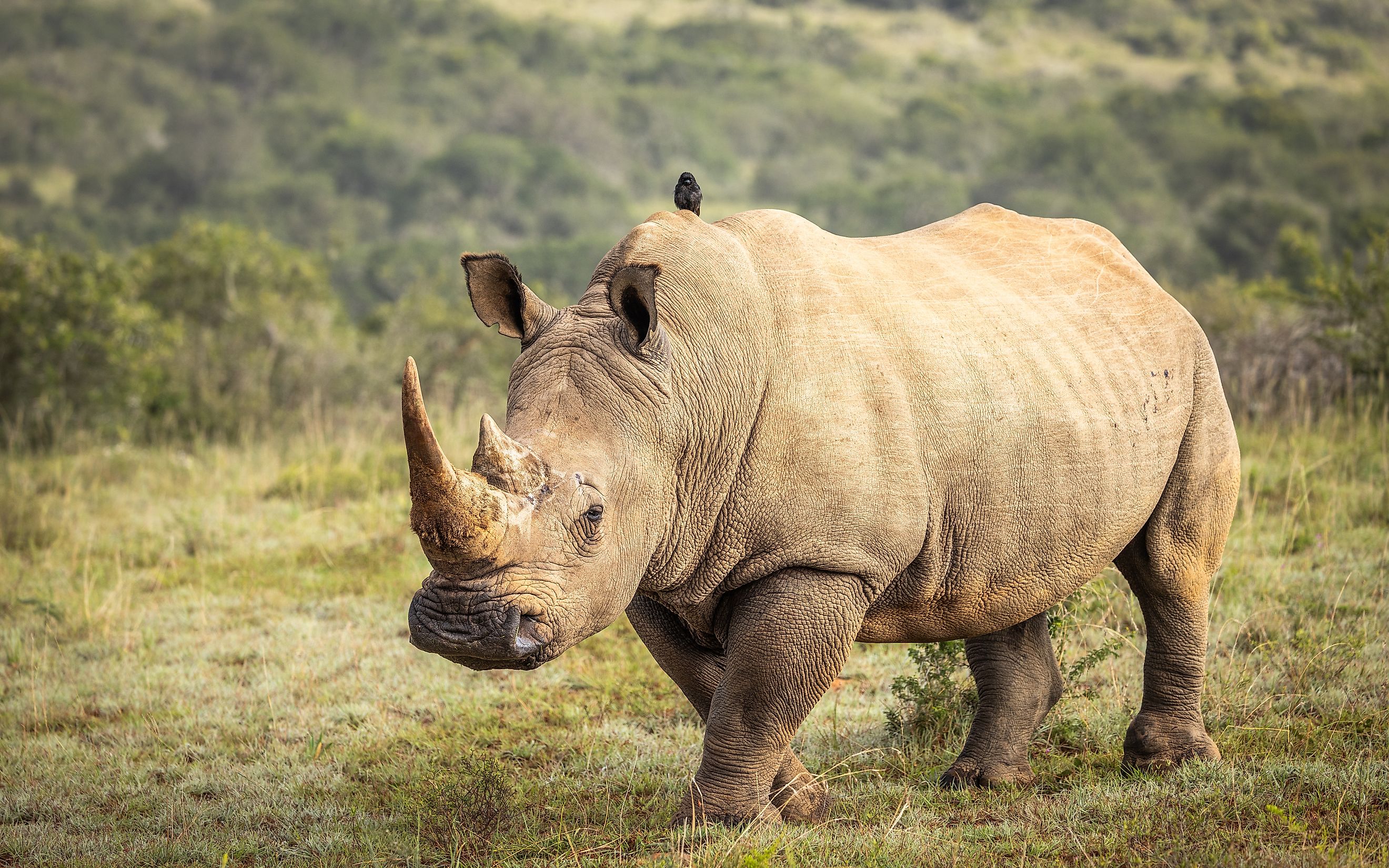
White Rhino
The white rhino is the largest of all living rhinoceroses and, after the elephant, among the heaviest land animals on Earth. A big bull can tip the scales at more than 5,000 pounds (2,300 kg) yet still move with surprising ease across the open grasslands it favors. Its most distinctive feature is a broad, squared-off upper lip built for cropping grass close to the ground, a design so characteristic that the animal is also known as the square-lipped rhinoceros.
Despite the name, the white rhino is not white at all. It is a muted grey, much like its relative the black rhino, and the two are told apart by lip shape and feeding style rather than color. Native to the savannas of Africa, the white rhino carries a remarkable double story. Its southern population is one of conservation's greatest recoveries, while its northern population sits on the very edge of extinction, reduced to a mere two aging females.
Taxonomic Classification

The white rhino belongs to the order Perissodactyla, the odd-toed ungulates, a group that also includes horses, zebras, and tapirs. Within that order it sits in the family Rhinocerotidae, which contains all five surviving rhino species. Its genus is Ceratotherium and its scientific name is Ceratotherium simum, described by the naturalist William Burchell in 1817. The genus name comes from the Greek words for horn and wild beast, while the species name derives from a Greek term meaning flat nosed.
Two subspecies are recognized. The southern white rhino, Ceratotherium simum simum, occupies southern Africa and accounts for nearly the entire living population. The northern white rhino, Ceratotherium simum cottoni, once ranged across central Africa and is now functionally extinct. Some researchers, notably a 2010 study led by Colin Groves, have argued that the two forms are distinct enough to be treated as separate species, a view based on genetic and skull differences. That reclassification has not won universal agreement, and most authorities still treat them as subspecies of a single species.
Physical Description

Everything about the white rhino is built on a large scale. Adults stand roughly 5 to 6 feet (1.5 to 1.8 m) tall at the shoulder and measure about 10 to 16 feet (3 to 5 m) in head and body length. Weight typically runs between 4,000 and 6,000 pounds (1,800 and 2,700 kg), with the largest bulls exceeding that upper figure. Males are heavier and bulkier than females, a clear case of sexual dimorphism tied to their competition for territory and mates.
The body is barrel shaped and carried on short, sturdy legs, each foot ending in three toes. A pronounced hump of muscle sits over the shoulders, supporting the animal's massive head and long skull. The skin is thick and grey, sparsely haired, and often takes on the color of whatever mud or dust the rhino has recently wallowed in.
Two horns rise from the snout, made not of bone but of keratin, the same fibrous protein found in hair and fingernails. The longer front horn can reach about 37 to 79 inches (94 to 201 cm), while the rear horn is shorter and thicker. The defining trait, though, is that wide, flat upper lip. Where the browsing black rhino has a hooked, prehensile lip for grabbing leaves, the white rhino's squared mouth works like a lawnmower, ideal for grazing short grasses across large stretches of savanna.
Range and Habitat

White rhinos are grazers of open country, and they thrive in grassland and savanna where short grasses grow thick and water is within reach. They avoid dense forest and steep terrain, preferring flat or gently rolling ground with scattered trees for shade.
The southern white rhino has its stronghold in South Africa, which holds the great majority of the world's wild population. Additional populations, many of them reintroduced or introduced, live in Namibia, Botswana, Zimbabwe, Eswatini, Mozambique, Uganda, Kenya, and Zambia. This spread across roughly a dozen countries reflects decades of translocation work aimed at rebuilding the subspecies from a tiny historical remnant.
The northern white rhino tells a starkly different story. It once roamed parts of Chad, Sudan, the Central African Republic, Uganda, and the Democratic Republic of the Congo. Today its entire living population consists of two females held under armed guard at the Ol Pejeta Conservancy in Kenya. The wild northern range is effectively empty.
Diet

The white rhino is a dedicated grazer, and its whole feeding apparatus is tuned to a grass diet. Using its broad lip, it clips grass close to the soil and can process large volumes in a day, a necessity given its enormous body. An adult may spend around half of each 24-hour period feeding, often in the cooler hours of morning and evening.
Grass makes up the bulk of the diet, with short, nutritious species preferred where available. Because grasses are relatively low in energy, the rhino compensates through sheer intake, moving steadily across grazing lawns and keeping them cropped. This feeding pattern shapes the landscape around it, an effect explored in the next sections. Rhinos drink regularly when water is available but can go a few days between visits to a waterhole during dry spells.
Behavior

Among rhinos, the white rhino is the most social. Females and their calves often gather in loose groups, sometimes called crashes, that may number several animals feeding in the same area. Adult males are more solitary and hold territories, which they mark and defend against rival bulls. A dominant male will tolerate subordinate males on his ground as long as they behave submissively, but serious clashes between equals can turn violent.
Scent is central to rhino communication. Animals deposit dung at communal sites known as middens and spray urine to advertise identity, status, and reproductive condition. Their eyesight is poor, so they lean heavily on smell and hearing to read their surroundings. White rhinos are generally most active in the morning, late afternoon, and evening, resting and wallowing in mud during the heat of the day to cool down and shed parasites.
For all their bulk, white rhinos can charge at speed when threatened and are capable of covering ground quickly over short distances, a reminder that their calm grazing manner should not be mistaken for docility.
Reproduction

White rhinos breed slowly, which makes population recovery a long process. Females reach maturity at around six to seven years, while males typically do not secure the territory needed to breed until they are older, often past ten. Courtship can be prolonged, with a bull following and guarding a receptive female for days before mating.
Gestation lasts roughly 16 months, one of the longest pregnancies of any land mammal. A female gives birth to a single calf, which can weigh over 100 pounds (45 kg) at birth and is able to stand and follow its mother within hours. The calf stays close for two to three years, often until a new sibling arrives, and in white rhinos the youngster usually walks in front of its mother rather than behind. Females generally produce a calf only once every two to three years. In the wild, white rhinos can live around 40 to 50 years.
Importance to the World

As a large grazer, the white rhino functions as a kind of ecosystem engineer. By feeding heavily on grass, it creates and maintains short grazing lawns that other herbivores use, and it helps shape the structure of savanna vegetation. Its dung returns nutrients to the soil and supports insects and other organisms that depend on it, tying the rhino into a wide web of savanna life.
The white rhino also acts as an umbrella species, meaning its protection shelters far more than the rhino itself. Because a viable rhino population needs large, secure tracts of grassland, safeguarding that habitat automatically protects the countless smaller and less famous species that live alongside it: antelope, ground-nesting birds, insects, and plants. Anti-poaching patrols, fencing, and reserve management put in place for rhinos end up guarding an entire community of wildlife. In this way a single well-protected rhino population can serve as a backbone for the conservation of a whole ecosystem.
Threats and Conservation

The IUCN Red List classifies the white rhino as a whole as Near Threatened, based on its 2020 assessment, which estimated roughly 10,080 mature individuals and a decreasing trend. The southern subspecies, though far more numerous, is also listed as Near Threatened, with figures from the African Rhino Specialist Group placing the southern population at around 17,000 animals at the end of 2023. The northern subspecies is Critically Endangered and considered possibly extinct in the wild.
By far the greatest threat is poaching for horn, which is trafficked to illegal markets in parts of Asia despite being made of nothing more remarkable than keratin. Southern white rhino numbers climbed steadily through the late twentieth century. Having dwindled below 100 animals in the early 1900s, the subspecies rebounded past 20,000 by 2012, one of the most dramatic conservation turnarounds ever recorded. A surge in poaching after 2007, centered on South Africa's Kruger National Park, then reversed part of that gain and drove numbers down again.
The northern white rhino stands as a warning of what unchecked killing can do. Its last male, Sudan, died in 2018, leaving only two females, Najin and her daughter Fatu, at Ol Pejeta in Kenya. Neither can carry a pregnancy, so an international scientific effort known as BioRescue is racing to save the subspecies through in vitro fertilization, using stored sperm and eggs collected from Fatu, with southern white rhino females serving as surrogates. Dozens of pure northern white embryos have been created, and transfers are underway, though a lasting pregnancy has not yet been achieved.
Takeaway
The white rhino is worth understanding because it holds two lessons at once. The southern subspecies proves that a large, slow-breeding mammal can be pulled back from near total loss. A population of perhaps 100 animals a century ago now numbers well over 15,000 today. That recovery did not happen by accident. It came from sustained investment in protected reserves, patient translocation of animals to rebuild scattered populations, and armed anti-poaching work carried out year after year. When those efforts hold, the numbers rise. When they slip, as they did during the poaching surge that began in 2007, the numbers fall just as fast.
The northern subspecies shows the other side of that same equation. Reduced to two females who cannot reproduce naturally, it is now dependent on an experimental IVF program that may or may not succeed. Its collapse is a direct measure of what happens when protection fails and demand for horn goes unchecked.
For anyone who cares about the animal, the practical takeaways are clear. The single greatest driver of white rhino decline is poaching fueled by the illegal horn trade, so reducing that demand and funding enforcement on the ground do more than almost anything else. Wildlife tourism and reputable conservation organizations channel money directly into that protection, which is why well-managed reserves tend to hold healthy rhino numbers. The white rhino's story is still being written, and unlike many endangered species, its fate rests less on some unsolved mystery of biology than on choices people are making right now.
Fun Facts

- The name has nothing to do with color. The white rhino is grey. Its name is widely thought to trace back to a word meaning wide, a reference to its broad mouth, though the exact origin is debated.
- It is among the heaviest land animals alive. Only the elephant reliably outweighs it, with big bulls exceeding 5,000 pounds (2,300 kg).
- The horn is basically hair. Both horns are made of keratin, the same protein found in fingernails and hair, not bone.
- Calves lead the way. Unlike black rhino young, white rhino calves usually walk in front of their mothers rather than behind them.
- An entire subspecies now numbers two. Only two northern white rhinos remain, both female, kept under armed guard while scientists attempt to revive the population through IVF.
Quick Facts
- Scientific name: Ceratotherium simum
- Family and order: Rhinocerotidae, Perissodactyla
- IUCN status: Near Threatened (southern subspecies Near Threatened, northern subspecies Critically Endangered)
- Height: 5 to 6 feet (1.5 to 1.8 m) at the shoulder
- Length: 10 to 16 feet (3 to 5 m), head and body
- Weight: 4,000 to 6,000 pounds (1,800 to 2,700 kg)
- Lifespan: around 40 to 50 years in the wild
- Diet: herbivore, grazer on short grasses
- Range: savannas and grasslands of southern and central Africa