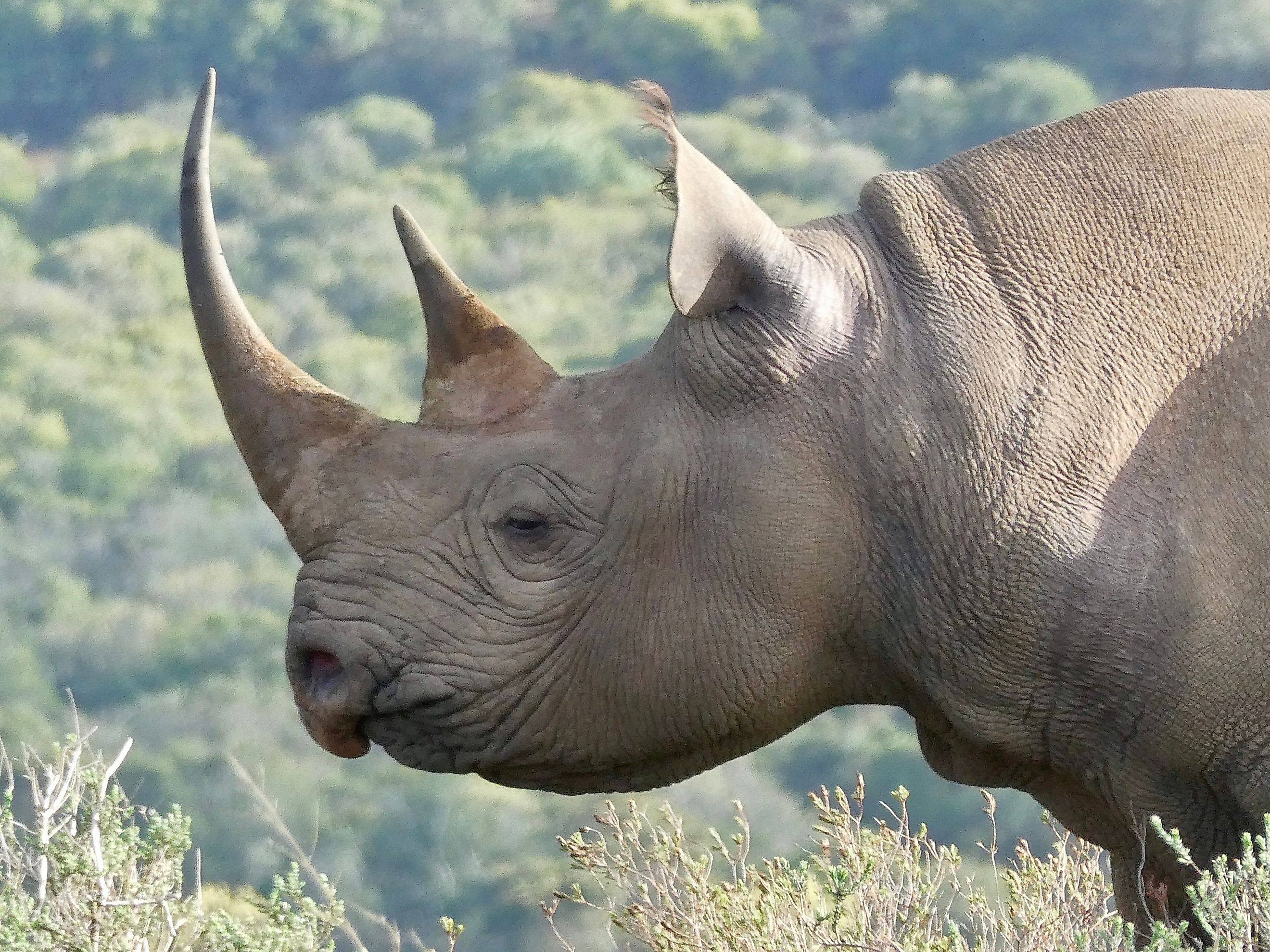
Black Rhino
The black rhino (Diceros bicornis) is a species of rhinoceros native to sub-Saharan Africa. Described as a megaherbivore, a herbivore over 2,200 lb (1,000 kg) the black rhino is critically endangered. The black rhino is one of two extant species of rhinoceros native to Africa, along with the white rhino (Ceratotherium simum). There are three other species of rhino alive today, all in Asia: the greater one-horned rhino (Rhinoceros unicornis), also known as the Indian rhino, and native to the Indian subcontinent, now found in India and Nepal; the Javan rhino (Rhinoceros sondaicus), one of the most endangered animals on Earth, with only 50 individuals, all living at Ujung Kulon National Park in Indonesia; and the Sumatran rhino (Dicerorhinus sumatrensis), the smallest extant rhino, with long hair and two horns.
Taxonomy and Naming

The black rhino is classified in the order Perissodactyla, odd-toed ungulates. These are hoofed animals that bear their body weight on the third digit of each foot, and are simple-stomached, digesting tough plant fibers in their large intestines. The order includes three living families: the equids (horses, zebras, and donkeys), the tapirs, and the rhinoceroses. Black rhinos are part of the family Rhinocerotidae and the genus Diceros (meaning two-horned).
Subspecies
Three living subspecies of the black rhino are currently recognized. The south-western black rhino (Diceros bicornis bicornis) occurs primarily in Namibia and South Africa. The eastern black rhino (Diceros bicornis michaeli) formerly ranged across much of East Africa but is now largely confined to Kenya and Tanzania. The south-central black rhino (Diceros bicornis minor) is the most numerous surviving subspecies and is found mainly in South Africa, Zimbabwe, and Malawi. A fourth subspecies, the western black rhino (Diceros bicornis longipes), once inhabited parts of western and central Africa. After decades of severe poaching and population decline, it was declared extinct by the International Union for Conservation of Nature (IUCN) in 2011.
Naming
The name rhinoceros has been in use in the English language since the 14th century. It is derived from the Ancient Greek rhinokerōs, meaning nose-horned. The scientific name of the genus Rhinoceros came a few centuries later, with the 1758 publication of the 10th edition of Swedish taxonomist Carl Linnaeus’ Systema Naturae. The name white rhino originates from the Afrikaans word wyd, which means wide. The term was used in reference to the white rhino’s broad, square-shaped lip. English settlers misheard the word wyd for white, and the name stuck. The black rhino was subsequently named primarily to distinguish it from the white rhino, even though neither species is actually black or white in color.
Range and Habitat

Found in sub-Saharan Africa, the black rhino is found predominantly in Eastern and Southern Africa. About 94% of the population is found in South Africa, Namibia, Kenya, and Zimbabwe. Their primary habitats are acacia savannas, which are tropical grasslands with flat-topped acacia trees, tropical bushlands and semi-arid deserts, and riverine forests. Their presence in any habitat is dependent on available water. Territories can be as small as 0.4 mi² (1 km²) and up to 38.6 mi² (100 km²) per rhino. In the past, the black rhino could be found in vast expanses of sub-Saharan Africa, but they are now confined to reserves, national parks, and conservancies.
Diet
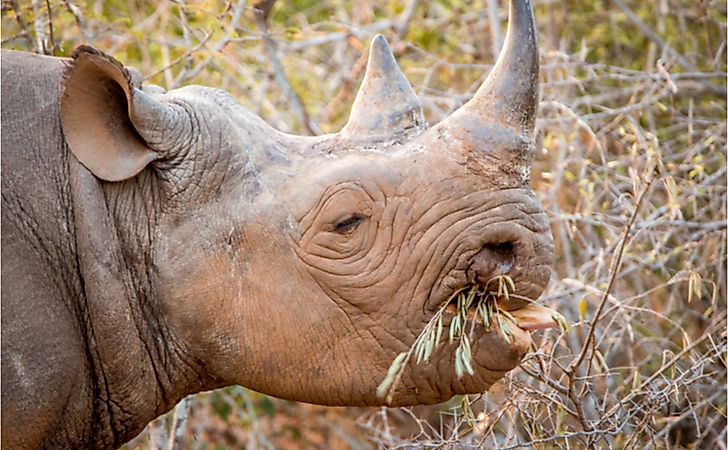
Black rhinos are strict herbivores, specifically herbivorous browsers. This means that rather than grazing on grass, their nutrition comes from trees, shrubs, and bushes. The black rhino’s pointed, prehensile upper lip is flexible and hook-shaped, acting much like a finger. In this way, it can grasp and manipulate stems and twigs and be able to strip away and eat leaves from thorny branches. The black rhino consumes over 70 lb (32 kg) of vegetation daily, from more than 200 different plant species. They are able to reach higher-growing vegetation and chew and consume wood from branches and stems, as well as tree bark. Their preference is for acacia shrubs and trees, and historically, black rhinos were found in vast expanses of savannas where various species of acacia grow.
In addition to their primary diet from trees and shrubs, black rhinos will also consume fruit, succulents, and herbs. They will also use their horns to dig roots for eating. Black rhinos also seek out minerals such as sodium and calcium, which they use as natural salt licks to obtain crucial biometals, regulate fluids, and aid digestion of tough plants. Water requirements vary according to temperature, habitat conditions, and the moisture content of available food. Individuals feeding primarily on dry browse generally drink more frequently than those consuming moisture-rich vegetation. Black rhinos are most active during the cooler hours of the day, including early morning, evening, and nighttime, when they spend much of their time feeding and moving between food and water sources.
Physical Characteristics

In addition to its pointed, prehensile upper lip, the other feature that distinguishes the black rhino from the white rhino is size. The black rhino is smaller, with a less pronounced neck hump, and has two separate keratin horns. Adult black rhinos stand 4.5-6 ft (1.4-1.8 m) in height at the shoulder. They are 9.5-12.5 ft (2.9-3.8 m) in length, and 1,760-3,090 lb (800-1,400 kg). Males are slightly larger than females, and females often have longer horns, but otherwise, they are physically similar.
The skin of the black rhino is not black, but dark gray or brownish-gray. Often, the color is not apparent, as the black rhino spends much of its time wallowing in mud and can be covered in mud for long periods. They are mostly hairless along their thick hides, except for fringes on the ears and the tip of the tail. The black rhino has two horns on its rostrum or snout. The horns are composed of compressed keratin, the same protein found in human nails and hair. The front horn is larger, with an average length of 20 inches (50 cm), and the rear horn is significantly smaller. They have larger ears, which can swivel independently, and the black rhino has excellent hearing and a powerful sense of smell, making up for extremely poor eyesight. Their eyes are side-facing, providing a panoramic view of their surroundings. However, they have limited binocular vision and poor depth perception with a key blind spot directly in front.
Mating and Reproduction
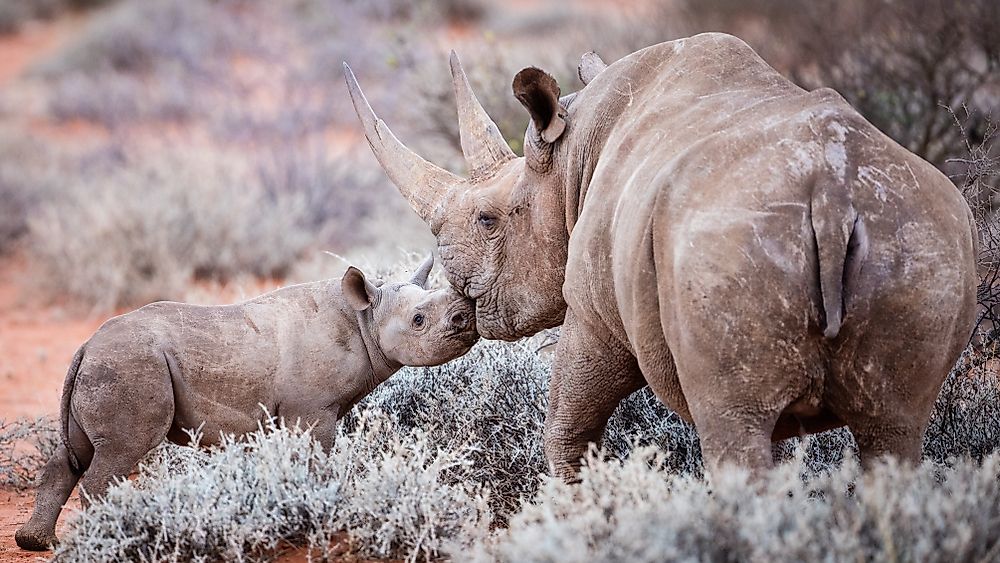
Females sexually mature at 4 to 7 years, and for males, it is 7 to 8 years. Females indicated their readiness for mating by spraying urine and scraping dung piles. The males will follow the females for days, and their courtship can become physical, involving snorting, jousting, and bluff and bluster behavior. Once paired, the bull and cow black rhino will remain together for 2 to 3 days, copulating multiple times a day.
The reproductive rate of the black rhino is slow. They give birth to a single calf every 2.5 to 4 years. Gestation is around 15 months, and the calf will stay with its mother for 2 to 4 years, until the next calf is born. The mother will find a secluded area to give birth, and calves typically weigh between 75-110 lb (34-50 kg). Newborn black rhinos are very vulnerable during their first few days.
The Importance of the Black Rhino

Black rhinos are both keystone and umbrella species in their ecosystems. Their survival directly affects the animals and plant life in the black rhino’s habitat. As megaherbivores, they consume large quantities of vegetation and disperse seeds through dung, maintaining a balance in the ecosystem. As big game hunting gives way to tourism, the survival of the black rhino is crucial to local economies. Black rhinos are also crucial for ecosystem engineering. Their clearings maintain grassland diversity, and their use of large territories helps other species utilize the space.
Black rhinos are part of Africa’s Big Five: lions, leopards, African elephants, Cape buffaloes, and rhinoceroses, the five iconic large animals that help drive ecotourism in Africa. For wildlife watchers and photographers, these are the must-see animals, and that interest is a huge benefit to local economies. As symbols of biodiversity, black rhinos are ancient and serve as symbols of natural heritage and as a barometer for the health of their habitats, and for the African savanna in general. There are three primary threats to the black rhino: illegal poaching for the illicit international rhino horn trade, habitat loss, and environmental issues such as severe drought. Conservationists have lobbied governments to establish conservation areas and preserves, and to implement anti-poaching patrols. There are dehorning programs, a drastic but sometimes necessary removal of horns, which is the primary target of poachers. Dehorning is humane when performed correctly under veterinary supervision and does not permanently harm the animal. Conservationists and activists continue to pressure governments to expand the ranges for black rhinos and encourage community-led conservation. These efforts have had a positive impact, and although black rhinos remain Critically Endangered, there have been successful repopulation initiatives that point to continued recovery.
Conservation Status of the Black Rhino

The International Union for Conservation of Nature (IUCN) is an international environmental network working in nature conservation and ecological sustainability. The IUCN published its Red List, an ongoing assessment of the global extinction risk of biological species. The IUCN Red List classifies the black rhino as Critically Endangered, the highest threat category assigned to species that still survive in the wild.
In addition to evaluating extinction risk, the IUCN has developed the Green Status of Species, a framework that measures species recovery and the impact of conservation efforts. In its Green Status assessment, the black rhino received a Species Recovery Score of 24%, placing it in the category Largely Depleted. This classification indicates that the species remains far below its historical abundance and distribution but has benefited substantially from conservation actions.
The assessment also found that conservation measures have produced a Medium Conservation Gain, meaning that protected areas, anti-poaching initiatives, habitat management, translocations, and community-based conservation programs have significantly improved the species' outlook. While the black rhino is still classified as Critically Endangered, current population trends suggest that continued conservation efforts can further expand and stabilize populations across parts of its former range.