Sumatran Rhino
The Sumatran rhinoceros is the smallest living rhino and the only one still wrapped in a coat of coarse reddish hair, a feature that links it directly to the woolly rhinos that roamed the Ice Age world. It is the sole survivor of an ancient lineage, the only remaining species in its genus, and the closest living relative of giants that vanished tens of thousands of years ago. That long evolutionary story now hangs by a thread, because fewer of these animals remain than almost any other large mammal on the planet.
Found today only in the rainforests of Sumatra and a small pocket of Indonesian Borneo, Dicerorhinus sumatrensis is a shy, solitary browser that spends its days wallowing in mud and its nights feeding on leaves and saplings deep in the forest. It is also the most talkative of all rhinos, producing whistles, squeaks, and eerie song-like calls that carry through thick vegetation.
Taxonomic Classification

The Sumatran rhino belongs to the order Perissodactyla, the odd-toed ungulates, and the family Rhinocerotidae, which holds all five living rhino species. Within that family it occupies its own genus, Dicerorhinus, and it is the only surviving member. Its full scientific name is Dicerorhinus sumatrensis, assigned by the naturalist Johann Fischer von Waldheim in 1814. The animal had first come to Western attention two decades earlier, when a specimen shot near Fort Marlborough on the west coast of Sumatra in 1793 was described in drawings and notes sent to Joseph Banks, then president of the Royal Society of London.
Three subspecies have been recognized, and their fates trace the decline of the species as a whole. The Western Sumatran rhino (D. s. sumatrensis) survives on the island of Sumatra and represents almost the entire remaining population. The Bornean rhino (D. s. harrissoni), once found across Borneo, now hangs on only as a scattered remnant in East Kalimantan on the Indonesian side of the island. Its Malaysian population, in the northern Bornean state of Sabah, was declared extinct in the wild in 2015, and the last known Malaysian individuals died in captivity in 2019. The Northern subspecies (D. s. lasiotis), which formerly ranged through mainland Asia, is believed to be extinct. What makes this rhino so scientifically remarkable is its position on the evolutionary tree, as the nearest living cousin of the extinct woolly rhinoceros.
Physical Description

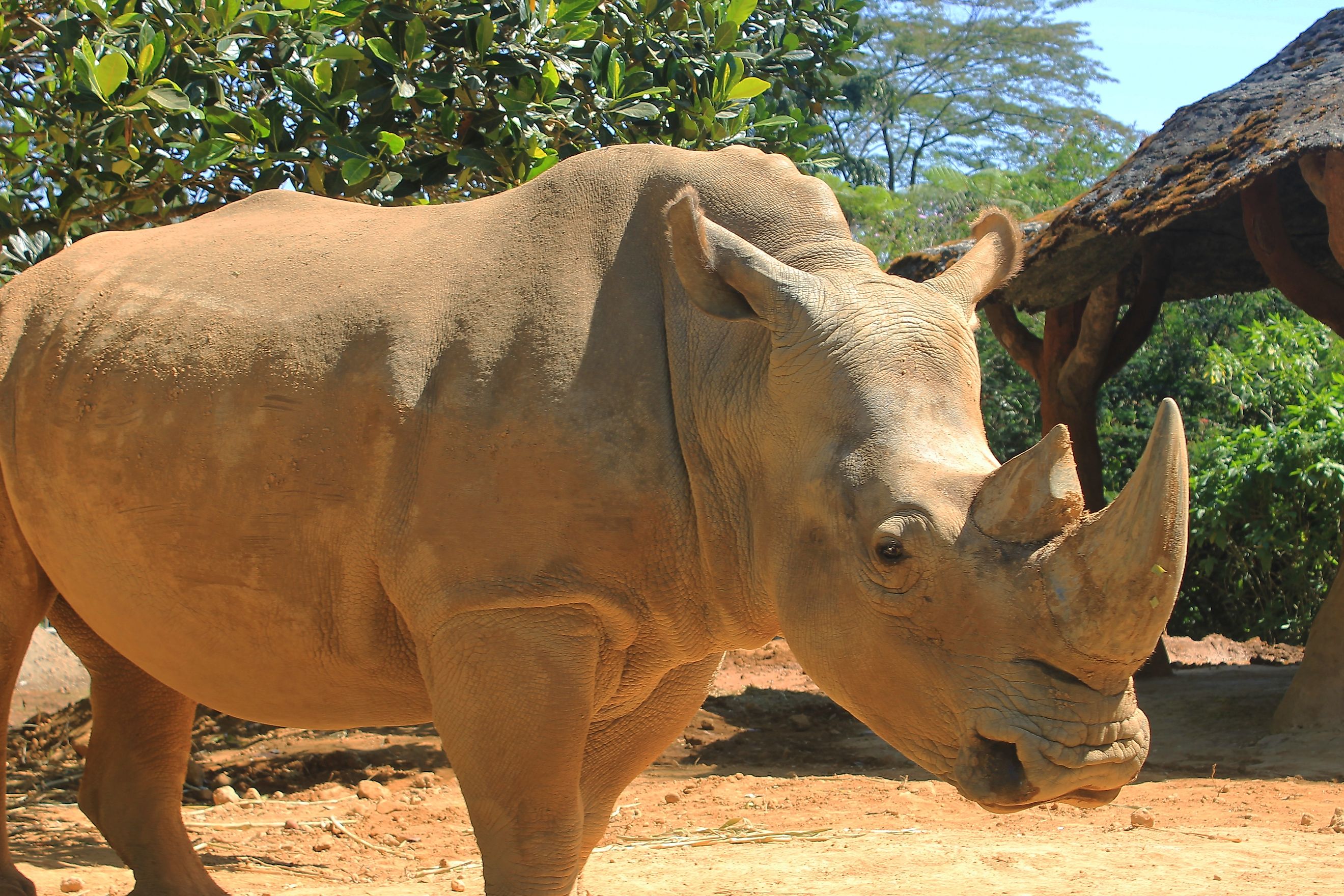
The Sumatran rhino is unmistakably the smallest of all rhinos, yet it remains a powerfully built animal. Adults stand roughly 44 to 57 inches (112 to 145 cm) high at the shoulder, measure about 7.7 to 10.4 feet (2.4 to 3.2 m) in head and body length, and typically weigh between 1,100 and 1,760 pounds (500 to 800 kg). Larger individuals can reach or exceed 2,000 pounds (900 kg). The body is short, stocky, and barrel-shaped, carried on stout, pillar-like legs suited to pushing through dense forest and climbing steep terrain.
Two features set this rhino apart from every other. First, it carries two horns rather than one, making it the only Asian rhino with a pair. The front nasal horn is the larger of the two, usually 6 to 10 inches (15 to 25 cm) long, though the record specimen reached about 32 inches (81 cm). The rear horn is much smaller and often little more than a knob. Both horns are made of keratin, the same protein found in hair and fingernails. Second, and most striking, the Sumatran rhino is the only living rhino covered in a shaggy coat of reddish-brown hair. The hair is dense in calves, coppery in young adults, and grows sparse and dark with age. A prehensile upper lip helps the animal grasp leaves and shoots, and its folded, leathery hide offers protection without the heavy plating seen on its Indian relative.
Range and Habitat

The Sumatran rhino once occupied a vast sweep of Asia. Its range reached the foothills of the Himalayas and ran through Myanmar, Thailand, Laos, and the Malay Peninsula into Sumatra and Borneo, extending as far north as southwestern China. That range has collapsed into a handful of isolated fragments. Today the animal survives almost entirely within a few protected areas on Sumatra, including Gunung Leuser, Way Kambas, and Bukit Barisan Selatan National Parks, with a tiny population clinging on in East Kalimantan on the Indonesian side of Borneo. It is now considered extinct in Malaysia, which leaves Indonesia as the species' last refuge.
Across its range the species favors dense tropical rainforest, including lowland swamps and higher montane cloud forest, usually near water and salt sources. These rhinos move seasonally within their forest home, climbing to higher ground when the lowlands flood and returning to lower elevations during drier months. Their preference for thick, remote forest has long made them almost impossible to observe, which is one reason so much of what is known comes from the small number of animals held in sanctuaries.
Diet

The Sumatran rhino is a browser rather than a grazer, feeding on the leaves, twigs, shoots, bark, and fruit of an enormous variety of forest plants. Studies of wild animals suggest their diet spans more than 150 species of trees and shrubs, giving them an important role in shaping the forest understory. A rhino will often knock down or trample young saplings to reach the tender growth at the top before feeding. Most foraging happens during the cooler hours around dawn and dusk and through the night.
Mineral intake matters as much as plant food. These rhinos regularly visit natural salt licks, which may take the form of small hot springs, salty seepages, or mud volcanoes. The salts and minerals gathered there are thought to be an important supplement to a leafy diet, and well-worn trails often lead directly to these sites.
Behavior

Sumatran rhinos are solitary by nature. Adults live alone across established home ranges and come together only to mate or when a mother is raising a calf. Males hold larger territories, sometimes around 20 square miles (roughly 50 square kilometers), while females occupy smaller ranges. They mark their ground by scraping soil with their feet, twisting saplings into distinctive shapes, and leaving dung and urine along their trails.
Two behaviors stand out. The first is wallowing. These rhinos spend much of the day submerged in mud, which cools the body, coats the skin against drying and cracking, and helps repel biting insects and parasites. When no wallow is available, a rhino will use its feet and horns to deepen a puddle of its own. The second is their voice. The Sumatran rhino is the most vocal of all rhino species, producing a range of sounds that researchers describe as eeps, whistle-blows, and long, whale-like songs. These calls travel through vegetation where sightlines are almost nonexistent, letting widely scattered animals locate one another. Despite their bulk, Sumatran rhinos are fast and agile, able to run and climb steep, forested slopes with surprising ease.
Reproduction

Reproduction in the wild has almost never been witnessed, and most of what is known comes from careful study of animals in managed care. Females reach sexual maturity at around six to seven years of age and males somewhat later. A notable quirk of their biology is that females may not enter estrus until they sense a male nearby, a trait that becomes a serious problem when the last remaining rhinos are separated by miles of fragmented forest.
Gestation lasts roughly 15 to 16 months, one of the longest pregnancies of any land mammal. A female gives birth to a single calf, usually only once every three to four years, and most births fall in the wet season between October and May. Newborns weigh around 55 to 66 pounds (25 to 30 kg) and arrive with a dense covering of hair. Calves nurse for well over a year and stay close to their mothers for two to three years before striking out alone. This slow reproductive pace, combined with long intervals between births, means populations recover very slowly even under the best conditions. In the wild these rhinos may live 30 to 45 years.
Importance to the World

As large forest browsers, Sumatran rhinos act as ecosystem engineers. By feeding on a wide range of plants and moving across the landscape, they disperse seeds and open up the understory, helping to shape and regenerate the rainforests they inhabit. Their trampling and browsing influence which plants thrive, supporting the biodiversity of some of the richest forests on Earth.
Because the species depends on healthy, intact forest, its presence serves as a barometer for the condition of an entire ecosystem. Where Sumatran rhinos survive, the surrounding habitat tends to be functioning well, and protecting them safeguards countless other species that share their range. The animal also carries deep cultural weight in Indonesia, where it appears in Malay folktales and has become a national symbol of forest conservation.
Threats and Conservation

The Sumatran rhino is listed as Critically Endangered on the IUCN Red List, a status it has held since 1996 and which was reaffirmed in the most recent assessment. Recent estimates place the wild population at only about 34 to 47 individuals, with as few as 30 breeding adults, though the Indonesian government has described the total as fewer than 100 animals scattered across protected areas. Whichever figure is closer, this is among the rarest large mammals alive, and its numbers continue to fall.
Three forces have driven the decline. Habitat loss came first, as lowland rainforest was cleared for palm oil, paper pulp, logging, and agriculture, shrinking and fragmenting the animal's range. Poaching for the horn, valued in some traditional medicine markets, cut deeply into an already small population. Now a third and quieter threat has become the most dangerous of all. With survivors spread thinly across isolated forest patches, animals struggle to find one another to breed, and long-isolated females can develop reproductive problems that leave them unable to reproduce at all.
Conservation now centers on managed breeding. The Sumatran Rhino Sanctuary in Way Kambas National Park, opened in 1996 and run with the International Rhino Foundation, holds the only reproductively viable captive herd in the world. Its semi-natural breeding program has produced several calves in recent years, a hard-won success after decades of setbacks. Plans are underway to expand sanctuary capacity and to search for and relocate isolated wild rhinos into safe breeding facilities, while researchers explore advanced reproductive techniques. The road ahead is steep, but each new calf offers a measure of hope for an animal that has come remarkably close to disappearing.
Takeaway
For all its evolutionary distinction, the Sumatran rhino's future now comes down to arithmetic. A wild population in the low double digits, females that breed only once every three to four years, and animals too scattered to find mates together mean the species can no longer recover on its own. The clearest path forward is the one conservationists are already pursuing, which involves gathering the remaining rhinos into protected breeding centers where they can be paired, monitored, and supported through pregnancy. The recent run of calves at the Way Kambas sanctuary shows this approach can work, though the margin for error has nearly vanished. The measures that matter now are concrete and depend on whether managed herds can produce healthy calves faster than the wild population declines and whether Indonesia can move more isolated animals into safe breeding facilities before they are lost. The next decade will be crucial in determining whether one of Earth's oldest rhino lineages survives into the next century.
Fun Facts

- The Sumatran rhino is a living Ice Age relic, the closest living relative of the extinct woolly rhinoceros, and its shaggy coat is a direct echo of that frozen past.
- It is the most vocal of all rhinos, producing whistles, squeaks, and long, whale-like songs that carry through dense forest.
- Among the five living rhino species, it is both the smallest and the only one covered in a coat of coarse reddish hair.
- A rhino horn has no bone at its core. It is built from keratin, the same protein found in human hair and fingernails.
- Mating has almost never been observed in the wild, so much of what science knows about how these rhinos breed comes from animals in sanctuaries.
- With a pregnancy of roughly 16 months, the Sumatran rhino has one of the longest gestation periods of any land mammal.
Quick Facts
- Scientific name: Dicerorhinus sumatrensis
- Family: Rhinocerotidae
- Order: Perissodactyla
- IUCN status: Critically Endangered
- Population: roughly 34 to 47 in the wild (2025 estimate)
- Height: 44 to 57 inches (112 to 145 cm) at the shoulder
- Length: 7.7 to 10.4 feet (2.4 to 3.2 m)
- Weight: 1,100 to 1,760 pounds (500 to 800 kg)
- Lifespan: 30 to 45 years
- Diet: herbivore (browser of leaves, twigs, shoots, bark, and fruit)
- Range: Sumatra and a small population in Indonesian Borneo