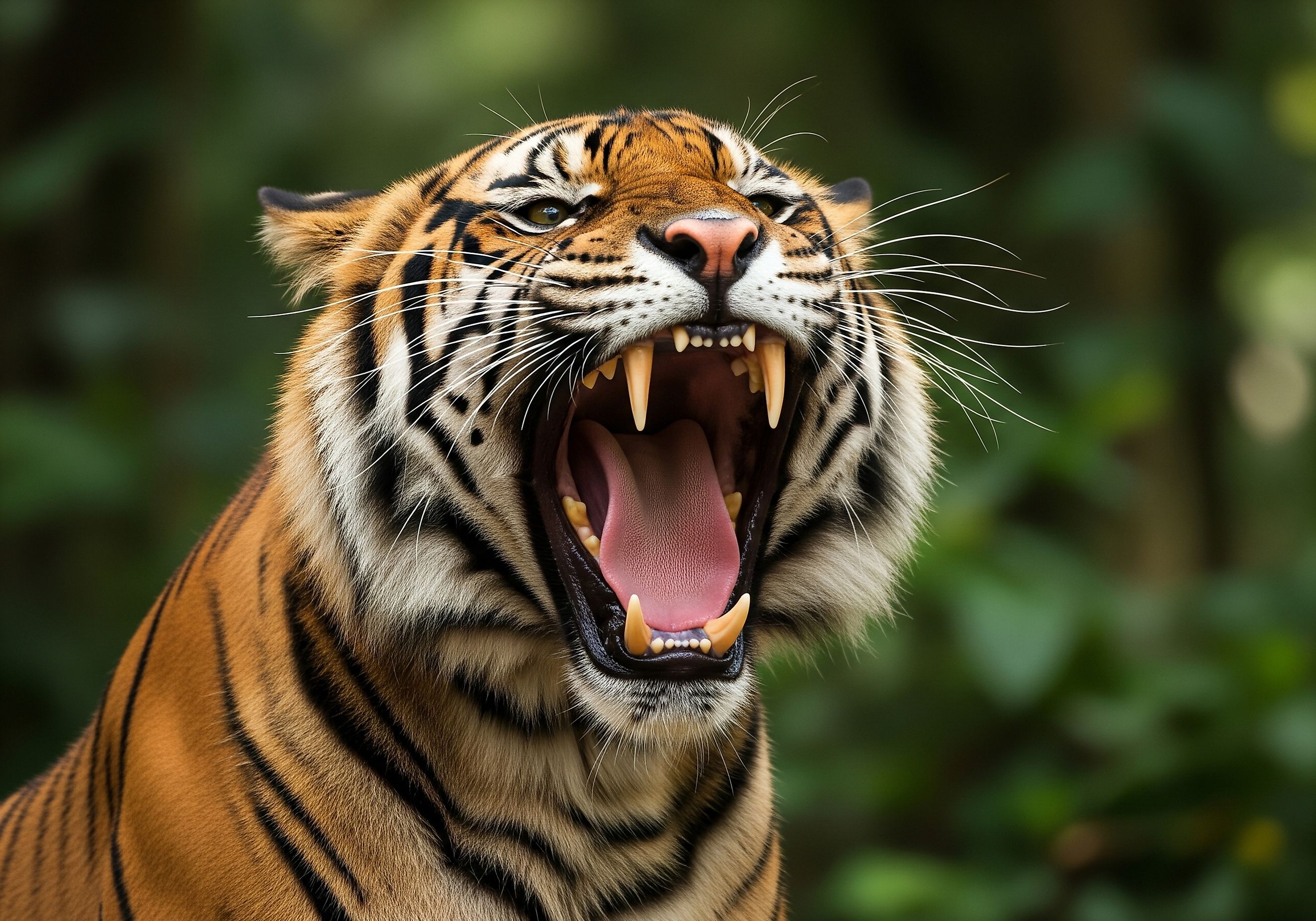
Sumatran Tiger
The Sumatran tiger is the smallest living tiger and the world's last remaining island-dwelling tiger population. It survives on a single land mass, the Indonesian island of Sumatra, where perhaps a few hundred adults remain. Two of its close island relatives, the Bali tiger and the Javan tiger, are already extinct, which makes this cat the sole surviving tiger of the Sunda region and one of the most threatened big cats on Earth.
What sets it apart is not only its size. The Sumatran tiger carries the darkest coat and the narrowest stripes of any tiger, adaptations tied to hunting in dense tropical forest. It is a strong swimmer with partial webbing between its toes, and it holds the position of apex predator across an island that has no other cat of comparable size. Understanding this animal means understanding a population under sustained pressure, one that conservationists track individual by individual.
Taxonomic Classification

The Sumatran tiger belongs to the cat family, Felidae, and the genus Panthera, which it shares with lions, leopards, jaguars, and snow leopards. All tigers are members of a single species, Panthera tigris, first described by Carl Linnaeus in 1758. The Sumatran population was long treated as a distinct subspecies, Panthera tigris sumatrae, named by Reginald Pocock in 1929.
That classification changed recently. In 2017 the Cat Classification Task Force of the IUCN Cat Specialist Group revised tiger taxonomy using genetic and morphological evidence and reduced the world's tigers to two recognized subspecies. Under that scheme, the Sumatran, Javan, and Balinese tigers are grouped as the Sunda tiger, Panthera tigris sondaica, while all mainland tigers fall under Panthera tigris tigris. Both names remain in circulation. Many wildlife agencies and zoos still use Panthera tigris sumatrae for the Sumatran population, while the newer literature increasingly uses sondaica. Genetic studies support the view that Sumatran tigers are distinct from mainland tigers, which is one reason conservation programs treat them as a separate management unit whichever label is applied.
Physical Description

Size is the first thing that distinguishes this tiger. Adult males typically weigh between 220 and 310 pounds (100 to 140 kg), and females between 165 and 245 pounds (75 to 110 kg). A large male measures roughly 8 feet (2.4 m) including the tail and stands about 23 inches (60 cm) at the shoulder. Those figures place the Sumatran tiger below every mainland tiger, including the much larger Siberian tiger, whose males can exceed 600 pounds (270 kg). Even so, it remains the largest land predator in Indonesia.
The coat is a deep orange, darker than that of mainland tigers, and the black stripes are set closer together. This narrow striping improves concealment in the shadow and undergrowth of rainforest. Each tiger carries a stripe pattern that is unique to the individual, comparable to a fingerprint, and researchers use camera-trap photographs of these patterns to identify and count specific animals. Males grow a pronounced ruff of longer fur around the cheeks and neck, giving the head a maned appearance, and both sexes show a pale beard of fur on the face.
Several features suit the animal to its environment. Partial webbing between the toes aids swimming, a trait useful in a landscape of rivers and swamp forest. The eyes deliver strong vision by day and night, with night vision several times keener than a human's, and hearing is the sharpest of the tiger's senses, tuned to the high-pitched sounds of prey. Long canine teeth and retractable claws allow the cat to grip and hold animals larger than itself.
Range and Habitat

The Sumatran tiger occurs only on Sumatra, a large island at the western end of the Indonesian archipelago. Tigers once lived on the neighboring islands of Java and Bali as well, but both of those populations were driven to extinction in the twentieth century, leaving Sumatra as the last island stronghold for any tiger.
Within Sumatra the cat uses a range of forest types, from coastal lowland rainforest and peat swamp forest up through sub-montane and montane forest at higher elevations. It can also persist in degraded and partly logged forest where prey remains available. The largest and most viable populations are concentrated in a handful of protected landscapes, among them the Leuser ecosystem in the north, Kerinci Seblat in the central highlands, and Bukit Tigapuluh. Three national parks on the island form the Tropical Rainforest Heritage of Sumatra, a UNESCO World Heritage Site, though these areas face ongoing pressure from logging, encroachment, and planned road construction. The tiger's range has contracted sharply as forest has been cleared, and the remaining animals live in isolated pockets rather than one continuous population.
Diet

The Sumatran tiger is an obligate carnivore and an ambush hunter. Wild pigs and deer, including sambar and the small barking deer, form the core of its diet on Sumatra. It also takes primates such as macaques, along with tapir, porcupines, birds, fish, and reptiles, and it will occasionally kill the calves of larger animals. A tiger can bring down prey up to about four times its own weight and prefers larger animals when they are available, which is especially true for a female feeding growing cubs.
Hunting relies on stealth rather than speed over distance. The tiger approaches under cover, closes the gap quietly, and attacks with a short rush, using its weight and grip to overpower the target before delivering a killing bite to the throat or neck. A tiger may eat a large amount in a single feeding, on the order of tens of pounds of meat, then rest and return to the carcass over following days. Because it sits at the top of the food chain, the tiger's own numbers depend directly on how much prey the forest can support, and declines in deer and pig populations translate quickly into declines in tigers.
Behavior

Adult Sumatran tigers live alone. Each holds a territory that it marks with scent, scrapes, and vocal signals, and a male's range commonly overlaps those of several females. The main exceptions to this solitary life are the brief periods of mating and the two years or so that a mother spends raising her cubs. Tigers communicate through roars, chuffing sounds, grunts, scent marking, and physical contact such as rubbing heads during courtship.
Activity is concentrated in the cooler hours, with much of the daytime spent resting in shade or cover. The Sumatran tiger is a capable swimmer and, like the jaguar, will readily enter water, crossing rivers and cooling off in a way most cats avoid. Its acute hearing and night vision support hunting after dark, and the narrow-striped coat keeps it concealed as it moves through dense vegetation. These are secretive animals, and much of what researchers know about wild individuals comes from camera traps and tracking rather than direct observation.
Reproduction

Sumatran tigers breed throughout the year rather than in a fixed season. Females reach sexual maturity at about three to four years of age and males at around four to five. When a female is receptive she signals nearby males through scent and vocalization, and a pair stays together for a few days of frequent mating before separating.
Gestation lasts roughly 100 to 108 days, a little over three months. The female seeks out a sheltered den, such as a thicket, cave, or rock crevice, and gives birth to a litter that usually numbers two or three cubs, though a single litter can hold anywhere between one and six. Cubs are born blind and helpless and weigh about 2 pounds (1 kg). The mother raises them alone, nursing for the first weeks before introducing meat, and the young begin learning to hunt at around six months. Cubs stay with their mother until roughly 18 months to 2 years of age, when they disperse to establish territories of their own. In the wild, Sumatran tigers generally live about 15 years, while individuals in managed care can reach 20 years or more.
Importance to the World

As the apex predator of Sumatra, the tiger regulates the numbers of the herbivores it hunts, which in turn shapes the structure of the forest and the balance of other species. Predators of this kind are often considered both keystone and umbrella species. Protecting enough intact forest to support a viable tiger population also helps safeguard the many other animals and plants that depend on the same habitat. Because tigers need large, prey-rich territories, their presence is a useful indicator of ecosystem health, and their disappearance signals wider trouble in the forest.
The tiger is a national symbol in Indonesia and a focus of wildlife tourism and international conservation funding. The protected landscapes maintained for tigers deliver benefits beyond the species itself, including watershed protection and carbon storage in the rainforests of Sumatra.
Threats and Conservation

The Sumatran tiger is listed as Critically Endangered on the IUCN Red List, a status it has held since 2008. Population estimates place the number of mature individuals at fewer than 400 based on 2018 assessment data, with broader figures across the island sometimes cited in the range of 400 to 600 animals. No single recent national survey covers all of Sumatra, so these numbers carry real uncertainty. The trend is not in doubt, though, since the population is declining and no individual subpopulation is large.
Two forces drive the decline. The first is habitat loss. Sumatra's forests have been cleared at a rapid pace for oil palm, acacia, and coffee plantations, along with logging and road building, which fragments tiger habitat and reduces the prey base. The second is direct killing. Poachers target tigers for their skin, bones, and teeth to supply the illegal wildlife trade, and tigers are also killed in retaliation after they attack livestock or people near the forest edge. One analysis found that more than eight tigers were killed each year through such conflict between 2001 and 2016.
Conservation efforts focus on protecting the core landscapes that can still hold viable numbers, strengthening anti-poaching patrols, reducing human-tiger conflict, and supporting captive breeding programs that maintain a genetic reserve against extinction in the wild. A viability analysis of Sumatra's tiger landscapes concluded that only a few of them are large enough to sustain the species over the long term, which places heavy weight on keeping those specific areas intact. Whether the Sumatran tiger persists through this century depends largely on how much of that forest survives.
Takeaway
The Sumatran tiger concentrates the story of tiger conservation into a single island. It is the smallest of its kind and the last of the island tigers, a dark-coated, narrow-striped hunter perfectly matched to the rainforest that is now vanishing around it. Its decline tracks the loss of that forest, and its survival depends on holding the line in the few landscapes still large enough to support it. Protecting those places protects far more than one cat, which is why the fate of the Sumatran tiger is watched so closely well beyond Indonesia.
Fun Facts

- The last island tiger: Sumatra is the only island on Earth that still has wild tigers, after the extinction of the Bali and Javan populations.
- Built to swim: Partial webbing between the toes helps the Sumatran tiger move through water, and it is one of the few cats that seeks out swimming.
- Fingerprint stripes: No two tigers share the same stripe pattern, and researchers identify individuals from camera-trap photos the way police use fingerprints.
- Darkest coat, narrowest stripes: Among all tigers, this subspecies has the deepest orange fur and the most closely spaced stripes, both suited to shadowed forest.
- Smallest but still the biggest: It is the smallest living tiger, yet it remains the largest land predator anywhere in Indonesia.
Quick Facts
- Common name: Sumatran tiger
- Scientific name: Panthera tigris sumatrae (also classified as Panthera tigris sondaica, the Sunda tiger)
- Family / Order: Felidae / Carnivora
- IUCN status: Critically Endangered (population decreasing)
- Length: Up to about 8 feet (2.4 m) including the tail
- Shoulder height: About 23 inches (60 cm)
- Weight: Males 220 to 310 pounds (100 to 140 kg); females 165 to 245 pounds (75 to 110 kg)
- Lifespan: About 15 years in the wild, up to 20 years or more in managed care
- Diet: Carnivore: wild pigs, deer, primates, tapir, fish, and birds
- Range: Island of Sumatra, Indonesia