Saharan Horned Viper
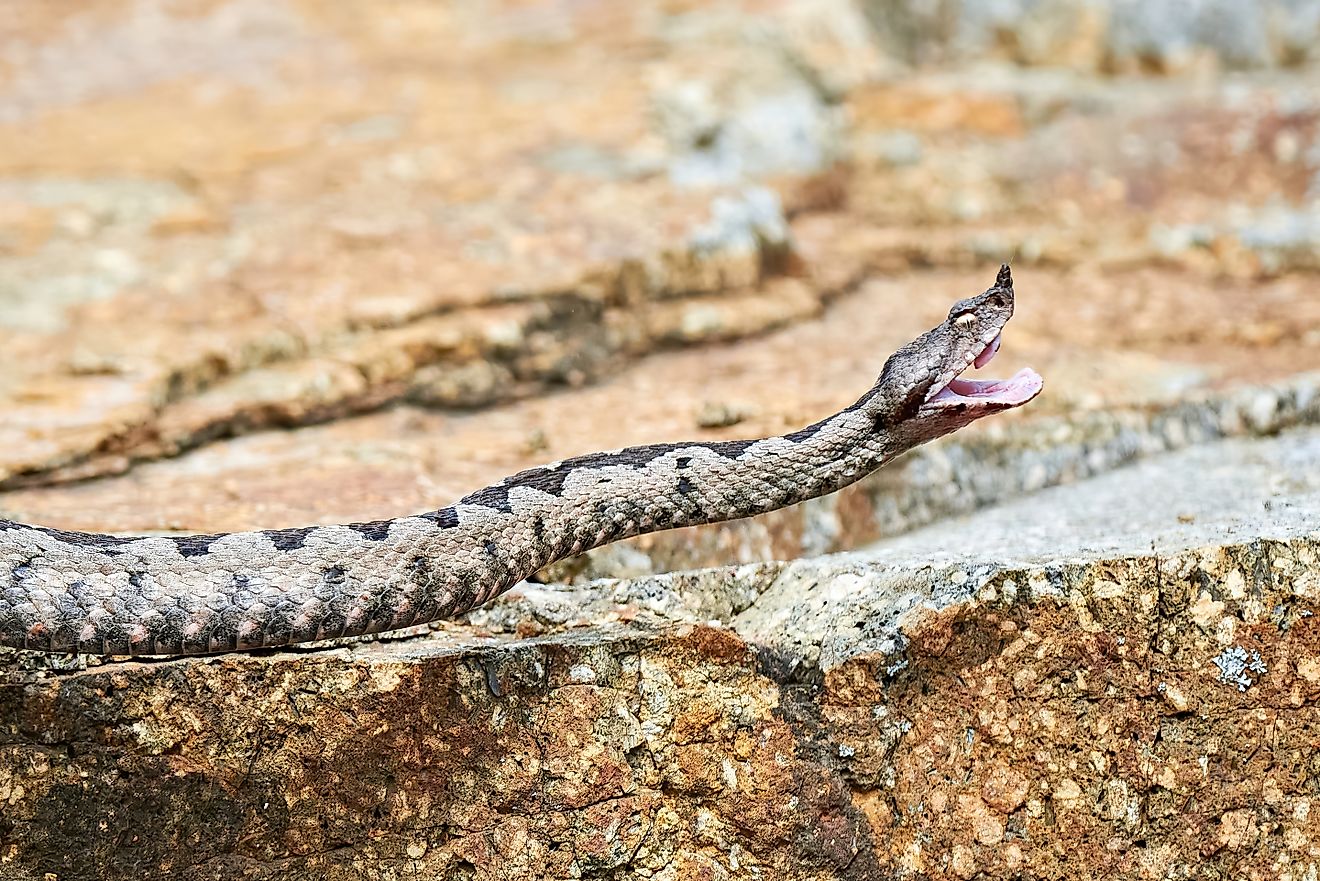
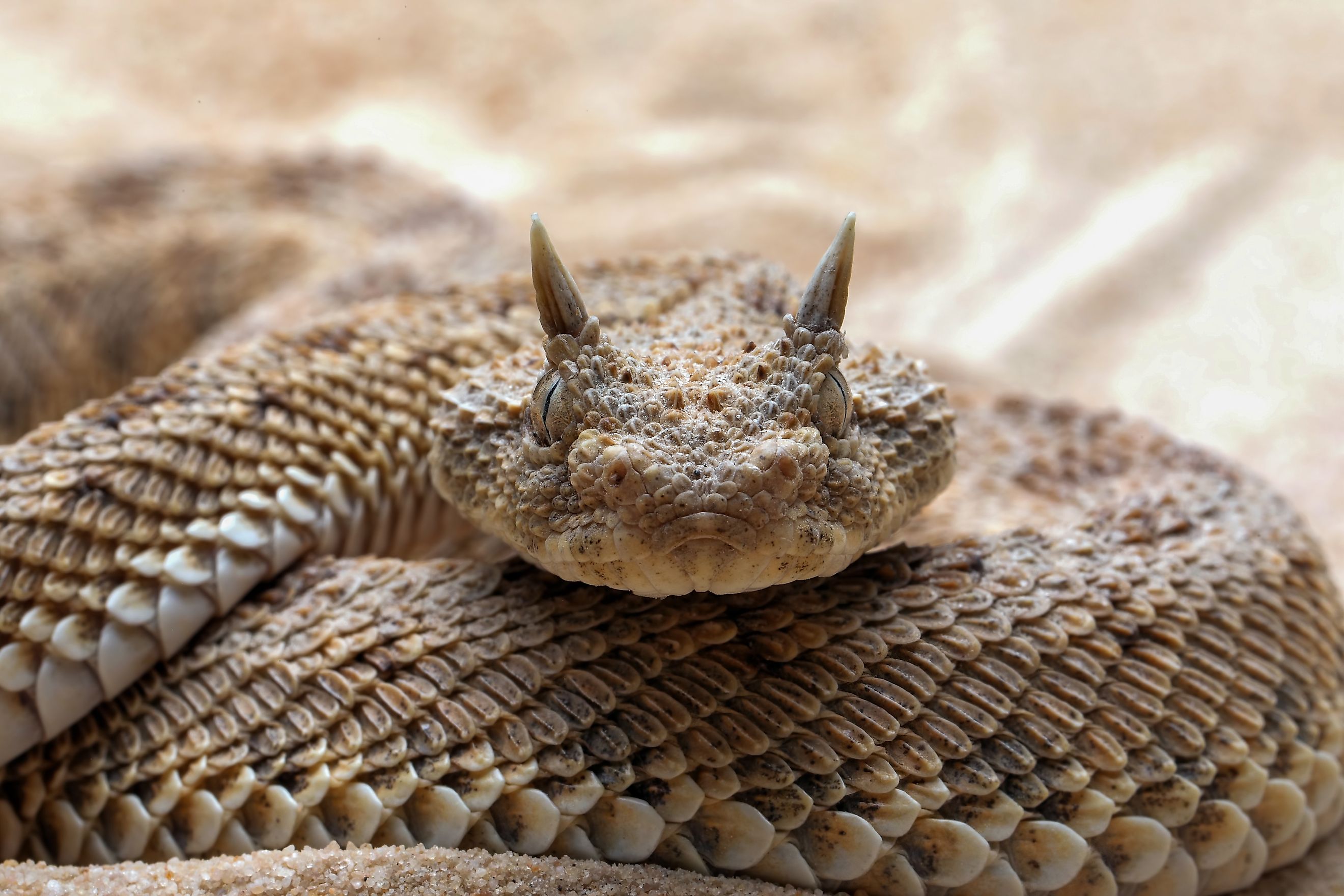
The Saharan horned viper (Cerastes cerastes) is one of the most recognizable reptiles of the desert. This small ambush predator has a pair of pointed scales above its eyes that give it a distinctive profile. Those unusual "horns" have captured human attention for thousands of years, appearing in traditions and imagery across the Sahara and in the hieroglyphs of ancient Egypt.
Despite its fearsome appearance, the Saharan horned viper is a master of patience rather than pursuit. It spends much of its life buried in loose sand, waiting for prey to wander within striking range. Found across the deserts of North Africa and into the Arabian Peninsula and the Levant, it ranks among the most common and widely distributed venomous snakes of these arid lands.
Everything about the animal, from its horns and camouflage to the strange sideways gait that carries it across shifting dunes, reflects a life shaped by extreme heat and scarce cover. To understand how such a specialized predator came to be, it helps to start with where it sits among the world's snakes.
Taxonomic Classification

The Saharan horned viper belongs to the family Viperidae, the true vipers, within the order Squamata. Its scientific name, Cerastes cerastes, comes from the Greek word for "horned," a reference both to the animal and to a horned serpent of Greek legend that buried its head in the sand to lure prey. The genus Cerastes contains a small number of desert-adapted vipers, and C. cerastes is the best known among them.
Researchers have described three subspecies, though the taxonomy of the genus has shifted over time as genetic studies refine the boundaries between populations. The Arabian horned viper (Cerastes gasperettii) was once treated as a subspecies of C. cerastes but is now recognized as a separate species. This kind of revision is common in modern reptile classification, where DNA evidence often reshapes older groupings built on physical features alone.
Physical Description

Compared with many snakes in its range, the Saharan horned viper is fairly small. Adults typically measure 12 to 24 inches (30 to 60 cm) in total length, with exceptional individuals reaching about 33 inches (85 cm). Females tend to be larger and heavier than males, while males often have proportionally longer tails. Reported weights range from roughly 0.2 to 1.3 pounds (100 to 600 g).
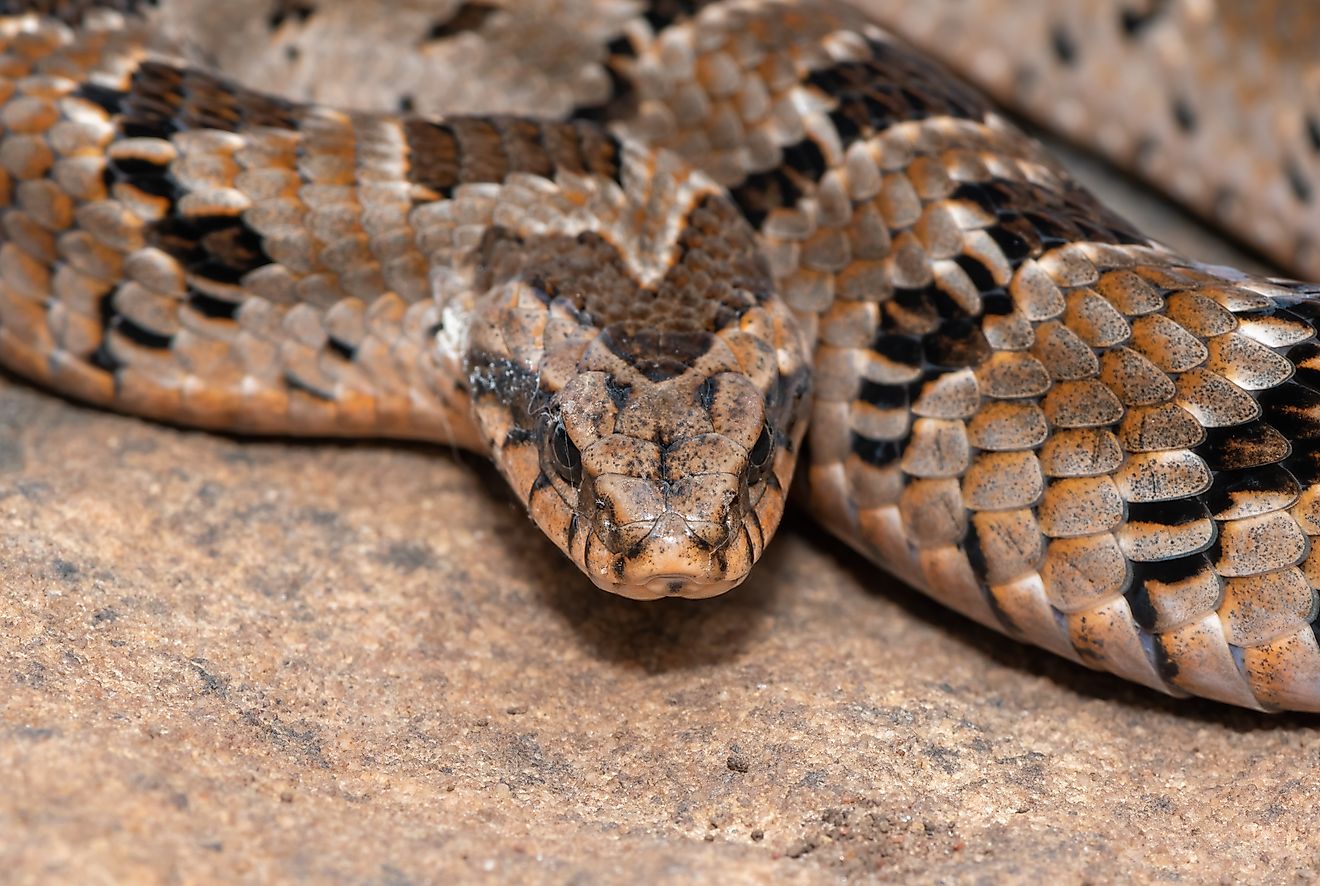
The most famous feature is the pair of upright "horns," each a single elongated scale positioned over an eye. Not every individual has them. Some snakes carry only reduced bumps, and hornless vipers occur naturally within the same populations. The horns may help break up the outline of the head against rippled sand and shield the eyes from glare and blowing grit.
The body is stout and covered in strongly keeled scales that give it a rough texture. Coloration ranges from pale sand and yellowish tones to grey, pink, and reddish brown, closely matching the local terrain. A row of darker, roughly rectangular blotches runs along the back, sometimes fusing into faint crossbars. This camouflage is so effective that a resting viper can be almost invisible against the desert floor.
Range and Habitat

The Saharan horned viper is widespread across the deserts of North Africa. It occurs most commonly between Morocco and Egypt and extends southward into Mauritania, Mali, Niger, Chad, and Sudan along the fringes of the Sahara. Beyond Africa, the species reaches into southwestern Arabia, the Sinai, and parts of the Levant, including areas of Israel.
Within these regions the snake favors sandy deserts and dunes, where its sidewinding movement and burying behavior are most effective. It also occupies rocky hills, gravel plains, and dry riverbeds known as wadis, and it has been recorded at elevations up to about 4,900 feet (1,500 m). Studies point to a strong link between the species distribution and local microclimate. The vipers tend to prefer areas with lower average temperatures and enough humidity to help them conserve body water, since much of their moisture comes from the prey they eat rather than from drinking.
Diet

The Saharan horned viper is a carnivore and an opportunistic hunter. Its diet centers on small desert rodents such as gerbils, mice, and jerboas, along with lizards, particularly geckos, and the occasional bird. Recorded prey includes desert geckos, small lacertid lizards, weaver finches, yellow wagtails, and chiffchaffs.
As an ambush predator, the viper does not chase its meals. Instead it lies partly submerged in sand, often near rocks, shrubs, or rodent trails, with only its eyes and horns exposed. When a target passes close enough, the snake strikes with great speed, injecting venom and holding smaller prey until the toxin takes effect. It can also travel considerable distances at night when hunting, and it relies heavily on vibration and chemical cues to locate prey in the dark.
Behavior

The Saharan horned viper is mostly nocturnal and crepuscular, avoiding the punishing daytime heat by burying itself in sand or sheltering beneath rocks and vegetation. It accomplishes this without any digging limbs. Rapid side-to-side movements of the body let it sink into loose sand within seconds, leaving little more than the top of the head visible.
The species is best known for sidewinding, a form of locomotion suited to loose, shifting substrates. Rather than sliding forward, the snake lifts and throws sections of its body sideways, pressing its weight into the sand and leaving a series of separate, whole-body impressions rather than a continuous trail. This reduces slipping on unstable dunes and limits contact with hot ground.
Solitary by nature, the viper generally avoids confrontation and depends on camouflage to stay unnoticed. When threatened, it may draw into a C-shaped coil and rub its rough, keeled scales together, producing a rasping sound similar to that made by saw-scaled vipers of the genus Echis. If a threat presses closer, the snake can deliver a fast defensive strike.
Reproduction

Reproduction sets the Saharan horned viper apart from many of its relatives. Most vipers give birth to live young, but C. cerastes is oviparous, meaning it lays eggs. Mating has been observed in captivity during April, and in the wild the breeding season runs roughly from April into June, while the animals are buried in sand.
Females deposit clutches of 8 to 23 eggs in sheltered sites such as abandoned rodent burrows or spaces beneath rocks, where temperature and humidity stay more stable. The eggs incubate for 50 to 80 days before hatching. Newly emerged young measure about 5 to 6 inches (12 to 15 cm) and are fully independent from birth, receiving no parental care. They reach reproductive maturity at around two years of age.
Importance

As a mid-level predator, the Saharan horned viper plays a valuable role in keeping desert food webs in balance. By preying heavily on rodents, it helps limit populations of animals that can damage vegetation and disturb human settlements and livestock. In turn, the viper serves as prey for larger desert hunters, including Nile monitors, honey badgers, and various wild cats, linking small prey animals to the larger predators above them.
The species also matters to people through its venom, which has drawn steady interest from medical researchers. Scientists working across North Africa and elsewhere have isolated a range of proteins and enzymes from Cerastes cerastes venom, including phospholipases, serine proteinases, and metalloproteinases. Several of these compounds act on blood clotting, and studies have explored them as possible tools against clotting disorders and thrombosis, while others have shown cytotoxic effects that researchers are investigating for relevance to cancer treatment. Viewed this way, the viper becomes less a hazard to avoid than a reservoir of biologically active molecules worth understanding.
Threats and Conservation

The Saharan horned viper is listed as Least Concern on the IUCN Red List, assessed in 2021. It is widespread and abundant across a vast range, and its remote, harsh habitat shields it from much of the pressure that affects wildlife elsewhere. No major range-wide threats currently endanger the species, and it appears in a number of protected areas across its territory.
That relative security does not mean the snake faces no risks. Localized habitat disturbance, road mortality, and killing out of fear can affect individual populations, and long-term shifts in desert climate could alter the microclimates the species depends on. For now, though, the outlook for the Saharan horned viper remains stable.
Its venom, while medically significant, is considered less potent than that of many other vipers. Bites can still cause serious effects including swelling, bleeding, tissue damage, nausea, and vomiting, and they warrant prompt medical care. Because the snake lives in sparsely populated deserts, recorded bites are relatively few.
Takeaway
The Saharan horned viper is exceptionally well adapted to life in the desert. Its horns, camouflage, sidewinding movement, and ability to bury itself in sand help it survive in an environment defined by intense heat, extreme dryness, and limited cover. Widespread and abundant, the species is currently considered secure and remains one of North Africa's most characteristic reptiles. Its survival offers a clear example of how animals adapt to harsh conditions while highlighting the importance of preserving intact desert ecosystems.
Fun Facts

- Its name comes from a myth. The genus Cerastes is named after a horned serpent of Greek legend said to bury its head in the sand to lure unsuspecting prey.
- The horns are optional. Individuals in the same population can have full horns, tiny bumps, or no horns at all, so the feature cannot reliably be used to tell one snake from another.
- It writes its own footprints. When sidewinding, the viper presses its whole body into the sand, leaving impressions so clear that researchers can sometimes count its belly scales from the tracks alone.
- It saws instead of hissing. A startled horned viper coils and rubs its rough scales together to produce a rasping warning sound rather than relying on a conventional hiss.
- It appears in hieroglyphs. The ancient Egyptians turned the horned viper into a written sign, cementing its place in one of the world's oldest writing systems.
Quick Facts
- Scientific name: Cerastes cerastes
- Family / Order: Viperidae / Squamata
- IUCN status: Least Concern (2021)
- Length: 12 to 24 in (30 to 60 cm), up to 33 in (85 cm)
- Weight: 0.2 to 1.3 lb (100 to 600 g)
- Lifespan: Up to 18 years in captivity
- Diet: Carnivore (rodents, lizards, and birds)
- Range: North Africa, the Arabian Peninsula, and the Levant