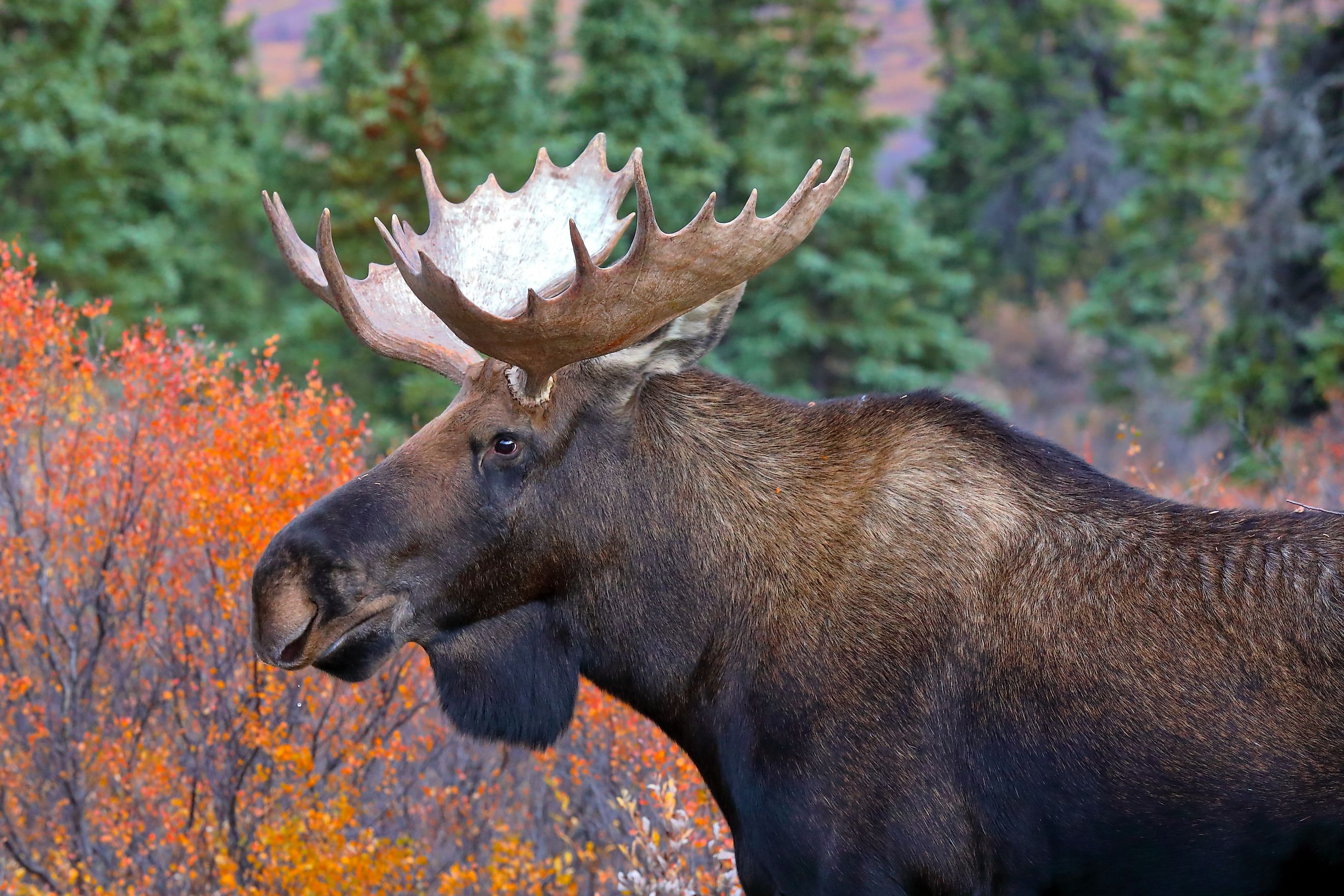
How Far South Moose Live In The United States
There are wild moose living at roughly 37.8 degrees north, which is the same latitude as San Francisco, Richmond, Virginia, Seoul and Athens. They are in the San Juan Mountains of southwestern Colorado. A 2025 paper in Wildlife Biology describes that herd as likely the southernmost moose herd in the Northern Hemisphere, which is not a sentence anybody expects about a state better known for skiing than for subarctic wildlife. The animal most people file under Alaska and Maine is living at the latitude of the Mediterranean. It manages that through one trick, which is swapping latitude for altitude, and the trick has limits worth understanding.
Altitude Substitutes For Latitude

The researchers who studied the San Juans herd put the mechanism plainly: high elevation mountains and high annual moisture compensate for the heat and arid conditions normally associated with southern latitudes.
The study area sits between about 2,470 and 2,800 meters, which is roughly 8,100 to 9,200 feet. At that height the summer temperatures, the snowpack and the willow-choked drainages resemble conditions hundreds of miles further north.
Climb high enough and you can find Canadian weather in Colorado. The moose did not travel south so much as travel upward.
Heat Is The Actual Limit

What stops moose going further south is not winter, obviously enough, and the threshold is lower than most people would guess.
Moose begin showing signs of heat stress at summer temperatures around 57 to 68 degrees Fahrenheit, which is to say at the sort of temperature a person would describe as pleasant. The animal is enormous, dark and insulated by a thick coat, and it has no efficient way to shed heat.
Heat-stressed moose reduce daytime foraging, which cuts nutritional intake and depresses reproduction. The southern boundary of the species is drawn by summer afternoons rather than winter nights.
The Southernmost Natural Population Is Elsewhere

Here is the distinction that matters for anybody repeating this, because two different claims get conflated constantly. Colorado's San Juans herd is the southernmost herd, but it was put there. Colorado Parks and Wildlife established it between 1991 and 1993 through trap-and-transplant, and the state never supported a native breeding population. The moose seen historically in Colorado were transients wandering down from Wyoming.
The southernmost naturally occurring moose population in the world is in northern Utah, in the Wasatch Mountains around 40.4 degrees north and on the north slope of the Uintas. That is about 180 miles further north than the San Juans.
Colorado Went From Twelve To Three Thousand

The introduction is one of the more successful wildlife translocations in American history, and the numbers are striking. In 1978 Colorado wildlife staff traveled to Utah's Uinta Mountains and brought back a dozen Shiras moose, releasing them in the North Park region. Today the state holds roughly 3,000, with one recent paper putting the figure nearer 3,500.
That is a 250-fold increase in under fifty years. State Forest State Park, near the original release site, now holds as many as 700 animals on its own, close to a quarter of the entire state population.
Why Colorado Works So Well

The success is not only about temperature, and the second reason explains why moose are thriving in the Rockies while collapsing in the Northeast.
Brainworm, a parasite carried harmlessly by white-tailed deer and fatal to moose, is the principal constraint on moose in the eastern United States. Colorado's high country has comparatively low white-tailed deer density, so exposure is low.
Cold winters help too, by killing winter ticks before they can build up. A moose in the San Juans faces heat it would rather avoid, but it faces far fewer parasites than one in New Hampshire.
Seventy Thousand Ticks
The parasite problem deserves a number, because the scale of it is genuinely hard to believe. A single moose can carry more than 70,000 winter ticks through the December to April period. Moose have no behavioral or physiological adaptation for dealing with them, unlike deer, which groom them off.
The result is blood loss, anemia and energy depletion at the worst possible time of year, and it kills calves in large numbers. Winter ticks are the primary driver of the moose declines across the northeastern United States over the past fifteen years.
Warming Pushes The Line North
The southern limit is not fixed, and at the moment it is moving in one direction only. Milder winters allow more winter ticks to survive, raising parasite loads. They also let white-tailed deer expand northward, carrying brainworm into moose country that previously had none. Warmer summers increase heat stress directly.
All three effects push the viable southern boundary north, which is why populations at the southern edge in Minnesota, New Hampshire and parts of the Rockies have seen the sharpest declines while the species overall remains secure.
The Eastern Edge Runs Differently

The southern limit is not one line of latitude, because the eastern and western halves of the range run on different constraints.
In the West, altitude lets moose reach 37 degrees north. In the East there is no comparable high ground, so the limit is set by where the forest, the winters and the deer density allow. Moose have recolonized parts of southern New England and hold populations in Massachusetts and the Adirondacks, but nothing approaching the Colorado latitude.
A moose in Massachusetts is living roughly 500 miles further north than a moose in the San Juans and having a harder time of it.
What The Southern Herd Still Faces
Being at the edge of a range has consequences even where the population is growing. The Colorado research found that despite being a cold-adapted species at the southern end of its range, moose there remained vulnerable to severe winter weather, with the cumulative effects of hard winters influencing population dynamics.
So the San Juans herd is not simply coasting. It is a cold-climate animal living in a pocket of cold climate surrounded by terrain that would kill it, and the pocket depends on elevation holding its weather.
The Answer

Moose live as far south as roughly 37.8 degrees north in the San Juan Mountains of Colorado, probably the southernmost herd in the Northern Hemisphere, though that herd was introduced in the early 1990s. The southernmost population that got there by itself is in northern Utah, about 180 miles further north.
The reason the Colorado number is possible at all is 9,000 feet of elevation doing the work that 1,000 miles of latitude does everywhere else. Moose are not a northern animal so much as a cold one, and in the Rockies cold is available considerably further south than the map suggests.