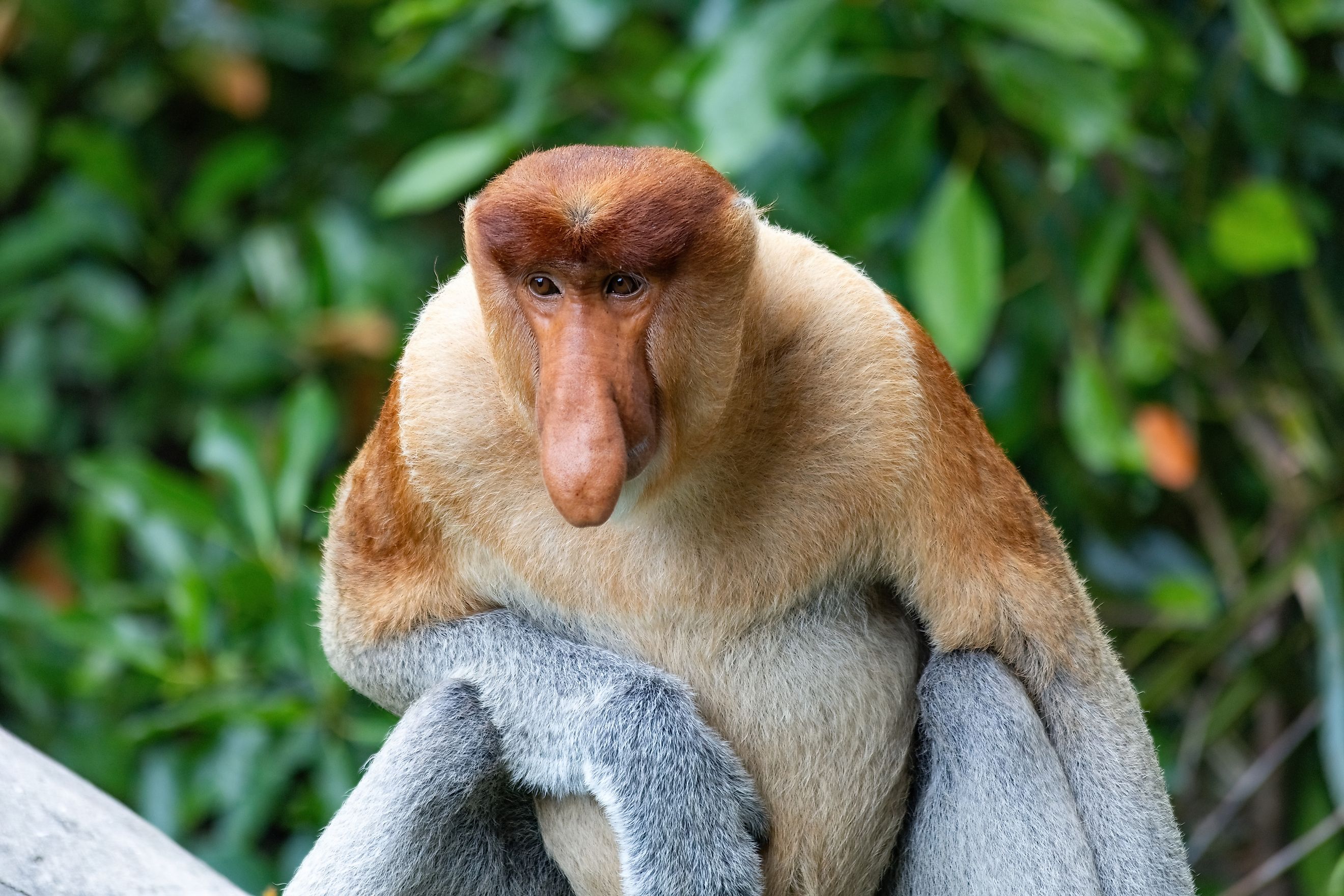
Proboscis Monkey
The adult male proboscis monkey is defined by a pendulous, fleshy nose that can hang below his mouth, giving the species one of the most unusual faces in the animal kingdom. So pronounced is this feature that early observers resorted to caricature when describing it. Yet the nose is far more than an unusual ornament. It amplifies the animal's honking calls and signals status to rivals and potential mates, making the proboscis monkey one of the most striking examples of sexual selection among mammals.
The proboscis monkey (Nasalis larvatus) is a large, reddish-brown Old World monkey found only on the island of Borneo. It lives in the mangrove swamps, riverine forests, and peat swamp forests that fringe the island's coasts and rivers, and it rarely strays far from water. Local people know it as the bekantan, and generations of Borneans have watched these pot-bellied primates crash into rivers from overhanging branches with an ungainly splash.
Beyond the famous nose, the proboscis monkey is a specialist built for a demanding life. It swims better than any other primate, digests leaves that would poison most animals, and organizes itself into a layered society of harems and bachelor bands. It is also endangered, with its wetland home shrinking fast.
Taxonomic Classification

The proboscis monkey belongs to the order Primates and the family Cercopithecidae, the Old World monkeys. Within that family it sits in the subfamily Colobinae, the leaf-eating monkeys, alongside langurs and colobus monkeys. The species was described by the German naturalist Friedrich von Wurmb in 1787 and carries the scientific name Nasalis larvatus. The genus name points to the nose, while the species name derives from the Latin larva, often translated as mask.
For most of its scientific history the proboscis monkey has stood alone in the genus Nasalis, making it a monotypic genus, though the pig-tailed langur was once grouped here as well. Some authorities recognize two subspecies, N. l. larvatus and N. l. orientalis, separated mainly by region rather than by clear physical differences, and the second subspecies is not universally accepted.
Physical Description

This is one of the largest monkeys in Asia, rivaled only by a handful of macaques and langurs. Males are far heavier than females, a pronounced case of sexual dimorphism. An adult male has a head-and-body length of about 26 to 30 inches (66 to 76 cm) and typically weighs 35 to 50 pounds (16 to 22.5 kg), with exceptional individuals reaching 66 pounds (30 kg). Females weigh roughly half as much, around 15 to 26 pounds (7 to 12 kg).
The coat is reddish-brown across the back, shading to pale grey on the limbs and tail, with redder hair around the head and shoulders. Both sexes carry a large, protruding belly that houses a chambered stomach. That pot-bellied outline gives the animals a perpetually well-fed look and is central to how they survive on a difficult diet.
The nose is the animal's signature. In mature males it grows long and pendulous, sometimes hanging below the mouth and reaching over 4 inches (10 cm). Females and juveniles have smaller, upturned noses that are still large compared with other primates. Researchers believe the male's nose works as a resonance chamber, deepening and amplifying his calls, and doubles as a visual signal of health and fitness. Larger-nosed males tend to hold more females.
Range and Habitat

The proboscis monkey is endemic to Borneo, the large island shared by Brunei, Indonesia, and Malaysia. It occurs in Indonesian Kalimantan, in the Malaysian states of Sabah and Sarawak, and in Brunei. Historically it ranged along much of coastal Borneo and on a few satellite islands.
The species is tied closely to water. It favors mangrove forests, riverine forests along major waterways, and freshwater peat swamp forests, and it seldom ventures deep into dry inland forest, which lacks the minerals and food plants it needs. In Malaysian Sabah, some of the largest populations survive in the Lower Kinabatangan floodplain. Groups tend to move inland to feed during the day and return to riverbank trees to sleep at night, a rhythm that keeps them within a safety leap of open water.
Diet

The proboscis monkey is chiefly a leaf and fruit eater. Its diet centers on young leaves, tender shoots, unripe fruit, seeds, and flowers, with the occasional caterpillar or insect. It feeds heavily on fruit between roughly January and May, and for the rest of the year it leans toward leaves.
Its digestion sets it apart. Much like a cow, the proboscis monkey has a large, sacculated foregut filled with bacteria that ferment tough plant material and break down cellulose. This lets the animal extract nutrients from mature leaves that many primates cannot process, and the monkey regurgitates and rechews its food much as ruminants do. There is a catch. Ripe, sugary fruit can ferment quickly in that chamber, producing gas that leads to dangerous, sometimes fatal bloating, which helps explain the animal's preference for unripe fruit.
Behavior

Proboscis monkeys are diurnal and highly arboreal, spending most of their time in the trees and moving through the canopy on long limbs. They are best known, though, for their swimming. Aided by partially webbed hands and feet, they are the strongest swimmers of any primate, able to cross wide rivers and travel up to about 65 feet (20 m) fully submerged. They will leap from high branches straight into the water, a habit that lets them outpace crocodiles and other predators.
Their society is layered. The core unit is a harem of one dominant male with several females, commonly two to seven, along with their young. Males that do not hold a harem live in separate bachelor groups. In the evening, several groups often gather into larger bands along the river, choosing fresh sleeping trees from one night to the next. Communication runs on a range of sounds. Males honk to warn of danger and growl to settle the group, while females and juveniles shriek when alarmed, and aggressive encounters bring loud screams.
Reproduction

Breeding can occur across the year. After a gestation of about 166 days, a female gives birth to a single infant, usually at night in the branches. Newborns arrive with a vivid blue face that darkens to grey by around two and a half months and lightens toward the adult tone by eight months. The mother does most of the rearing, nursing the infant for about seven months and keeping it close for roughly a year.
Dominant males guard their harems rather than caring directly for young. When a new male takes over a group, he may kill existing infants, a brutal but well-documented pattern in many primates that brings females back into breeding condition sooner. In the wild, proboscis monkeys can live up to about 20 years.
Importance to the World

As large leaf and fruit eaters, proboscis monkeys help shape the wetland forests they inhabit. By feeding on fruit and seeds and moving through the canopy, they disperse seeds across mangrove and riverine habitats, supporting forest regeneration. As sizable prey, they also feed top predators such as crocodiles and form part of the food web that keeps these ecosystems in balance.
The proboscis monkey has become an important symbol of Borneo's threatened wetlands. Endemic to the island, it attracts wildlife tourists, particularly along the Kinabatangan River, while also drawing attention to the mangroves and swamp forests it depends on. Protecting these habitats helps preserve ecosystems that protect coastlines, store carbon, and support a wide range of other species.
Threats

The proboscis monkey is listed as Endangered on the IUCN Red List and is protected under Appendix I of CITES, the strictest level of international trade control. Its total population has fallen by more than half over roughly the past 36 to 40 years, and current estimates put the global figure at fewer than 25,000 animals, heavily fragmented across the island.
Habitat loss is the central threat. Mangrove and swamp forests are cleared for oil palm plantations, logging, and settlement, carving continuous riverbank populations into isolated pockets that are vulnerable to local extinction. Hunting compounds the pressure, since the monkeys are taken for meat and, in some areas, for use in traditional medicine, and their slow, conspicuous habits make them easy targets. The animals are protected by law throughout Borneo and occur in more than a dozen reserves, yet only a small share of the population lives inside well-protected areas, leaving much of the species exposed.
Takeaway
The proboscis monkey's unusual features reflect a close adaptation to life in Borneo's coastal wetlands. Its large nose, strong swimming ability, and specialized digestive system allow it to exploit a habitat that few other primates can use in the same way. However, these adaptations also leave the species closely tied to a shrinking environment. As mangroves and swamp forests are cleared for plantations and development, suitable habitat becomes increasingly fragmented, leaving the monkeys with fewer places to live and move. Protecting Borneo's remaining wetlands and the reserves where proboscis monkeys still occur will be essential to ensuring that the bekantan remains part of the island's wildlife.
Fun Facts

- The "Dutch monkey" nickname. Local people call it monyet belanda, or Dutch monkey, joking that its big nose and round belly recalled the European colonizers.
- Blue-faced babies. Infants are born with bright blue faces that fade to grey within a few months of life.
- A built-in loudspeaker. The male's oversized nose acts as a resonance chamber that makes his honking calls louder and deeper.
- Champion primate swimmer. With webbed hands and feet, it can swim more than 60 feet (20 m) underwater to escape crocodiles.
- No ripe fruit allowed. Sugary ripe fruit can ferment inside its stomach and cause deadly bloating, so it sticks to unripe fruit and leaves.
Quick Facts
- Scientific name: Nasalis larvatus
- Family / order: Cercopithecidae / Primates
- IUCN status: Endangered
- Size (male head-body): 26 to 30 inches (66 to 76 cm)
- Weight: males 35 to 50 pounds (16 to 22.5 kg), females 15 to 26 pounds (7 to 12 kg)
- Lifespan: up to about 20 years in the wild
- Diet: folivore and frugivore (young leaves, unripe fruit, seeds, flowers)
- Range: endemic to Borneo (Brunei, Indonesia, Malaysia)