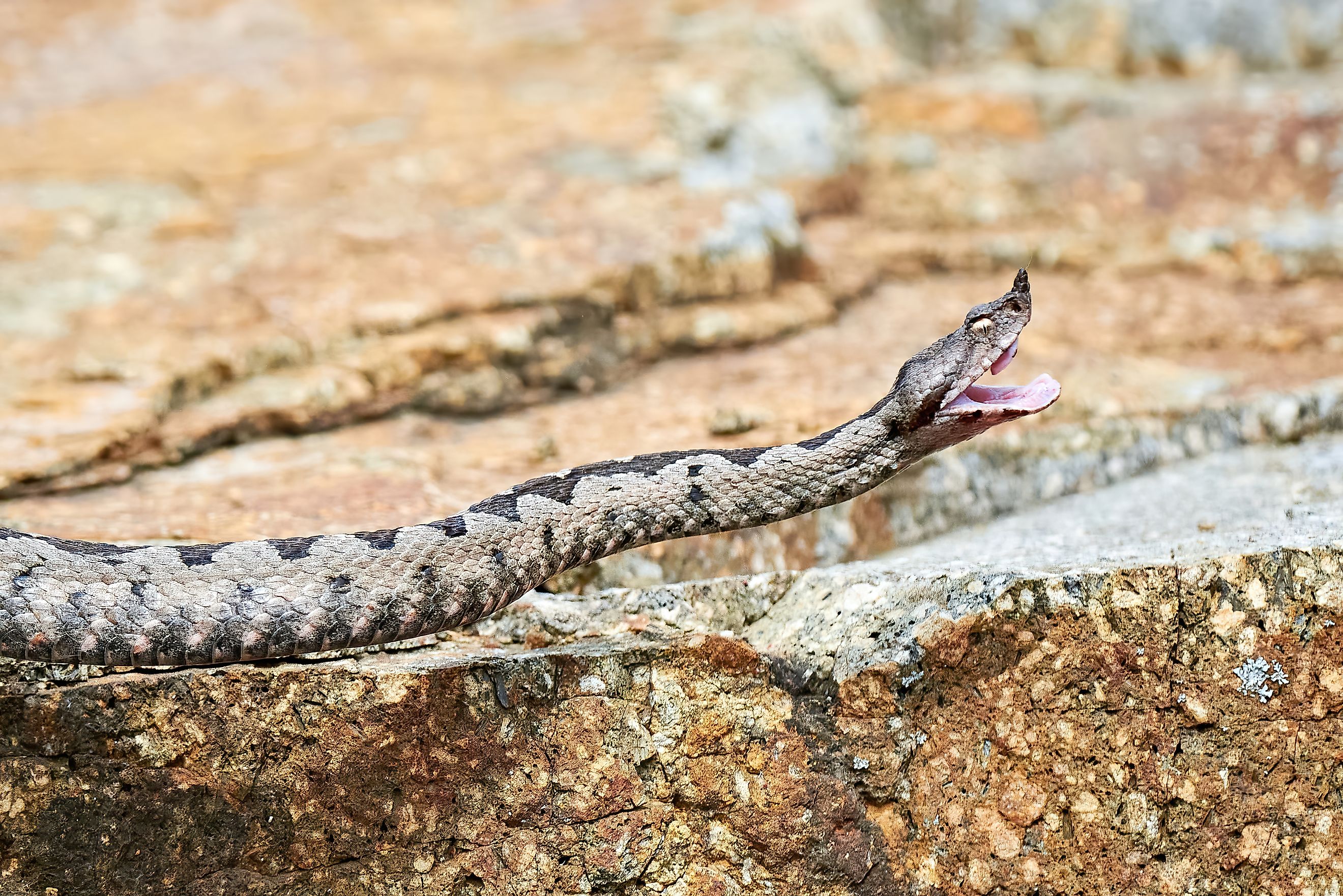
Nose-Horned Viper
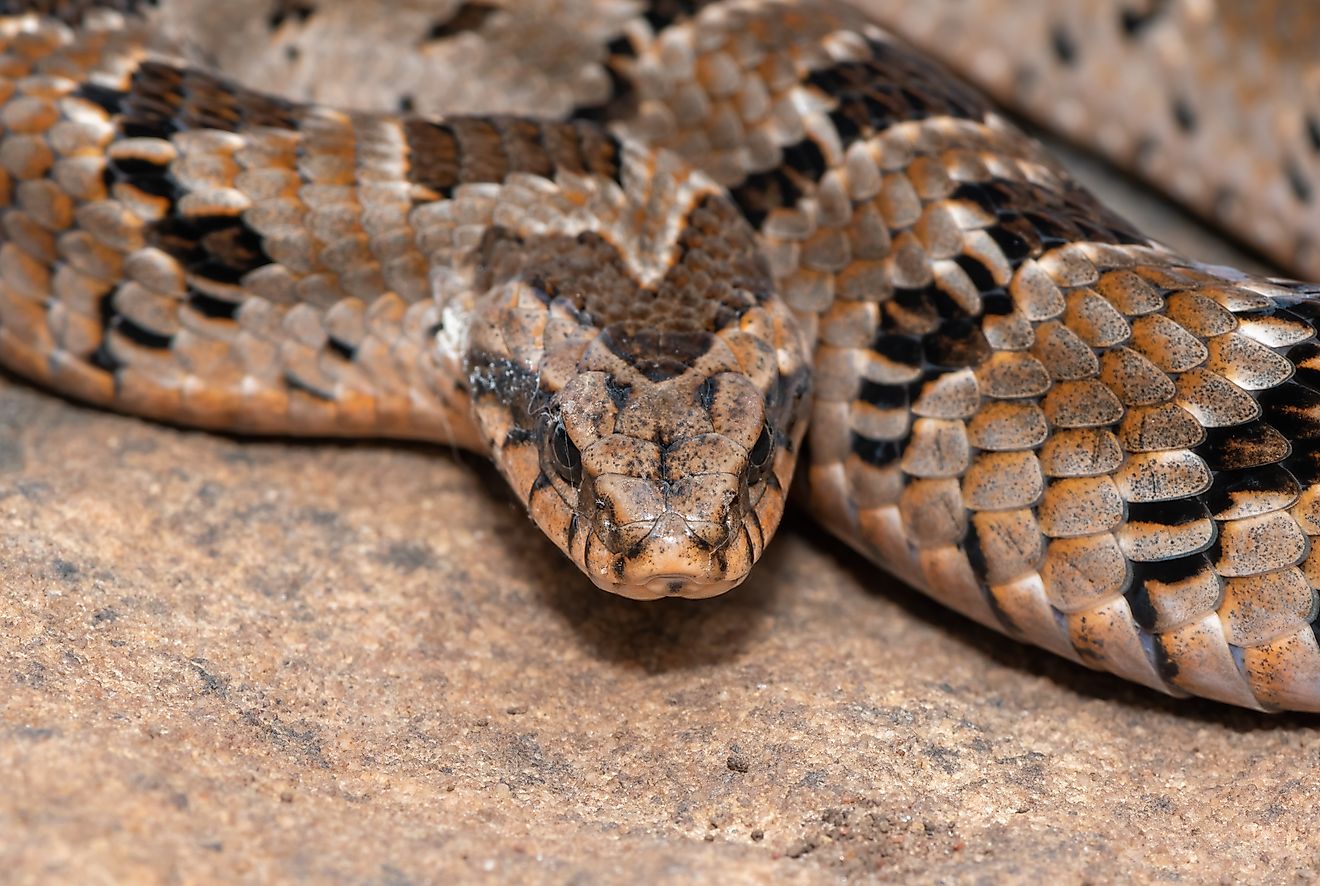
The nose-horned viper (Vipera ammodytes) carries a small, soft horn on the tip of its snout, a feature that sets it apart from every other snake in Europe and gives the species its name. That horn, combined with a heavy body and a bold zigzag pattern, makes this one of the most recognizable reptiles across the Balkans and southern Europe.
It is also widely regarded as the most dangerous venomous snake on the continent, a reputation built on its large size, unusually long fangs, and potent venom. Despite this, the animal is slow-moving and reluctant to strike, and most people who share its rocky hillsides never see one.
That unmistakable profile has long made the species easy to recognize, and its scientific description dates back to the very foundations of modern zoology.
Taxonomic Classification

The nose-horned viper belongs to the family Viperidae, the true vipers, within the order Squamata that contains all snakes and lizards. Its full classification runs from kingdom Animalia through phylum Chordata, class Reptilia, and genus Vipera, ending in the species Vipera ammodytes. Carl Linnaeus described the animal in 1758, originally naming it Coluber ammodytes before it was moved into the genus Vipera.
The species name ammodytes comes from Greek and translates roughly as "sand burrower" or "sand diver," an odd label given that this viper strongly prefers dry, rocky ground rather than sand. Several subspecies have been described over the years, among them Vipera ammodytes ammodytes, V. a. meridionalis, V. a. montandoni, and V. a. transcaucasiana. Their exact number and boundaries remain debated, and molecular studies continue to reshape the picture. Some researchers argue that the Transcaucasian population deserves recognition as a full species in its own right.
Physical Description

Adult nose-horned vipers usually measure 20 to 28 inches (50 to 70 cm) in total length, though large individuals can reach roughly 37 inches (95 cm), and a few records exceed 39 inches (100 cm). Northern populations tend to grow larger than southern ones. Females are typically heavier and more thickly built, yet the longest specimens on record are actually males, which also carry proportionally longer tails.
The most famous feature is the soft, flexible horn that rises from the tip of the snout. It stands about 0.2 inches (5 mm) tall and is made of roughly nine to seventeen small scales arranged in transverse rows. The horn is not a weapon and plays no role in defense or hunting, and its exact function remains uncertain. In the nominate subspecies the horn tilts diagonally forward, while in southern forms it stands nearly upright.
The body is thick for the animal's length and ends in a short tail. A bold, dark zigzag stripe runs down the back over a background of grey, brown, or reddish tones, with color varying by region and sex. Males often show sharper contrast, while females tend to look duller and browner. This patterning breaks up the snake's outline against stone and dry vegetation, making a resting viper remarkably hard to spot. The head is broad and triangular, covered in small irregular scales, and the vertical pupils mark it clearly as a viper rather than a harmless colubrid.
Behind that head sit the fangs, which reach up to 0.5 inches (13 mm) and rank among the longest of any European snake relative to body size. Like all vipers, the fangs are hinged and fold back against the roof of the mouth when not in use, then swing forward during a strike to inject venom deep into prey.
Range and Habitat

The nose-horned viper occupies a broad band of southern Europe and western Asia. Its range stretches from northern Italy and southern Austria eastward through Slovenia, Croatia, and the wider Balkan Peninsula, reaching Greece, Bulgaria, Romania, and parts of Turkey. Certain subspecies extend farther east into Georgia and Armenia.
Despite a species name that points to sand, this viper is a specialist of dry, rocky country. It favors sun-warmed slopes, scrubland, stone walls, dry meadows, vineyards, and the broken edges of woodland. Rocks and loose stone give the animal both basking sites and quick shelter from predators and from the heat. It ranges from near sea level up into hilly and lower mountain terrain, and populations at higher elevations adjust their activity to the cooler climate.
Diet

The nose-horned viper is an ambush predator that relies on camouflage and patience rather than pursuit. Adults feed mainly on small mammals such as mice and voles, along with birds and the occasional lizard. Juveniles follow a different path and eat mostly lizards, gradually shifting toward warm-blooded prey as they grow.
Hunting style depends on the size of the target. Larger prey is struck, released, and then tracked by scent until the venom takes effect, after which the snake swallows it whole. Smaller prey is often seized and swallowed directly without any venom at all, since the risk of injury is low and venom is metabolically expensive to produce. By preying heavily on rodents, the species helps limit populations of animals that damage crops and carry disease.
Behavior

For an animal with such a fearsome reputation, the nose-horned viper is strikingly calm. It is generally slow and lethargic, and it rarely bites unless heavily provoked or accidentally touched. A surprised viper may hold still and hiss loudly, hiss and then retreat, or in some cases strike at once, and its response varies from one individual to the next.
Activity shifts with temperature and season. In cooler conditions and at higher altitudes the snake is active by day, while in the heat of lowland summers it becomes more active around dusk and after dark. Through the coldest months the viper hibernates, spending two to six months underground depending on local climate. Males emerge from hibernation first in early spring, followed about ten days later by the females.
Reproduction

Breeding follows soon after the vipers leave hibernation, usually across April and May. Rival males perform a wrestling contest, rearing up and pushing against one another in a ritual combat dance to win access to receptive females.
The nose-horned viper is ovoviviparous, which means the eggs develop and hatch inside the female's body so that she gives birth to live, fully formed young. Litters generally contain four to twenty snakelets, most often born in August and September. Newborns measure about 5.5 to 9.4 inches (14 to 24 cm) and arrive fully venomous and independent, ready to hunt small prey on their own. In captivity the species can be long-lived, with a recorded maximum lifespan of around 22 years.
Venom and Medical Importance

The nose-horned viper is often called the most dangerous snake in Europe, and the label reflects real biology rather than folklore alone. The World Health Organization lists it among the medically important snakes of the region. Its venom is a complex mixture that damages tissue, disrupts blood clotting, and attacks the nervous system, thanks to potent neurotoxins known as ammodytoxins working alongside tissue-destroying enzymes.
A serious bite can cause intense local pain and swelling, bleeding, and dangerous drops in platelet counts, and in rare untreated cases it can be fatal. Effective antivenoms exist, and prompt hospital treatment reliably manages even severe envenomation. Bites remain uncommon because the snake is retiring and well camouflaged, and most occur when a person steps on or reaches near a hidden viper. The same venom that makes the animal dangerous has also become a resource for science, and researchers now study its components for uses in blood-clotting research and experimental cancer therapies.
Conservation Status

The IUCN Red List classifies the nose-horned viper as Least Concern, a reflection of its wide range across southern Europe and western Asia. That status comes with a warning, however, because the overall population is decreasing. Pressures on the species include habitat loss as rocky hillsides are cleared or developed, deliberate killing by people who fear the snake, deaths on roads, and collection for the pet trade and for venom extraction.
The animal is strictly protected under the Berne Convention, and several countries add their own legal safeguards. As a mid-level predator, the nose-horned viper links small vertebrates to larger hunters such as raptors and mammalian carnivores, so a serious decline would ripple through the ecosystems it inhabits.
Takeaway
For all its notoriety, the nose-horned viper survives by staying still and staying hidden, a quiet ambush hunter that holds rodent numbers in check while feeding the raptors and carnivores ranked above it. The same venom that has earned the snake generations of fear now yields compounds that support serious medical research, a reminder that a dangerous animal can also be a useful one. Its Least Concern listing offers some reassurance, yet the steady loss of warm, rocky hillsides and the habit of killing snakes on sight continue to chip away at its numbers. Safeguarding the open, stony habitats it depends on across Balkan slopes and Mediterranean scrub is the surest way to keep the horned silhouette a fixture of southern Europe well into the future.
Fun Facts

- The horn is soft, not sharp. Despite old stories that the snake stabs with a "stinger," the nasal horn is a soft, flexible flap of scaled skin with no known weaponized purpose.
- Its name is a misnomer. The word ammodytes means "sand burrower," yet the species avoids sand almost entirely and thrives on rock.
- Folklore calls it "the leaper." In parts of the Balkans, legend claims the viper can spring at people or even at riders on horseback, a tale that likely grew from its sudden strikes out of hidden perches.
- Newborns come armed. Baby nose-horned vipers are fully venomous and able to hunt from the moment they are born.
- Its venom aids cancer research. Components of the venom show promise as tools in melanoma studies and other medical work.
Quick Facts
- Scientific name: Vipera ammodytes
- Family: Viperidae (order Squamata)
- IUCN status: Least Concern (population decreasing)
- Length: usually 20 to 28 in (50 to 70 cm), up to about 37 in (95 cm)
- Weight: around 8 oz (220 g)
- Fang length: up to 0.5 in (13 mm)
- Lifespan: up to about 22 years in captivity
- Diet: carnivore, taking small mammals, birds, and lizards
- Range: northern Italy and the Balkans east to Turkey, Georgia, and Armenia