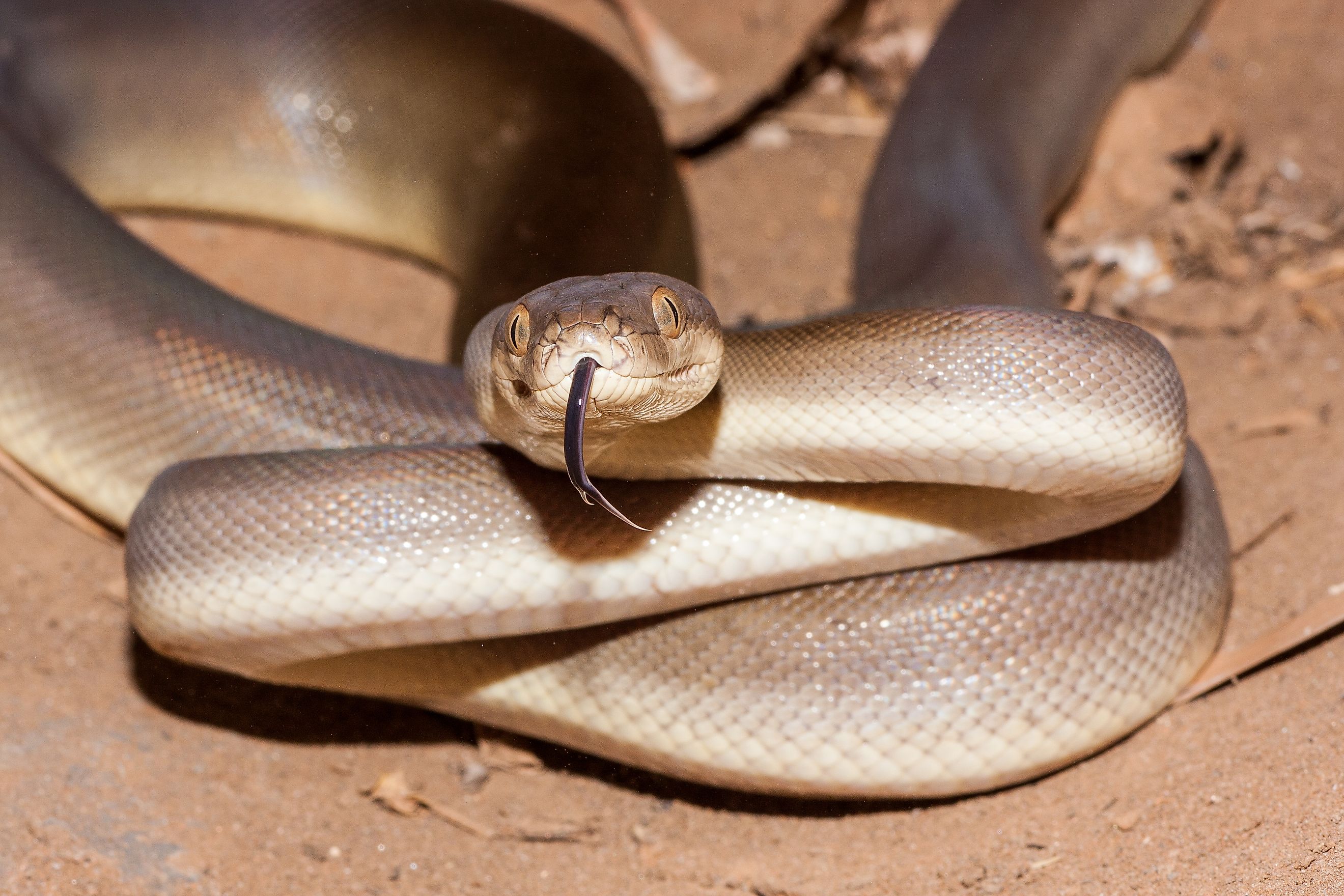
Olive Python
The olive python is one of Australia's true heavyweight snakes, a muscular non-venomous constrictor that ranks as the third-largest serpent on the continent. Only the amethystine python and the rare Oenpelli python grow longer. Adults regularly stretch beyond 13 feet (4 m), and their unusually smooth, glossy skin sets them apart from the patterned pythons most people picture when they think of large snakes.
Scientifically named Liasis olivaceus, the species is found only in the tropical and arid north of Australia, where it haunts rocky gorges and permanent waterholes. Its plain, uniform coloring is a chocolate brown or dull olive green, giving it a low profile against the red rock and shadowed crevices it calls home. For a snake this large, it is remarkably good at going unnoticed.
What makes the olive python worth knowing is the combination of size, stealth, and adaptability. It is an ambush hunter that can strike from dry land or from beneath the surface of a pool, a powerful swimmer in a landscape defined by drought, and a quiet fixture of Aboriginal water-serpent tradition across the north. It is also, unfortunately, frequently killed by people who mistake it for a deadly venomous snake it happens to resemble.
Taxonomic Classification

The olive python belongs to the family Pythonidae, the group of non-venomous constricting snakes that includes some of the largest reptiles on Earth. Within that family it sits in the genus Liasis, alongside the water pythons and their close relatives. The full binomial is Liasis olivaceus, and the species was first described by the British zoologist John Edward Gray in 1842, working from museum specimens collected in northern Australia.
Two subspecies are currently recognized. The nominate form, Liasis olivaceus olivaceus, is often called the northern olive python and occupies the broad sweep of the species range across the tropical north. The second, Liasis olivaceus barroni, is the Pilbara olive python, described by Laurie Smith in 1981 from specimens held at the Western Australian Museum. The Pilbara form is restricted to the rugged ranges and gorges of the Pilbara region in Western Australia and tends to run slightly smaller on average than its northern cousin.
Like many Australian pythons, the species has passed through a tangle of scientific names over the years, having been placed at various times in the genera Morelia, Bothrochilus, and others as taxonomists have argued over python relationships. Modern molecular work has largely settled it back into Liasis, though the genus-level arrangement of Australian pythons remains an active area of study.
Physical Description

The olive python is a heavy-bodied snake built for power rather than speed. Adults commonly measure between 8 and 13 feet (2.5 to 4 m) in total length, with the largest confirmed individuals reaching or slightly exceeding 13 feet (4 m). Some accounts describe animals as long as 21 feet (6.5 m), but these outsized figures are not well supported and should be treated with caution. A typical large adult weighs between 22 and 44 pounds (10 to 20 kg), and exceptionally large females kept in captivity can exceed 44 pounds (20 kg).
The most distinctive feature is the skin itself. The olive python carries a very high number of scale rows across the middle of its body, between 61 and 72, which are individually small and smooth. This high count gives the animal a satiny, almost polished appearance quite unlike the rougher, more textured look of many other pythons. The number of belly scales running down its underside falls between 355 and 377.
Coloring is understated. The back and sides are a rich chocolate brown or muted olive green, usually without the bold blotches or bands seen in relatives such as the carpet python. The belly is pale, typically cream to whitish, and the lips are pale and finely flecked with grey or brown. The head is broad and clearly set off from the neck, and the eyes carry vertical, slit-shaped pupils, a hallmark of a hunter active in low light. Females tend to grow slightly longer than males, a modest form of size difference between the sexes.
Ranged along the upper and lower lips are rows of heat-sensitive pits. These labial pits detect the infrared radiation given off by warm bodies, allowing the snake to sense a mammal or bird in complete darkness. Combined with an ability to feel ground vibrations, this sensory equipment makes the olive python a formidable nocturnal predator.
Range and Habitat

The olive python is endemic to Australia, meaning it occurs naturally nowhere else on the planet. Its range spans the northern third of the continent, reaching across Western Australia and the Northern Territory and just into Queensland. The type locality, the place from which the species was first formally described, is Port Essington in the Northern Territory. The Pilbara subspecies occupies a much smaller pocket of ranges and gorges in northwestern Western Australia.
Within this broad region, the olive python is strongly tied to rock and water. It favors rocky outcrops, escarpments, and steep gorges, and it is especially associated with the permanent pools, creek lines, and waterholes that persist through the dry season in otherwise parched country. Individuals shelter during the heat of the day in caves and deep rock crevices, though they also use hollow logs and burrows beneath boulders. This preference for rugged, broken terrain near reliable water shapes almost every aspect of the animal's daily life.
Diet

As a constrictor, the olive python kills by coiling around its prey and tightening until the animal can no longer breathe, then swallowing it whole. Its diet is broad and reflects its size. Recorded prey includes birds such as ducks and spinifex pigeons, a range of mammals including rock wallabies and fruit bats, and various reptiles. Large adults are capable of taking surprisingly big prey, and the species has been documented killing monitor lizards and even juvenile freshwater crocodiles.
The olive python hunts in two very different ways. On land it is a patient ambush predator, coiling beside a well-used animal trail and waiting, sometimes for hours, for prey to pass within striking range. In water it becomes something else entirely. A strong and confident swimmer, it will lie submerged at the edge of a waterhole and strike upward at birds and mammals that come to drink, exploding from beneath the surface. This dual strategy lets the snake exploit both the dry rock country and the scarce, life-giving pools scattered through it.
Behavior

The olive python is mainly nocturnal, emerging after dark to hunt and retreating to rock crevices and caves through the heat of the day. Its slit pupils, vibration sensitivity, and heat-sensing pits all point to a life spent largely in darkness. This is a solitary animal for most of the year, with individuals occupying distinct home ranges that they patrol in search of food and, in season, mates.
Movement studies using radio tracking have shown that males can travel considerable distances during the breeding period, covering up to 2.5 miles (4 km) to locate a receptive female. Outside of breeding, the species is generally slow moving and deliberate, a trait that unfortunately makes it vulnerable on roads, where basking or crossing individuals are frequently struck by vehicles. Despite its intimidating size, the olive python is not aggressive toward people, and captive animals are widely described as calm and even placid once past the initial feeding response.
Reproduction

Breeding in the olive python is seasonal and tied to the cooler part of the year. Mating activity begins around May and continues into mid-July. The species is oviparous, meaning females lay eggs rather than giving birth to live young. After a successful mating, a female carries developing eggs for a gestation period of roughly 81 to 85 days before depositing her clutch in late spring.
Clutch size varies considerably, between about 12 and 40 eggs, with an average near 19. As in many pythons, the female coils protectively around her eggs during incubation. The young emerge after an incubation period of around 50 days, each hatchling measuring roughly 14 inches (35 cm) in length. From that modest start, an olive python will grow across years into one of the largest snakes on the continent, and captive individuals have been known to live for well over a decade.
Importance to the World

As a large apex predator of the northern Australian rock country, the olive python helps regulate populations of the birds, mammals, and reptiles it hunts. In an environment where permanent water is scarce and concentrates wildlife, an ambush predator stationed at a waterhole exerts real influence over the animals that gather there. Healthy python numbers are one marker of a functioning ecosystem in these arid and semi-arid ranges.
The olive python has also proved a rewarding subject for science. Because the Pilbara population lives in country now crisscrossed by mining and industry, researchers have tracked individuals by radio for years, building an unusually detailed picture of how a big reptile survives where water is scarce and the summers are punishing. That work has traced how the snakes shift between cool-season caves and warm-season waterholes, how far a male will travel to find a mate, and how long a female stays wrapped around her clutch. Findings like these feed back into reptile biology more broadly and into the practical business of steering roads and new development away from the animals living alongside them.
Threats and Conservation

At the species level, the olive python is currently listed as Least Concern on the International Union for Conservation of Nature Red List. It has a large range, occurs across remote country that is not heavily developed, and is not considered globally threatened. That broad security, however, hides a more fragile picture at the subspecies level.
The Pilbara olive python, Liasis olivaceus barroni, is listed as Vulnerable under Australia's federal environmental legislation. Its restricted range overlaps heavily with a region of intensive mining and industrial activity, which brings habitat disturbance and increased road traffic. Because the snake is slow moving and often crosses or basks on roads, vehicle strikes are a serious and ongoing source of mortality for this form.
A further and avoidable threat comes from mistaken identity. The olive python is sometimes confused with the venomous king brown snake, Pseudechis australis, and harmless individuals are killed by people who believe they are dealing with a dangerous animal. Public education about how to tell the two apart, alongside habitat protection and efforts to reduce road deaths in the Pilbara, forms the core of conservation work for this species.
Takeaway
The olive python is one of Australia’s largest snakes, despite lacking the bold patterns and fearsome reputation associated with some other large species. It is a versatile hunter that can ambush prey along dry trails or strike from beneath the surface of a waterhole. Its smooth olive-colored skin, heat-sensing pits, and close association with the rocky waterways of northern Australia reflect its adaptation to a demanding environment. Although the species remains secure overall, the Pilbara subspecies shows how quickly localized populations can come under pressure. Protecting its habitat and reducing persecution driven by fear will be essential to ensuring that the olive python continues to inhabit Australia’s gorges.
Fun Facts

- Australia's third-largest snake. Only the amethystine python and the elusive Oenpelli python grow longer than the olive python.
- An underwater ambush artist. It is a strong swimmer that can lie submerged and strike upward at birds and mammals drinking at the water's edge.
- It hunts crocodiles. Large adults have been recorded killing and eating juvenile freshwater crocodiles, along with monitor lizards and rock wallabies.
- Built-in night vision. Heat-sensitive pits along its lips let it detect warm-blooded prey in total darkness by sensing infrared radiation.
- Deceptively smooth. Its very high count of small scales, up to 72 rows across the body, gives the snake a satiny sheen unlike most pythons.
- A case of mistaken identity. It is often confused with the venomous king brown snake and killed by mistake, even though it is entirely harmless to people.
Quick Facts
- Scientific name: Liasis olivaceus
- Family: Pythonidae
- Order: Squamata
- Subspecies: Northern olive python (L. o. olivaceus) and Pilbara olive python (L. o. barroni)
- IUCN status: Least Concern (Pilbara subspecies listed as Vulnerable under Australian federal law)
- Length: Commonly 8 to 13 feet (2.5 to 4 m), reaching over 13 feet (4 m)
- Weight: Typically 22 to 44 pounds (10 to 20 kg), large females may exceed 44 pounds (20 kg)
- Lifespan: Over a decade, especially in captivity
- Diet: Carnivore, feeding on mammals, birds, and reptiles
- Range: Northern Australia, across Western Australia, the Northern Territory, and into Queensland
- Habitat: Rocky gorges, outcrops, and permanent waterholes in arid to tropical country