Rhinoceros Viper
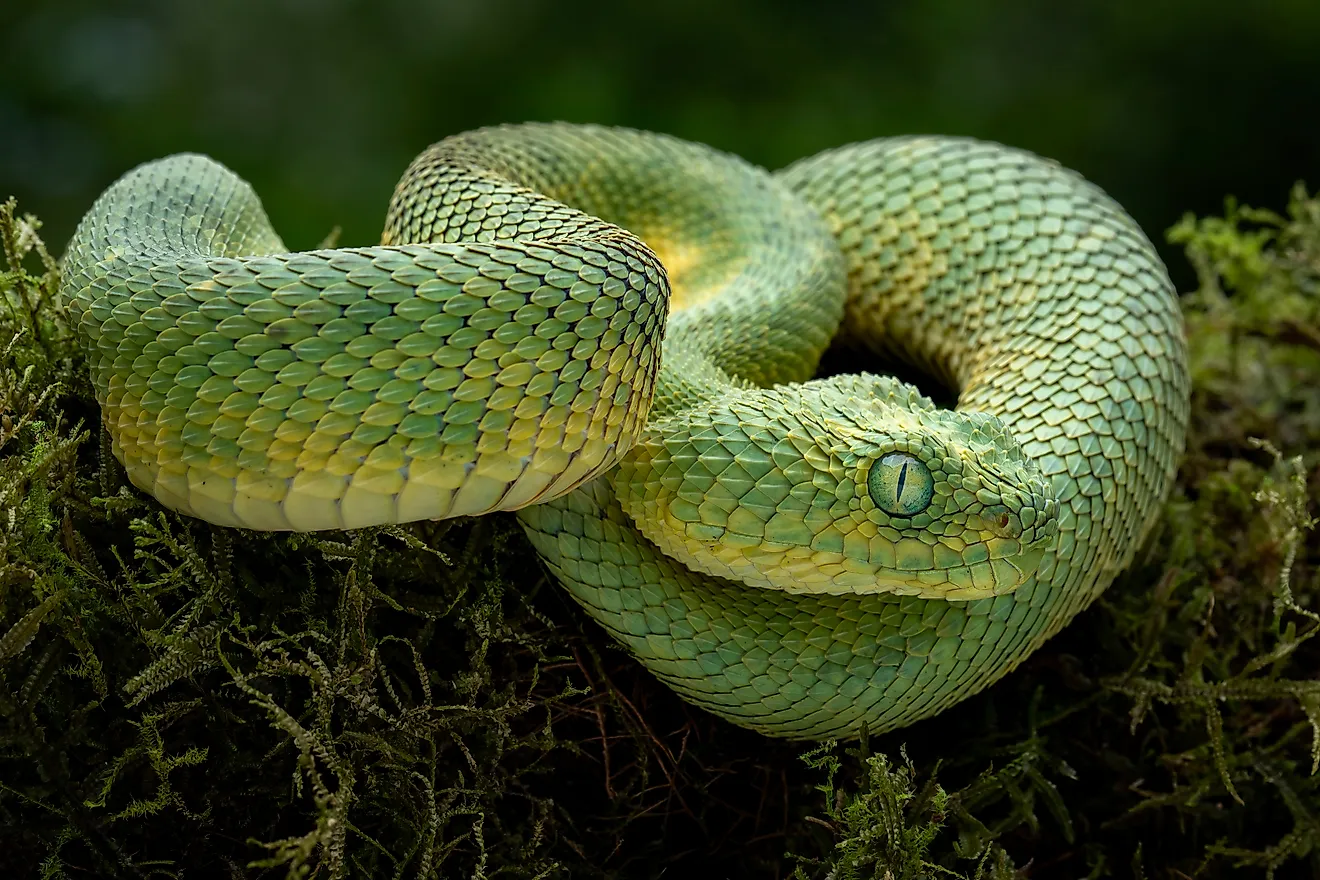
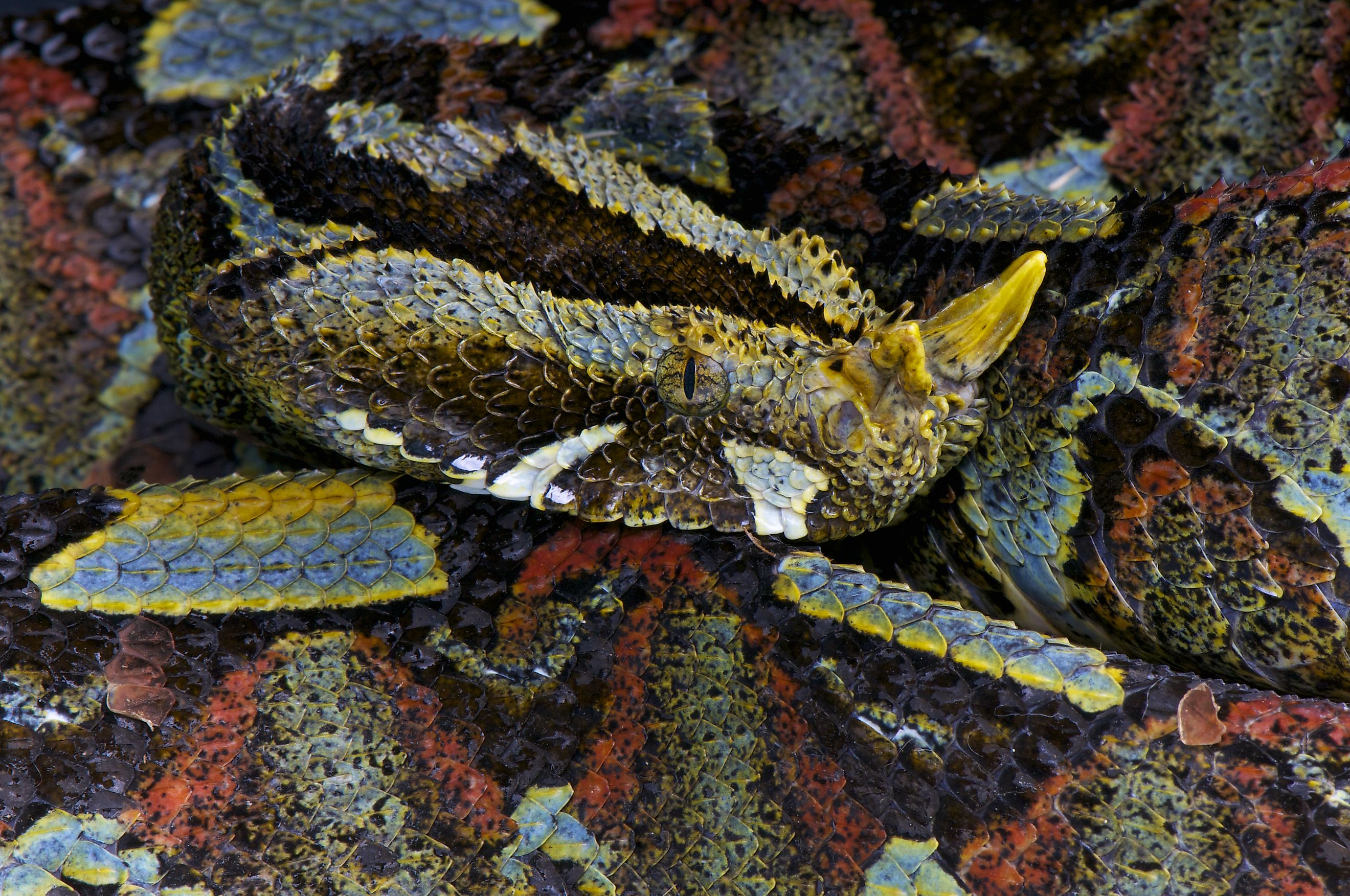
The rhinoceros viper stands out for its unusually vivid coloration and distinctive facial features. Its heavy body is patterned with blue, green, red, and yellow scales arranged in bold geometric shapes, creating an appearance unlike that of most African snakes. Its name comes from the small, upturned scales on the tip of its snout, which form horn-like projections and give its head a distinctly prehistoric appearance.
Known to science as Bitis nasicornis, the rhinoceros viper is a venomous member of the puff adder group native to the rainforests and swamp forests of West and Central Africa. Despite that vivid coat, it is one of the hardest snakes in its range to spot, because the pattern breaks up its outline against damp leaf litter. It is slow, secretive, and easy to overlook, which is exactly how a heavy ambush predator prefers to live.
Taxonomic Classification

The rhinoceros viper belongs to the family Viperidae and the subfamily Viperinae, the true vipers, within the reptile order Squamata. It sits in the genus Bitis, the African adders, a group that also contains the puff adder and the closely related Gaboon viper. The English naturalist George Shaw first described the species in 1792, and it has carried the name Bitis nasicornis ever since, with the species name meaning "nose-horned." No subspecies are currently recognized across its range.
Genetic work places the rhinoceros viper in the giant Bitis lineage alongside the Gaboon viper (Bitis gabonica) and its West African relative Bitis rhinoceros. That last name is a frequent source of confusion. Bitis rhinoceros, sometimes called the West African Gaboon viper, was once treated as a subspecies of the Gaboon viper and only recognized as a full species in 1999. Because "rhinoceros viper" has historically been applied to Bitis nasicornis, many field guides now favor the alternate common name "butterfly viper" to keep the two apart. Across its wide range the animal answers to several names, among them river jack, rhinoceros horned viper, and horned puff adder.
Physical Description

The rhinoceros viper is short, thick, and powerfully built, a design that supports a fast strike from a coiled ambush. Adults typically measure 24 to 35 inches (60 to 90 cm), with many individuals reaching 28 to 42 inches (72 to 107 cm). Exceptional specimens approach 47 inches (120 cm), and a few historical reports describe animals near 4.3 feet (1.3 m), though records at that size are rare. Females grow larger than males. A stout adult carries real bulk for its length, weighing on the order of 1.5 pounds (roughly 700 g).
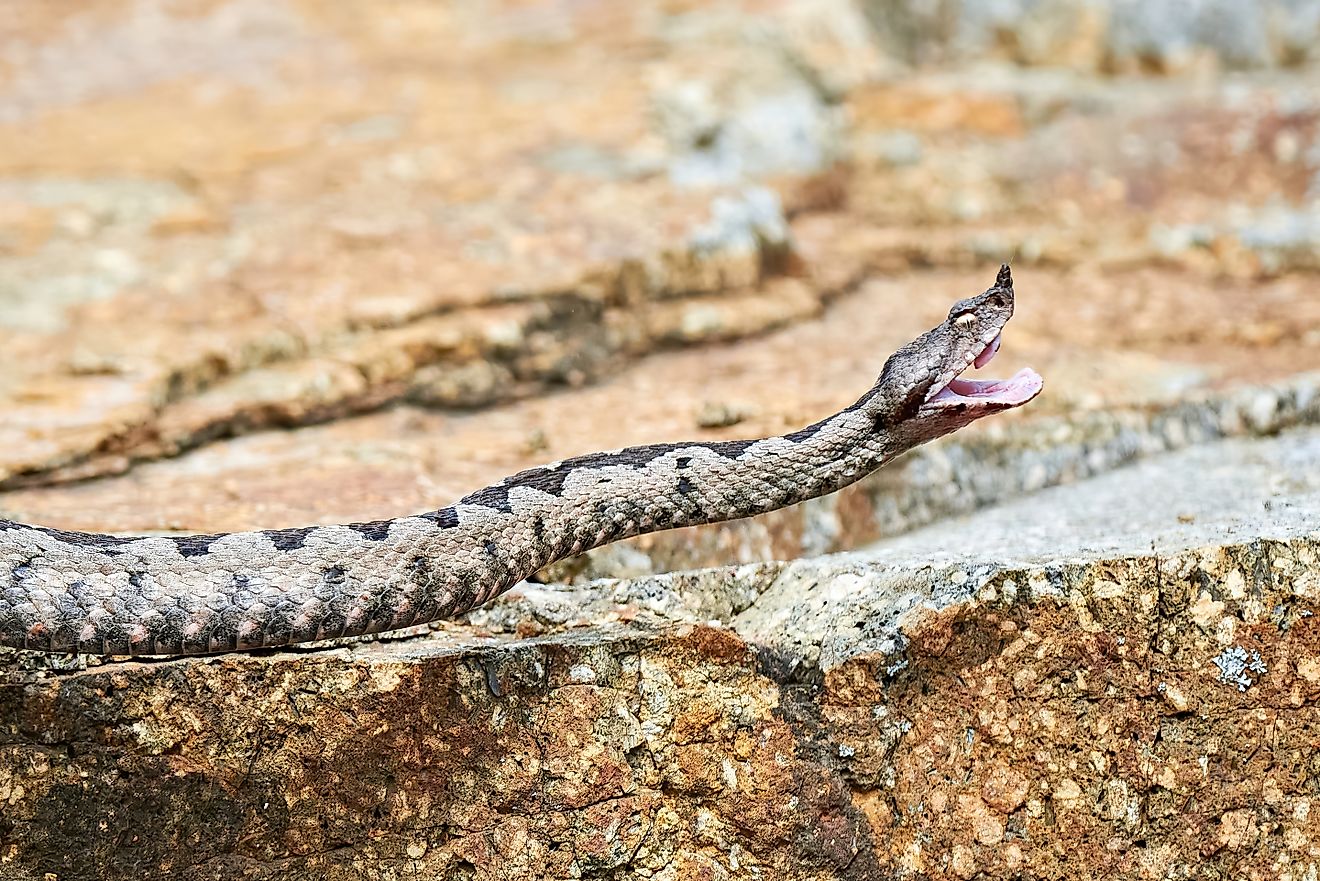
The head is small, flat, narrow, and triangular, set off from the body by a thin neck. Its defining feature is the set of two or three pairs of horn-like scales at the tip of the snout, the front pair often the longest and most prominent. The eyes are small and positioned well forward. The fangs, folded back against the roof of the mouth when at rest, are modest for such a heavy snake, rarely more than about 0.6 inches (1.5 cm) long, and the animal can control whether they swing into place.
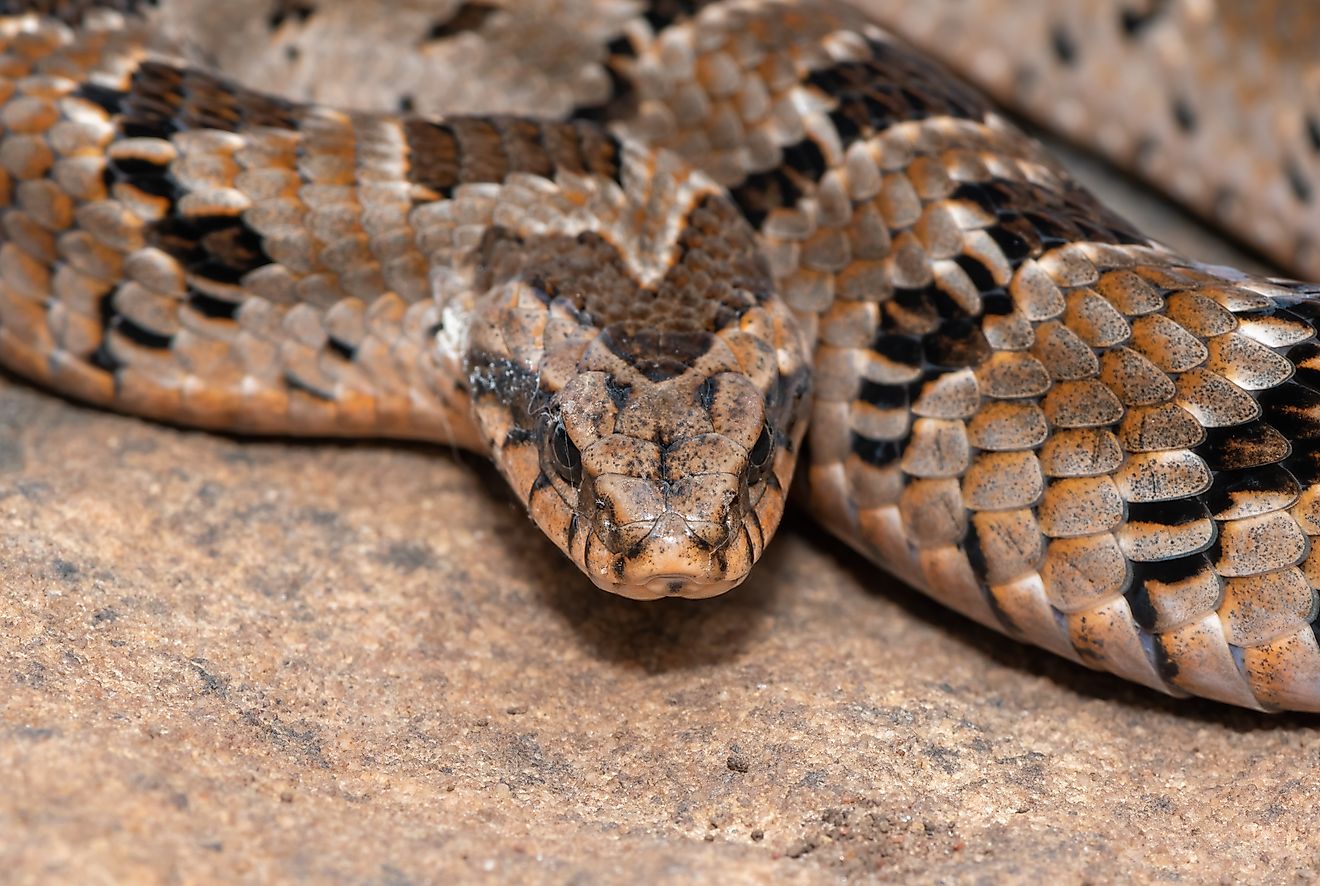
Color is where this viper stands apart from almost every other snake in Africa. The back carries a series of blue or blue-green markings edged in black and yellow, laid over a base of crimson, buff, and olive, forming a repeating pattern of geometric shapes. The head is often blue or green with a dark arrowhead mark on top. The dorsal scales are strongly keeled and so rough that a struggling captive can leave shallow cuts on a handler's skin. That vivid coat, counterintuitively, is superb camouflage. Under the broken, mottled light of the forest floor the bold shapes dissolve the snake's body edge, so the whole animal reads as scattered leaves and shadow rather than a living target.
Range and Habitat

The rhinoceros viper occupies the forest belt of West and Central Africa. Its range runs from Liberia and southern Guinea eastward through Cameroon, Equatorial Guinea, Gabon, the Republic of the Congo, and the Democratic Republic of the Congo, extending into Burundi, Rwanda, southern Uganda, and western Kenya, with a small northern reach into Angola. It also occurs on the island of Bioko off the coast of Equatorial Guinea.
This is a snake of wet places. It favors tropical rainforest, swamp forest, and the margins of streams and marshes, and it turns up on plantations and in damp secondary growth as well. Its strong attachment to water is the reason for the common name river jack. The species is mainly terrestrial, spending its days concealed among leaf litter, root tangles, and low vegetation, but it is a capable climber and will move into shrubs and low trees in search of prey or a better ambush post.
Diet

The rhinoceros viper is a carnivore and a sit-and-wait ambush hunter rather than an active pursuer. It coils in cover, often near a game trail or water's edge, and stays motionless for long stretches, relying on camouflage to bring prey within reach. When an animal wanders close, the viper delivers a short, explosive strike, injects venom, and releases, then tracks the dying prey by scent using its tongue and the sensory organ in the roof of its mouth.
Small mammals such as rodents make up much of the diet, and the snake also takes amphibians such as frogs and toads, along with fish and other small vertebrates near water. Prey is swallowed whole, head first, and a large meal can sustain a heavy-bodied viper for a considerable time. Because the strike is brief and forceful, the venom does most of the work, immobilizing the prey and beginning to break down tissue before digestion even starts.
Behavior

For most of its life the rhinoceros viper is quiet and slow. It is largely nocturnal and solitary, active from dusk into the night when humidity is high, and it spends daylight hours hidden and still. Movement, when it happens, tends to be a slow, rectilinear crawl rather than the quick slither of many snakes. Its first line of defense is not flight but concealment, and many encounters happen only because a person steps close before noticing the animal at all.
When it is disturbed and cannot slip away, the temperament changes. The rhinoceros viper produces one of the loudest hisses of any African snake, a long, high warning delivered from a tightly drawn coil. If the threat presses on, it can strike fast and hard over a short distance. Its venom is primarily hemotoxic, attacking the circulatory system and destroying tissue and blood vessels, with some additional toxic components typical of vipers. Serious bites are uncommon, largely because the snake lives in remote, thinly settled forest and is not aggressive by nature, but any bite is a medical emergency that needs prompt professional care.
Reproduction

Like other members of its genus, the rhinoceros viper gives birth to live young rather than laying eggs, a strategy suited to the warm, humid forest floor. Litters are large. A single female can produce anywhere from about 6 to nearly 40 offspring, with birth timed to the onset of the rainy season, often around March and April, when prey is abundant. Gestation lasts roughly seven months.
Newborns measure about 7 to 10 inches (18 to 25 cm), arrive brilliantly colored, and are fully venomous from the moment they are born, which means they can hunt and defend themselves without any parental help. There is no maternal care beyond birth. In the wild the species is thought to live around 8 to 12 years, and well-kept captives can reach older ages.
Importance

As a mid-level predator of the forest floor, the rhinoceros viper helps regulate populations of rodents and other small animals, a role that quietly limits crop damage and the spread of some pests near human settlements. In turn, it serves as prey for larger forest predators, so it forms one strand in the wider web of the rainforest.
The species' venom is one of the components used to produce a regional polyvalent antivenom, a treatment that protects people bitten by several dangerous African snakes. Venom from the genus Bitis has drawn steady interest from researchers studying blood clotting and tissue chemistry, so this brightly marked viper contributes to science well beyond the forests where it lives.
Threats and Conservation

The most recent assessment on the IUCN Red List, published in 2022, lists the rhinoceros viper as Vulnerable, citing a substantial population decline estimated at around 30 percent across three generations. It is worth noting that some older references still record the species as Least Concern, a reminder that conservation status is revised as new survey data arrive. The current Vulnerable listing reflects growing pressure on the animal and its habitat.
The leading threat is loss of forest. Logging, farming, and the clearing of land across West and Central Africa steadily shrink the wet, densely vegetated habitat this snake depends on. The species is also collected for the exotic pet trade and taken for its skin and venom, and like most large vipers it is sometimes killed on sight out of fear. None of these pressures alone may seem decisive, but together, across a range under heavy human development, they add up. Protecting intact rainforest and swamp forest remains the most effective way to keep this animal secure.
Takeaway
The rhinoceros viper is one of the most colorful snakes on the African continent, yet almost invisible in its natural setting. It carries potent venom and can strike with startling speed, yet it spends most of its life motionless and reclusive. Its horned snout, geometric coat, and powerful build make it instantly recognizable to anyone who has seen one, while its habits keep it hidden from nearly everyone who shares its forest. As deforestation continues to reshape West and Central Africa, the outlook for this remarkable ambush hunter will depend on how much of its wet forest home survives.
Fun Facts

- Its name means "nose-horned." The species name nasicornis comes from the horn-like scales on the tip of the snout, the same feature that inspired the common name rhinoceros viper.
- It hisses louder than almost any other African snake. When threatened, the rhinoceros viper produces a long, high warning hiss that ranks among the loudest of any serpent on the continent.
- Its bright coat is camouflage. The bold blues, reds, and greens break up the snake's outline in dappled forest light, so a colorful animal reads as a pile of leaves and shadow.
- Its scales can cut you. The heavily keeled body scales are so rough that a struggling snake can leave shallow scratches on a handler's skin.
- Newborns are already dangerous. The young are born live, brilliantly colored, and fully venomous, ready to hunt and defend themselves with no help from a parent.
- It goes by many names. River jack, butterfly viper, horned puff adder, and rhinoceros horned viper all refer to the same animal.
Quick Facts
- Scientific name: Bitis nasicornis
- Common names: Rhinoceros viper, butterfly viper, river jack, horned puff adder
- Family: Viperidae (order Squamata)
- IUCN status: Vulnerable (2022 assessment)
- Length: 24 to 42 inches (60 to 107 cm), rarely to 47 inches (120 cm)
- Weight: About 1.5 pounds (roughly 700 g)
- Lifespan: Around 8 to 12 years in the wild
- Diet: Carnivore (small mammals, amphibians, fish, and other small vertebrates)
- Venom: Primarily hemotoxic
- Reproduction: Live birth, about 6 to 38 young per litter
- Range: Rainforests and swamp forests of West and Central Africa