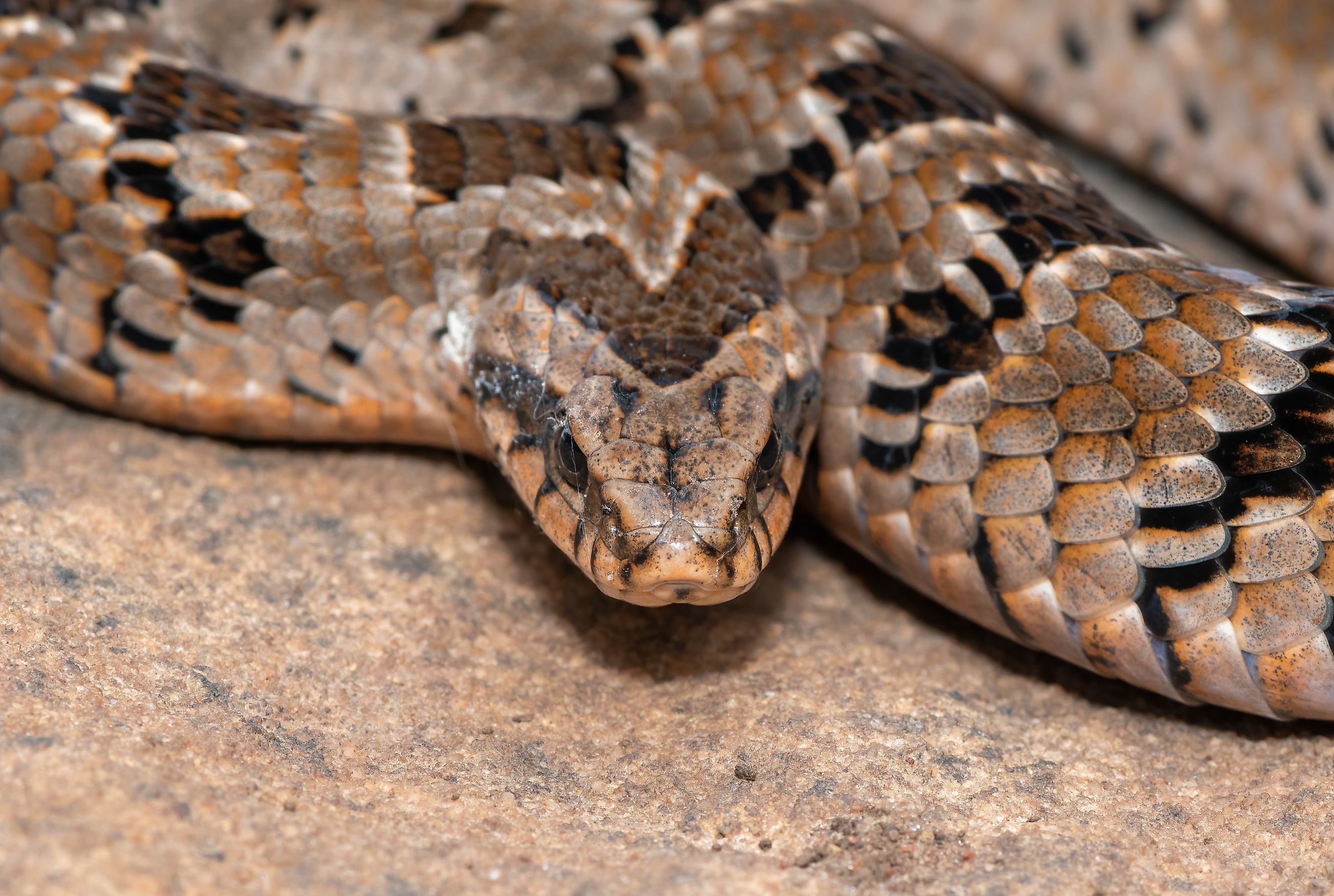
Night Adder
Few African snakes carry a name as misleading as the night adder. Despite the label, these small vipers of the genus Causus are most often seen moving about in daylight or at dusk, hunting frogs and toads across the grasslands and forests of sub-Saharan Africa. Their reputation as creatures of the dark owes more to folklore than to biology.
Night adders are compact, thick-bodied snakes that rarely exceed 3 feet (0.9 m) in length. They occur only in sub-Saharan Africa, where they range widely across savanna, woodland, and the edges of wetlands. What makes them worth close attention is not their size but the string of traits that set them apart from nearly every other viper on Earth.
They lay eggs, they have round pupils, and they carry venom glands so long that the tissue extends well back into the neck. Each of these features breaks the usual viper mold, and together they have puzzled biologists for more than a century. And the name covers not one snake but a cluster of closely related species scattered across the continent, each with its own quirks of color, size, and range.
Taxonomic Classification

Night adders make up the genus Causus, which sits within the viper family, Viperidae, and the subfamily Viperinae. The German naturalist Johann Georg Wagler established the genus in 1830, and the type species is the rhombic night adder, Causus rhombeatus. For much of the twentieth century the group was treated as its own subfamily, Causinae, a decision that reflected how strange these snakes appear next to other vipers.
The genus currently holds roughly seven to eight recognized species, and that count remains in flux. Modern DNA studies keep reshaping the picture, splitting wide-ranging forms into separate lineages and hinting that unnamed species may still be hiding in plain sight. A comprehensive phylogeny published in 2025 worked with seven of the eight recognized species and confirmed that Causus sits at the base of the viper subfamily, sister to all other members.
Well-known species include the rhombic night adder (Causus rhombeatus), the West African or spotted night adder (Causus maculatus), the green night adder (Causus resimus), and the snouted night adder (Causus defilippii). Older sources once described night adders as among the most primitive of all vipers, pointing to their head scales, egg-laying, and venom anatomy. Recent molecular work complicates that older story, so the label of primitive is now used with caution.
Physical Description

Night adders are stout snakes with short, rounded heads that blend smoothly into the neck. Most measure between 12 and 24 inches (30 and 60 cm) as adults, and few push past 3 feet (0.9 m). The rhombic night adder is the largest member of the genus, averaging about 24 inches (60 cm), and the longest individual on record was a male of 37 inches (93 cm) collected in eastern Zimbabwe.
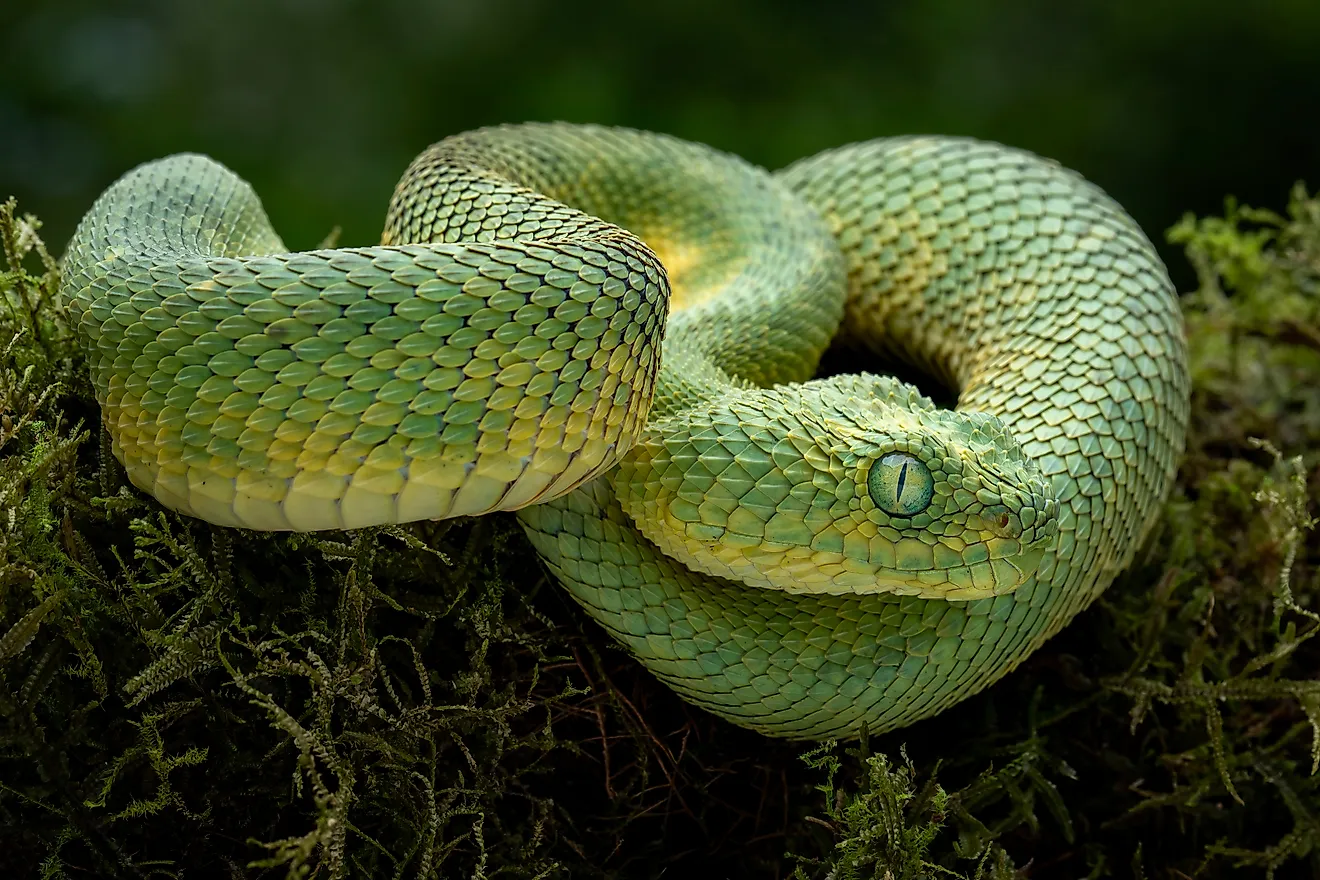
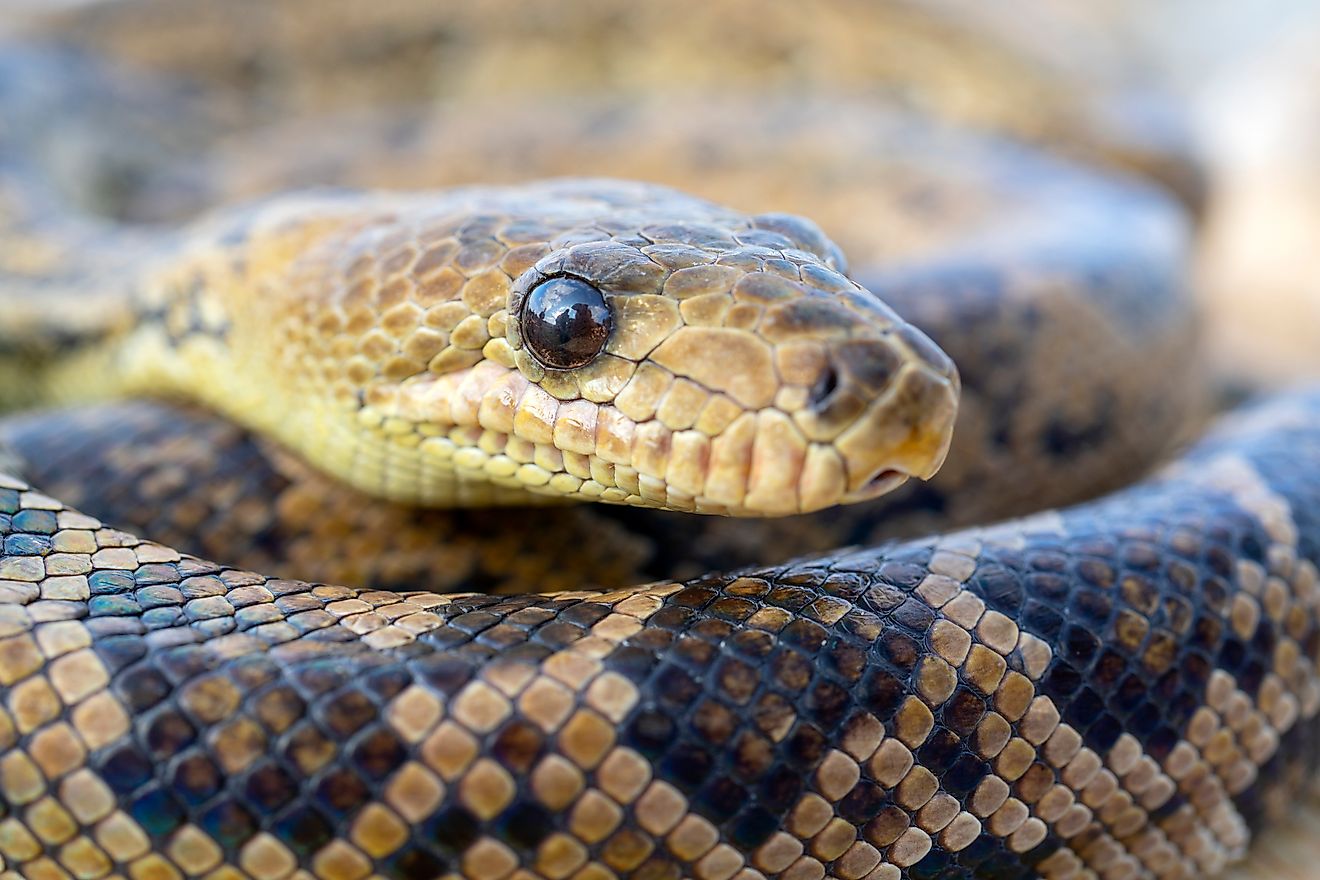
Color varies a great deal across species and regions. Many night adders wear shades of brown, pink-brown, olive, or gray, marked along the back with a row of dark rhombic or diamond-shaped blotches. A dark V-shape or chevron often sits on the neck or crown. The green night adder breaks this pattern with a bright, velvety green body. Some desert-dwelling individuals show markings so faint that identification in the field becomes difficult.
Two features stand out to anyone who studies vipers. First, night adders have round pupils rather than the vertical, cat-like slits typical of the family. This gives them relatively good daytime vision and hints at their active, sun-friendly habits. Second, several species carry unusually long venom glands that stretch back beyond the head and into the front of the body. These elongated glands connect through ducts to short fangs at the front of the mouth. Scales along the back are smooth or only weakly keeled, and the snakes have a single anal plate.
Range and Habitat

Night adders live only in sub-Saharan Africa, and as a group they cover an enormous slice of the continent. The rhombic night adder alone occupies a range of roughly 8 million square kilometers, spanning the southern tip of Africa and reaching north into Nigeria, Sudan, and Ethiopia. That footprint is unusual for a medium-sized snake and rivals the range of far larger species such as the puff adder.
These snakes favor moist environments where amphibians thrive. They turn up in savanna, grassland, open woodland, forest margins, marshes, and the green corridors along rivers and streams. Some species also tolerate drier country, and the West African night adder has been recorded in semi-desert as well as forest, at elevations up to about 5,900 feet (1,800 m). Gardens, farmland, and the damp edges of villages suit them well too, since these places attract the frogs and toads they depend on. After heavy rain, night adders often appear in yards and along footpaths as their prey becomes active.
Diet

Frogs and toads make up the heart of the night adder diet. These snakes are amphibian specialists, and their seasonal movements track the rise and fall of frog and toad activity. During wet months, when amphibians breed in large numbers, night adders become far more visible as they follow the food. In dry spells they grow scarce and spend long stretches hidden and inactive.
A night adder hunts by ambush and by slow, deliberate searching through leaf litter and grass. When it finds prey, it delivers a bite and uses its venom to subdue the animal before swallowing it whole. Large toads, which many predators avoid because of their toxic skin secretions, are taken readily. Beyond amphibians, night adders occasionally eat small mammals such as mice, and some individuals take lizards. Young snakes feed on tiny frogs and toads soon after hatching. When prey is plentiful, a night adder can consume a large quantity in a short period, building reserves against leaner times.
Behavior

The name night adder suggests a creature of darkness, yet most species are active by day or around dusk. Some hunt both day and night, and individuals are often seen basking in the early morning or late afternoon. Round pupils support this daytime activity and separate night adders from the many strictly nocturnal vipers.
For all their venomous reputation, night adders are usually calm and reluctant to bite. Many rely first on stillness and camouflage, staying motionless while a threat passes. When that fails and the snake feels cornered, it can mount a dramatic defense. A frightened night adder coils tightly, inflates its body so the dark markings stand out, and hisses and puffs loudly. It may flatten the front of its body and neck in a way that recalls a small cobra, then strike hard and repeatedly. Small individuals sometimes strike with enough force to lift themselves clear of the ground. A large share of these strikes are bluffs that deliver no venom, a tactic that lets the snake conserve its resources while still warning off intruders. Some night adders also release a strong musky odor when handled.
Reproduction

Reproduction sets night adders apart from most of their relatives. While the great majority of vipers give birth to live young, every night adder species lays eggs. This egg-laying habit, known as oviparity, is one of the traits that long marked the genus as unusual within the family.
Females of the rhombic night adder produce an average clutch of about two dozen eggs, and the eggs require a lengthy incubation of roughly four months before hatching. Newly hatched night adders measure only 4 to 5 inches (10 to 12.5 cm) in total length and begin life feeding on tiny frogs and toads. Breeding tends to follow the seasons, with activity rising during warmer, wetter periods when prey is abundant and conditions favor developing eggs. Night adders are otherwise solitary and come together mainly to mate.
Venom and Human Encounters

Night adder venom is mild by viper standards. It acts mainly on tissue, producing what specialists call a cytotoxic effect. A bite typically brings sharp pain, swelling, bruising, and tender, swollen lymph nodes near the wound. Mild fever can follow. In most cases these symptoms fade within two or three days and leave no lasting damage. Serious tissue death, known as necrosis, is rare and usually the result of secondary infection rather than the venom itself.
Compared with larger African vipers such as the puff adder, night adders pose a modest threat to people. There are no well-documented modern records of a human death caused by a night adder bite. Even so, the venom is not to be dismissed. In at least one recorded case a bitten child required a surgical procedure called a fasciotomy to relieve dangerous swelling. Anyone bitten should seek medical care and avoid the folk remedies that often do more harm than good. Because night adders live close to people and become active after rain, they account for a fair number of snakebites across their range, most of which resolve without complication.
Importance

Night adders play a valuable part in the ecosystems they inhabit. As dedicated hunters of frogs and toads, they help regulate amphibian numbers and form one link in a food web that includes birds of prey, larger snakes, and small carnivores that feed on them in turn. Their close tie to amphibians also makes them useful indicators of environmental health, since both predator and prey depend on clean water and healthy wetlands. Around farms and villages, night adders quietly reduce populations of pests, though their habit of turning up in gardens can bring them into unwanted contact with people.
Threats and Conservation Status

The better-studied night adders are in reasonable shape. The rhombic night adder and the green night adder are both listed as Least Concern on the IUCN Red List, reflecting wide ranges and stable populations. No major threat currently endangers these species as a whole. The main pressures come from habitat loss and pollution, which harm the amphibians that night adders rely on, along with the persistent killing of snakes by people who fear them. Because the genus is still being sorted out by DNA research, some newly recognized or range-restricted species may prove more vulnerable than the familiar wide-ranging forms, which makes continued study a priority.
Takeaway
Night adders defy several expectations associated with vipers. Unlike most members of their family, they lay eggs, and despite their name, they are generally active during the day. When threatened, they often rely on bluffing rather than biting. Small and easily overlooked, these snakes play an important ecological role by hunting amphibians across much of sub-Saharan Africa. Their venom is usually mild and rarely fatal to humans, although bites still deserve medical attention. Their unusual reproductive biology and behavior also make the genus an ongoing subject of scientific interest. Better understanding these snakes can help reduce unnecessary fear and support safer coexistence with the people who share their habitats.
Fun Facts

- Vipers that lay eggs. Almost all vipers give birth to live young, but every night adder species lays a clutch of eggs, a rare habit within the family.
- Round-eyed hunters. Unlike most vipers, which have vertical slit pupils, night adders have round pupils that suit their daytime activity.
- Venom glands in the neck. Several night adders carry venom glands so long that the tissue extends well behind the head into the front of the body.
- Cobra impressions. When threatened, a night adder can flatten its neck and rear up in a display that mimics a small cobra.
- Toad specialists. Night adders readily eat toads that many other predators avoid, and they track amphibian activity so closely that they nearly vanish during dry seasons.
Quick Facts
- Scientific name: Causus (genus)
- Family: Viperidae
- Subfamily: Viperinae
- IUCN status: Least Concern for well-studied species such as Causus rhombeatus and Causus resimus
- Number of species: Around seven to eight, with the count still under revision
- Size: Most 12 to 24 inches (30 to 60 cm), largest recorded 37 inches (93 cm)
- Weight: Light-bodied, typically well under 1 pound (0.5 kg)
- Lifespan: Not well documented in the wild, with several years typical and longer reported in captivity
- Diet: Carnivore, feeding mainly on frogs and toads
- Reproduction: Oviparous, with clutches of around two dozen eggs in the rhombic night adder
- Range: Sub-Saharan Africa, in savanna, woodland, forest edge, and wetland margins