Puff Adder
Few snakes carry a reputation as fearsome as the puff adder, and few earn it so quietly. This heavy-bodied African viper is responsible for more serious snakebites than any other snake on the continent, a distinction it owes not to aggression but to its superb camouflage and its habit of lying perfectly still while people pass within inches of it. When the animal finally announces itself, it does so with a long, low hiss that sounds like air rushing from a tire, the behavior that gives the puff adder its name.
Known to science as Bitis arietans, the puff adder ranges across most of sub-Saharan Africa and reaches into parts of the Arabian Peninsula. It is common, widespread, and finely tuned for a sit-and-wait way of life. For anyone drawn to the natural history of venomous snakes, it stands as one of the most important and most misunderstood reptiles in Africa.
What makes the puff adder worth close attention is the gap between how it looks and how it strikes. It appears sluggish, thick, and slow, yet it delivers one of the fastest strikes in the snake world. Understanding that contrast explains almost everything about the animal, from why it survives so well to why it bites so many people.
Taxonomic Classification

The puff adder belongs to the family Viperidae, the true vipers, and sits within the genus Bitis, a group of stout African vipers that also includes the Gaboon viper and the rhinoceros viper. Its full scientific name is Bitis arietans. The species name comes from the Latin verb meaning to strike or butt, a fitting nod to the animal's explosive lunge. In the broader chain of life it is a reptile in the order Squamata, the scaled reptiles that contain all snakes and lizards.
Two subspecies are usually recognized. The nominate form, Bitis arietans arietans, occupies the vast majority of the range across Africa and Arabia. A second form, Bitis arietans somalica, is restricted to the Horn of Africa and differs in scale details. As with many wide-ranging snakes, ongoing genetic work continues to refine how these populations relate to one another, and future study may adjust the picture.
Physical Description

The puff adder is built like a coiled length of rope. Adults average about 3.3 feet (1 m) in length, with a thick, muscular body, a broad triangular head, and a short tapering tail. Large individuals, especially those from East Africa, can reach 4.9 feet (1.5 m), and exceptional specimens approaching 6.3 feet (1.9 m) have been recorded, ranking it among Africa's largest vipers. A heavy adult can weigh 10 to 15 pounds (4.5 to 6.8 kg), and the thickest individuals reach a girth of around 10 inches (25 cm).
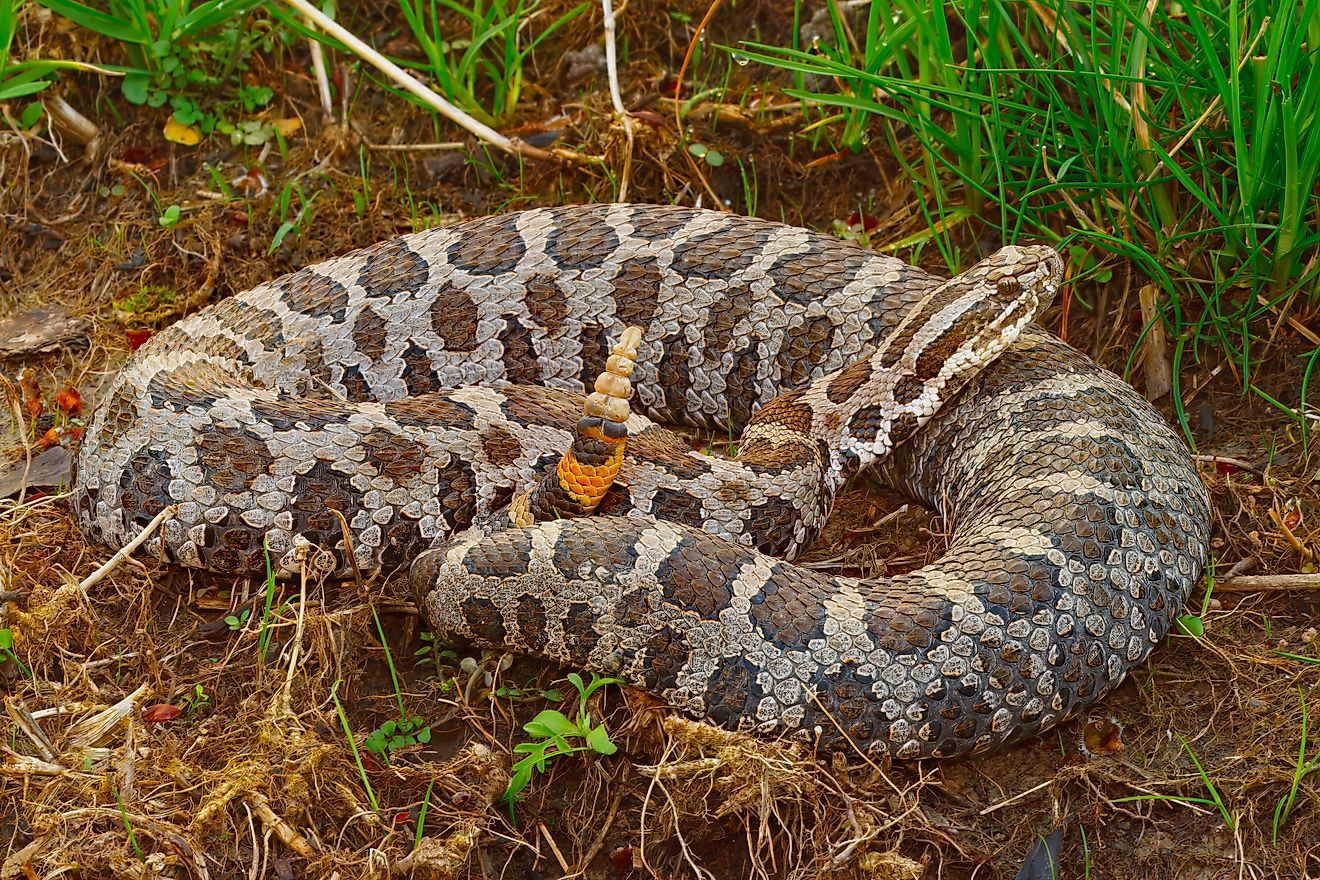
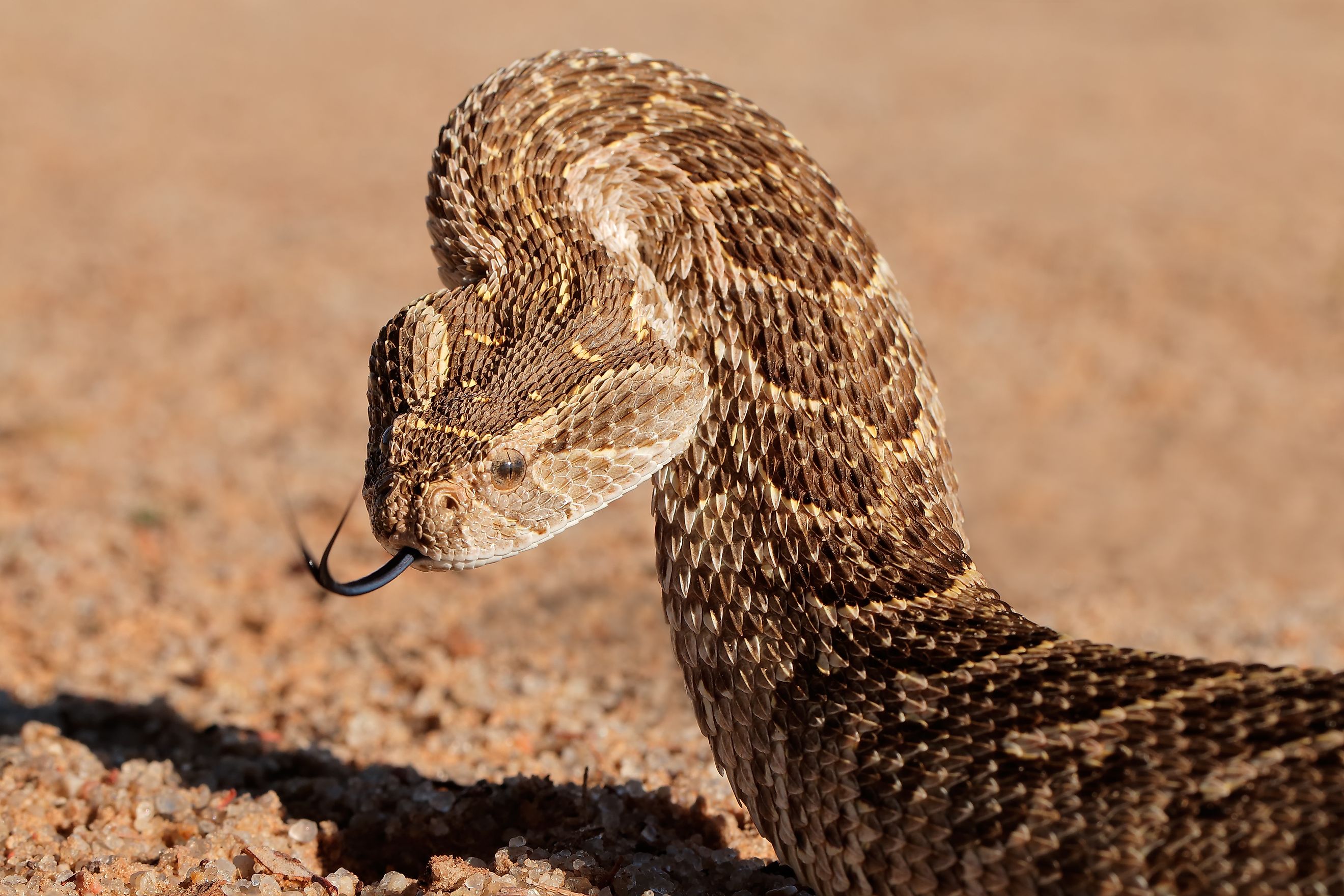
Coloration varies widely across the range and helps the snake vanish against its surroundings. Most puff adders are some shade of tan, brown, or gray, overlaid with a series of pale-edged dark chevrons that run down the back in a repeating V or U pattern. Some populations produce vivid yellow or orange individuals. The scales are heavily keeled, giving the body a rough, matte finish that scatters light and softens the animal's outline in grass, leaf litter, and sandy soil.
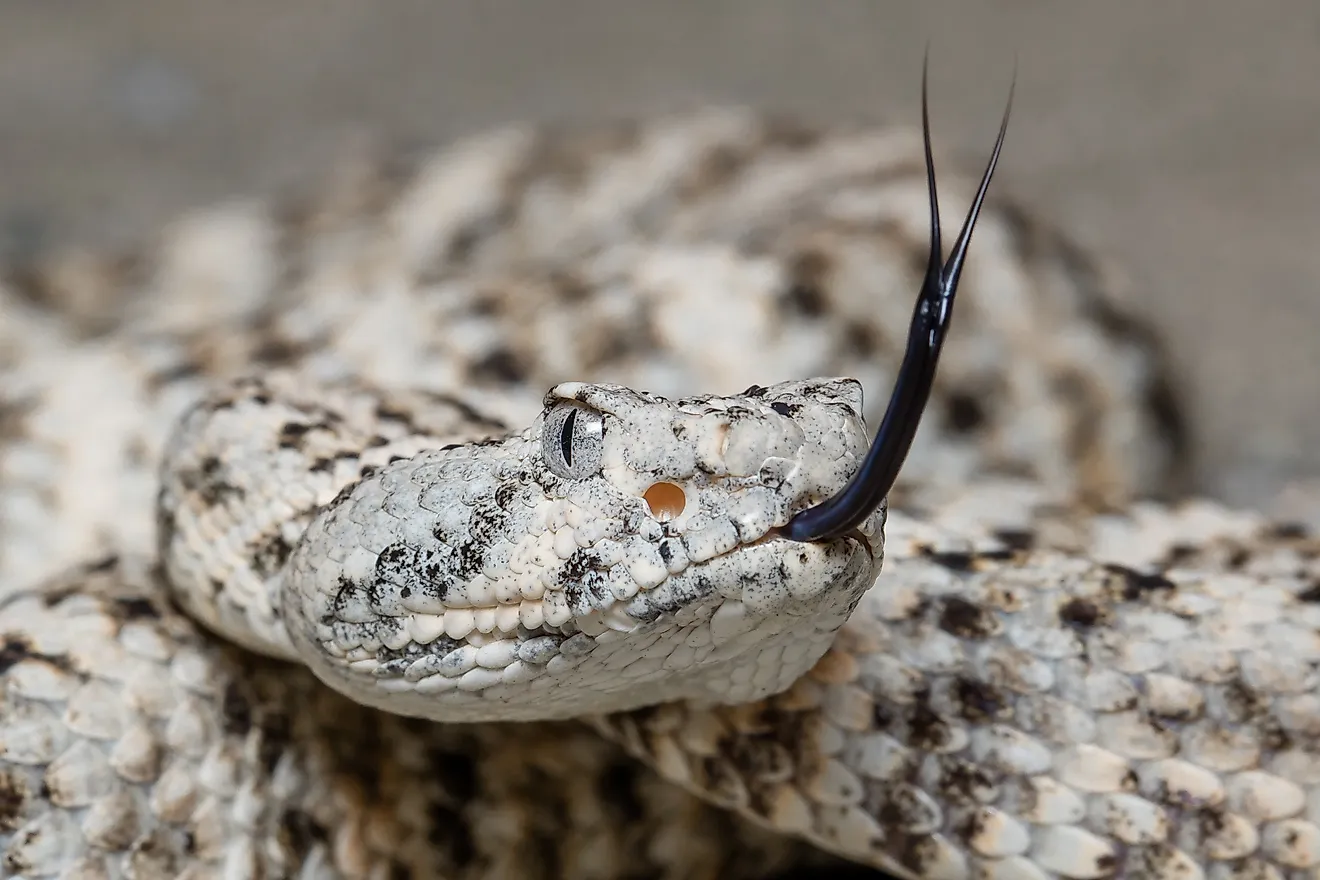
The head hides the snake's most dangerous equipment. Like other vipers, the puff adder carries long, hinged fangs that fold flat against the roof of the mouth when the jaws are closed and swing forward during a strike. In big adults these fangs can reach roughly 0.6 to 0.8 inches (15 to 20 mm). Females tend to have slightly shorter tails than males, but the two sexes otherwise look much alike.
Range and Habitat

The puff adder is one of the most widely distributed snakes in Africa. Its range covers nearly all of sub-Saharan Africa, extends into parts of Morocco in the north, and continues across the Red Sea into the southwestern Arabian Peninsula. Within this enormous area the snake is largely absent from only two kinds of country, the true sand deserts of the Sahara and the dense equatorial rainforests, both of which fail to offer the mix of conditions it prefers.
Everywhere else the animal thrives. It favors savanna, grassland, semi-arid scrub, coastal bush, montane slopes, and the fynbos shrublands of southern Africa. What ties these habitats together is a reliable combination of warmth, cover, and access to water, along with a healthy supply of small prey. This adaptability, more than any single specialization, explains why the puff adder turns up across so many landscapes, including farmland and the edges of towns where people and snakes cross paths.
Diet and Hunting

The puff adder is the definition of an ambush hunter. Rather than chase its meals, it settles into a coil beside a game trail or a rodent run and waits, sometimes for days or even weeks, for prey to wander close. Rodents make up the bulk of the diet, but the snake also takes birds, lizards, amphibians, other snakes, and on occasion, larger prey such as small ground-dwelling mammals.
When a target steps within range, the strike is astonishingly quick. The snake throws its head forward, drives its fangs deep, injects venom, and releases the animal almost in the same instant. The bitten prey stumbles off and dies nearby, and the puff adder then follows the scent trail with its tongue and Jacobson's organ to find and swallow the carcass at leisure. This release-and-track strategy spares the snake the risk of holding a struggling, wounded animal against its own body.
Behavior

Puff adders are mostly nocturnal and crepuscular, hunting through the cooler hours and basking by day to raise their body temperature. For most of their lives they are slow, deliberate animals that rely on stillness and camouflage as their first line of defense. Given the choice, a puff adder would rather stay hidden than flee, and this preference is the single biggest reason people are bitten. A well-hidden snake is easy to step on.
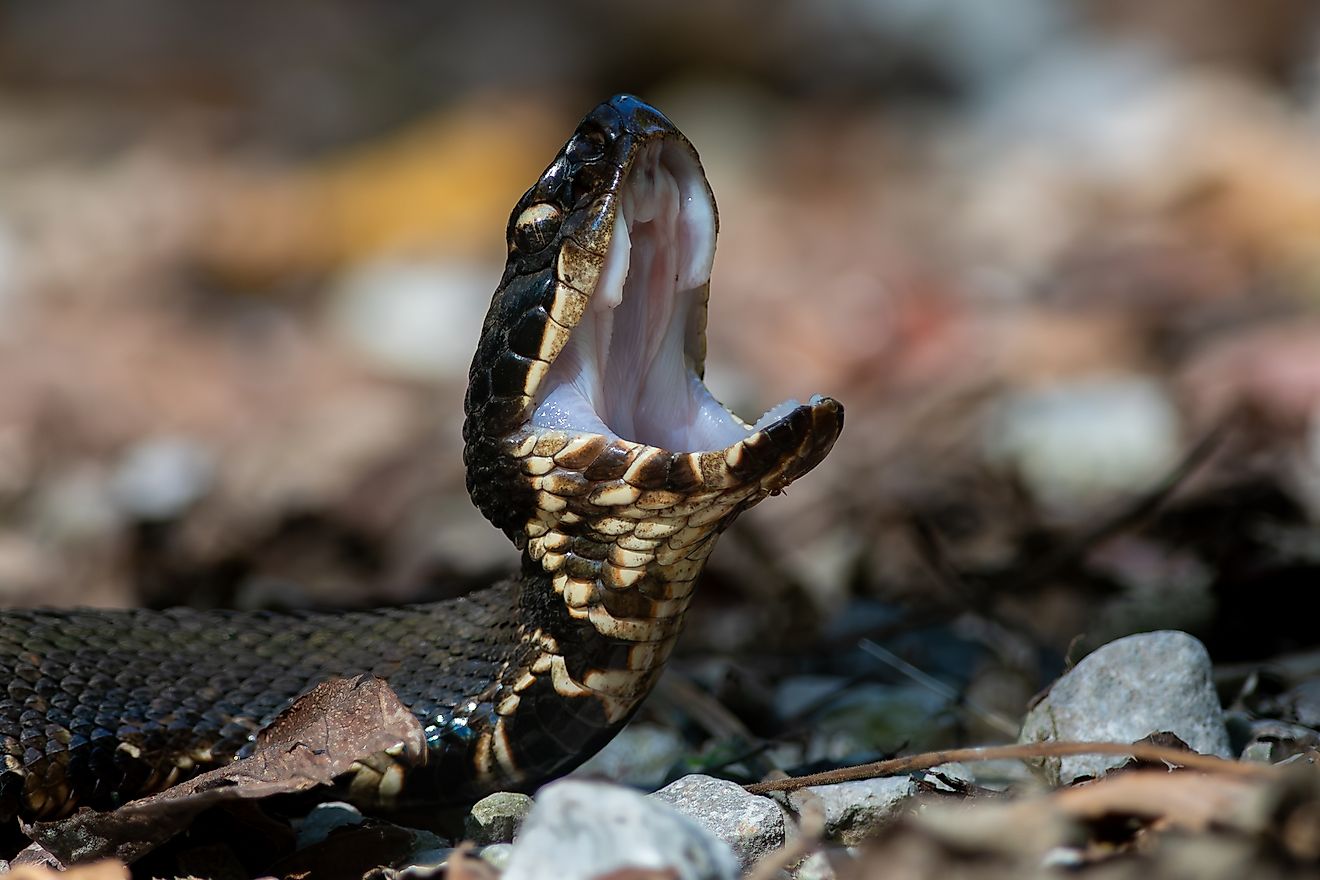
The defensive display is unmistakable and gives the species its common name. When cornered, a puff adder draws in a large volume of air and expels it in a deep, hissing puff, inflating and deflating its body while pulling into a tight S-shaped coil ready to lash out. The message is clear, and it is a bluff worth respecting, because from that coiled posture the snake can strike forward or to the side with remarkable speed. Despite its slow ordinary movements, the puff adder is often ranked among the fastest-striking snakes in the world.
Reproduction

Puff adders are ovoviviparous, which means the eggs develop and hatch inside the mother's body so that she gives birth to live, fully formed young. Breeding is tied to the local seasons, with mating in southern Africa taking place in the warmer spring months and births following after a gestation of roughly five to nine months. In the run-up to mating, females release a scent that draws males, and rival males may rise up and wrestle in a slow, twining contest for the chance to breed.
Litters are large by snake standards. A typical brood holds 20 to 40 young, and litters of more than 80 have been documented. The newborns measure about 5 to 7 inches (12.5 to 17.5 cm), arrive fully venomous, and receive no care from the mother once they are born. From their first day they are independent hunters, ready to ambush their own small prey. Puff adders generally reach breeding age at around four years old.
Importance to the World

Within its ecosystems the puff adder plays a valuable role as a controller of rodents. By steadily removing rats, mice, and other small mammals, it helps limit populations of animals that damage crops and spread disease, which makes the snake a quiet ally of farmers even where it is feared. In turn, puff adders themselves feed a range of predators, including birds of prey, honey badgers, and larger snakes, so they sit in the middle of the food web as both hunter and hunted.
The species matters to people in a second way. Because its venom is medically important and chemically complex, the puff adder has become a subject of active research. Scientists study its venom both to improve the antivenoms that treat snakebite and to explore the compounds it contains, some of which show promise for medical and antimicrobial investigation. A snake this common and this dangerous is, by necessity, one of the best studied vipers on the continent.
Threats and Conservation

The puff adder is listed as Least Concern on the IUCN Red List. It remains common and widespread across most of its enormous range, and its populations are considered stable, so it faces no serious risk of extinction as a species. This resilience flows directly from its adaptability, its broad diet, and its ability to live close to human settlement.
That closeness cuts both ways. Puff adders are frequently killed on sight because they are seen as dangerous pests, and habitat change and road traffic take a steady toll on individual snakes. The greater danger, though, is the one the snake poses to people. Thanks to its wide distribution, its excellent camouflage, and its tendency to hold its ground, the puff adder is thought to cause a large share of Africa's serious snakebites, and its cytotoxic venom can produce intense pain, swelling, blistering, and tissue death if a bite goes untreated. Prompt access to the right antivenom is the key to a good outcome, which is why improving antivenom supply across rural Africa remains an urgent goal. For the species itself, the outlook is secure, and the real conservation story is less about saving the snake than about helping people and puff adders share the same ground more safely.
Takeaway
The puff adder is slow yet explosively fast, dull-looking yet perfectly designed, feared across a continent yet reluctant to bite. Almost everything that makes it dangerous to people also makes it a masterful survivor. The rough, patterned scales erase it against the ground, and the patient ambush strategy lets it thrive in habitats as varied as coastal bush and montane grassland. That same toolkit has carried the species into nearly every corner of sub-Saharan Africa and made it one of the most successful vipers in the world.
For all its fearsome reputation, the puff adder is far more valuable alive than dead. It keeps rodent numbers in check, feeds a web of larger predators, and offers researchers a venom rich enough to advance both snakebite treatment and medical science. Its future as a species looks secure, so the real work ahead lies in understanding the animal well enough to live alongside it. Seen clearly, the puff adder is not a villain but a quietly remarkable predator that has earned its place in Africa's landscapes.
Fun Facts

- A record-setting mother. A Kenyan female puff adder in a European zoo once gave birth to 156 young in a single litter, believed to be the largest brood recorded for any snake.
- Named for a warning. The common name comes straight from the loud, drawn-out hiss the snake makes when it puffs up its body to warn off a threat.
- Slow body, lightning strike. A puff adder can complete a strike in about a quarter of a second, ranking it among the fastest-striking snakes despite its heavy, sluggish build.
- The continent's most widespread viper. The puff adder ranges across nearly all of sub-Saharan Africa, which makes it the most widely distributed venomous snake on the continent.
- A vanishing scent. Research suggests puff adders can chemically hide their own odor, helping them stay undetected by sharp-nosed predators and prey while they wait in ambush.
- Dangerous from birth. Newborn puff adders are fully venomous and able to deliver a harmful bite from their very first day of life.
Quick Facts
- Scientific name: Bitis arietans
- Family and order: Viperidae, Squamata
- IUCN status: Least Concern (populations stable)
- Length: Average about 3.3 feet (1 m), up to roughly 6.3 feet (1.9 m)
- Weight: 10 to 15 pounds (4.5 to 6.8 kg) in heavy adults
- Lifespan: Commonly 10 to 15 years, longer in captivity
- Diet: Carnivore, mainly rodents, plus birds, lizards, and amphibians
- Range: Most of sub-Saharan Africa, parts of North Africa, and the southwestern Arabian Peninsula