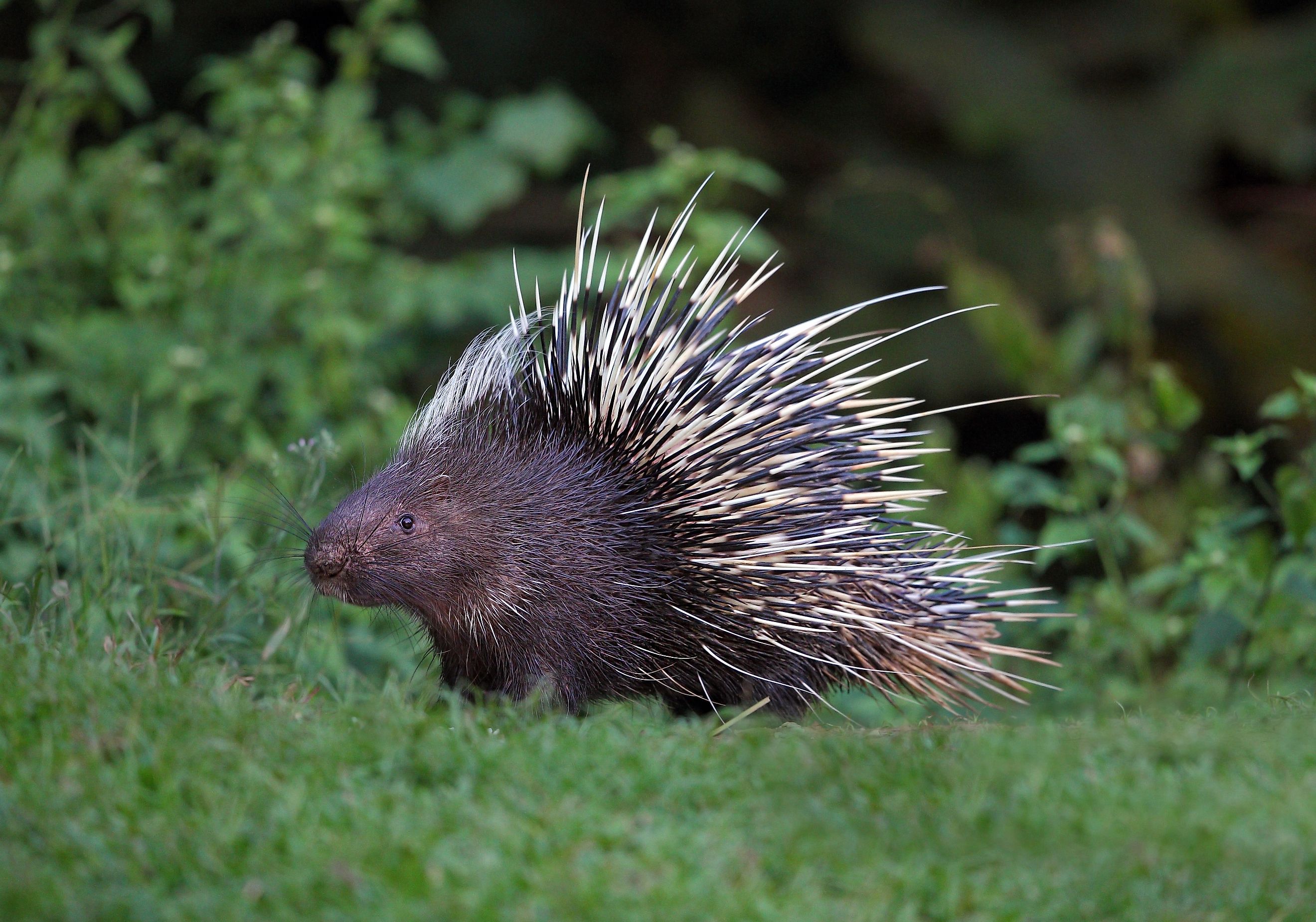
Porcupine
The porcupine is one of the best-armored mammals on Earth, a slow and heavy-bodied rodent wrapped in a coat of up to 30,000 barbed quills that turn most predators away before a fight ever begins. Its name comes from old words meaning spined pig, yet the animal is a true rodent with no relation to swine. What sets it apart is not speed or strength but a defense so effective that a lumbering, near-sighted creature can wander the forest floor at night with little to fear.
Porcupines are found across much of the world. New World species inhabit the forests of North and South America, while Old World species range across the grasslands and rocky slopes of Africa, southern Europe, and Asia. They fall into two separate families that evolved their spines independently, a striking case of two distant lineages arriving at the same solution. They are worth knowing because they have several fascinating traits and behaviors that are often misunderstood, including the common misconception that they can launch their quills like arrows.
Taxonomic Classification

Porcupines belong to the order Rodentia and the infraorder Hystricognathi, but the single word covers two families that are not close relatives. The Old World porcupines make up the family Hystricidae, which lives in Africa, southern Europe, and Asia. The New World porcupines make up the family Erethizontidae, which lives across the Americas. Between them these families hold roughly 25 to 30 species, with counts shifting as DNA studies split and merge groups.
The best-known Old World member is the crested porcupine, Hystrix cristata, described by Carl Linnaeus in 1758 and still the only porcupine found in continental Europe. The best-known New World member is the North American porcupine, Erethizon dorsatum, the only species in its genus and the only porcupine ranging north of Mexico. Modern genetic work has reshaped the tree of tree-dwelling species, folding several once-separate genera into Coendou, the prehensile-tailed porcupines of Central and South America. The two families sit far apart within the rodents, and their shared quills are a product of convergent evolution rather than close kinship.
Physical Description

All porcupines are stout, rounded animals with blunt heads, small eyes, and short legs, but size varies widely across the group. Body length runs from about 12 inches (30 cm) in the smaller tree species to roughly 36 inches (90 cm) in the largest ground dwellers, not counting the tail. Weight spans a wide band, from around 3 pounds (1.4 kg) in a dwarf porcupine to as much as 60 pounds (27 kg) in a large crested porcupine, which ranks among the biggest rodents alive. The North American porcupine typically weighs 11 to 31 pounds (5 to 14 kg), placing it second among North American rodents behind the beaver.
The quills define the animal. They are modified hairs stiffened with keratin, the same material found in human nails, and a single porcupine may carry about 30,000 of them mixed with softer guard hairs. In many species each quill ends in a field of microscopic backward-facing barbs that work like fishhooks, sliding into flesh with ease and resisting removal. Old World species tend to have longer, thicker, banded quills that can reach nearly a foot (30 cm) on the crest, while New World species often carry shorter quills partly hidden beneath their fur. Coloration is usually a warning display of dark brown or black set against white or yellow, a signal that tells predators to keep their distance.
Range and Habitat

Porcupines occupy an enormous range and a broad set of habitats. Old World species live across Africa, the Middle East, southern Europe, and much of southern Asia, favoring rocky hills, savanna, scrub, and forest edges where they can dig or shelter in burrows and crevices. New World species range widely, occupying the cold forests of Alaska and Canada as well as the tropical woodlands of Central and South America.
Habitat use tracks the two lifestyles within the group. Ground-dwelling Old World porcupines den in burrows and rock shelters and forage over open terrain, tolerating deserts, grasslands, and mountain slopes at a wide range of elevations. The tree-climbing New World species spend much of their lives in the canopy of tropical and temperate forests, gripping branches with strong claws and, in the case of Coendou, a muscular tail that coils around limbs. The North American porcupine bridges both worlds, climbing conifers to feed yet just as comfortable on the ground, and it turns up in tundra, deciduous woodland, and dry chaparral alike.
Diet

Porcupines are herbivores with a taste for plant matter that most animals leave alone. Depending on the species and the season, they eat bark, twigs, roots, stems, buds, leaves, fruit, seeds, and the inner cambium layer of trees. In warmer months, a porcupine works through fresh greenery, berries, and new growth, while in winter it survives on conifer needles and the nutritious inner bark of trees, gnawing patches that can girdle and kill a limb.
Their teeth suit this rough diet. Like all rodents, porcupines have ever-growing incisors that wear down against hard food, and their broad cheek teeth grind fibrous plant tissue. A well-documented quirk is a craving for salt and other minerals. North American porcupines will chew antlers, bones, and even wooden tool handles or plywood soaked with road salt and sweat to correct a sodium shortfall. Old World crested porcupines gather bones in their burrows and gnaw them, a habit that both sharpens their teeth and supplies calcium, and a single den can hold a surprising collection of them.
Behavior

Most porcupines are nocturnal, resting in dens, burrows, or trees by day and feeding after dark. They are typically solitary, though some share winter dens and Old World species may live in small family groups. On the ground, a porcupine moves slowly and cannot outrun much, so it relies entirely on its coat rather than escape.
The defense unfolds in stages. A threatened porcupine first raises its quills into a bristling shield and turns its back to the danger, showing the black-and-white warning pattern. It may chatter its teeth, stamp its feet, and release a strong odor as further warning. If the predator presses on, the porcupine lashes out with its heavily armed tail, driving quills into the attacker on contact. This is the heart of the most famous myth about the animal. Porcupines cannot shoot their quills. The spines have no muscle or spring behind them and detach only when something touches them, which is why a predator often walks away with a face full of quills that looked, from a distance, as if they had been fired.
Reproduction

Breeding habits differ between the two families, but all porcupines invest heavily in a small number of young. North American porcupines mate in autumn after elaborate courtship, and males compete for females before the pair mates. Gestation is long for a rodent at about seven months, and the female usually gives birth to a single well-developed baby, called a porcupette, in late spring. Old World species tend toward shorter pregnancies of around three to four months and litters of one to four young.
Newborns arrive in remarkable shape, with eyes open and a full set of soft quills that harden within about half an hour of birth. The young grow quickly and are weaned within weeks to a few months, though they may stay near the mother through much of their first summer. Females generally reach breeding age at around one to two years. Lifespan is long for an animal of this size, with many wild porcupines living 5 to 15 years and large Old World species surviving past 20 years in captivity, one crested porcupine reaching 28.
Importance to the World

Porcupines shape the forests and grasslands they live in. By gnawing bark and clipping branches, they prune and sometimes kill trees, opening the canopy and creating deadwood that other species use for food and shelter. Their feeding, digging, and burrowing move nutrients through the soil, and their abandoned burrows give refuge to a range of smaller animals. As a large, meaty prey item, the porcupine also supports predators willing to risk the quills, most notably the fisher in North America, which has learned to flip a porcupine and attack its unprotected underside.
The porcupine has also proven useful to human medicine in an unexpected way. The last few millimeters of a North American porcupine quill are studded with rows of tiny backward-facing barbs, and researchers found that this design lets a quill slide into tissue with far less force than a smooth needle while gripping four times harder on the way out. Engineers have copied that geometry to prototype surgical staples, tissue adhesives, and needles that pierce more easily and cause less damage, placing the porcupine alongside the burr and the gecko foot as a model for bio-inspired design.
Threats and Conservation

Most porcupine species are common and carry a conservation status of Least Concern on the IUCN Red List, including the North American porcupine, the crested porcupine, the Indian crested porcupine, and the African brush-tailed porcupine. Their broad ranges, flexible diets, and formidable defense help them persist in landscapes that trouble many other mammals.
That security is not universal. Some tropical tree porcupines are known from only a handful of specimens and remain poorly studied, which leaves their true status uncertain. Across the group the main pressures come from habitat loss, hunting for meat and quills, road strikes, and persecution by farmers who overstate the harm porcupines do. In North America the recovery of the fisher, the porcupine's chief natural enemy, has lowered numbers in some areas, a reminder that even a well-armored animal answers to the balance of its ecosystem. Careful driving on rural roads and a measure of tolerance from landowners go a long way toward keeping these animals part of the wild.
Takeaway
A few points are worth carrying away from all of this. The word porcupine covers two unrelated families that arrived at the same spiny defense on opposite sides of the world, so a claim that is true for the North American porcupine may not hold for an African or Asian one. Their quills work only on contact and are never thrown, which means an encounter is avoidable if the animal is given room. Most species are secure, but the outlook depends on habitat and human tolerance far more than on any natural predator, and the least-studied tropical tree porcupines are the ones to watch.
That knowledge has practical value. Anyone walking a dog in porcupine country is wise to keep it leashed after dark, since curious pets account for most quill injuries and embedded quills need prompt veterinary removal rather than a tug at home. Drivers on rural roads can slow down at dusk, when slow-moving porcupines are most often struck. Landowners tempted to treat them as pests should weigh the modest damage they cause against their role in pruning trees, cycling nutrients, and feeding the predators that depend on them. Understood on its own terms, the porcupine is less a nuisance or an oddity than a quiet, well-defended part of the ecosystems it has occupied for millions of years.
Fun Facts

- They cannot shoot their quills. No porcupine has the muscle or mechanism to launch a quill. The spines detach only on contact, then stay embedded thanks to microscopic barbs.
- A single porcupine may carry about 30,000 quills. Each one is a modified hair stiffened with keratin, the same material as human fingernails.
- Newborns come armed. Porcupettes are born with soft quills that harden within roughly half an hour of birth.
- Their quills may be self-medicating. Researchers have found that the quill tips of North American porcupines carry an antibiotic coating, which may protect the animal when it accidentally jabs itself.
- They crave salt. Porcupines will gnaw antlers, bones, and salt-stained tool handles to make up for a sodium shortage in their plant diet.
- Some have a fifth limb. New World tree porcupines in the genus Coendou grip branches with a long muscular tail that works almost like an extra hand.
- The name means spined pig. Despite the label, porcupines are rodents and are not related to pigs at all.
Quick Facts
- Scientific grouping: Families Hystricidae (Old World) and Erethizontidae (New World)
- Order: Rodentia
- Number of species: Roughly 25 to 30
- IUCN status: Most species Least Concern
- Length: About 12 to 36 inches (30 to 90 cm), excluding the tail
- Weight: About 3 to 60 pounds (1.4 to 27 kg), depending on species
- Lifespan: Around 5 to 15 years in the wild, over 20 years in captivity for large species
- Diet: Herbivore (bark, twigs, leaves, buds, roots, fruit, and seeds)
- Range: The Americas, Africa, southern Europe, the Middle East, and southern Asia
- Defining feature: A coat of up to 30,000 barbed keratin quills