Beaver
Trappers nearly wiped the beaver off two continents to make felt hats. The global fur trade ran hard on beaver pelts between the 16th and 19th centuries. North American numbers crashed past 99 percent and left about 100,000 animals by 1900. Eurasian beavers fell to roughly 1,200 animals across a handful of refuges. A change in hat fashion eased the pressure just in time. Scientists later measured what beavers build into a river and found wetlands that feed and shelter dozens of other species. Both species have since climbed back across much of their old range.
Taxonomic Classification

The English word beaver comes from the Old English word beofor and is connected to the German word biber and Dutch word bever, which are ultimate root words simply for the word brown. For a long time, scientists considered the Eurasian beaver (Castor fiber) and the North American beaver (Castor canadensis) the same species, but in the 1970s research confirmed them as distinct with the Eurasian beaver having 48 chromosomes while the North American beaver having 40, preventing them from interbreeding. There are 25 subspecies classified for C. canadensis and nine for C. fiber. Beavers belong to the rodent suborder Castorimorpha, along with Heteromyidae (kangaroo rats and kangaroo mice), and gophers, and are the only extant members of the family Castoridae. They originated in North America in the late Eocene era and colonized Eurasia via the Bering Land Bridge in the early Oligocene, a time of significant changes in animal species around 33 million years ago.
Range And Habitat
The North American beaver is widely distributed throughout Canada and the United States, ranging as far west as Alaska's Aleutian Peninsula, as far north as the Arctic Ocean in the Yukon, about midway up Hudson's Bay in Nunavut and all the way to far eastern Newfoundland-Labrador and the Maritimes. Its range includes every state in the contiguous United States but is limited to Florida's Panhandle as the presence of predators restricts them from the Everglades and lower peninsula. It is also absent from true deserts in The US southwest like Death Valley and the Mojave Desert. Their southern limit dips into Mexico just south of Texas. North American beavers also exist in Finland and northwest Russia. They were introduced there in the 1937 before people realized they were a distinct species from the Eurasian beaver and have since thrived alongside Europe's native beavers.
The Eurasian beaver lives in scattered parts of Europe and Asia, most commonly in Scandinavia, western Russia, the Baltics, and Poland, but can be found in almost every European country in limited numbers as it recovers from near extinction due to depredation by humans.
Preferred habitat for both types of beaver includes areas with permanent water sources like small rivers, slow moving streams, marshes, wetlands, and small lakes. Water depth must be at least three feet deep to provide safe swimming routes and underwater access to their dens, and slow moving current or none at all is preferred over swift current or crashing waves to help them transport branches and logs used to build their dens.
Food

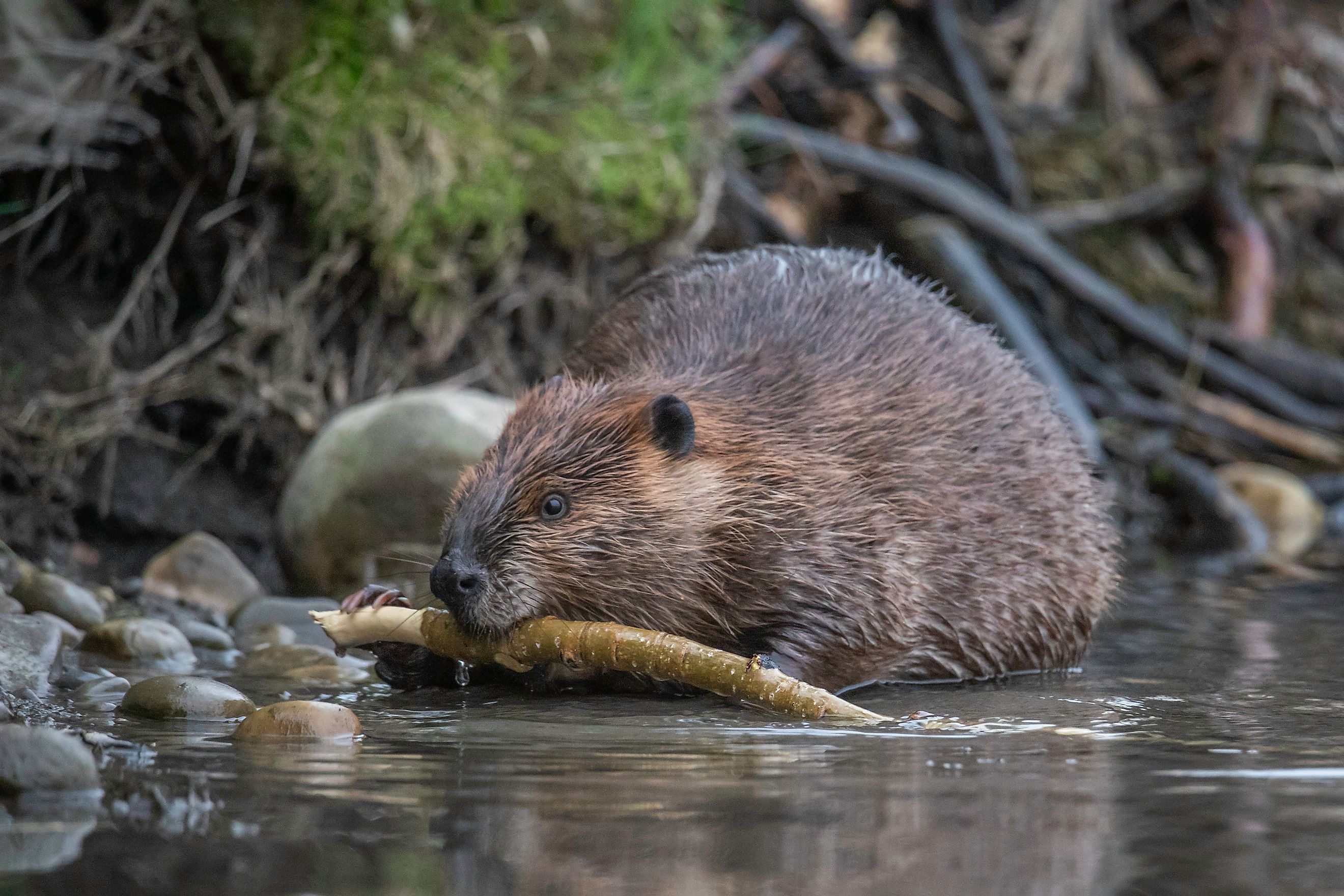
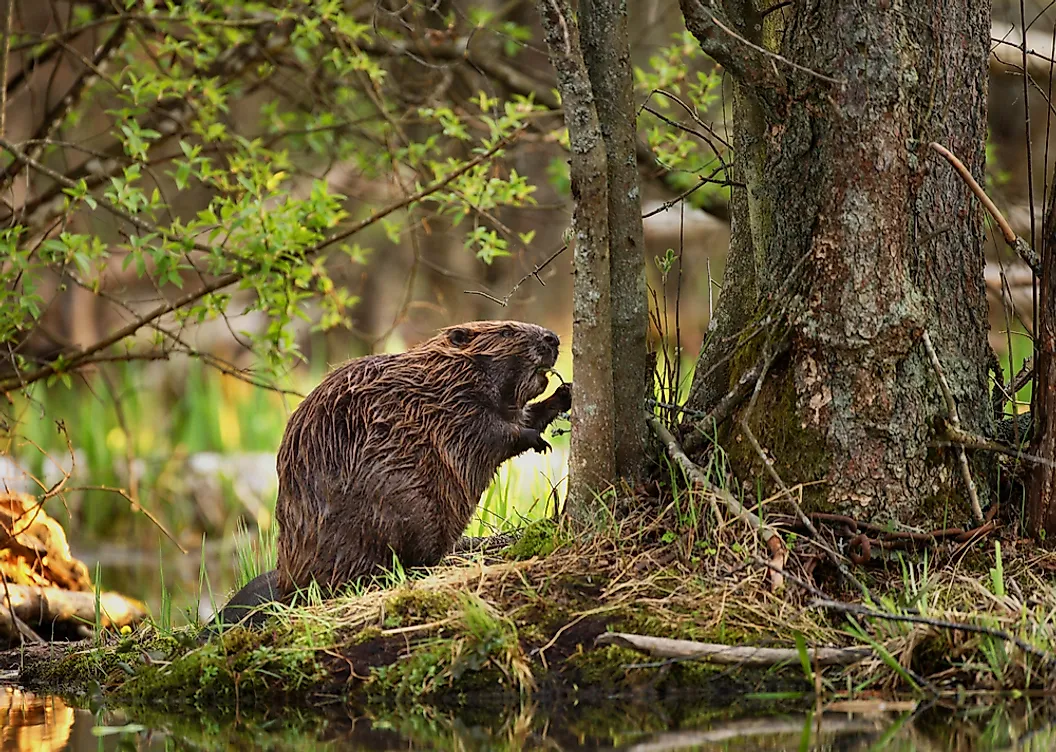
Beavers are strictly herbivores, but they don't just eat any vegetation. Some trees they eat for nutrition, some they use for building. In the spring, summer, and autumn their diet includes both woody and soft flora, preferring new shoots and leaves from favorites like willow, aspen, poplar, and cottonwood, while liking to a lesser extent birch, alder, maple, oak, and fruit trees. They also love water lilies and cattails, and ferns and grasses growing near the water's edge. In the winter, when there is less new growth, their diet switches to inner tree bark (called cambium), from their favorite trees. Because a beaver's diet relies heavily on cellulose from tree bark and woody stems, their bodies use a highly adaptive digestive system to break down these tough fibers, turning them into digestible fatty acids and vitamins.
Physical Description
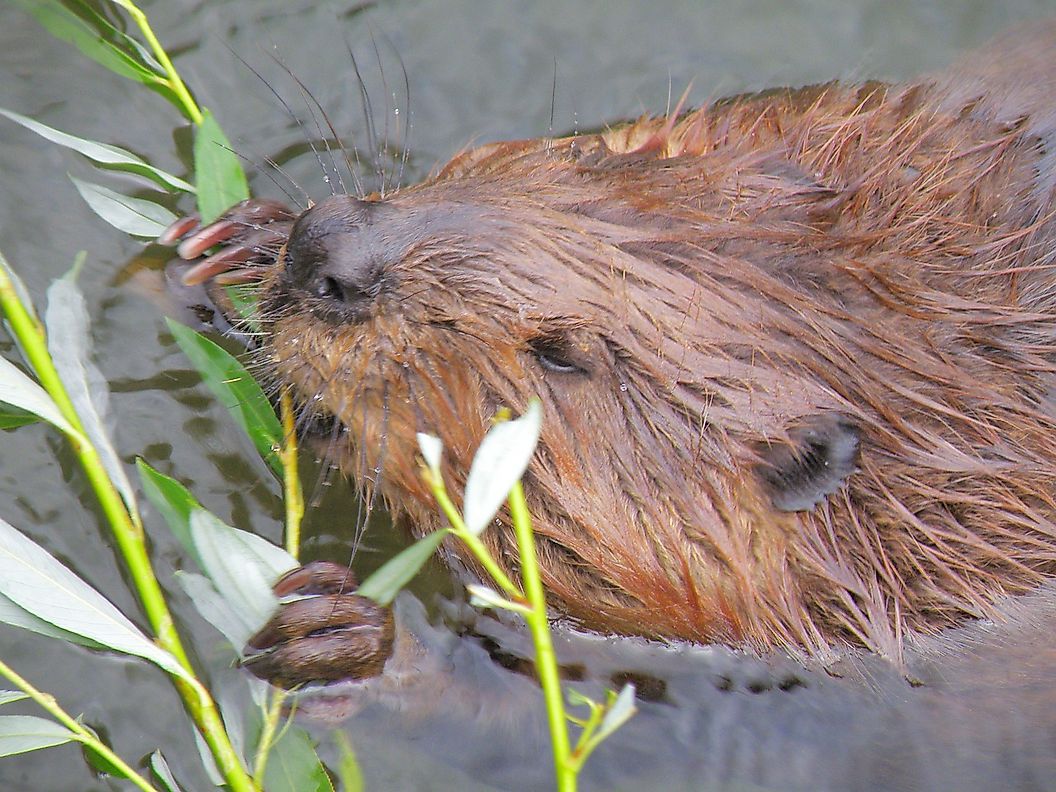
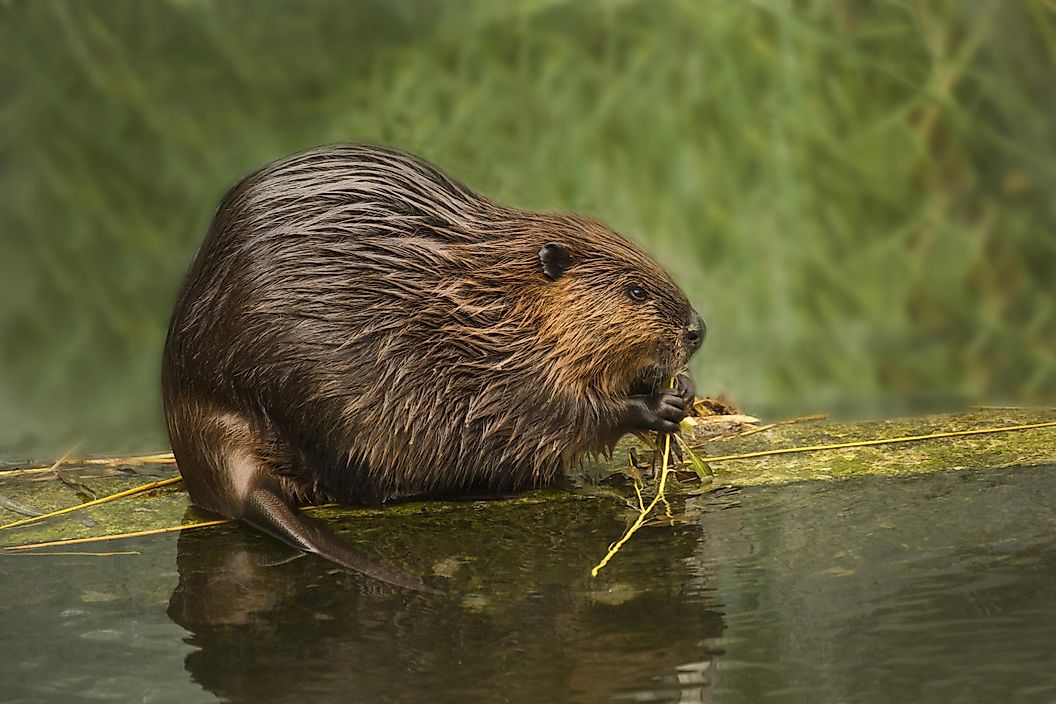
Beavers are the second-largest rodents in the world, surpassed only by the capybara of South America. They feature a strong, streamlined anatomy that is highly adapted to a semi-aquatic lifestyle. They have thick bodies and weigh between 20 to 75 pounds, though some have been recorded as surpassing 100 pounds. Their hind legs are longer than their front legs, giving them a hunched appearance on land, and their back feet are webbed to help them swim. Their most recognizable feature is their tail, which is large and flat and covered in black scales. It is used as a rudder while swimming, a prop for balancing on land, and is slapped against the water as a warning when threatened. Their water repellent fur is brown, dense, and double layered, and a soft undercoat traps insulating hair while coarse, oily guard hairs provide waterproofing. Beavers have large, thick skulls and powerful jaws equipped with chisel-like incisors, which present as bright orange due to an iron-reinforced outer enamel layer needed for gnawing wood. Their small ears and nostrils seal completely underwater, while a clear third eyelid acts like goggles to protect their eyes while swimming.
There are a few subtle differences between the North American and Eurasian beaver in appearances. The North American's fur is generally darker, its tail broader and rounder, and its body slightly stockier than its Eurasian cousin.
Behavior
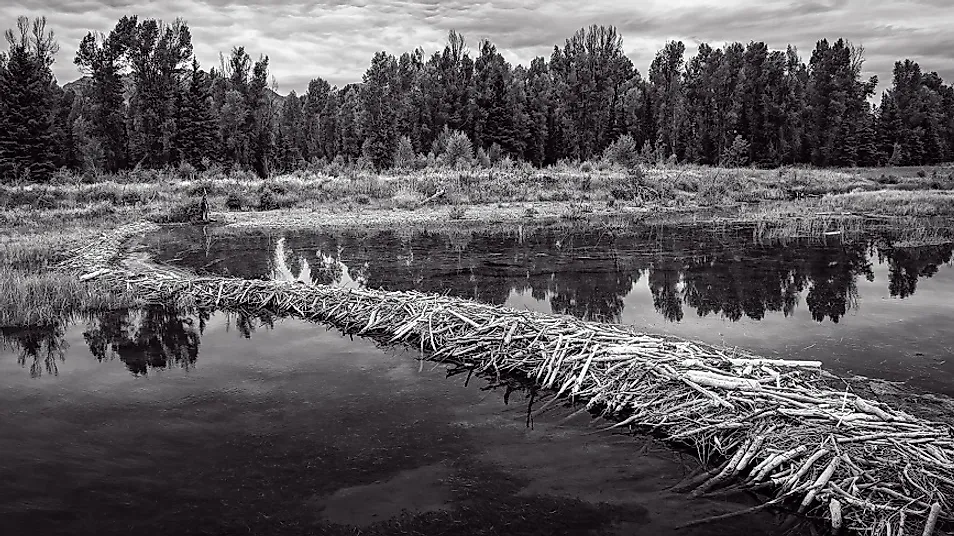
Beavers are famous for their impressive engineering, but North American and Eurasian beavers differ significantly in their building behaviour, social structure, and territorial marking. North American beavers are aggressive builders, constructing massive, complex dams and regularly turn fast streams into deep ponds. Their freestanding open-water lodges are made of sticks and mud and are often built in the middle of water bodies. They are highly territorial and build large scent mounds by piling up mud and spraying them with castoreum. The North American's average colony size is about six to eight individuals and the young are highly cooperative, and families generally avoid heavily grazed or human-altered areas. The Eurasian beaver build much smaller, less complex dams, or none at all if they consider the water to be of adequate depth, preferring then to dig burrows into riverbanks. They only build lodges if the riverbank is unsuitable for burrowing. They have much smaller, less intense scent mounds, and the colony size is usually just three to five members with the dominant female holding strict control over the family. Eurasian beavers are often found navigating ditches closer to agricultural areas.
General behaviours to both species include activity mostly at dawn and dusk, as well as some nocturnal. They live in small, tightly knit family groups called colonies, and their primary behavioural driver is safety as they are quite clumsy on land, and they alter their environment to create deep water channels to better escape aquatic predators.
Reproduction

Beavers are monogamous and mate for life, breeding once a year between January and March in all regions. Pregnancy lasts just over 100 days, and the female gives birth to a single litter of two to six kits in late spring. Older siblings are very cooperative and help care for newborns inside the family lodge. They reach sexual maturity between two to three years old, and kits are born fully furred with open eyes and can swim within the first 24 hours. They nurse for about two months before transitioning to eating plants and bark. Young beavers leave the colony at around aged two to find a mate and establish their own territory.
Importance to the World
Beavers are a keystone species and nature's premier ecosystem engineers. By building dams and altering the landscape, they create complex wetlands that provide essential environmental benefits to many other species. The ponds they create provide food and shelter for fish, birds, insects, and amphibians, the dams act as natural filtration systems, trapping sediment and excess nutrient runoff to clean the water downstream. Beaver-created wetlands store large amounts of water, recharging underground aquifers and during wildfires, these saturated zones act as firebreaks that resist burning, providing safety zones for themselves and other wildlife. By slowing down water flow and promoting plant growth, beaver wetlands capture and store carbon in wet soils and plant matter, helping to reduce greenhouse gases. Their dams also protect human communities, helping to slow down fast-moving water during heavy rains, lowering the peak water volume downstream.
Threats

After more than a century of being hunted by humans for their fur and castoreum, both North American and Eurasian beavers have made significant comebacks. The Eurasian beaver was once down to 1,200 individuals but has rebounded over the last decades to reach a current population of about 1.5 million. In North America, an estimated 400 million beavers populated the landscape and by 1900, relentless over-trapping reduced that number to just 100,000 individuals. Still, human intolerance and lethal trapping of these animals continues as their behaviour can flood roads, block agricultural drainage, and damage valuable timber. As a result, they are still viewed by many people as a nuisance. Urban expansion, logging, and agricultural development continue to destroy wetlands, leading to a loss of habitat, and increasing habitat fragmentation makes it harder for beavers to mate and expand. As young beavers leave their colony to find their own territory, they must travel long distances and become prone to being struck by vehicles and natural predation by wolves, black bears, coyotes, and lynx.
Once considered a pest (and still are by some), beavers are now being employed by scientists and conservationists to help out with major environmental restoration projects. Instead of using heavy machinery in sensitive wetlands, researchers are now using beavers as low-cost, self-maintaining engineers to heal damaged landscapes. In states like Utah and Idaho, teams of university researchers and ranchers are relocating "nuisance" beavers from urban spaces to degraded areas suffering from water scarcity to help restore and replenish water resources. Scientists at NASA are using satellite data and remote sensing to monitor how vegetation and water quality improve in areas where beavers have been introduced. A species once trapped toward extinction for fashion now works alongside researchers fighting climate change. That reversal marks a rare turn in how people value a wild animal.