Papuan Taipan
The Papuan taipan is one of the most feared snakes in the Asia-Pacific region, and for good reason. It carries one of the most potent venoms of any land snake on Earth, moves with startling speed, and accounts for the overwhelming majority of serious snakebites across southern Papua New Guinea. Few reptiles combine lethal chemistry, size, and agility so completely.
This large elapid is the New Guinea representative of the coastal taipan, Oxyuranus scutellatus. It ranges across the southern lowlands of the island of New Guinea, hunting warm-blooded prey by day in grasslands, savannah, and farmland. To the villages and clinics of southern Papua New Guinea it is a constant and dangerous neighbor, responsible for a public health burden that few other single snake species can match.
Yet the Papuan taipan is more than a medical threat. It is a fast, alert, mammal-hunting predator that keeps rodent numbers in check, a prized subject of venom research, and a snake whose exact place in the taipan family tree scientists are still working out.
Taxonomic Classification

The Papuan taipan belongs to the family Elapidae, the group of front-fanged venomous snakes that also includes cobras, mambas, and sea snakes. Within that family it sits in the genus Oxyuranus, the taipans, alongside the coastal taipan, the inland taipan (Oxyuranus microlepidotus), and the central ranges taipan (Oxyuranus temporalis). The genus name comes from Greek words meaning sharp or pointed tail, a nod to the taipan's long, tapering rear end.
Australian herpetologist Ken Slater formally described the Papuan taipan in 1956 as a subspecies of the coastal taipan, giving it the scientific name Oxyuranus scutellatus canni. He based the description on the snake's distinctive coloration, and he chose the subspecies name in honor of George Cann, a well-known Australian snake handler often called the Snake Man of La Perouse.
Modern genetics has complicated that tidy picture. When German herpetologist Wolfgang Wüster and colleagues analyzed mitochondrial DNA in 2005, they found the Papuan and Australian populations to be very close, almost indistinguishable at the genetic level. Wüster stopped short of merging the two, partly because of their obvious color differences and partly because sampling was limited. Many authorities today treat all coastal and Papuan populations as a single species, Oxyuranus scutellatus, and regard the name canni as an informal marker for the New Guinea form rather than a firmly separate subspecies.
Physical Description
The Papuan taipan is a large, powerfully built snake. Most adults measure between 4.9 and 6.6 feet (1.5 and 2.0 m) in total length, and New Guinea individuals are known to exceed 8.2 feet (2.5 m). The largest coastal taipans reach around 9.5 feet (2.9 m), which places this among the longest venomous snakes in the Australasian region. A two-meter animal weighs roughly 6.6 pounds (3.0 kg), though the body is slender rather than bulky.
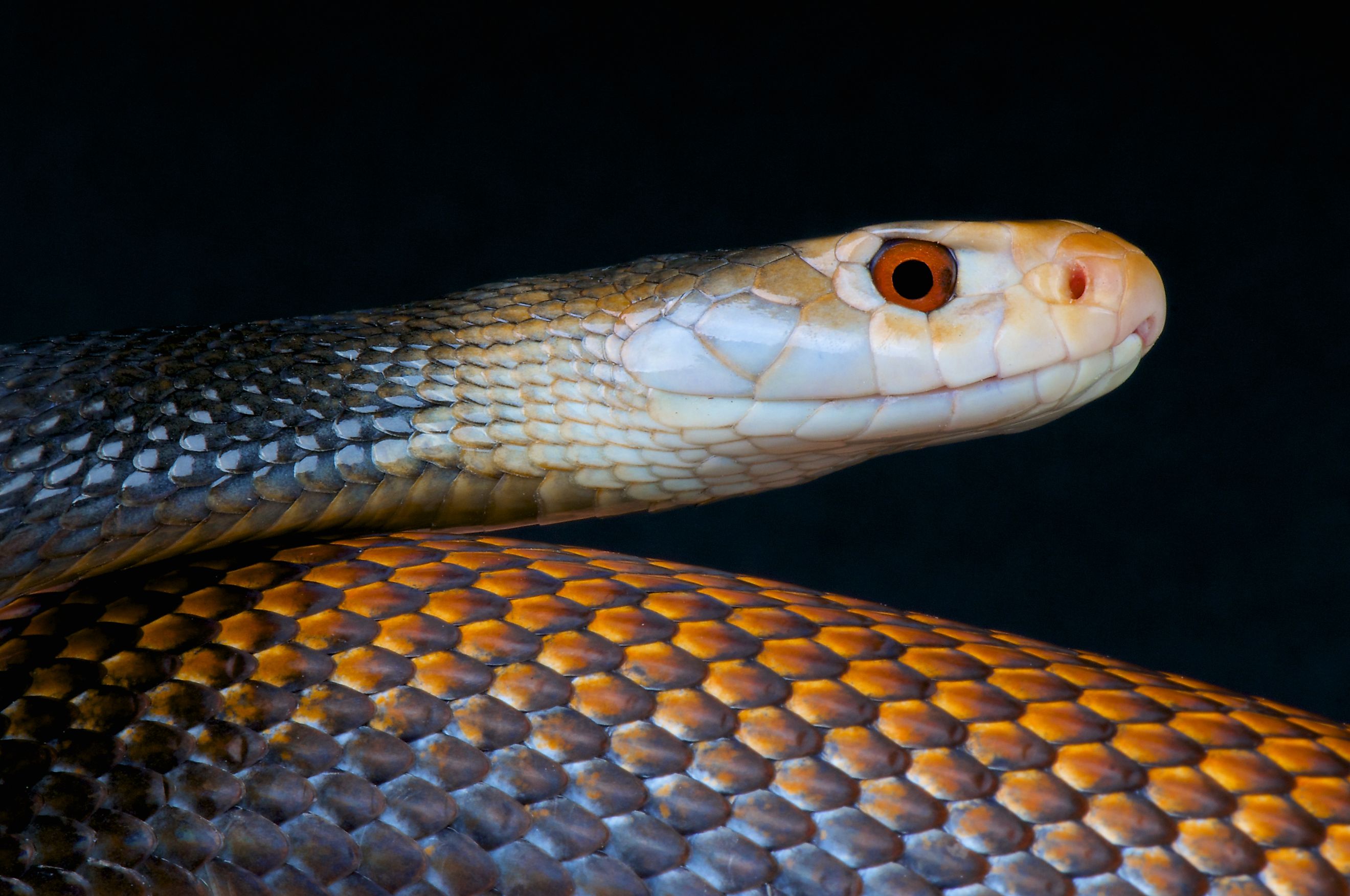
Color is where the Papuan form stands apart from its Australian cousin. The back is usually gunmetal grey, dark brown, or nearly black, and it often carries a broad orange or copper stripe running down the spine. The head can be paler than the body, and the grey underside is sometimes flecked with orange. This copper racing stripe gives the snake a striking appearance, and it was one of the features that first led Slater to name the New Guinea population as a separate subspecies.
The head is long and rectangular with a blunt snout, set off from a narrow neck, and the muscular jaws bulge slightly toward the rear. The eyes are large with round pupils, an adaptation suited to a daytime hunter that relies heavily on sight. Smooth dorsal scales lie in 21 to 23 rows at midbody. Like all elapids, the Papuan taipan has short, hollow, fixed fangs at the front of the upper jaw rather than the long folding fangs of a viper. Those fangs are backed by large venom glands that make even a glancing bite dangerous.
Range and Habitat
The Papuan taipan lives across the southern lowlands of New Guinea. Its range covers the southern side of the island, extending across the West Papua region of Indonesia and southern Papua New Guinea as far east as Milne Bay. It is a lowland animal, most common well below the central mountain spine that divides the island.
Within that band the snake occupies a wide spread of open and semi-open country. It thrives in savannah woodland, kunai grassland, grassy hillsides, dry sclerophyll forest, and the edges of monsoon forest. Crucially, it also does very well in landscapes reshaped by people. Sugarcane fields, oil palm plantations, and the weedy margins of gardens and villages all draw rats and mice, and where the rodents gather the taipan follows. This overlap with farms and settlements is a large part of why the species bites so many people.
Diet
Warm-blooded prey forms the core of the Papuan taipan's diet. It feeds mainly on small mammals, taking rats, mice, and bandicoots, and it hunts these actively rather than lying in wait. A hunting taipan moves through cover with its head slightly raised, using keen eyesight to locate a target before it strikes.
The taipan's feeding method suits an animal armed with fast-acting venom. Rather than gripping struggling prey in its jaws, where a bite from a cornered rat could injure it, the snake delivers one or more rapid bites and then releases, allowing the venom to do its work. It tracks the dying animal and swallows it once resistance has ended. Because rodents breed quickly in cane fields and plantations, a single taipan can find abundant food and may feed several times in a week.
Behavior
This is a diurnal snake, active mainly in daylight, though it may shift toward dawn and dusk during the hottest weather. It is famously fast and alert, with a nervous, high-strung temperament. When it senses a threat it often tries to flee, but a cornered taipan can rear the front of its body, flatten its neck, and strike with remarkable speed and reach.
A defensive taipan does not always stop at a single bite. It can strike repeatedly in quick succession, delivering several venom loads before it retreats. That mix of speed, reach, and repeat striking, paired with an extremely toxic venom, is exactly what makes the species so hazardous to anyone who steps on one or tries to handle it. For most of its life, though, the snake is a wary hunter that would rather avoid people than confront them.
Reproduction
Like all taipans, the Papuan taipan reproduces by laying eggs. A female deposits a clutch that may hold anywhere between a handful and roughly twenty eggs, choosing sheltered sites such as hollow logs, animal burrows, or cavities in the ground where temperature and humidity stay stable. The eggs are left to incubate on their own, with no parental care after laying.
Hatchlings emerge already equipped with functional fangs and potent venom, measuring roughly 12 to 13 inches (30 to 33 cm) long. Young taipans are vulnerable to predators such as birds of prey and monitor lizards, but those that survive grow quickly. Coastal and Papuan taipans reach breeding size at around 3.9 feet (1.2 m) in length. In the wild these snakes can live for well over a decade when conditions allow.
Importance to the World
Ecologically, the Papuan taipan is an important control on rodent populations across southern New Guinea. By preying heavily on rats and mice, including the pest species that swarm through sugarcane and oil palm, it provides a natural check that benefits both native ecosystems and agriculture. As a large predator it also forms part of the prey base for other animals during its vulnerable early life.
Its importance to people, however, is dominated by its venom. The Papuan taipan is the most medically significant snake in Papua New Guinea. In the southern parts of the country it has been blamed for close to 90 percent or more of life-threatening snakebites in some hospital studies, a burden that has driven decades of antivenom development and venom research. Scientists have isolated a suite of toxins from its venom, including a powerful presynaptic neurotoxin named cannitoxin after the New Guinea population, and the snake remains a key focus for efforts to make antivenom cheaper and more widely available in the region.
Threats and Conservation
The coastal taipan, the species to which the Papuan form belongs, is listed as Least Concern on the IUCN Red List. It remains widespread across its range and is not considered at risk of extinction. The Papuan population in particular is common throughout suitable habitat in southern New Guinea, and its comfort with farmland and disturbed ground has helped it persist where more specialized snakes decline.
That said, no large predator is fully insulated from pressure. Clearing of native grassland and woodland, road deaths, and deliberate killing by people who fear the snake all take a local toll. Because the taipan is dangerous, it is often destroyed on sight, which can thin populations near settlements. For now the species appears secure, though its future depends on the same lowland habitats that are steadily being converted for agriculture across New Guinea.
Takeaway
The Papuan taipan has a fearsome reputation for good reason. It is fast, large, and carries venom potent enough to place it among the most dangerous land snakes in the world. One pharmacological study ranked it third among known venomous land snakes. But its life is not defined by venom alone. By feeding on rodents, it helps regulate populations that can damage crops and spread disease. Although encounters with people can be dangerous, the Papuan taipan generally avoids unnecessary contact. Learning where it lives and giving it space is a practical way to reduce conflict while allowing this native predator to continue its role in Australasia's ecosystems.
Fun Facts
- Named after a snake showman. The subspecies name canni honors George Cann, a famous Australian snake handler known as the Snake Man of La Perouse.
- It has a toxin named after it. A major component of its venom is called cannitoxin, a presynaptic neurotoxin that makes up roughly 16 percent of the whole venom by weight.
- The top snakebite threat in Papua New Guinea. Across the southern part of the country it causes the large majority of dangerous bites, making it the most medically important snake in the nation.
- It wears a copper racing stripe. Many Papuan taipans have a bold orange to copper band running down the spine, a look that first convinced scientists it was distinct from the Australian taipan.
- Bite and let go. Instead of holding dangerous prey, it delivers fast bites and releases, then follows the trail and swallows the animal once the venom has worked.
- Almost a genetic twin. DNA studies show the Papuan and Australian taipans are so close that some researchers no longer treat them as separate subspecies.
Quick Facts
- Common name: Papuan taipan
- Scientific name: Oxyuranus scutellatus canni
- Family: Elapidae
- Order: Squamata
- IUCN status: Least Concern (assessed as the coastal taipan, Oxyuranus scutellatus)
- Length: 4.9 to 6.6 ft (1.5 to 2.0 m), sometimes over 8.2 ft (2.5 m) in New Guinea
- Weight: around 6.6 lb (3.0 kg) for a two-meter snake
- Lifespan: more than 10 years in the wild
- Diet type: carnivore, mainly small mammals such as rats, mice, and bandicoots
- Range: southern lowlands of New Guinea, across West Papua and southern Papua New Guinea to Milne Bay