Pallas Cat
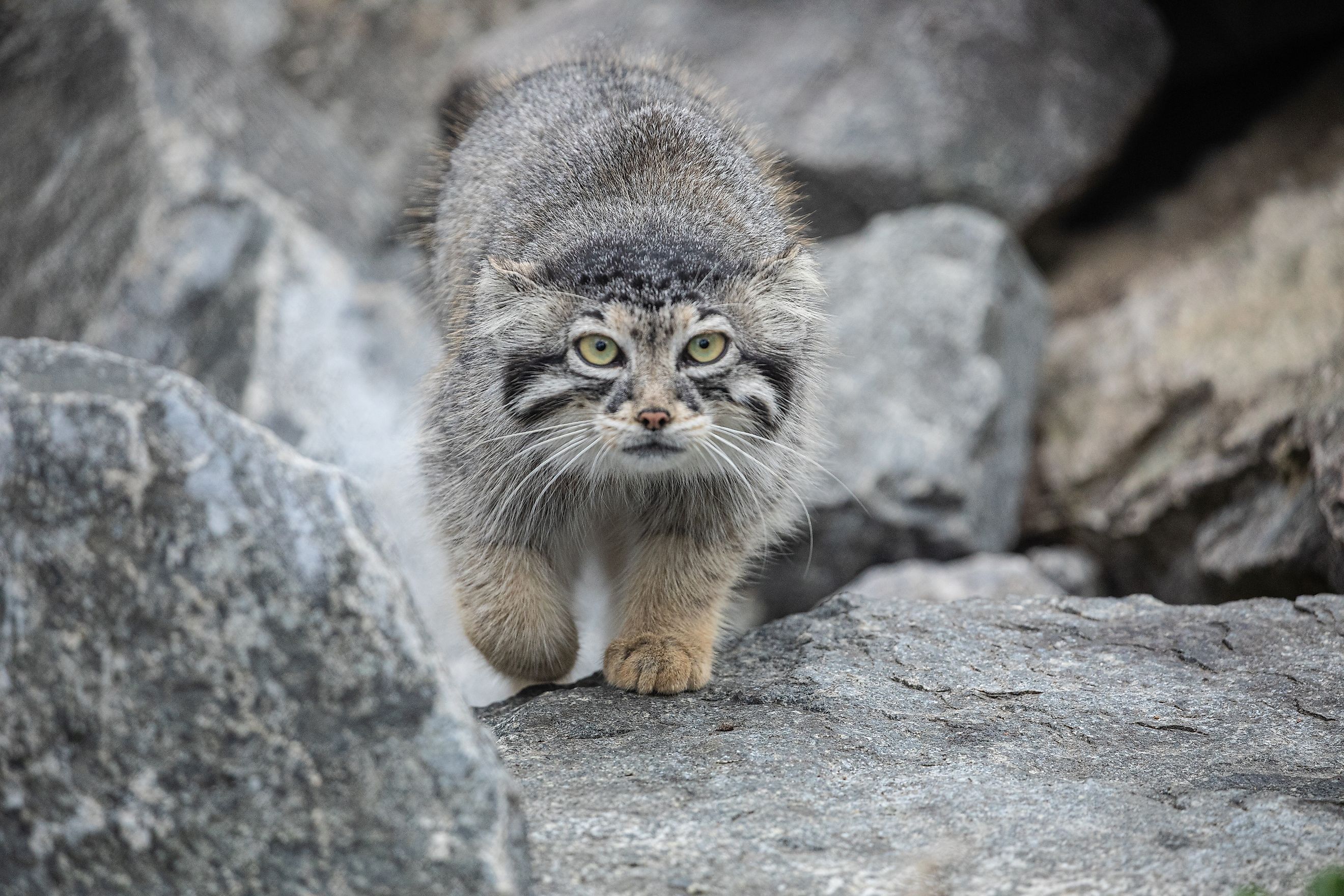
The Pallas's cat wears the thickest, densest coat of any wild cat, a pelt built to withstand winters that plunge far below freezing across the high steppes of Central Asia. Also known as the manul, this small, stocky felid is close in body size to a house cat, yet it looks considerably heavier because of its long fur, short legs, and low-slung stance. Its flattened face, wide-set ears, and round pupils give it an expression unlike any other member of the cat family, which has helped make it one of the most recognizable small cats in the world.
The species occurs across the cold grasslands, rocky slopes, and semi-deserts of Central Asia, with a range that reaches west into Iran and east into China and Mongolia. Despite its broad distribution, it is rarely seen. It is a secretive, largely solitary hunter adapted to one of the harshest climates any cat endures.
Taxonomic Classification

The Pallas's cat belongs to the family Felidae, within the order Carnivora and the class Mammalia. Its scientific name is Otocolobus manul. The German naturalist Peter Simon Pallas first described the species in 1776, and the cat's common English name honors him. The genus name Otocolobus comes from Greek and translates roughly to "ugly-eared," a reference to the low, rounded ears set on the sides of the head. The word "manul" derives from Mongolian.
The manul is the sole living species in the genus Otocolobus, which the naturalist Johann Friedrich von Brandt established in 1841. Genetic studies place it within the leopard cat lineage, making it a close relative of the leopard cat (Prionailurus bengalensis). Two subspecies have traditionally been recognized. O. m. manul covers most of the species' range, while O. m. nigripectus is found in the Tibetan Plateau region, India, Nepal, and Bhutan. Recent molecular work suggests the species may in fact be monotypic, meaning the subspecies distinction may not hold up under closer genetic scrutiny. This kind of reassessment is common as DNA analysis refines older classifications.
Physical Description

The Pallas's cat has a head-and-body length of 18 to 26 inches (46 to 65 cm), with a thick, bushy tail adding another 8 to 12 inches (21 to 31 cm). Adults typically weigh between 5 and 9 pounds (2.5 to 4.5 kg), placing them squarely in the size range of a domestic cat. The impression of bulk comes from the coat rather than the frame beneath it.
That coat is the animal's defining feature. The fur is the longest and densest of any cat species, and it grows nearly twice as long on the belly and underparts as it does on the back and sides. This adaptation lets the cat lie on frozen ground and snow while stalking prey without losing body heat. Coloration runs pale and frosted gray in the northern parts of the range and warmer tawny or fox-red in the south, and it shifts with the seasonal molt. Many of the guard hairs are tipped in white, which produces a silvery, frosted sheen across the coat.
Range and Habitat

The Pallas's cat is native to Central Asia and has one of the widest distributions of any small cat in the region, though its occurrence within that range is patchy. It is found in Afghanistan, Bhutan, China, India, Iran, Kazakhstan, Kyrgyzstan, Mongolia, Nepal, Pakistan, Russia, and Turkmenistan. The species may still persist in Tajikistan and Uzbekistan, while it appears to have vanished from Armenia and Azerbaijan. The largest populations are believed to occur in Mongolia, with core populations also in China.
Habitat is the key limiting factor. The manul favors rocky montane grasslands, steppe, and cold semi-desert, where rock crevices, boulders, and ravines provide the cover it needs to hunt and shelter. It occurs at elevations reaching roughly 15,000 feet (4,500 m) or higher on the Tibetan Plateau. Its range is strongly influenced by snow depth. The cat generally avoids areas where snow regularly exceeds 6 to 8 inches (15 to 20 cm), as deep snow makes movement and hunting more difficult. The climate across this habitat is severe, with little rainfall, low humidity, and temperature swings between blistering summers and deeply cold winters.
Diet

The Pallas's cat is an obligate carnivore, meaning it must eat meat to obtain the nutrients it needs. Its diet centers heavily on small mammals, and in many populations pikas make up more than half of what it eats. In some studies, small rodents and pikas together account for over 85 percent of the diet. Beyond pikas, the manul preys on voles, gerbils, hamsters, jerboas, and young marmots, and it will take birds, insects, and lizards when the opportunity arises. Remains of fish have even been recorded in scat in at least one reserve in China.
The cat uses three main hunting strategies. It stalks prey by creeping low between rocks and vegetation, it flushes animals out of hiding, and it waits in ambush at rodent burrows, sometimes reaching a paw into shallow holes to pull prey out. Because its prey often lives in colonies, Pallas's cat numbers tend to track the abundance of pikas and voles closely. Where these small mammals thrive, the cats are more numerous, and where prey is poisoned or scarce, the cats decline.
Behavior

Pallas's cats are largely crepuscular, meaning they are most active at dawn and dusk, though they may hunt at other times depending on weather and prey activity. They are solitary animals, and adults generally interact only during the brief mating season. Both sexes hold home ranges, and these ranges are unusually large for such a small cat. In Mongolia, female territories averaged around 9 square miles (23 km²), while male ranges averaged roughly 38 square miles (98 km²) and could exceed 80 square miles (200 km²). Males overlap the ranges of several females, which maximizes their access to mates.
Population densities are low, estimated at around 4 to 8 individuals per 100 square kilometers in good steppe habitat. This low density stems partly from predation pressure, which confines the cats to areas with reliable cover. The manul communicates mainly through scent marking, scratch marks, and body language, reserving vocalizations for mating, disputes, and interactions between mothers and kittens. Its calls have been described as resembling a cross between the bark of a small dog and the hoot of an owl. Despite their small size, Pallas's cats are known for aggressive, defensive behavior.
Reproduction

Reproduction in the Pallas's cat is strictly seasonal and closely tied to day length rather than temperature. Mating occurs between December and March, and if the natural light cycle is disrupted, individuals may not breed until the following year. Females are in estrus for only 24 to 48 hours, and males follow a receptive female for several days, likely guarding her from rival males. The mating system is polygynous, with a single male breeding with several females across a season.
Gestation lasts 66 to 75 days, and most births occur between late April and May, timed so that kittens arrive when the weather softens and prey becomes more plentiful. Litters average three to four kittens but sometimes number as few as two or as many as eight. The young are born blind in a den among rocks or in a burrow, and the female raises them alone with no help from the male. Kittens remain in the den for roughly two months, during which they grow their adult coat, then follow the mother to forage before dispersing at four to five months of age. They reach sexual maturity within their first year. Survival is challenging, with an estimated 68 percent of kittens dying in the wild before they disperse. Wild individuals typically live only three to four years, while animals in captivity have reached 11 to 12 years.
Importance to the World

As a mesopredator of the Central Asian steppe, the Pallas's cat helps regulate populations of pikas, voles, and other small mammals. In doing so, it plays a part in maintaining the balance of grassland and semi-desert ecosystems where these prey species can otherwise reach high densities. Because the cat depends so directly on healthy prey populations and intact steppe cover, its presence can serve as an indicator of the overall condition of these landscapes. A decline in manul numbers often signals broader problems, such as prey poisoning campaigns or habitat degradation, that affect many other species sharing the same environment.
Threats and Conservation

The IUCN reassessed the Pallas's cat in 2020 and now lists it as Least Concern, with a global estimate of about 58,000 mature individuals. This was a change from its previous listing of Near Threatened in the 2016 assessment, and the reassessment reflected evidence that suitable habitat was disappearing more slowly than once feared. The population trend, however, is considered to be decreasing, and the species remains uncommon and fragmented across its range. It is listed under Appendix II of the Convention on International Trade in Endangered Species (CITES), and several range countries afford it stronger national protection, with China and Turkmenistan listing it as Endangered.
The threats it faces are real and varied. Large-scale poisoning campaigns aimed at pikas and rodents strip away its primary food supply and can kill the cats directly through secondary poisoning. Overgrazing by livestock, mining, and infrastructure development degrade and fragment its habitat. Herding dogs kill manuls, and hunters sometimes shoot them by mistake for marmots. Their specialization in open terrain leaves them exposed to larger predators such as wolves and large raptors. Climate change poses an added risk because a breeding cycle tied to day length rather than temperature could fall out of step with prey availability as conditions shift. Since 2012, the Manul Working Group, a network of more than 60 researchers and range-country experts, has coordinated study and conservation of the species.
Takeaway
The Pallas's cat is highly specialized for life on the cold, open steppes of Central Asia. Its thick fur, round pupils, ambush hunting style, and light-sensitive breeding cycle all reflect the challenges of living in a harsh environment where prey can be scarce. But these adaptations also leave it vulnerable when habitat is degraded or prey is poisoned. Although the species is currently classified as Least Concern, its numbers are declining, and its future depends on protecting the grasslands and rocky slopes it relies on. Continued research and coordinated conservation efforts will be important for ensuring this distinctive small cat remains part of the Central Asian landscape.
Fun Facts

- Round pupils: Unlike most small cats, the Pallas's cat has pupils that contract to circles rather than vertical slits.
- Thickest coat of any cat: Its fur is the longest and densest of any feline, and it grows nearly twice as long on the belly as on the back.
- A case of mistaken ancestry: When Pallas first described the cat, he wrongly suggested it might be the ancestor of the long-haired Persian cat.
- Fierce from birth: Kittens have been observed growling before their eyes are even open.
- An unflattering name: The genus name Otocolobus means "ugly-eared" in Greek.
Quick Facts
- Scientific name: Otocolobus manul
- Family / order: Felidae / Carnivora
- IUCN Red List status: Least Concern (2020 assessment); population decreasing
- Head-and-body length: 18 to 26 inches (46 to 65 cm), plus an 8 to 12 inch (21 to 31 cm) tail
- Weight: 5 to 9 pounds (2.5 to 4.5 kg)
- Lifespan: 3 to 4 years in the wild; up to 11 to 12 years in captivity
- Diet: Obligate carnivore, feeding mainly on pikas and small rodents
- Range: Central Asia, including Iran, Mongolia, and China